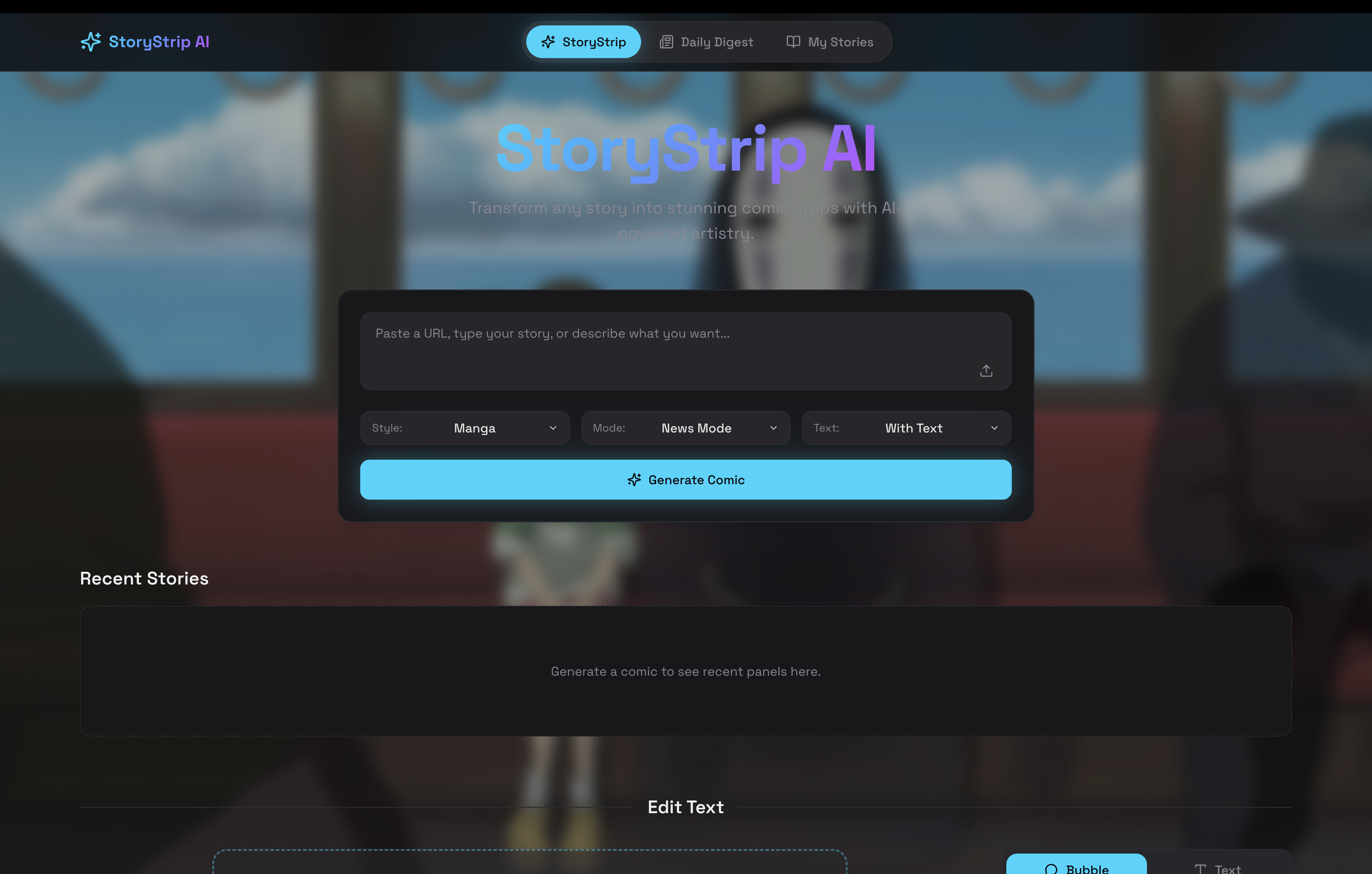
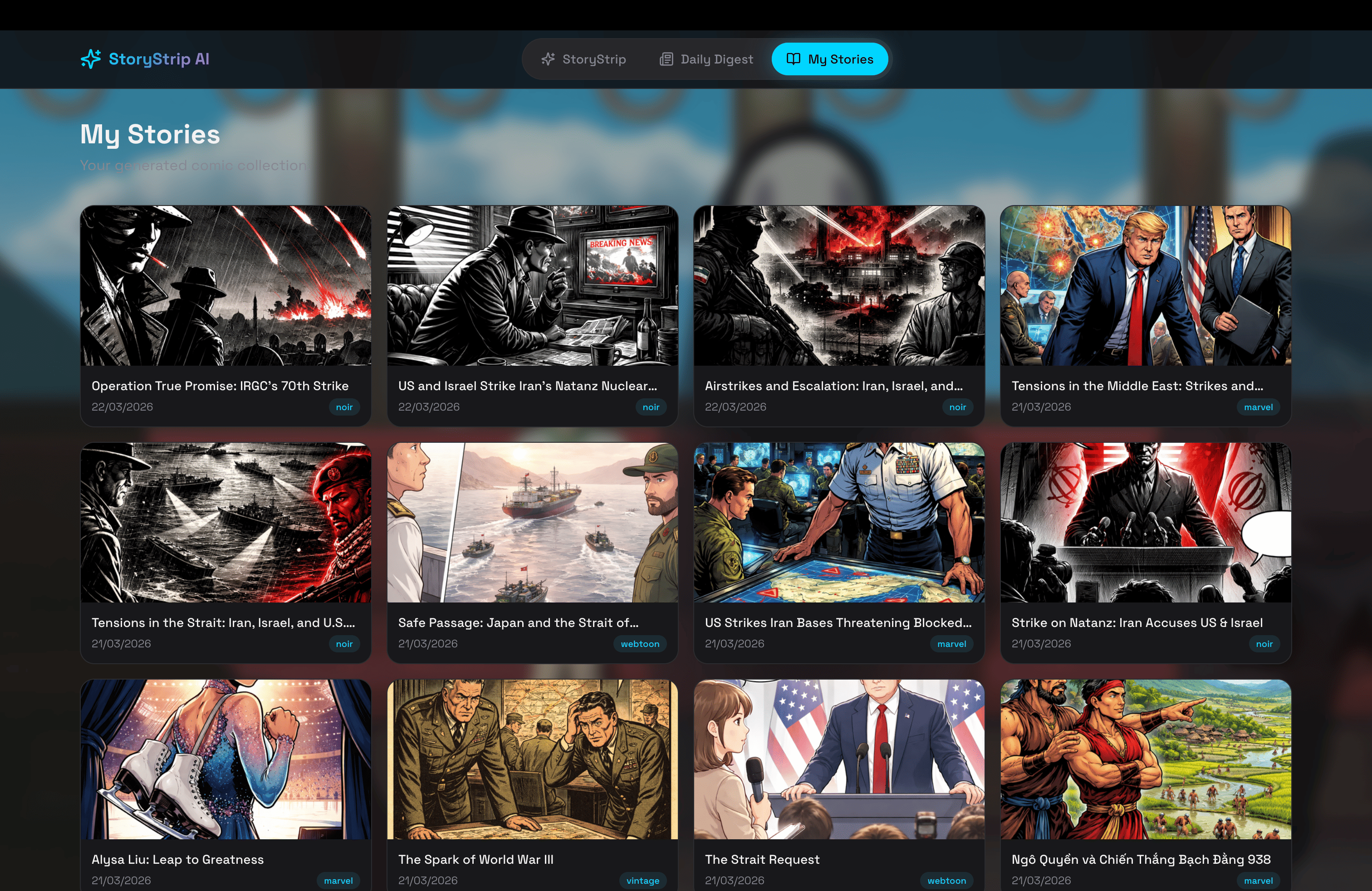
StoryStripsAI — The World's News. In Panels. In Seconds.
Inspiration
The idea was born from a simple frustration: we are drowning in information, yet starving for understanding.
The average person is exposed to over 5,000 media messages per day, yet only 20% of online articles are ever read beyond the headline. Research in cognitive science shows that the human brain processes visual information roughly $60{,}000\times$ faster than text — yet virtually every news platform still delivers stories as walls of prose.
We kept asking ourselves: what if the format of news itself was the problem, not the content?
Comics have always been a medium that compresses complex ideas into scannable, emotionally resonant panels. From wartime propaganda to science communication, sequential art has proven that a well-drawn panel can communicate in seconds what a paragraph takes minutes to deliver. We wanted to bring that power to breaking news — and automate it entirely.
The final spark came when we noticed that Gen Z and Millennials are not disengaged from current events — they are disengaged from the delivery mechanism. They consume short-form video, memes, and infographics at scale. StoryStripsAI is our answer to that gap: real journalism, delivered as art.
What We Learned
Building StoryStripsAI taught us lessons across three dimensions: technical, editorial, and systemic.
On multi-agent orchestration
Coordinating multiple AI agents in a reliable pipeline is significantly harder than calling a single model. Each agent introduces latency and failure probability. If we model each step $i$ as having success probability $p_i$, the overall pipeline reliability is:
$$P_{\text{pipeline}} = \prod_{i=1}^{n} p_i$$
With $n = 5$ steps and each step at $p_i = 0.95$, the end-to-end success rate drops to:
$$P_{\text{pipeline}} = 0.95^5 \approx 0.774$$
This meant that robust error handling, retries, and fallback agents were not optional — they were load-bearing architecture decisions.
On prompt engineering for structured output
Getting GPT-4o to produce consistent, parseable JSON comic scripts required careful prompt design. We learned that schema-constrained prompting — where the model is given the exact JSON structure it must fill — dramatically outperforms open-ended generation for downstream reliability.
On visual consistency
Generating multiple panels for a single story while maintaining character and style consistency is a hard problem. Image generation models have no persistent memory across calls. We addressed this by encoding style anchors — color palette, line weight, character descriptors — directly into every panel prompt, essentially re-injecting "memory" manually.
On the social agent
Autonomous social media posting taught us the difference between automation and agency. A script posts. An agent monitors, decides, and adapts. Building something that behaves as a native social media user — not a bot — required careful attention to timing, content framing, and platform-specific formatting.
How We Built It
StoryStripsAI is a five-stage multi-agent pipeline, where each stage is handled by a specialized model or service.
Pipeline overview
User topic
    │
    ▼
[Step 1] Research       ←  Exa AI (real-time news + historical context)
    │
    ▼
[Step 2] Script         ←  GPT-4o (structured JSON: scenes, dialogue, layout)
    │
    ▼
[Step 3] Visuals        ←  GPT-4o Image (panel-by-panel illustration)
    │
    ▼
[Step 4] Composition    ←  Panel sequencing → Supabase + Zilliz (vector cache)
    │
    ▼
[Step 5] Publish        ←  Bright Data social agent (Twitter/X, Instagram)
Vector caching and query efficiency
To avoid redundant generation for popular topics, we index completed strips in a Zilliz (Milvus) vector store. Incoming queries are embedded and compared against cached strips using cosine similarity:
$$\text{similarity}(q, d) = \frac{q \cdot d}{|q| \cdot |d|}$$
If $\text{similarity}(q, d) \geq \tau$ for some threshold $\tau$ (we use $\tau = 0.92$), the cached strip is returned instantly — no generation required. This reduces both latency and cost for high-traffic queries significantly.
Technology stack
| Layer | Technology |
|---|---|
| Script generation | OpenAI GPT-4o — Comic scripts (JSON) |
| Image generation | OpenAI GPT-4o Image |
| News & research | Exa AI — Real-time news & historical content |
| Social media agent | Bright Data — Autonomous posting |
| Frontend | React (Vite) + Tailwind CSS |
| Backend & auth | Supabase — Database, authentication, storage |
| Vector cache | Zilliz (Milvus) — Fast retrieval for repeat queries |
| Audio (optional) | ElevenLabs — AI narration for comic strips |
Challenges We Faced
1. Visual consistency across panels
The hardest unsolved problem in our pipeline. Each panel is generated independently, so characters and settings can drift visually between panels — undermining the sense of a coherent story. Our current solution (style-anchor prompting) reduces drift but does not eliminate it. A proper solution likely requires a fine-tuned image model or a reference-image conditioning approach, both of which are on our roadmap.
2. Pipeline reliability under real-time constraints
As shown in the reliability analysis above, a five-step pipeline with even high per-step reliability can fail meaningfully in aggregate. We implemented exponential backoff retries at each stage:
$$t_{\text{wait}}(k) = t_0 \cdot 2^k + \varepsilon, \quad \varepsilon \sim \mathcal{U}(0, 1)$$
where $k$ is the retry attempt and $\varepsilon$ is a jitter term to avoid thundering-herd failures. This significantly improved end-to-end success rates during load testing.
3. The social agent and platform constraints
Building an agent that posts autonomously to platforms like Twitter/X runs into hard rate limits, authentication challenges, and content policy constraints. We had to design around these carefully — the agent must behave like a thoughtful human poster, not a firehose.
4. Balancing speed and quality
Comic generation is inherently slower than text generation. A full strip — research, script, five panels, composition — takes 30–90 seconds end-to-end. For breaking news, this is borderline acceptable. Optimizing this pipeline, potentially through parallel panel generation, is one of our next priorities.
What's Next
StoryStripsAI is the first platform to combine real-time news research with automated comic generation at this level of integration. But this is just the beginning.
We are exploring parallel panel generation to cut total latency, fine-tuned image models for visual consistency, and multilingual support so that comics can cross language barriers as naturally as they cross reading-level barriers.
Give us a topic. We'll give the world the story.
StoryStripsAI · [email protected] · www.storystripsai.com

Log in or sign up for Devpost to join the conversation.