Inspiration
In many parts of the world, doctors and patients face language barriers — sometimes in life-or-death situations. Internet-based translation tools fail in low-connectivity or offline settings, leaving healthcare providers without critical communication support. MediTongue was built to solve that.
What it does
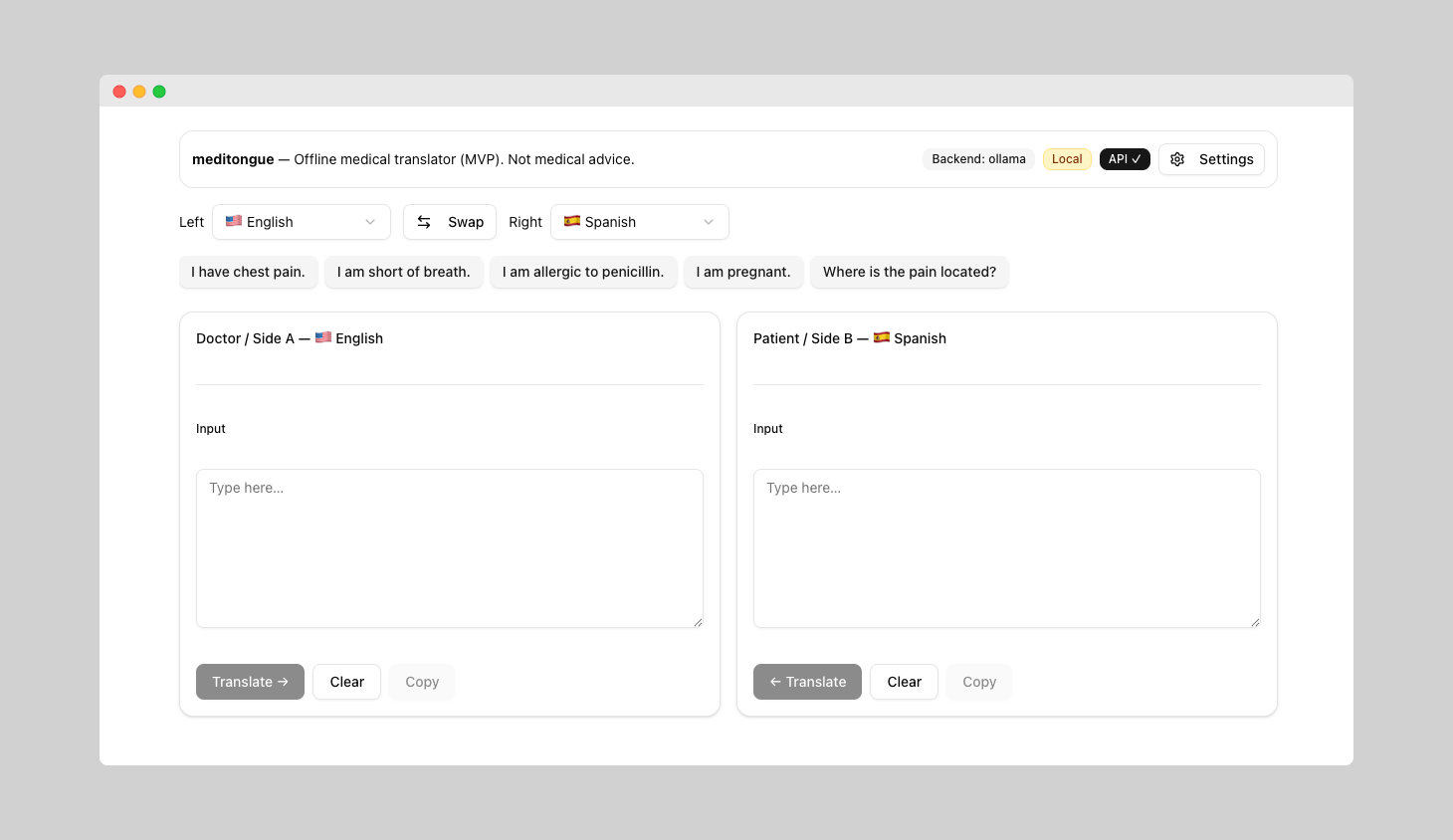
MediTongue is an offline AI-powered medical translator that:
- Translates medical dialogue in real time between multiple languages
- Flags potential emergencies like chest pain or severe breathing issues
- Works completely offline, ensuring reliability anywhere
- Provides a quick-access emergency phrasebook for common urgent questions
How we built it
- Frontend: Next.js + TailwindCSS + shadcn/ui for a clean, responsive UI
- Backend: Node.js local API that communicates with the Ollama runtime
- Model: GPT-OSS 20B running locally for translations and symptom detection
- Emergency detection: Rule-based keyword spotting combined with AI classification
- Designed to gracefully handle offline mode, with health checks and latency badges
Challenges we ran into
- Optimizing large language model inference to run locally at acceptable speeds
- Ensuring translations remained medically accurate while still concise
- Designing a UI that works well on both desktop and mobile for field use
- Managing local model storage and startup times without overwhelming system resources
Accomplishments that we're proud of
- Achieved full offline functionality — no internet required for translations
- Emergency detection works instantly in both directions
- Built a simple, intuitive interface that non-technical users can pick up in seconds
- Integrated medical term highlighting for better clarity between doctor and patient
What we learned
- Offline AI is now powerful enough to serve real-world, high-stakes use cases
- Medical translations require a balance of precision, cultural sensitivity, and speed
- Even small UI tweaks (like flag emojis or phrasebook chips) can greatly improve usability
What's next for MediTongue
- Expand to more languages and dialects used in medical missions and rural healthcare
- Add voice input/output for completely hands-free translation
- Create a “triage mode” for paramedics and first responders
- Optimize model performance for low-power devices like tablets and rugged field laptops
Built With
- express.js
- gpt-oss-20b
- lucide-icons
- next.js
- node.js
- ollama
- react
- shadcn/ui
- sonner
- tailwindcss

Log in or sign up for Devpost to join the conversation.