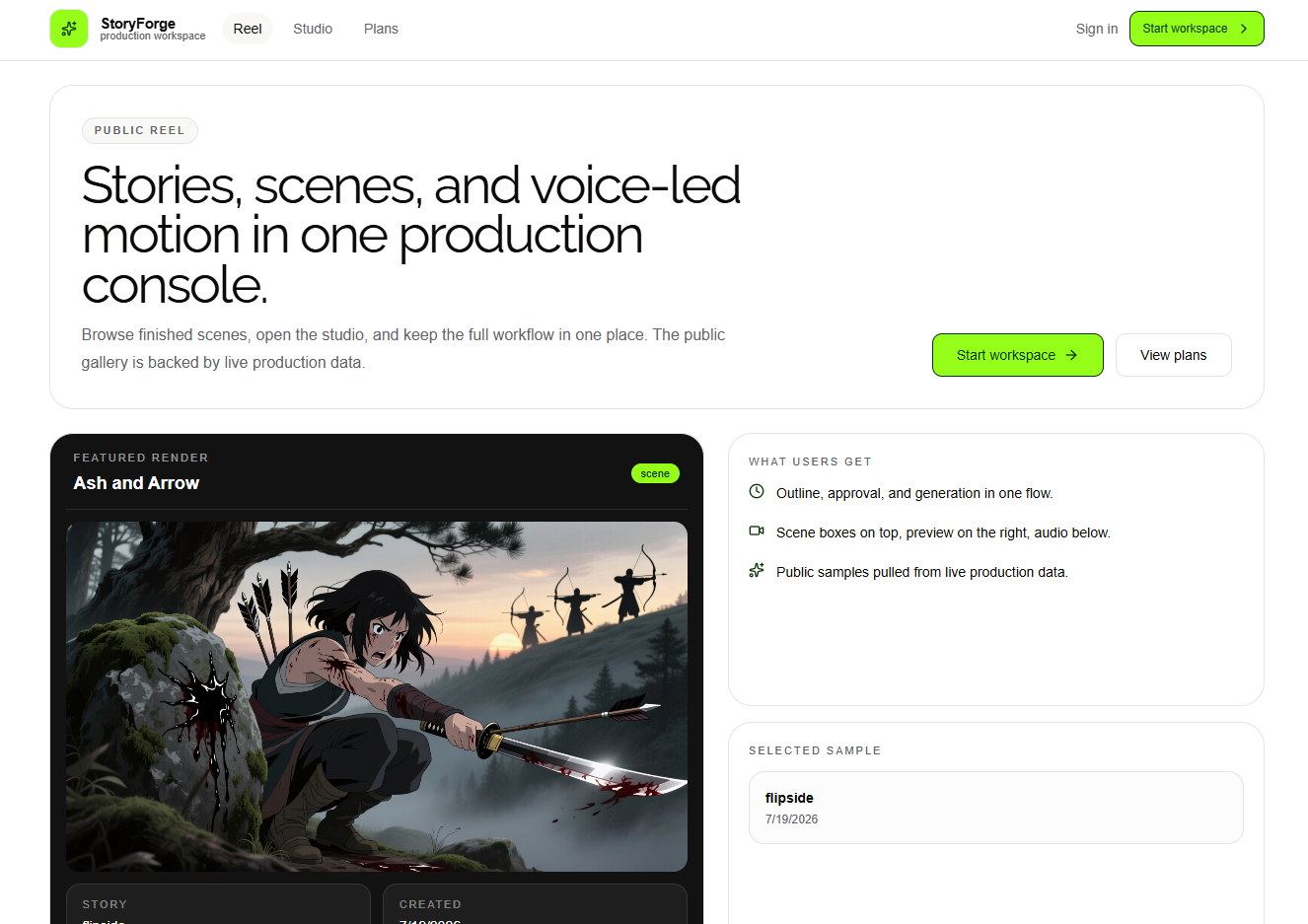
StoryForge Studio is an AI showrunner for serialized short-form media. It turns a prompt into an outline, persistent characters, narrated scenes, and generated media with human approval checkpoints. The backend runs on Alibaba Cloud ECS, uses Qwen Cloud models for text, image, audio, and video workflows, and stores state and assets across Redis, CockroachDB, and B2
Inspiration StoryForge Studio came from a simple gap: most AI media tools can generate a clip or an image, but they do not help you run a real production pipeline. For creator workflows, continuity matters more than one-off generation. We wanted a system that could keep characters consistent, preserve story state across scenes, and let a human review the output at checkpoints instead of restarting from scratch every time.
What it does StoryForge Studio is an AI showrunner for serialized short-form media. A user can create a production from a prompt, upload character and scene references, generate an outline, approve it, and then move into scene generation with narration and media output. The app keeps persistent story state, tracks character references, stores generation history, and exposes a production console where users can review scenes, assets, logs, and progress.
How we built it We built the backend with FastAPI and structured the pipeline around Qwen Cloud / DashScope models for text, image, audio, and video workflows. Redis handles queued jobs, retries, and worker coordination, while CockroachDB stores persistent story state, history, and metadata. Generated assets and references are stored in Backblaze B2. The frontend is a React + Vite app with a production console, dashboard views, and review flows. The backend is deployed on Alibaba Cloud ECS.
Challenges we ran into The main challenge was making generation reliable enough for multi-step production workflows. Early versions had brittle state handling, slow or failing generation paths, and unclear frontend/backend boundaries. We also had to fix deployment issues, including environment variable propagation, file uploads, public gallery access, and making sure the frontend pointed at the correct backend origin. Another challenge was designing the workflow so it supports continuity without forcing users to manually manage every low-level step.
Accomplishments that we're proud of We built a real end-to-end pipeline instead of a demo wrapper. StoryForge Studio now supports persistent characters, approval gates, reference-based generation, job queuing, retries, history tracking, and a production console that surfaces the right state to users. We also got the backend running on Alibaba Cloud ECS and integrated Qwen Cloud models into the media workflow rather than just using them for a chat layer.
What we learned We learned that good AI product design is mostly state management, failure handling, and workflow design. Model calls are only one part of the system; the hard part is keeping the production coherent across scenes, references, retries, and approvals. We also learned how much deployment quality matters for a hackathon project. A good demo needs a stable backend, clear frontend state, and visible proof that the system is actually running in production.
What's next for StoryForge Studio Next, we want to improve the console UX, add stronger project analytics, and make the workflow more flexible for creators. That includes deeper character versioning, better scene editing tools, clearer generation logs, more granular approval checkpoints, and richer media previews. On the infrastructure side, we want to harden scaling for multiple workers and expand the production workflow so creators can move from prompt to published media with less manual intervention.
Built With
- alibaba
- b2
- cockroachdb
- qwen
- redis


Log in or sign up for Devpost to join the conversation.