Inspiration
The idea for CreatorPilot came from a simple question:
What if a filmmaker could have an AI production crew working alongside them from the first idea to the final film?
Creating a film involves much more than generating video. A filmmaker needs to research a subject, develop the story, write the script, visualize scenes, plan individual shots, organize production, generate footage, and review the final result.
I wanted to explore how agentic AI could bring these different stages together instead of treating each task as a separate AI interaction.
That became CreatorPilot, an AI production crew designed to help creators move from an initial creative idea to a structured production workflow.
What it does
CreatorPilot takes a creator through a connected filmmaking workflow:
Creative Brief → Research → Script → Storyboard → Production Plan → Video Generation → Quality Review
The Research Agent investigates the subject and provides research findings that can support the creative process, with Parallel Search integrated into the research workflow.
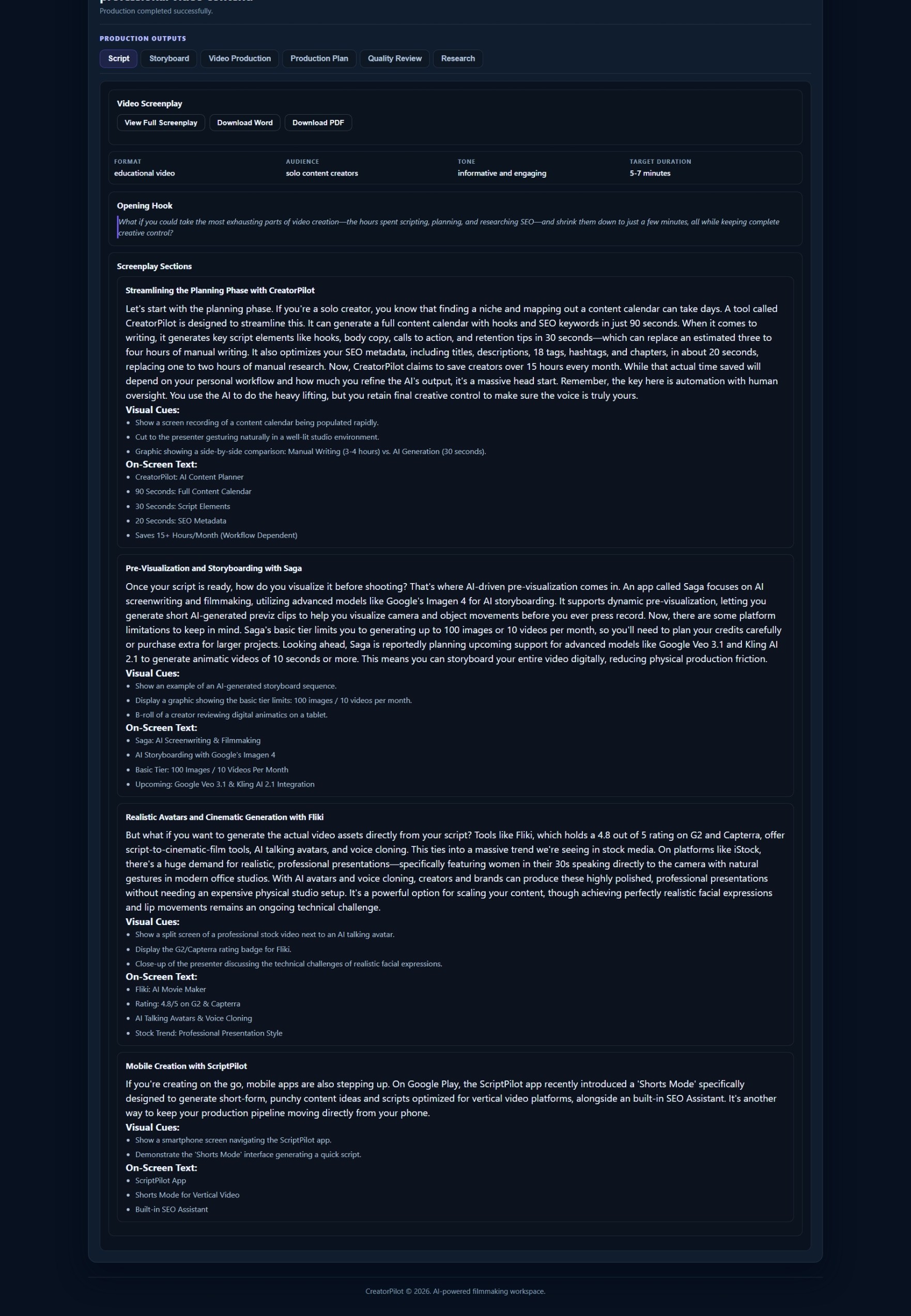
The script stage transforms the creative direction and research into a structured screenplay.
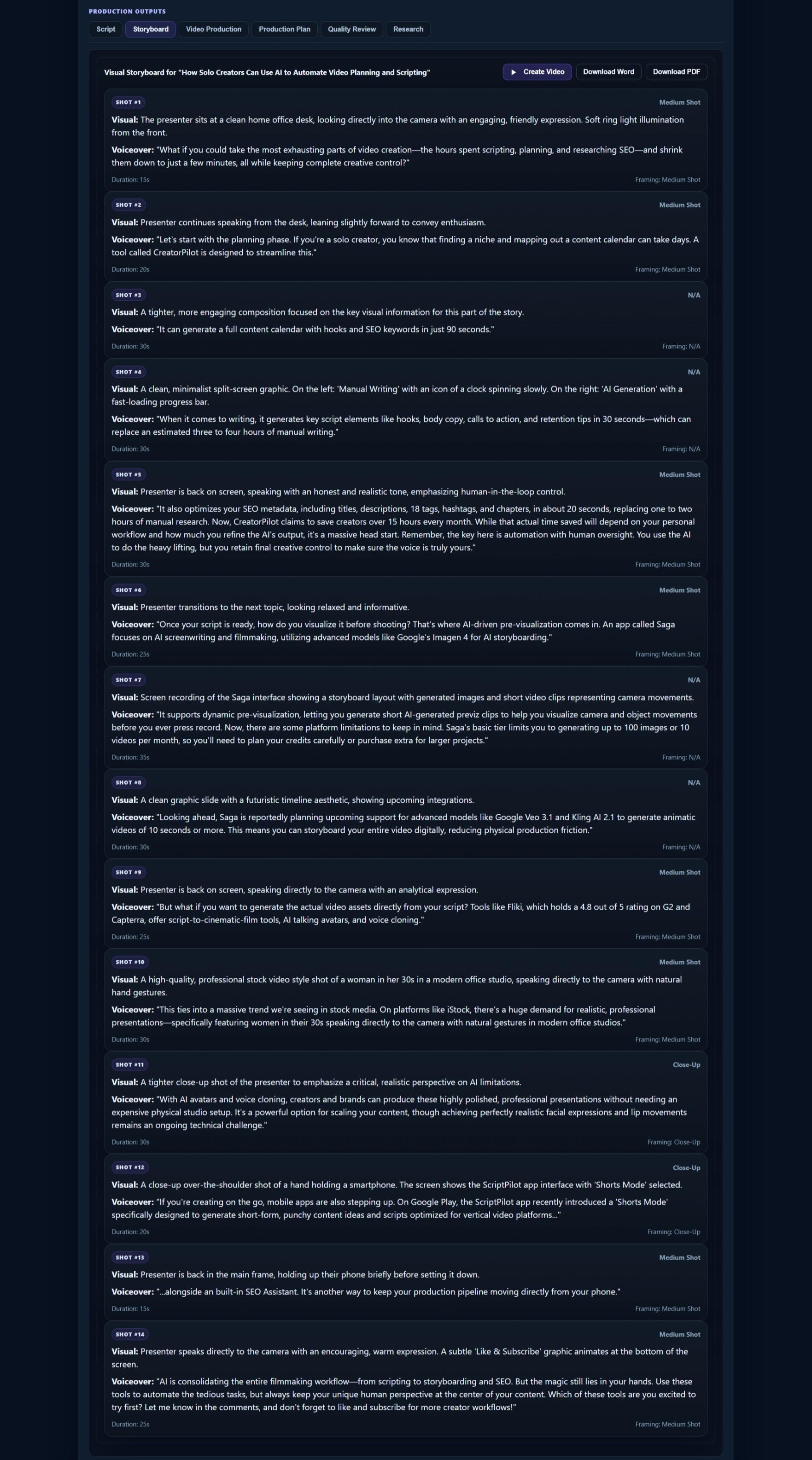
The Director Agent then breaks the script into individual shots and creates a storyboard with visual direction, camera instructions, composition, action, atmosphere, and duration.
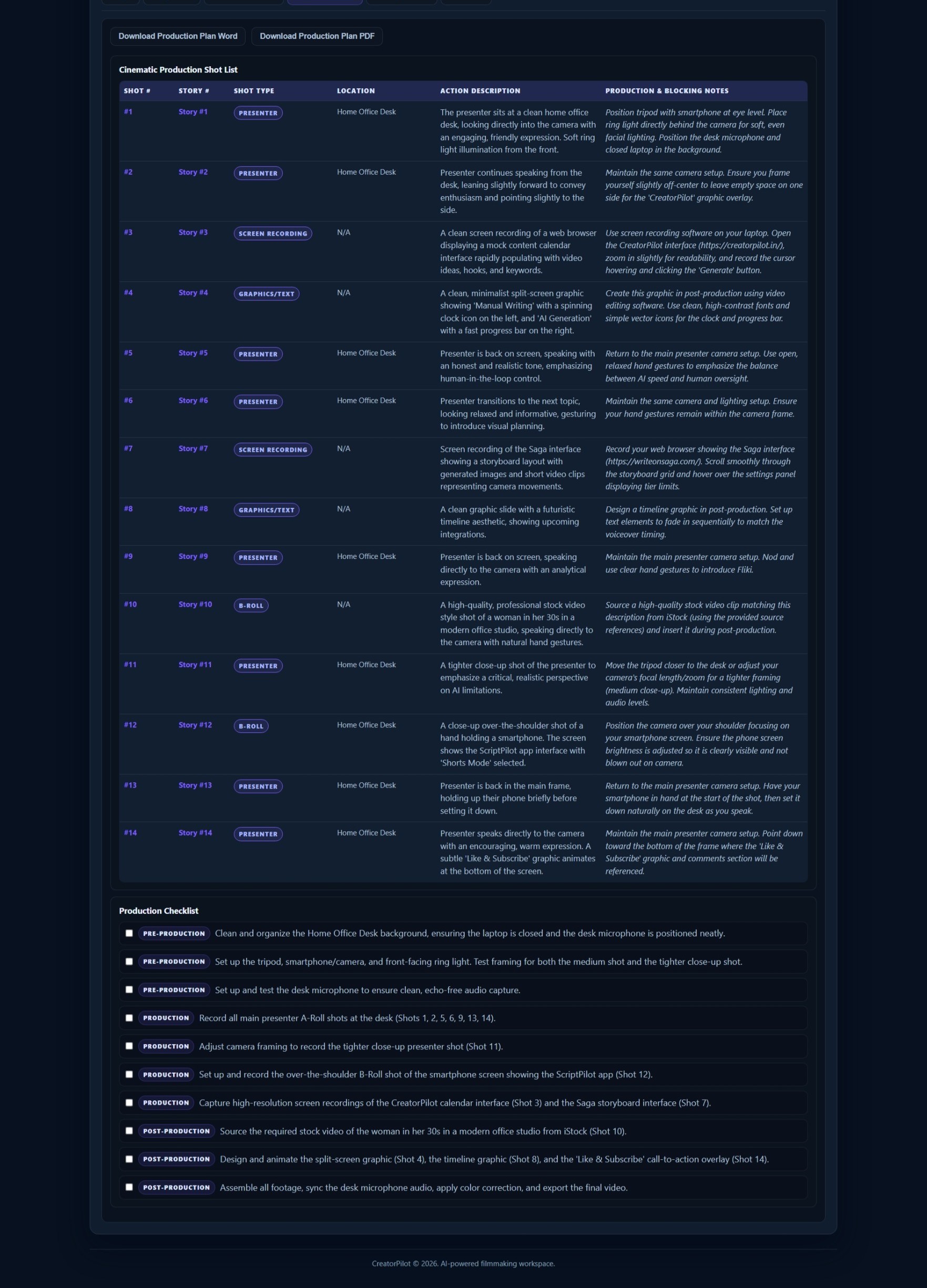
CreatorPilot turns the storyboard into a cinematic production shot list and production checklist.
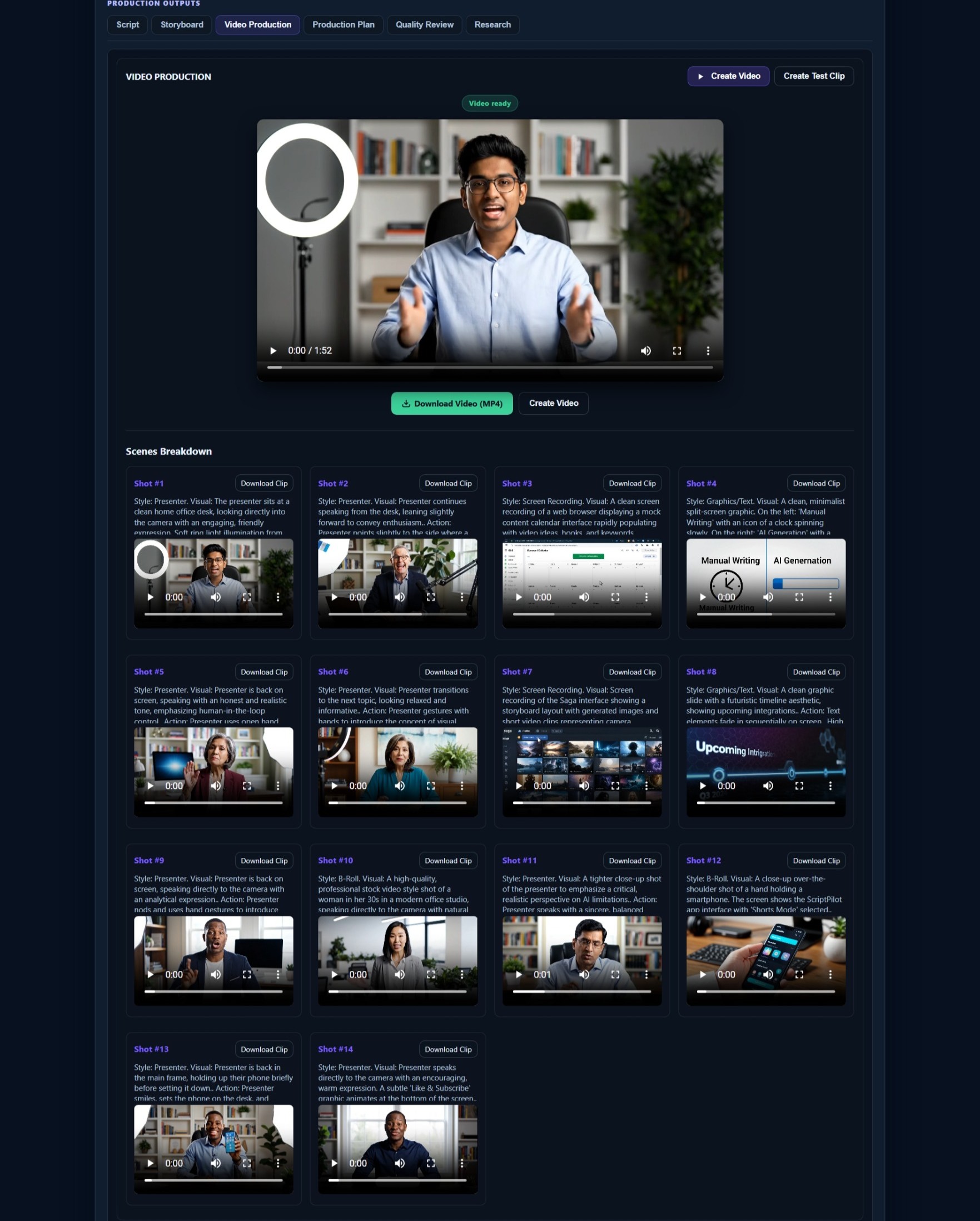
The video-generation stage connects the production workflow to Google's Veo capabilities to generate visual footage.
Finally, the Quality Review stage evaluates the production for areas including grounding, consistency, production readiness, and compliance.
The result is a connected AI-assisted production workflow rather than a collection of unrelated creative tools.
How we built it
CreatorPilot was built as a modular agentic application using a Google-centered AI stack.
The application uses Google Gemini for AI-assisted reasoning and content generation, with the Google Gen AI SDK providing the application integration.
Google Cloud / Vertex AI provides the cloud AI infrastructure, while Google Veo is used for video generation.
We also integrated Parallel Search into the research stage so that the Research Agent can work with search-based information rather than relying entirely on generated knowledge.
The application is built with:
- Node.js
- JavaScript
- HTML
- CSS
- Google Gemini
- Google Gen AI SDK
- Google Cloud / Vertex AI
- Google Veo
- Parallel Search API
- FFmpeg
The system is organized around specialized production responsibilities, including research, directing, video generation, video persistence, processing, and quality review.
A key part of the implementation was creating structured handoffs between stages. The output from research can inform the script, the script informs the storyboard, the storyboard informs the production plan, and the production plan feeds into video generation.
Challenges we ran into
One of the biggest challenges was moving from individual AI generations to a connected production workflow.
Generating text is only one part of filmmaking. The more difficult problem was making sure that information produced at one stage remained useful at the next stage.
For example, a script needs to contain enough information for the Director Agent to create meaningful shots, while those shots need enough production detail to become useful inputs for video generation.
Video generation introduced another technical challenge because generation is asynchronous. The application had to handle generation operations, wait for completion, retrieve the resulting video, persist the output, and continue processing it as part of the production workflow.
We also had to think carefully about how to present all of this complexity through a simple interface. The filmmaker should experience a production workspace, not a collection of disconnected technical components.
Accomplishments that we're proud of
We are proud that CreatorPilot evolved from an idea into a working end-to-end filmmaking workflow.
Some of the accomplishments we are particularly proud of include:
- Building a specialized AI production workflow rather than a single-purpose AI tool
- Connecting research, scripting, storyboarding, production planning, video generation, and quality review
- Integrating Google Gemini into the creative workflow
- Integrating Parallel Search into the research process
- Connecting production planning to Google's Veo video generation
- Building a shot-by-shot storyboard workflow
- Building a cinematic production shot list and checklist
- Implementing video generation handling and processing
- Creating a browser-based production dashboard
- Adding a quality-review stage to the filmmaking workflow
Most importantly, we are proud of the idea behind CreatorPilot: using AI as a coordinated production crew that supports the filmmaker throughout the creative process.
What we learned
Building CreatorPilot taught us that an effective agentic system is not just about choosing a powerful AI model.
The real challenge is designing how specialized responsibilities work together.
We learned that the quality of an agentic workflow depends heavily on the quality of the handoffs between its stages. Research needs to produce useful context for the script. The script needs to translate into meaningful visual direction. The visual direction needs to become actionable production information.
We also learned a great deal about integrating AI into an asynchronous media-generation pipeline, handling generated video, processing media, and designing an interface around a complex multi-stage workflow.
Most importantly, we learned to think about AI less as a single assistant and more as a team of specialized collaborators.
That is the idea behind CreatorPilot.
Built With
- agent
- cloud
- context
- gemini
- javascript
- mcp
- model
- protocol
- python
- react
- replit
- server


Log in or sign up for Devpost to join the conversation.