-
-
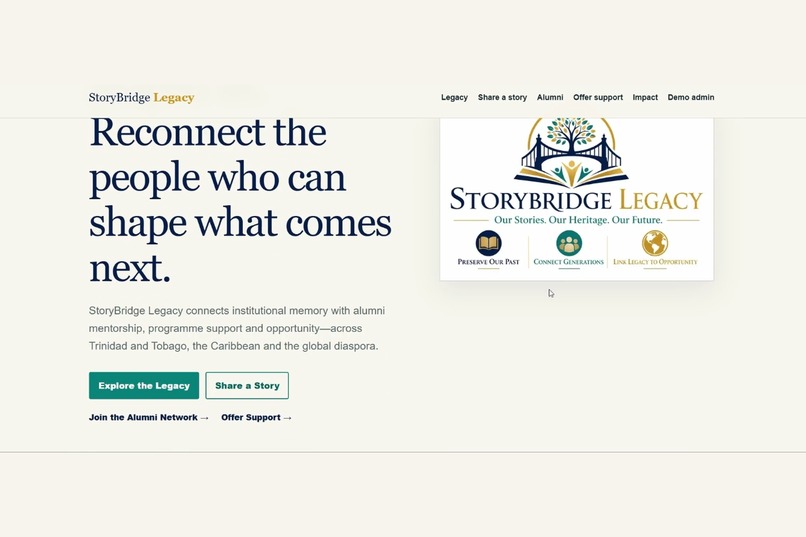
StoryBridge Legacy reconnects institutional memory with alumni, mentorship and future opportunity.
-
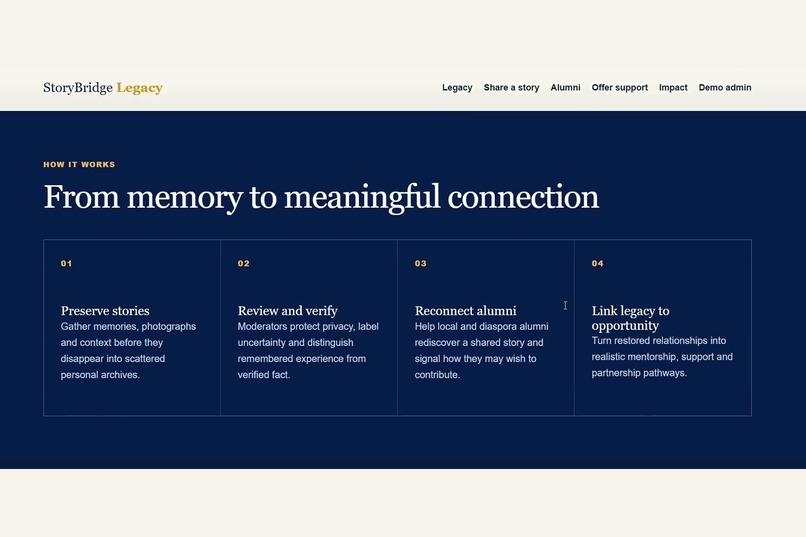
StoryBridge moves from preserving stories to review, alumni reconnection and opportunity.
-
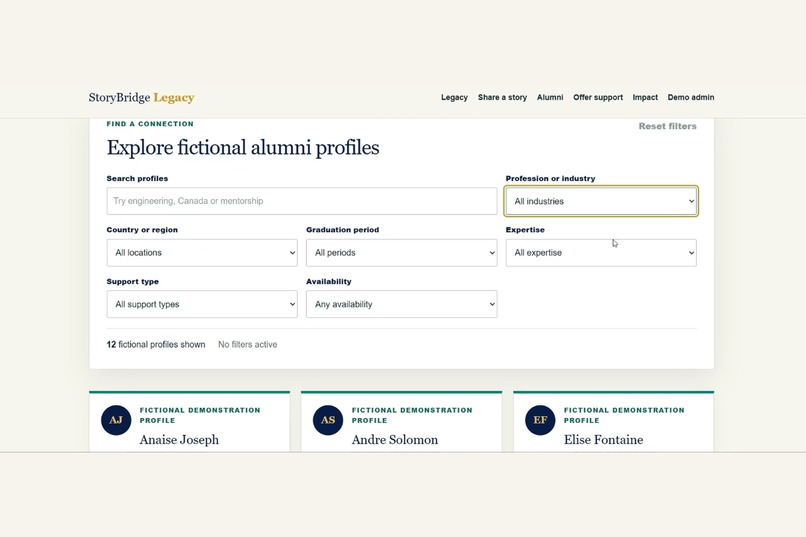
Human moderation protects privacy, preserves contributor control and separates memory from verified history.
-
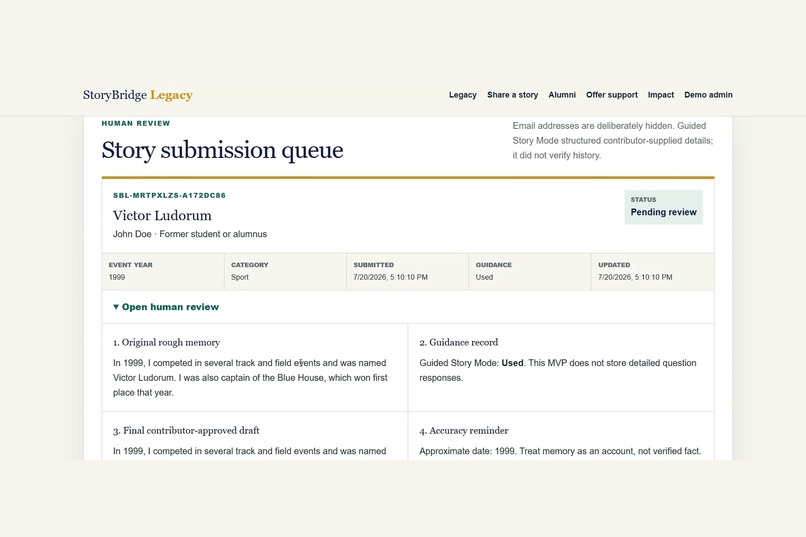
A searchable fictional alumni directory connects expertise, location and willingness to support.
-
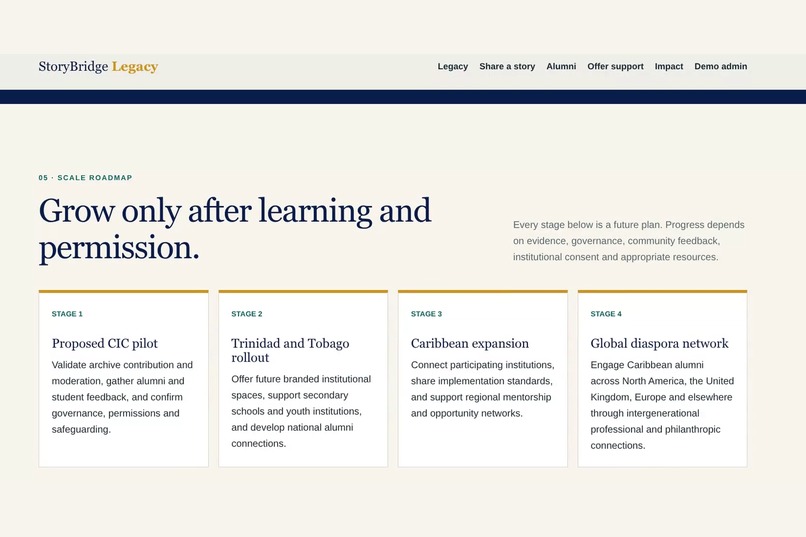
A roadmap from a proposed CIC pilot to a Caribbean and global diaspora network


Inspiration: This idea came from a specific afternoon, not a general observation. I went back to my alma mater, St. Mary's College in Trinidad, for an Open House. Along one wall there were a few old College Annuals laid out, yearbooks going back decades, and people were just standing around them, flipping pages, pointing at photos, telling each other stories. I ended up reconnecting with past students and even some staff I hadn't spoken to in years. It stuck with me afterward that all of that only happened because those annuals happened to be there, in that room, on that specific day. Most of the school's history isn't sitting out where people can stumble into it. It's in yearbooks nobody's opened in years, filing cabinets, someone's old photo album, or just in people's memories waiting for the right prompt to bring them back. At the same time, a lot of alumni who've done well and moved abroad drift away from the schools that shaped them. Not because they've stopped caring. There's just no obvious door back in. Their experience, their networks, their willingness to help, it's all still there, just disconnected. That's really where StoryBridge Legacy came from. I wanted to recreate what happened at that Open House table, but make it permanent and searchable instead of a once-a-year accident. Something that keeps institutional memory alive and turns "brain drain" into something closer to brain circulation, where people stay connected and give back even from a distance. What it does: StoryBridge Legacy is a digital time capsule and alumni platform for Caribbean schools. As an MVP, it lets people browse a searchable timeline of the school's history, submit their own memories or historical accounts, and get help shaping a submission through a GPT‑5.6 powered Story Guide that asks follow up questions and flags gaps. Stories go through moderation before anything goes live. Users can also browse alumni profiles by profession, location, and expertise, and see concrete ways alumni could plug back in through mentorship, internships, scholarships, program funding, introductions, or future investment. Worth being upfront: all the alumni and competition data right now is fictional demo content, and nothing submitted gets published automatically. Everything goes through moderation first. How I built it: It's a Next.js/TypeScript/Tailwind web app. I used Codex with GPT-5.6 heavily during Build Week, mainly to help scaffold the architecture, build out the archive and moderation flows, run tests, and keep documentation up to date as things changed. That said, the actual judgment calls, getting the Caribbean context right, the social impact framing, the user journeys, how to safeguard historical accuracy, the alumni engagement model, those were mine to make. AI sped up the building; it didn't make the decisions. I tried to keep a consistent loop going the whole week: plan, build, test, audit, repair, retest, document, commit. There's a changelog, acceptance tests, an audit report, and an evidence record from Build Week in the repo if you want to see the process rather than just the output. Challenges: Honestly, the biggest challenge was reining in scope. It's easy to imagine this platform eventually supporting multiple schools, real digitized archives, secure student accounts, mentor matching, and fundraising, basically the whole thing. For one week, I had to force myself to build a narrow, working journey I could actually test and demo properly, instead of a half built version of the big vision. The other challenge was making sure the AI assistance helped with storytelling without quietly inventing facts. The Story Guide is built to ask questions and organize what a contributor gives it, not to fill in blanks on its own. Anything uncertain gets flagged, and a human still has to review it before it goes anywhere. Accomplishments: I got a full journey working end to end. A memory gets preserved, then refined with responsible AI support, then submitted for moderation, then used to help reconnect alumni, and finally turned into an actual opportunity. More than that, I wanted this to be a foundation that could keep going after the competition ends, not just a demo that gets shelved. What I learned: Brain drain doesn't have to mean people are gone for good. Caribbean alumni overseas can still mentor, share what they know professionally, offer internships, fund scholarships, make introductions, or back fundraising and future investment. The willingness is often there, it just needs a structure to move through. What's next: CIC/St. Mary's College here in Trinidad and Tobago is who I'd want to pilot this with first, given that's where the idea started. This isn't purely hypothetical either. I've already written to a colleague at the College's Past Students' Union proposing a similar digital legacy and living history concept, so there's a real conversation underway about what a pilot could look like. If that goes well, the rough plan is to start with one school, then expand nationally across Trinidad and Tobago, then across the wider Caribbean, and eventually connect into the global Caribbean diaspora. Down the line, I'd want to add verified alumni accounts, real document digitization, proper mentor matching, sponsorship tools, fundraising campaigns, and a responsible path for entrepreneurship and investment connections.
Built With
- codex
- css
- github
- gpt-5.6
- javascript
- next.js
- openai
- react
- tailwind
- typescript
- vercel

Log in or sign up for Devpost to join the conversation.