-
-
Tap YOUR toy, get a story!
Inspiration
Our inspiration came from two of our favorite toys growing up - Skylanders and amiibos. From Skylanders, we were inspired by the sense of immersion, imagination, and storytelling that makes a world feel alive and personal. From amiibos, we loved the idea that a physical object can instantly unlock a digital experience with a simple tap. We wanted to combine those ideas into something meaningful for children. A way for a favorite toy to become more than just an object, and instead become the center of a unique story experience. Beyond the technical inspiration, we were also motivated by a social issue. Many interactive toys and personalized learning tools are expensive and inaccessible, especially for families or communities with fewer resources. We wanted to create a system that works with toys children already own, making imaginative and personalized storytelling more accessible, affordable, and emotionally engaging. We also wanted to solve the issue of children being on their screens, I growing problem you see out anywhere in public. Finally, we wanted to use SOTA technology to voice clone and give children the opportunity to hear stories of and in their familiy and friend's voices.
What it does
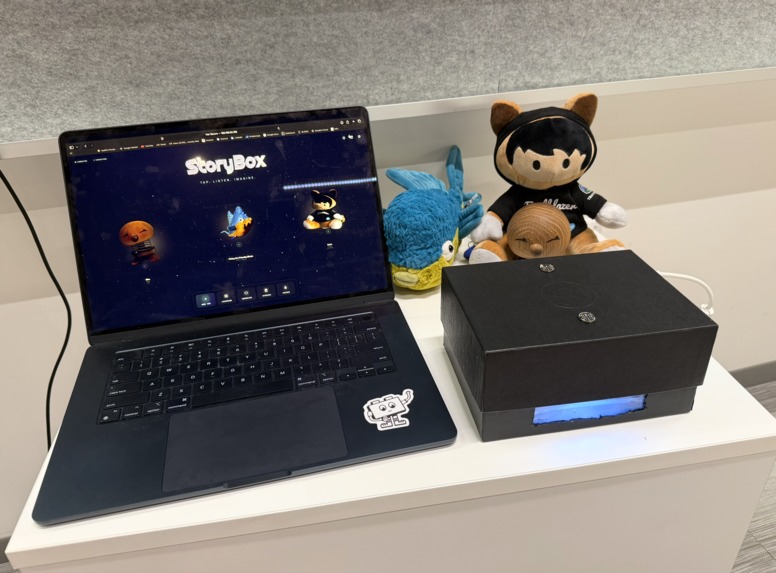
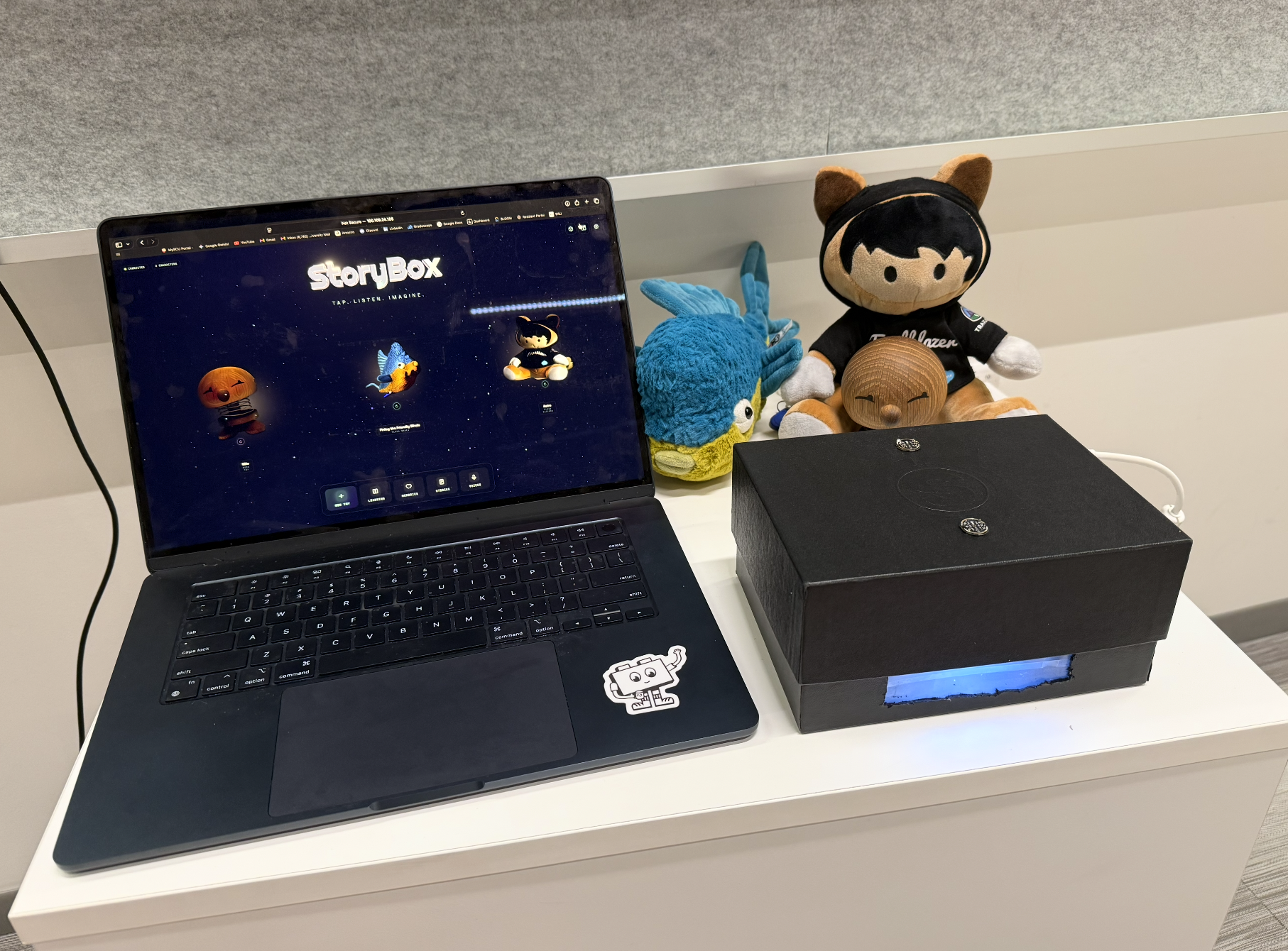
Our project transforms an ordinary toy into an interactive storytelling companion. Each toy is linked to an RFID tag or sticker, which can be scanned on our device. Through a parent or caregiver dashboard, the toy is assigned attributes such as its name, color, texture, personality, or other descriptive traits. When the child taps that toy on the reader, our system recognizes it and generates a personalized story based on those attributes. The story is then read aloud using an AI voice model through a speaker, creating an engaging and hands-free storytelling experience. We also explored a familiar-voice feature, where a trusted loved one’s voice can be used to narrate the story or tell a pre made story, adding emotional comfort and connection. The result is an interactive platform that turns toys children already love into personalized story worlds.
How we built it
We built the project by combining simple hardware with AI-powered software. On the hardware side, we used RFID tags and a tap-to-read setup so that physical toys could be connected to digital identities. On the software side, we created a dashboard that allows a parent, teacher, or caregiver to register each toy and input its unique characteristics. Once a toy is scanned, the backend takes those stored attributes and passes them into an AI text generation pipeline to create a custom children’s story in real time. That story is then sent into a text-to-speech or voice generation system so it can be spoken aloud naturally. We focused on building a smooth end-to-end flow: assign a toy, scan the toy, generate the story, and play it back instantly. Our goal was to make the experience feel magical for the child while keeping the system simple and practical behind the scenes.
Challenges we ran into
One of our biggest challenges was connecting the physical and digital parts of the project in a way that felt seamless. It was not enough for the RFID scan to work technically. It also had to feel fast, intuitive, and reliable in a live demo environment. Another challenge was balancing story quality with speed. Since the stories are generated dynamically, we had to think carefully about how to provide enough toy detail for the output to feel personal, while still making sure the response was quick enough to hold a child’s attention. We also ran into challenges around voice features, especially when thinking about how to make them emotionally meaningful without overcomplicating the experience. In addition, because this is a social-impact project, we had to be intentional about our framing: we wanted to show that this is not just a fun AI toy, but a tool for accessible, personalized play and storytelling.
Accomplishments that we're proud of
We are proud that we built a project that feels both technically creative and socially meaningful. Instead of creating another expensive smart toy, we designed a system that works with toys children already own, which makes the experience more accessible and emotionally resonant. We are especially proud of the physical-to-digital interaction, tapping a toy and instantly hearing a custom story gives the project a magical quality that people can understand immediately when they see it. We are also proud that the platform supports personalization at multiple levels, from the toy’s descriptive traits to the voice output itself. More than anything, we are proud that the project has a clear human-centered purpose. It is not just about showing AI for the sake of AI, it is about using technology to support imagination, comfort, and storytelling for children in a way that can be scalable.
What we learned
Through building this project, we learned how powerful it can be to combine simple hardware with intelligent software to create an experience that feels much bigger than the sum of its parts. We learned that personalization matters a lot, even a small amount of detail, like a toy’s name or personality, can make generated content feel much more engaging and special. We also learned that social-impact projects need a very clear narrative. It is not enough to build something technically impressive, you also need to explain why it matters, who it helps, and why your solution is better than existing alternatives. On a technical level, we learned more about integrating RFID systems, coordinating data flow between hardware and backend services, and designing an AI pipeline that can generate and deliver content in real time. On a broader level, we learned how to think more deeply about accessibility, emotional design, and what makes technology meaningful in a child-centered setting.
What's next for StoryBox
The next step for StoryBox is to make the platform more robust, scalable, and adaptable to real-world use cases. We want to improve the quality and consistency of the generated stories, expand the dashboard so caregivers can better customize a toy’s personality and story style, and create a larger variety of narration options. We also want to explore how this could be used beyond the home, such as in classrooms, libraries, hospitals, or therapy settings where children could benefit from comforting and personalized storytelling experiences. In the future, we see StoryBox becoming a flexible platform for interactive play that supports not only entertainment, but also literacy, emotional connection, and developmental learning. Our long-term vision is to make personalized storytelling more accessible to every child by turning the toys they already treasure into companions for imagination.

Log in or sign up for Devpost to join the conversation.