Inspiration
I’ve always loved children’s storybooks, but creating a personalized illustrated book has traditionally been time-consuming and expensive. Parents, educators, and creators often want something unique — a story tailored to their child, family, or theme — without needing artistic or writing skills. That inspired me to build StorybookAI, a tool that brings this magic to anyone with just a short idea or a picture.
What it does
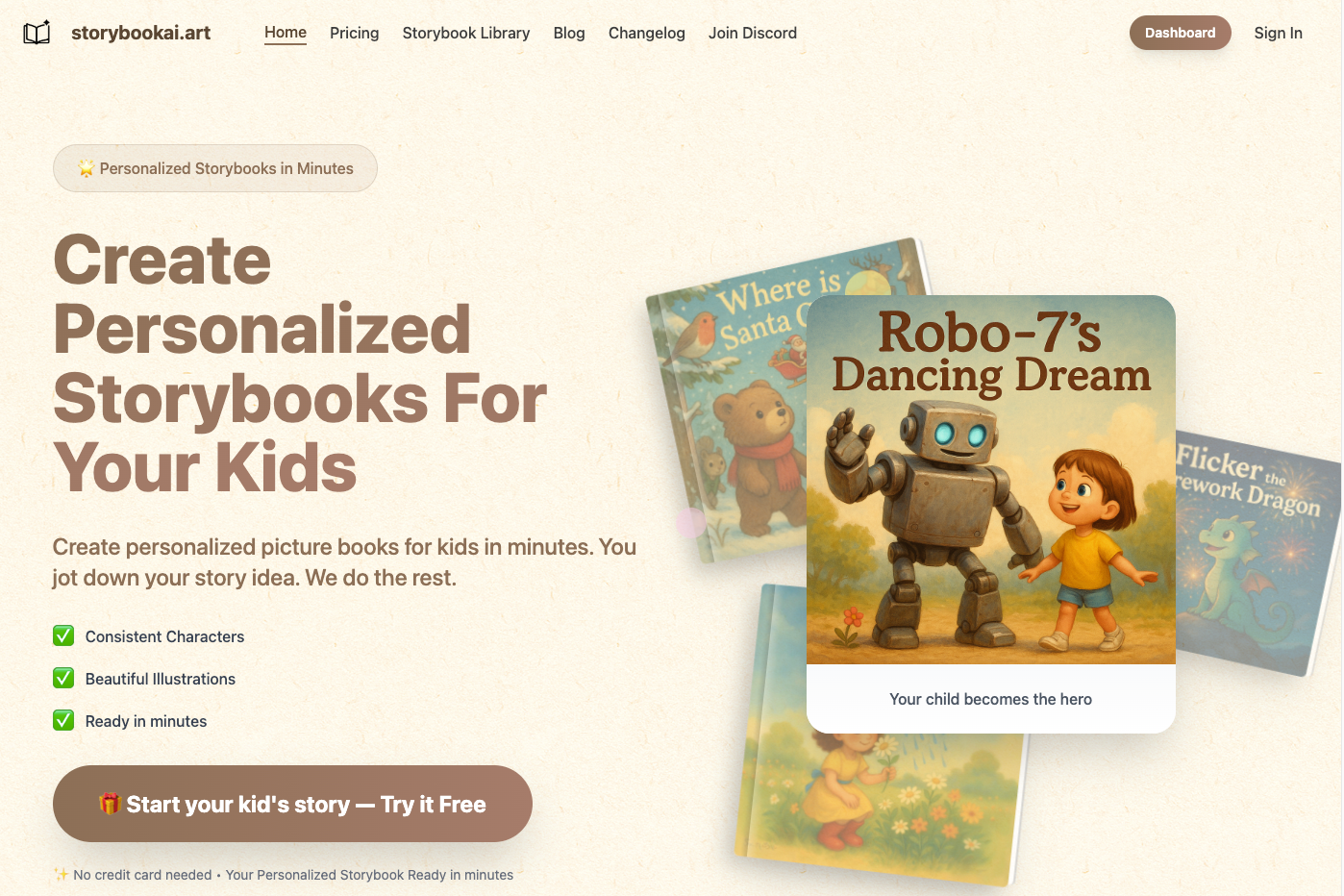
StorybookAI lets users create a complete, illustrated children’s storybook in minutes.
- Users type a short idea (like “A pirate cat finds treasure”) or upload a photo of a character.
- The system automatically generates:
- A full story tailored to the child’s age group.
- A structured page-by-page breakdown with scenes and dialogue.
- Consistent character illustrations across all pages in a chosen art style.
- A full story tailored to the child’s age group.
- The final output is a digital storybook that can be read online or exported as a PDF.
How I built it
- Frontend: Built with modern web technologies for speed and usability.
- AI Generation:
- Story text powered by large language models, with strict prompts to ensure child-friendly content.
- Image generation pipelines using consistent character rules and style presets.
- Story text powered by large language models, with strict prompts to ensure child-friendly content.
- Infrastructure: Deployed on Cloudflare for fast serverless execution and global availability.
- Workflow: A multi-step automated pipeline: idea → story → character set → scene descriptions → illustrations → compiled book.
Challenges I ran into
- Character consistency: AI often changes characters across pages. I had to design structured prompts and rules to enforce consistent appearance.
- Age-appropriate language: Stories needed to feel natural for different age groups (0–2, 3–5, 6–9, 10+), which required careful prompt engineering.
- Scalability: Handling multiple simultaneous requests with image generation was tricky to optimize for speed and cost.
- User experience: Balancing full automation with user control (e.g., letting users regenerate a single page instead of restarting the whole book).
Accomplishments that I'm proud of
- Built an end-to-end pipeline that creates a complete storybook automatically from just one idea.
- Solved the problem of AI “forgetting” characters by implementing structured character anchors.
- Created a clean, interactive interface where users can see story progress step-by-step.
- Generated dozens of consistent, high-quality demo books that proved the system works.
What I learned
- The importance of structured prompts: vague instructions produce chaotic results, while detailed, rule-based prompts unlock consistency.
- How to combine language + image models into a single cohesive workflow.
- That building trust in AI products requires transparency: showing progress, giving users checkpoints, and letting them make edits mid-process.
What's next for StorybookAI
- User editing tools: Let users pause and revise specific characters, pages, or scenes without restarting the entire book.
- More art styles: Beyond Ghibli-inspired, add watercolor, cartoon, crayon, and photo-realistic presets.
- Printed books: Allow users to order physical storybooks for gifts.
- Community sharing: A gallery where people can publish and share their books with others.
- Educational features: Templates for Bible stories, folktales, or classroom activities.
Built With
- astro
- cloudflare
- supabase

Log in or sign up for Devpost to join the conversation.