-
-
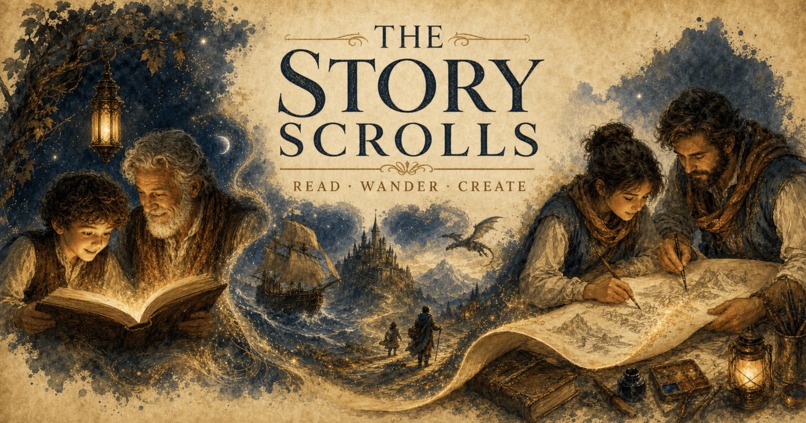
The Story Scrolls — Living literature, made visible.
-
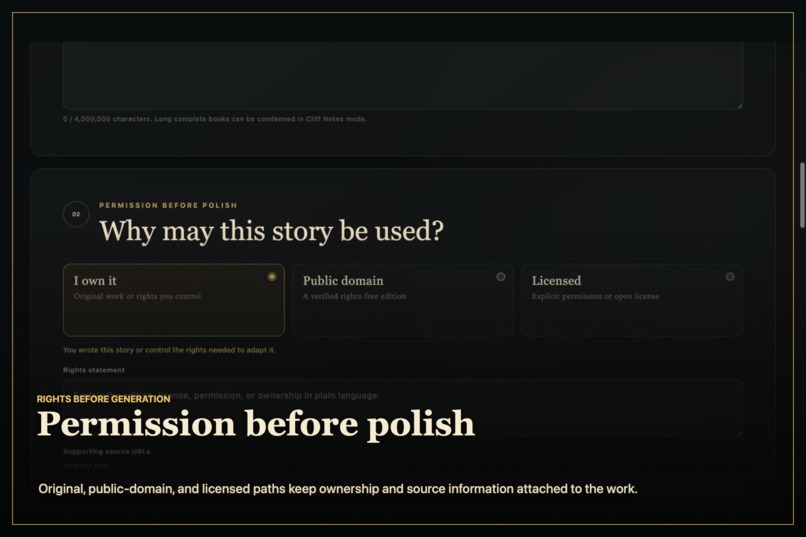
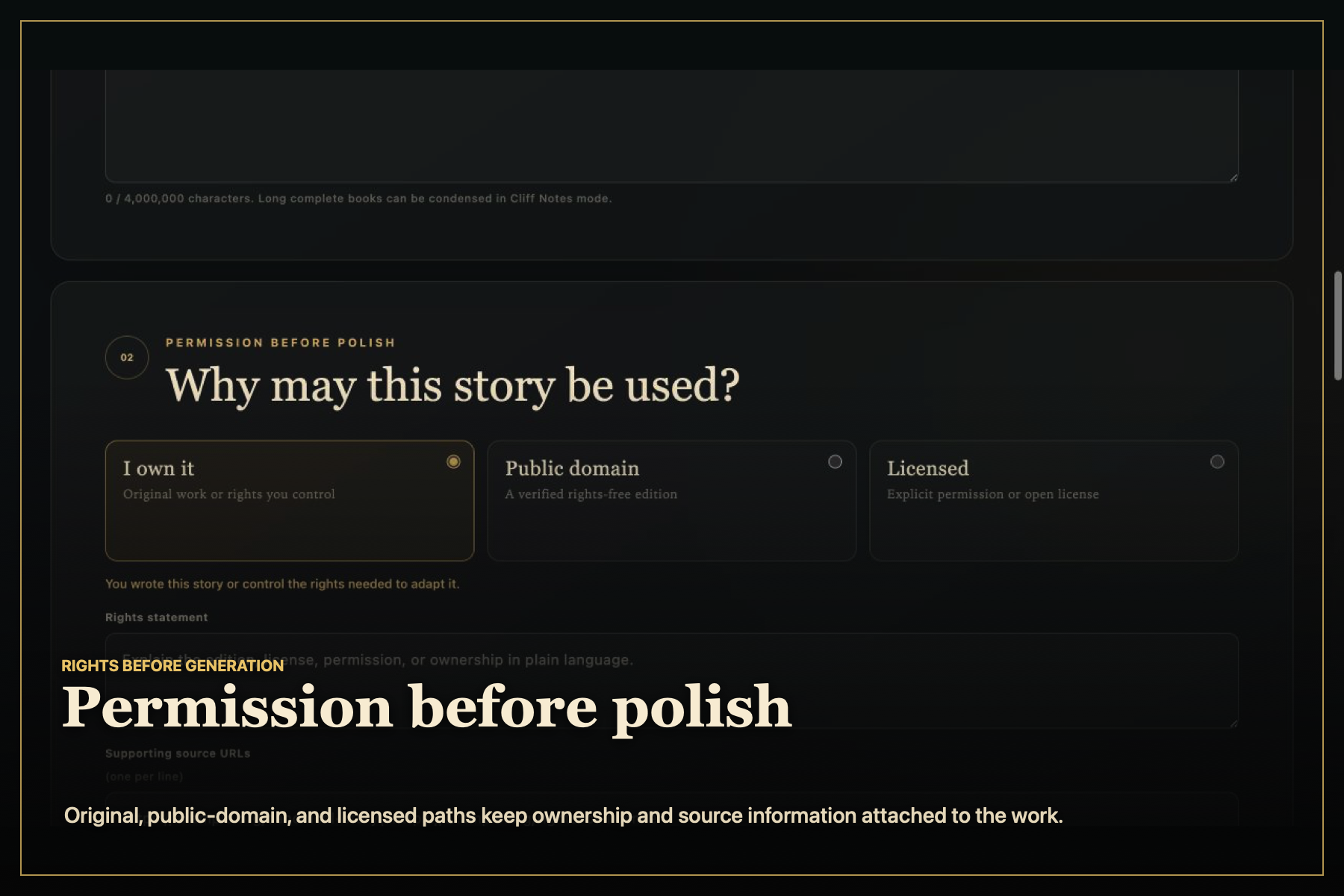
Permission before prompting — Authorship, public-domain status, license, or explicit permission come first.
-
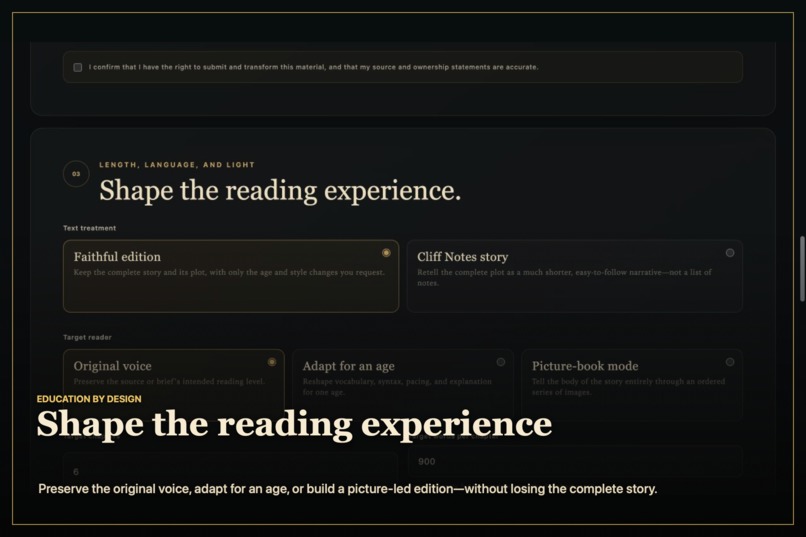
Adaptation with intent — Choose fidelity, reading age, chapter shape, length, and picture-led treatment.
-
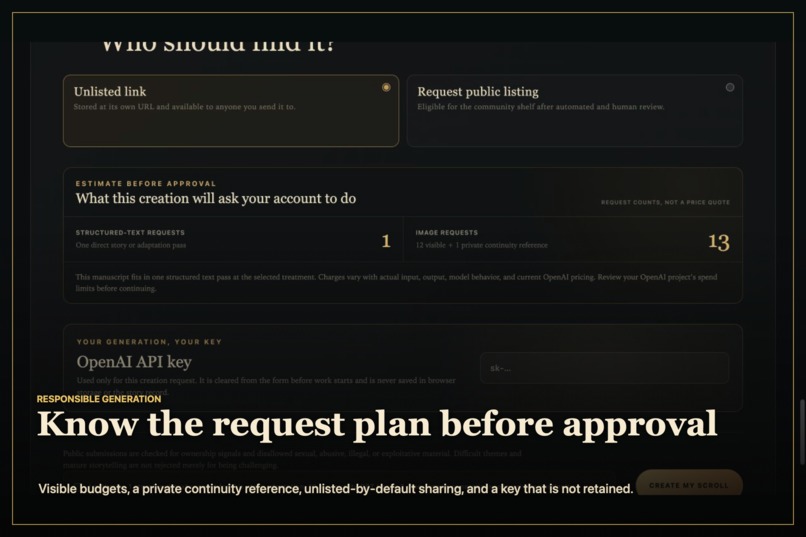
Responsible generation — Visible request planning, fixed art budgets, continuity approval, and unlisted-by-default publishing.
-
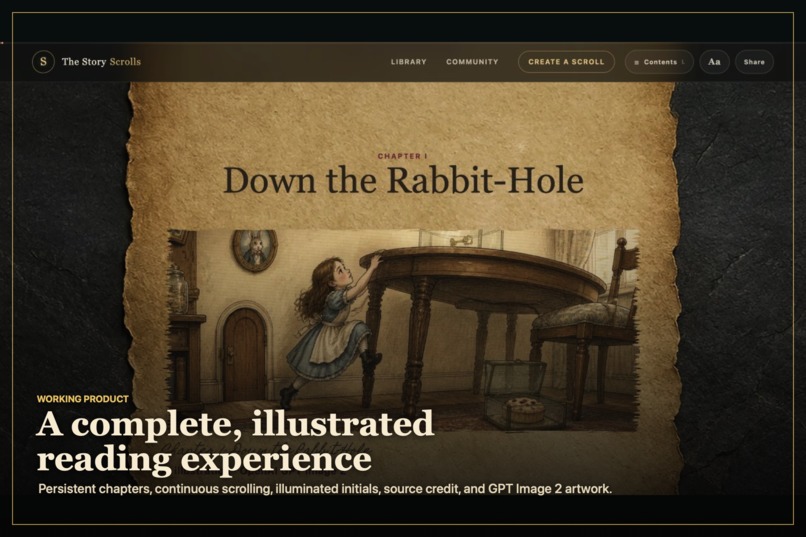
A complete reading experience — A polished living scroll that makes long-form literature inviting on screen.
-
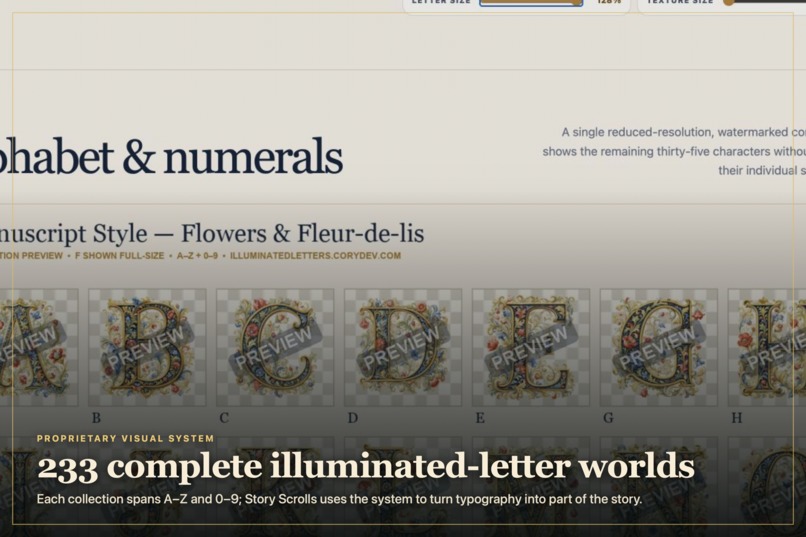
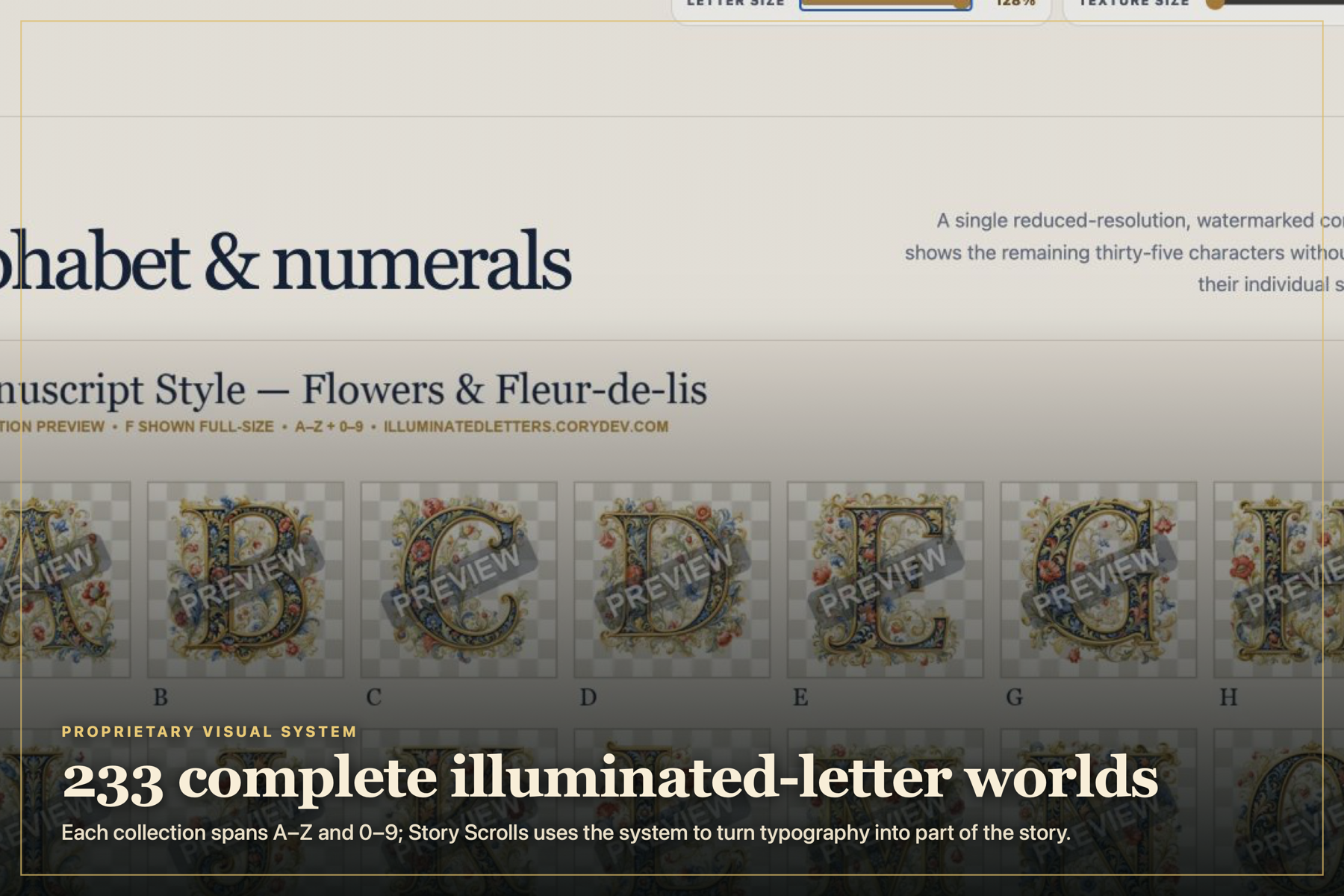
A coherent visual world for every book — 233 complete A–Z plus 0–9 illustrated alphabets, totaling 8,388 letters and numerals.
What I built during OpenAI Build Week
Before July 13, 2026, Story Scrolls was an experimental scrollytelling reader. During the July 13–21 Build Week window, I used Codex and GPT-5.6 to turn it into a working end-to-end adaptation, generation, and publishing platform.
The existing reader became the delivery surface. The new Build Week system lets a creator establish rights, bring an authorized source or original idea, choose an audience and treatment, approve visual continuity, generate within a visible budget, publish with provenance, and read the result as a finished living scroll.
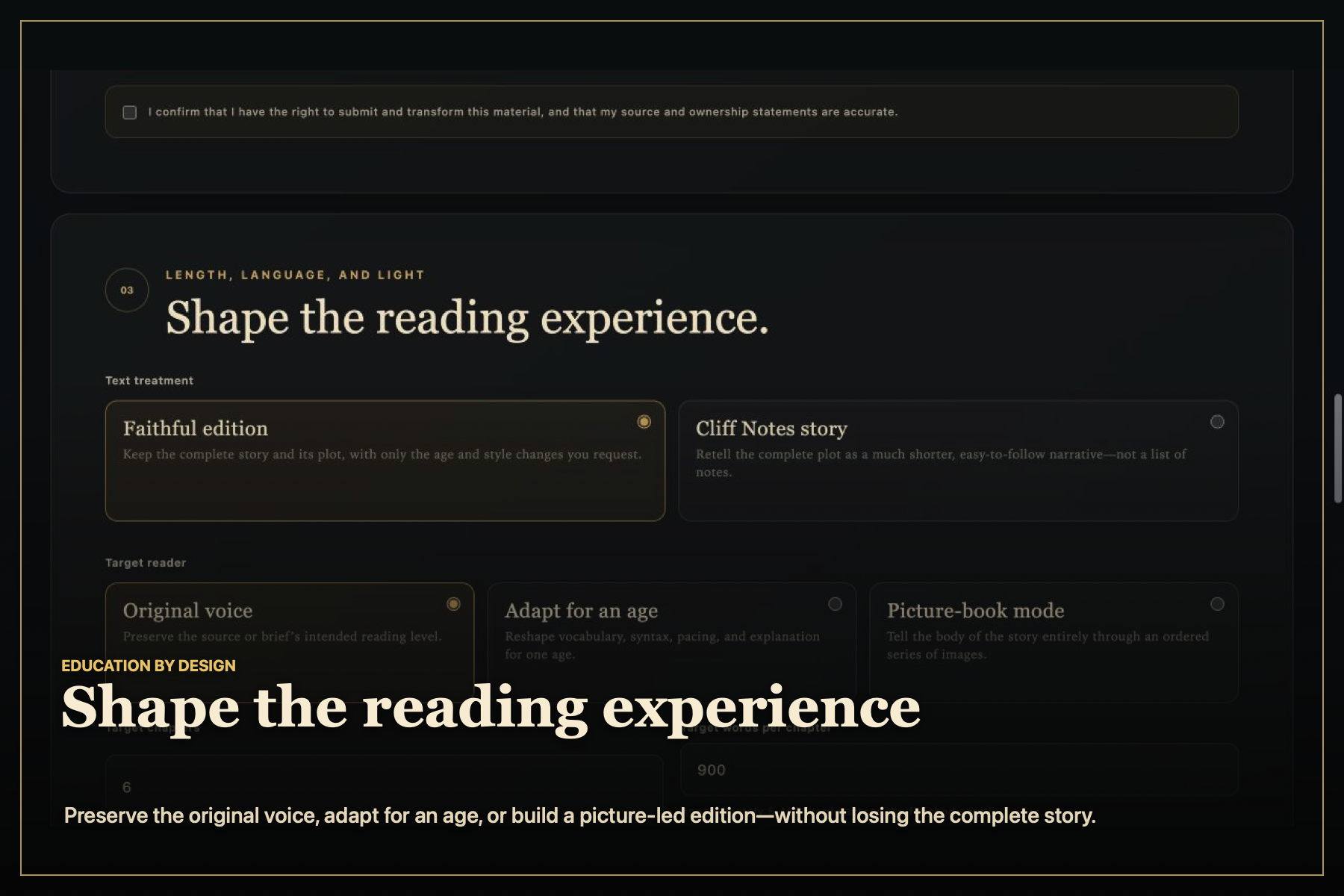
- Authoring: A six-stage Rights → Story → Shape → Art → Review → Create workflow for source, audience, fidelity, chapter structure, length, quality, visual direction, and publication choices
- Reasoning: Hierarchical long-source ledgers, strict GPT-5.6 structured outputs, allowlisted model and reasoning tiers, editorial refinement, age-suitability review, and a creator-approved continuity bible
- Generation and trust: Bounded GPT Image 2 artwork, moderation, request-scoped API keys, cost preflight and local spend caps, private media, durable asynchronous jobs, unlisted-by-default publishing, public review, and persistent provenance
- Proof and operations: A public no-login deployment, two completed GPT-5.6 proof scrolls, automated tests, responsive visual QA, deployment and release runbooks, a dated source freeze, and the principal Codex session
This is not a mockup or a one-prompt demonstration. Judges can inspect the complete creation plan without an API key, read two generated proof scrolls, run the public product, and review the exact code and timestamped Build Week evidence.
The frozen judging source is tag googledevweekjul-submission-20260721-1950, commit 4029d302, timestamped 2026-07-21T23:48:49Z. The final pre-deadline illuminated-initial sync is commit 3ebc429, timestamped 2026-07-21T23:56:05Z.
Judge Quick Start — No API Key Required
- Open the frozen Build Week deployment. It is free, public, and requires no login.
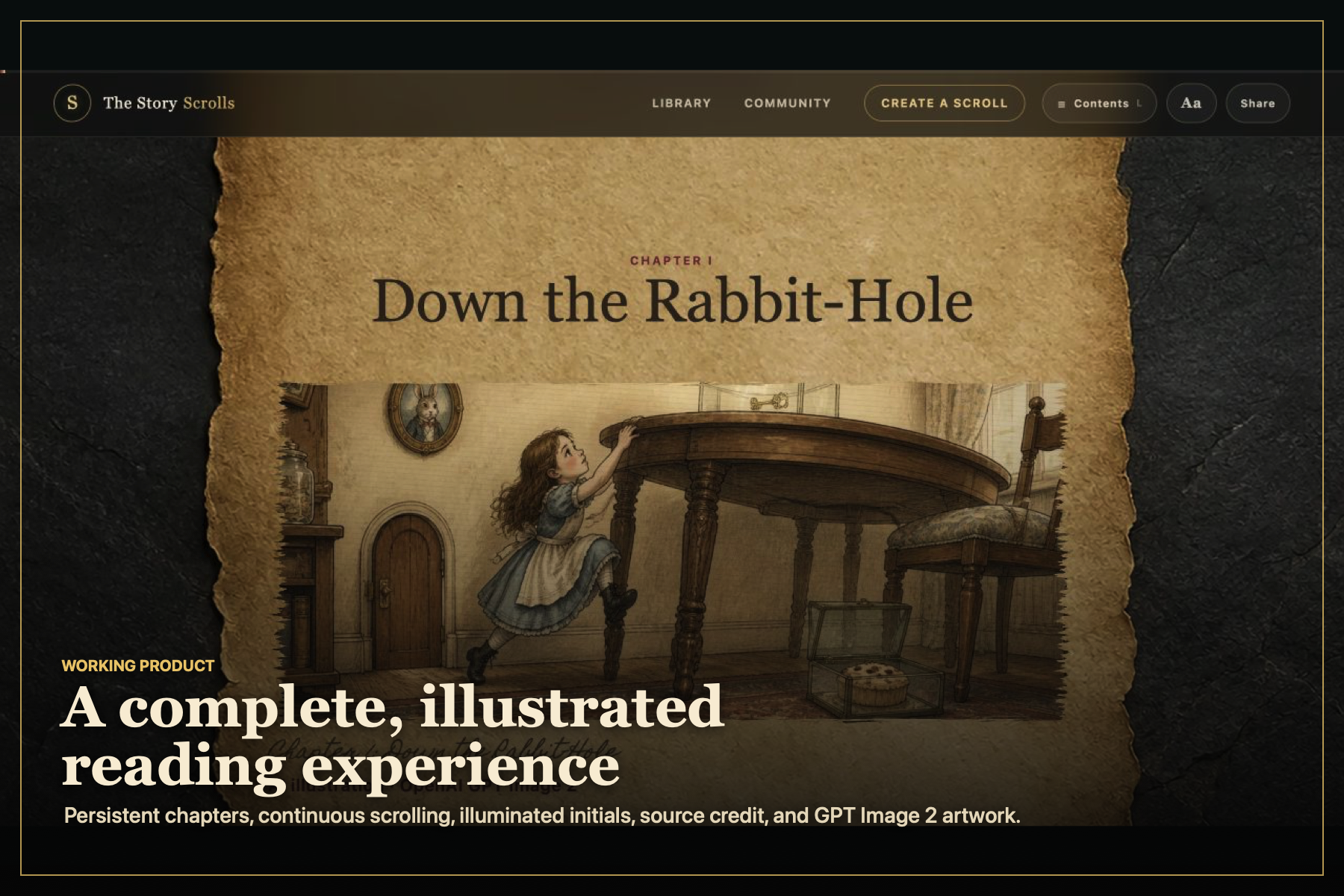
- Enter Alice's Adventures in Wonderland to inspect a complete living scroll: continuous reading, chapter art, illuminated initials, controls, and source/provenance details.
- Open Create a Scroll and walk through Rights, Story, Shape, Art, Review, and Create. No key is needed to inspect the full plan; an OpenAI API key is required only if a judge chooses to run new paid generation.
- Inspect two published GPT-5.6 proof scrolls: A Christmas Carol: A Clearer Road and The Lanternmaker's Map. Both require no login or API key.
- Review the public source repository for setup, architecture, tests, the dated judging freeze, and Codex/GPT-5.6 evidence.
Why Story Scrolls is different
Story Scrolls does not begin with a blank prompt and stop at generated prose. It begins with permission and a source. For long works, GPT-5.6 first creates a loss-resistant chronological ledger intended to preserve events, causality, character choices, motifs, unresolved threads, and ending state.
The creator then makes the important adaptation decisions visible: audience, reading age, fidelity, treatment, chapter shape, length, visual direction, quality, and budget. The system pauses for human approval of visual continuity before paid image generation. It publishes a finished illustrated reading experience carrying authorship, source, rights, transformation, model, and safety provenance.
The difference is the complete combination:
- Rights before generation
- Source structure before adaptation
- Human choices instead of an opaque rewrite
- Continuity approval before illustration
- Predictable cost before execution
- Provenance attached to the result
- A finished long-form reader rather than a generated text box
Story Scrolls is simultaneously a source-aware adaptation engine, a story-craft studio, a rights-first publishing workflow, and a complete illustrated reading experience.
Inspiration
Books have always been portals. On a screen, though, even a remarkable story can become a flat wall of text. Older language can also place distance between a young or reluctant reader and a world they might otherwise love.
I wanted to make reading feel like wonder again without treating books, creators, ownership, cost, privacy, or safety as afterthoughts. The goal was not another chatbot that produces a disposable bedtime story. It was a complete reading and publishing system where a transformed story remains traceable to its source and understandable as a set of deliberate human choices.
What it does
The Story Scrolls is an immersive reading library and creator studio that turns literature into flowing, illustrated journeys.
Readers can explore 24 curated story routes, including complete public-domain classics, as living scrolls with chapter artwork and illuminated initials. Authorized creators can bring original work, public-domain material, or work they are licensed or explicitly permitted to use. They can choose a faithful edition, a complete-plot condensation, an age adaptation, a modernization, a reimagining, a new ending, or a picture-led experience.
Creators control chapter and length targets, visual direction, total image budget, quality tier, illuminated-letter family, and whether the result remains unlisted or is requested for public review.
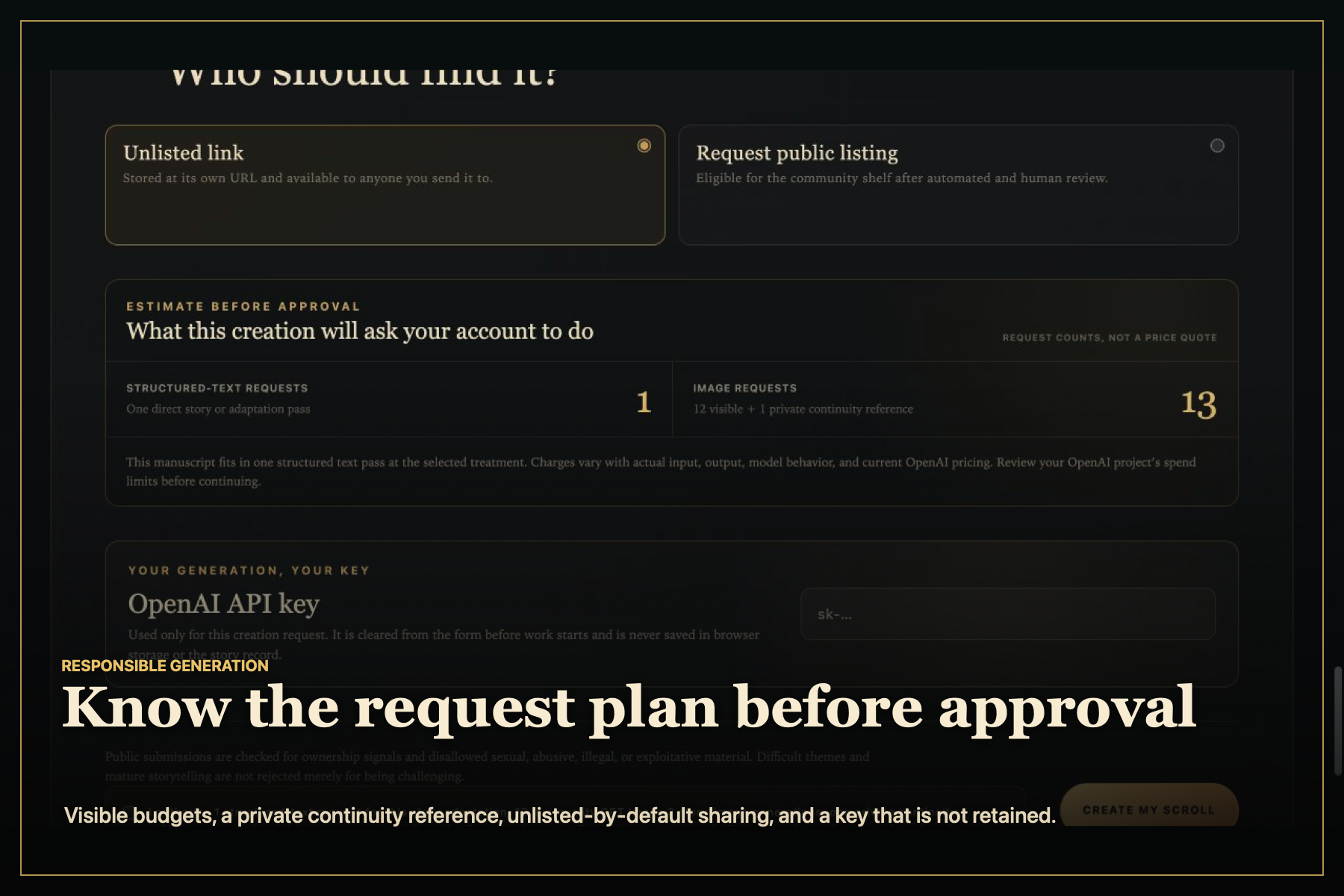
Creation begins with a rights declaration rather than a blank prompt. Public scrolls preserve authorship, source, rights, transformation, model, and safety provenance. New work is unlisted by default. Before generation, the Review step shows exact planned text/image requests, a conservative dollar range, and an optional local spend cap.
The creator's OpenAI API key is request-scoped: the service does not write it to browser storage, cookies, SQLite, the filesystem, logs, errors, or story records.
Why it matters for education
The primary audience is young and reluctant readers who may be kept at a distance from remarkable literature by older language, long-form density, or flat screen presentation. Families and educators need approachable ways into those works, while authors and other authorized creators need a transparent way to adapt them without hiding the source or the choices involved.
Story Scrolls demonstrates a direct response to that problem. In reading mode, complete works become navigable illustrated journeys with strong pacing, chapter artwork, illuminated initials, clear controls, and visible source information. In creation mode, adaptation becomes a reviewable act of story craft. Creators reason explicitly about character, goal, obstacle, consequence, change, audience, fidelity, chapter structure, and visual continuity. Age adaptation is a deliberate setting—not an invisible rewrite—and the source remains attached to the finished work.
The two public proof scrolls demonstrate both sides of the system:
- A Christmas Carol: A Clearer Road demonstrates the source-to-adaptation path.
- The Lanternmaker's Map demonstrates the original-story creation path.
The impact claim is concrete: help a reader enter a story that might otherwise feel inaccessible, without detaching the adaptation from its source or hiding the human and model decisions that shaped it.
Technical implementation
The core pipeline lives in server/platform-server.mjs and uses the OpenAI Responses API with strict JSON schemas, store: false, bounded inputs and outputs, moderation, structured validation, retry/error handling, and persistent provenance.
The quality ladder maps directly to an allowlisted GPT-5.6 model and reasoning level:
- Sketch:
gpt-5.6-luna, low reasoning - Storybook:
gpt-5.6-terra, medium reasoning - Crafted / Heirloom / Masterwork:
gpt-5.6-sol, high reasoning, with one to three editorial refinement passes
For long sources, GPT-5.6 first creates loss-resistant chronological source ledgers that preserve events, causality, character choices, motifs, unresolved threads, and ending state. It then transforms source material plus the creator's rights, treatment, audience, chapter, length, and illustration constraints into a validated story package. Optional passes refine arc, voice, causality, and consistency; stories for readers eight and under receive an additional age-suitability audit.
GPT-5.6 also produces the reviewable visual continuity bible. GPT Image 2 turns the approved bible into one private continuity reference and a bounded set of cover, chapter-hero, and inline illustrations. The resulting scroll records model tier, reasoning effort, transformation, audience, source-condensation evidence, illustration budget, continuity approval, and safety provenance.
Rights-cleared source + creator constraints
        ↓
moderation + GPT-5.6 source ledger / structured story package
        ↓
strict schema validation + refinement + age audit
        ↓
approved continuity bible + GPT Image 2 artwork
        ↓
persistent illustrated scroll + provenance + unlisted/public-review state
The production architecture separates trust levels: static curated readers are served directly, while community creation runs through an isolated loopback Node service backed by SQLite and a private media directory outside the public web root.
How Codex accelerated the build
Codex was my primary engineering collaborator across every major layer of the new Build Week system—not merely a scaffold generator for isolated features. In the principal session, Codex helped translate product direction into the React authoring workflow, responsive reader, Node/SQLite creation service, Caddy deployment, source-mirror policy, privacy and security controls, structured validation, test suite, live proof harness, and release runbooks.
The collaboration extended beyond initial implementation. Codex helped:
- Trace failures across model, image, storage, proxy, and publishing boundaries
- Diagnose provider errors without exposing user API keys or private source material
- Exercise desktop and mobile states through repeated visual QA
- Validate complete illuminated-letter alphabets and integrate them into Story Scrolls
- Test failure paths, moderation, schema handling, deployment wiring, and proof routes
- Freeze and document a reproducible judging build
Primary Codex session: 019f665a-8407-7f02-a82a-fed05e0eac93
I retained the defining product and engineering decisions: permission before prompting; provenance that travels with public work; unlisted-by-default publishing; predictable generation budgets; no retained user key; explicit quality and cost tradeoffs; creator approval before visual generation; and a complete reading experience instead of a thin prompt box.
Codex accelerated implementation, debugging, testing, visual verification, and release hardening. GPT-5.6 supplied the source reasoning, structured story generation, editorial refinement, age adaptation, and continuity planning used by the final product.
Illuminated Letters: a complete visual-language system
Story Scrolls draws on Illuminated Letters, a companion visual-language system created during the Build Week effort: 233 complete A–Z plus 0–9 illustrated alphabets, totaling 8,388 letters and numerals across nine creative directions.
This is not a gallery of 8,388 unrelated generated images. Each alphabet is a complete, selectable visual world. A creator can choose one family, such as Fleur-de-lis Garden Gold, so chapter openings throughout a book share the same motifs, materials, ornament, and visual grammar instead of appearing as disconnected one-off assets.
ChatGPT with GPT-5.6 and GPT Image 2 supported generation and iteration of the asset families. Codex supported completeness validation and integration into the Story Scrolls selection and rendering workflow. The companion archive is supporting infrastructure rather than the central product claim; its role is to give the rights-aware adaptation and reading system a level of visual coherence that a handful of generic generated initials could not provide.
Outside OpenAI's GPT-5.6, Codex, GPT Image 2, and ChatGPT, the only production tools used during the build were Google Veo 3 and Adobe Photoshop. ElevenLabs was used only for the final demo narration.
Challenges we ran into
Long-form transformation is not solved by asking a model to “rewrite this book.” The system has to preserve narrative cause and effect across many sections, honor fidelity and reading-level choices, produce an intentional chapter structure, and remain readable as one continuous experience. The hierarchical source ledger and schema-validated multi-pass workflow are the response to that problem.
Visual continuity created a second challenge. Independent illustrations can each be attractive while still feeling unrelated. A creator-approved private continuity reference, fixed artwork budget, and constrained visual direction help the result feel like one world.
Generation also has real cost and failure modes. Story Scrolls therefore exposes its quality ladder, conservative planning range, request counts, and local cap before approval. Public publishing required separating ownership, rights, safety, and content notes instead of treating all difficult material as the same problem.
Accomplishments that I'm proud of
- Shipped a frozen, public, no-login product with a six-stage creator studio, complete reader, two GPT-5.6 proof scrolls, and a testable repository
- Built a rights-first workflow covering authorized sources, original creation, visible transformation choices, human review, and persistent provenance
- Implemented a long-source GPT-5.6 pipeline with chronological ledgers, strict schemas, refinement, age review, and visual continuity planning
- Made generation operationally responsible through request-scoped keys, moderation, bounded artwork, cost forecasting, spend caps, private media, durable jobs, and explicit publication states
- Created and integrated 233 complete illuminated alphabets totaling 8,388 illustrated letters and numerals
- Documented the Build Week delta with dated commits, a frozen source tag, tests, architecture documentation, and the principal Codex session
What we learned
The most important work in an AI-native creative product is often not the first model call. It is the constraints, provenance, review, budgeting, failure handling, and human choices around that call.
AI can make literature more approachable without making it disposable. It becomes more valuable when readers can understand where a story came from, how it was transformed, who is responsible for it, and what choices shaped the result.
What's next
- Educator-curated collections and classroom reading paths
- Side-by-side reading-level comparisons
- Teacher guides tied to character, goal, obstacle, consequence, and change
- Read-aloud and accessibility controls
- Multilingual editions and collaborative annotations
- Expanded moderation, community curation, and classroom evaluation
Built With
- caddy
- chatgpt
- codex
- css
- drizzle-orm
- gpt-5-6
- gpt-image-2
- javascript
- next-js
- node.js
- openai-api
- react
- sqlite
- typescript
- vinext
- vite


Log in or sign up for Devpost to join the conversation.