About the Project
🎬 Inspiration
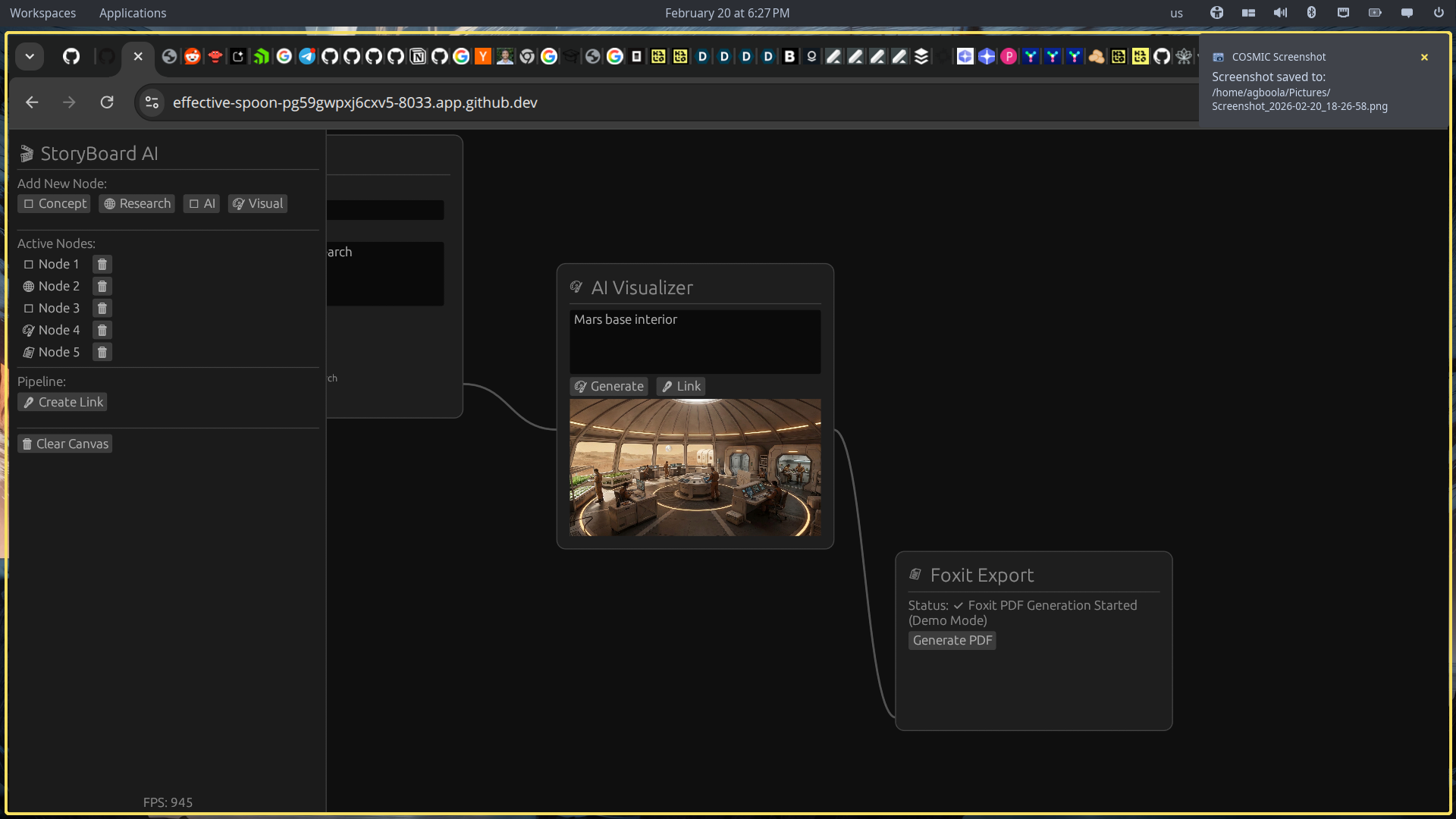
Creative professionals are currently forced to juggle dozens of disconnected AI tools. You research trends in one tab, write scripts in another, generate images in a third, and manually compile PDFs in a fourth. It is linear, messy, and invisible. We were inspired by tools like Natto.dev and Figma to create StoryBoard AI: a spatial, infinite canvas where AI workflows aren't just executed—they are visualized and chained together.
🚀 What it does
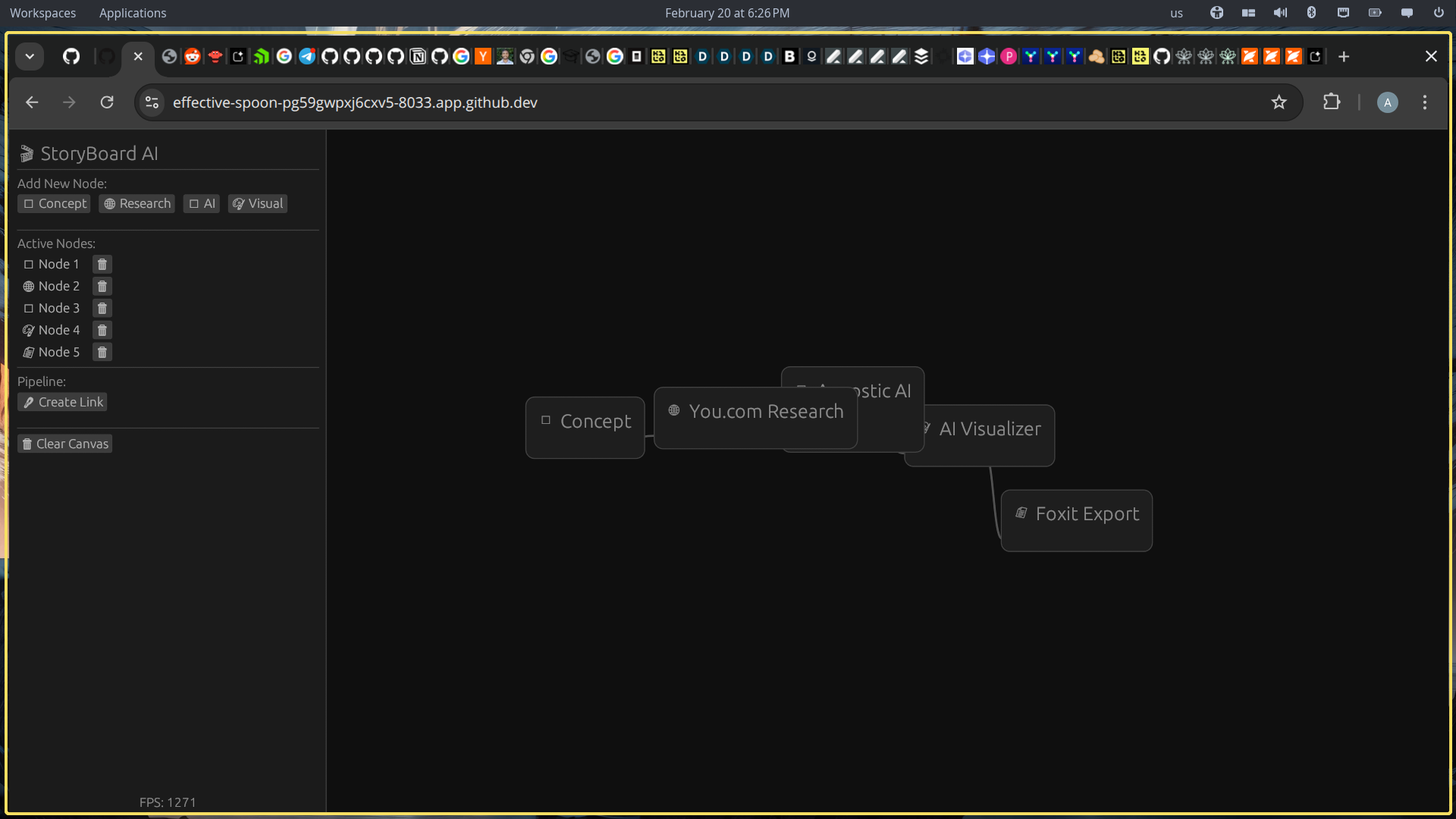
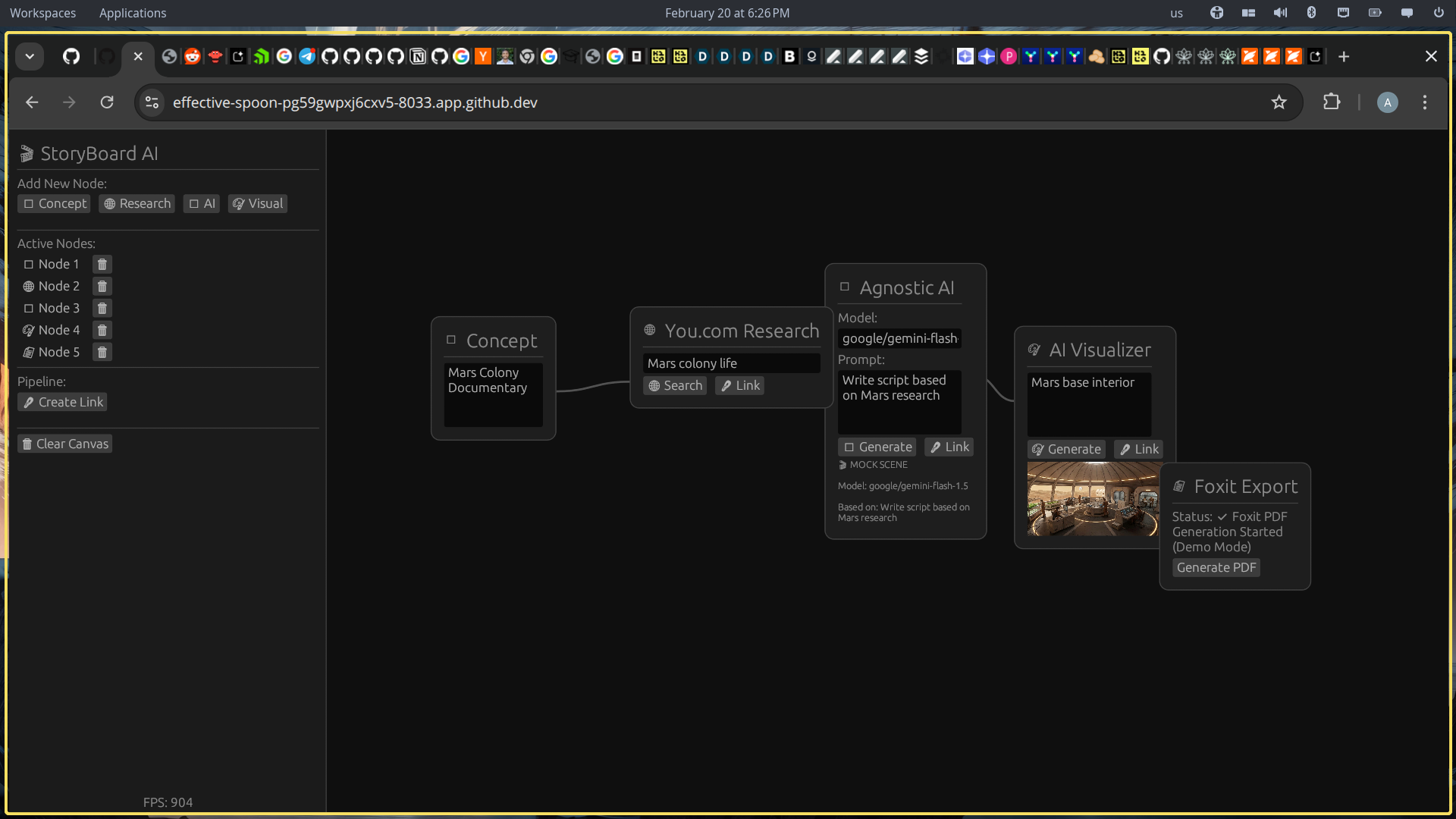
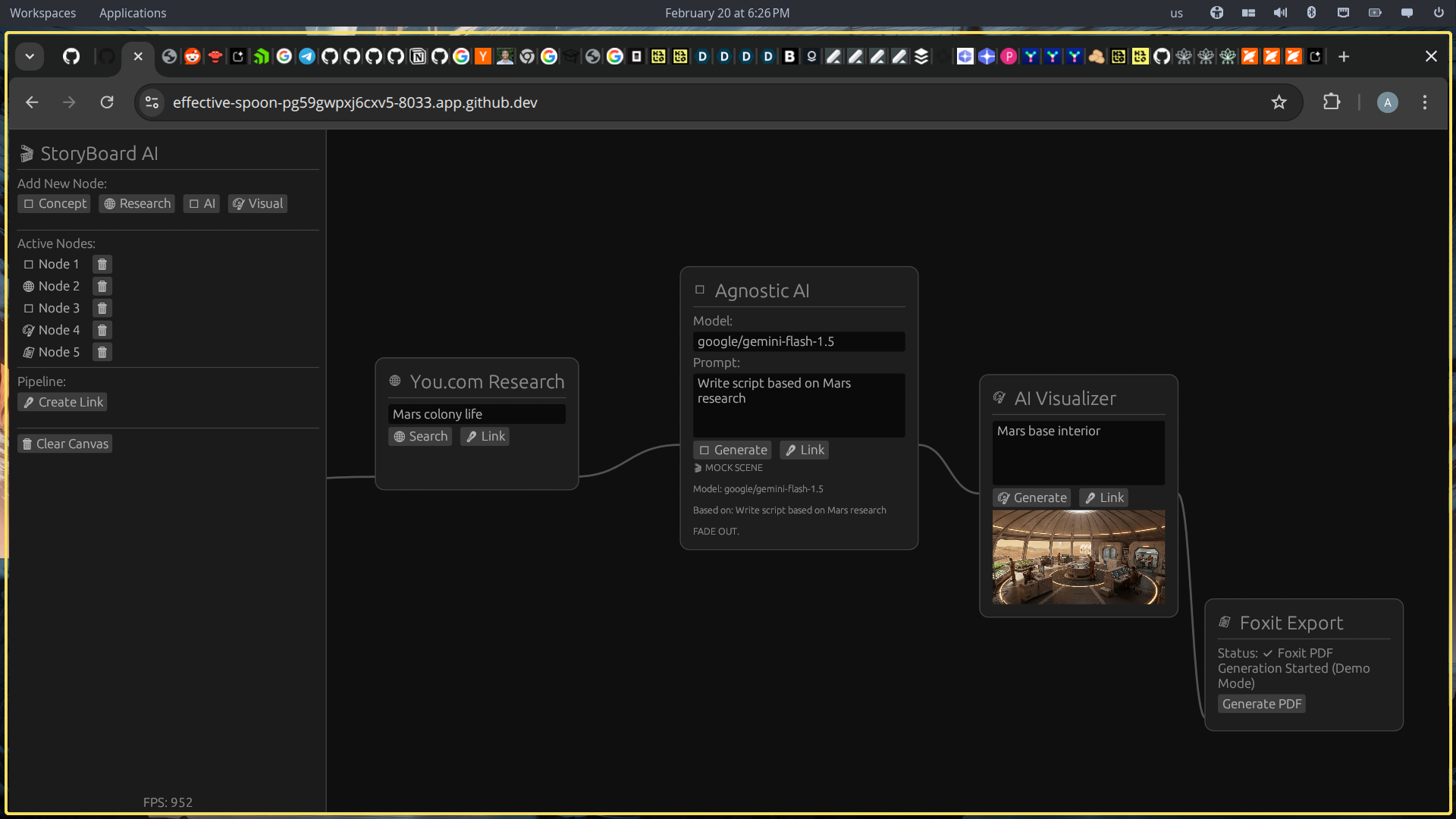
StoryBoard AI is a visual IDE for creative workflows. Users drag and drop "Smart Nodes" to build an automated production pipeline:
- Research Node: Powered by You.com, it grounds the project in real-world live web data.
- Director Node: Uses OpenRouter/Gemini to transform research into dramatic scripts or scene descriptions.
- Visual Node: Generates instant "Mood Board" visualizations to anchor the creative vision.
- Foxit Export Node: Automates the "boring" part of production by compiling the entire canvas into a professional PDF call-sheet using Foxit's Document Generation API.
🛠 How we built it
The core engine is built in Rust and compiled to WebAssembly for blazing-fast performance (reaching 600+ FPS). We used the egui framework for a premium, immediate-mode UI.
- Backend: A Node.js proxy handles secure API orchestration and bypasses CORS.
- Infrastructure: Developed and shipped using Kilo Code. We leveraged Kilo’s cloud environment to iterate rapidly and ensure the final artifact was production-ready.
🧠 Challenges we faced
Handling asynchronous API calls in a WASM environment was a major hurdle. We implemented a custom mpsc channel architecture to allow the UI to remain responsive while multiple AI "Smart Nodes" were fetching data in the background. We also pivoted our visual engine mid-hackathon to ensure a better user experience without credit-gated blockers.
🏅 Accomplishments that we're proud of
We built a high-performance node graph engine from scratch in Rust that feels as smooth as a native desktop app but runs in the browser. Successfully chaining live search data into a generative AI scriptwriter and then into a document automation pipeline felt like magic.
📖 What we learned
We learned the power of "Provider-Agnostic" AI design—building a tool that doesn't just use one model, but orchestrates the best model for each specific task (You.com for facts, Gemini for creativity).
Built With
- Rust
- WebAssembly (WASM)
- egui
- Kilo.ai (Cloud Development & Deployment)
- You.com API (Live Web Research)
- Foxit API (Document Generation)
- OpenRouter (Agnostic AI Orchestration)
- Node.js (API Proxy)
- Docker


Log in or sign up for Devpost to join the conversation.