
Inspiration
The inspiration behind StorySpinner came from our diverse backgrounds: two Indians, one Ivorian, and one Nigerian. We saw the opportunity to create a platform that would bridge the gap in content accessibility, especially for people from various cultural backgrounds. As people who’ve experienced different educational systems and cultural environments, we wanted to build something that could break barriers in content consumption and make it more engaging for a global audience.
We realized that many content creators and educators struggle with reaching diverse users effectively. Some may face language barriers, while others might find traditional written content unengaging. StorySpinner was born from the idea of creating a platform that allows writers to upload content and transform it into multiple interactive formats, making it accessible and engaging for everyone.
What we learnt
Working on StorySpinner was an incredible learning journey for all of us. We had the chance to dive deep into Microsoft’s powerful cloud services, especially Azure. Learning how to integrate Azure’s Immersive Reader API to transform text into an accessible read-aloud experience was particularly eye-opening.
We also learned a lot about cloud infrastructure, especially using Azure Blob Storage for content management and Azure Functions for serverless processing. The project allowed us to understand how to scale applications with Azure’s flexibility and power, ensuring that StorySpinner could handle a global audience.
Another key takeaway was how to make content more interactive, engaging, and adaptable to various user needs—whether it’s for young students, professionals on the go, or those with visual impairments.
How we built it
Frontend Development:
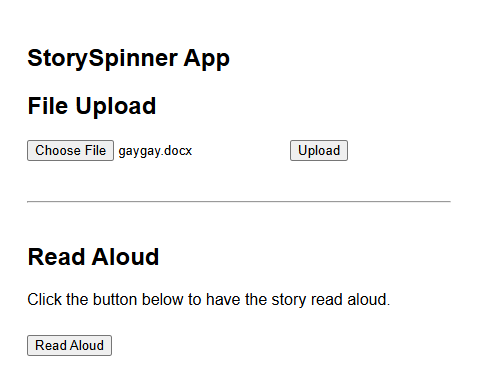
The user interface was built using HTML, CSS, and JavaScript. We made sure the design was simple and intuitive, keeping in mind a diverse user base.
Power Apps helped us develop an interactive web app interface where users can select how they want to experience the content—whether through story cards, audio narration, or an interactive version.
Backend and Cloud Integration:
We used Azure App Service to host the platform, providing a scalable environment for users to interact with our web app.
For content storage and retrieval, Azure Blob Storage played a vital role in managing uploaded files and generated outputs, like story cards and audio files.
Azure Functions provided the serverless capability to process the uploaded content. For example, when a user uploads a story, Azure Functions automatically triggers to convert the text into audio or generate story cards.
The Azure Cognitive Services Text-to-Speech API was integrated to provide the read-aloud feature in natural, human-like voices.
Testing and Refinement:
We used Visual Studio Code to write and test the code locally before deploying it to the Azure platform.
After launching the MVP, we tested it with a small group of users, gathering feedback on features like the interactivity of the story cards and the quality of the read-aloud feature.
Challenges we ran into
Language and Cultural Differences:
With our team being from different countries—India, Ivory Coast, and Nigeria—we faced the challenge of ensuring that the platform was universally accessible and relevant. We had to be careful with content localization, ensuring that the platform worked for people from different linguistic and cultural backgrounds.
Technical Integration:
Integrating various Azure services—like Azure Functions, Blob Storage, and Immersive Reader—was not always seamless. We had to ensure that all these services worked smoothly together, which sometimes required debugging and refining the APIs.
Scalability Concerns:
As we expected a growing user base, we had to plan for scaling the platform on Azure App Service. This meant understanding how to optimize our storage and processing workflows to handle more content without compromising performance.
Accomplishments that we're proud of
Making Content Interactive and Accessible: We’re proud of creating a platform that offers multiple interactive experiences—like read-aloud and dynamic story cards—while ensuring that it’s accessible to a global audience.
Leveraging Cutting-Edge Technology: Using Microsoft Azure’s powerful suite of tools helped us streamline the development process. Azure Functions, Blob Storage, and the Cognitive Services API enabled us to build a scalable, reliable, and accessible platform without needing extensive server management.
Successful Cross-Cultural Collaboration: Despite coming from different countries and backgrounds, we successfully collaborated to build something that serves a global audience. The diversity within our team brought different perspectives, which we believe contributed to making StorySpinner a well-rounded and inclusive platform.
What we used
HTML, CSS, JavaScript, Power Apps, Azure App Service, Azure Blob Storage, Azure Functions, Azure Cognitive Services (Text-to-Speech), Azure Immersive Reader, Visual Studio Code and nexleap compiler.
What's next for Story spinner
Expanding Features: As we refine the platform, we plan to expand the features offered to users. This could include additional language support, more interactive experiences, and enhanced customization options for content creators.
Improving User Experience: We want to gather more user feedback to further improve the interface and overall user experience. This could involve making the process of uploading and transforming content even more streamlined and intuitive.
Scaling for a Global Audience: We plan to focus on scaling the platform to handle even larger user bases. This includes further optimizing performance, adding serverless processing capabilities, and expanding the global reach of StorySpinner in platforms like App store, Samsung store, MI Store and Play store.
Partnerships with Content Creators and Educators: Moving forward, we aim to partner with educators, content creators, and businesses to tailor StorySpinner to specific needs and grow its user base. We believe the platform could revolutionize how educational content, stories, and articles are consumed worldwide.
Built With
- azure-app-service
- azure-blob-storage
- azure-cognitive-services-(text-to-speech)
- azure-functions
- azure-immersive-reader
- css
- html
- javascript
- power-apps
- studio
- visual


Log in or sign up for Devpost to join the conversation.