-
-

Story Forge
-
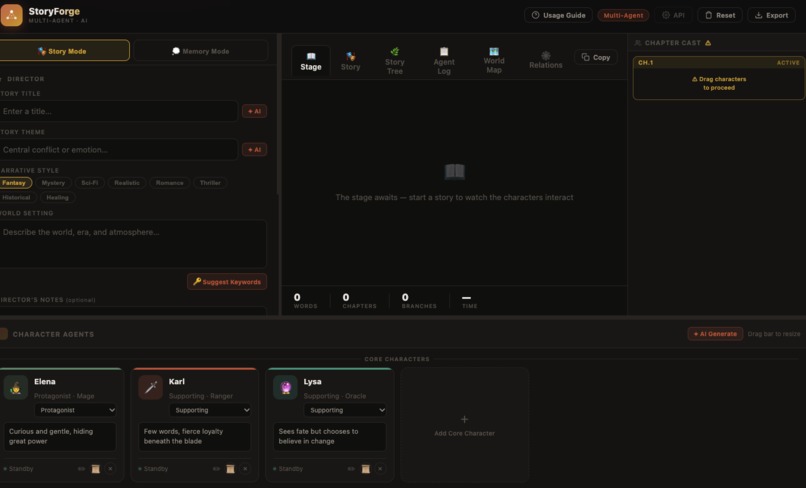
Main Page
-
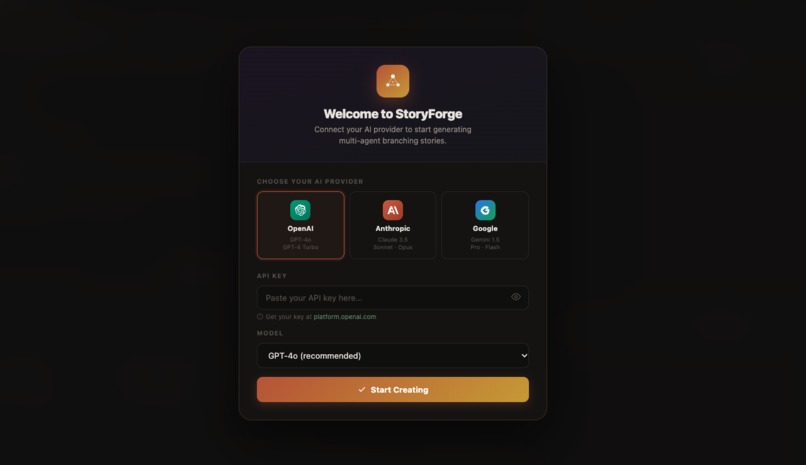
Choose Api
-
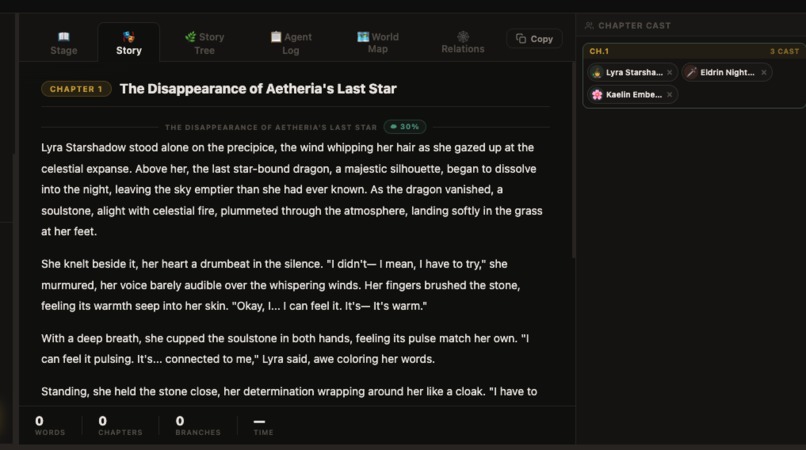
Story

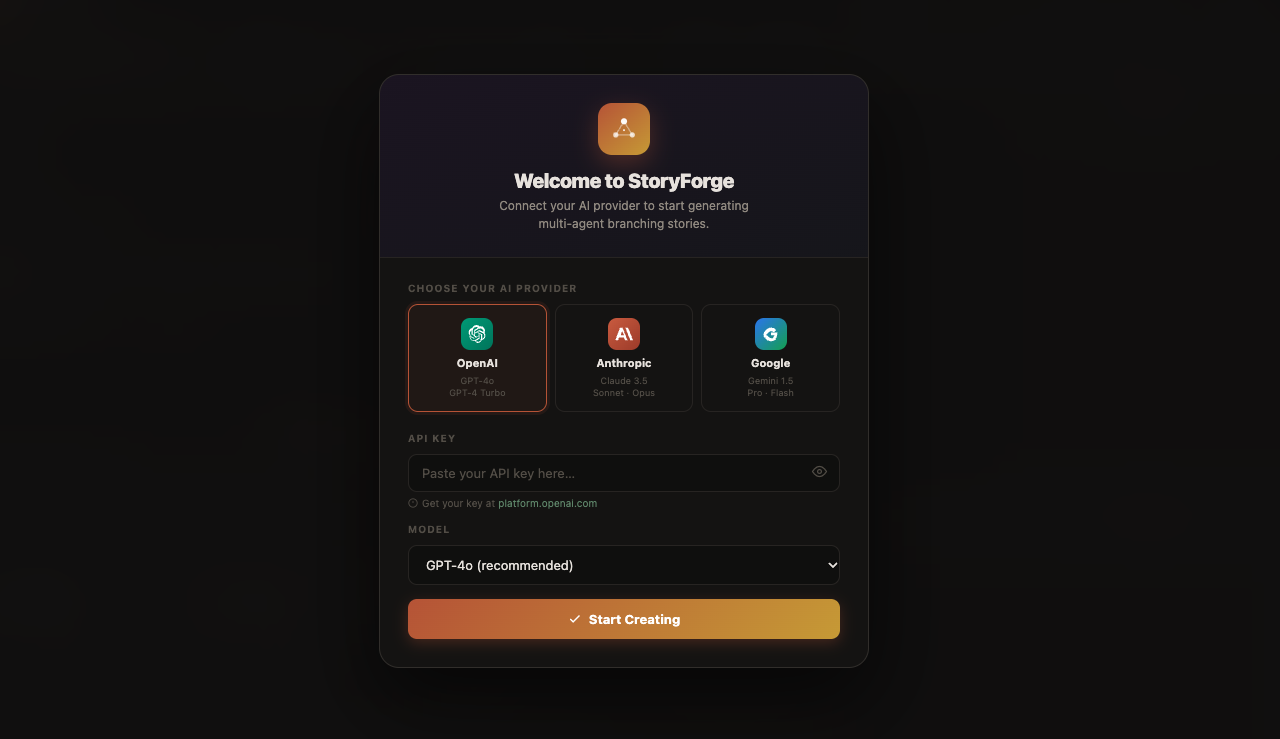
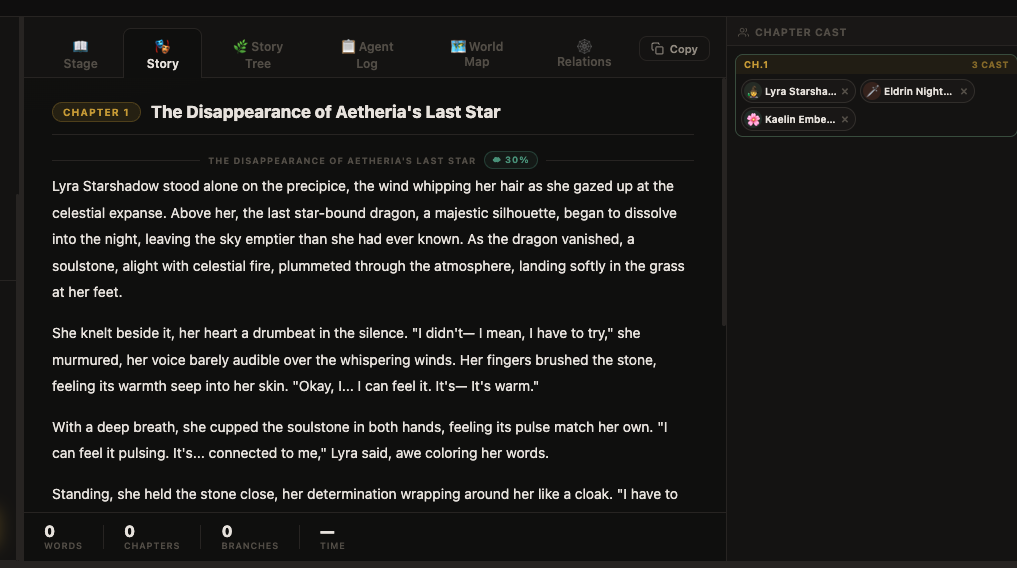
Project Story: StoryForge
What Inspired Us
StoryForge has real psychological healing value: putting difficult or joyful experiences into narrative form can reduce rumination, improve emotional regulation, and support re-authoring of pivotal moments. It is also a tool that helps ordinary people express — to give people who are not professional writers a deeper expression window, a stage where they can steer a story and say what matters to them.
We drew on expressive writing therapy and narrative re-authoring: the practice of turning experience into story has strong evidence behind it. We wanted to scale that kind of process — not as a chatbot, but as a collaborative stage where multiple AI “agents” act out a story with the user, so that the act of choosing what happens next becomes part of the work. We were inspired by the idea that your life story is not fixed: you can revisit pivotal moments and imagine different outcomes. StoryForge makes that literal: every chapter ends at a branching point. You pick one of three AI-generated continuations, or use the Story Tree to go back and try another path. The product is not just text; it’s the experience of steering a story that reflects your themes, your world, and your choices.
We added Memory Mode as a gentle variant where the “world” is built from a short childhood questionnaire (hometown, best friend, favourite place, a joyful moment, etc.). The same pipeline then runs on that nostalgic setup — same Director, same Character Agents, same branching — so users can relive and re-author positive memories when they choose.
Above all, we care about helping ordinary people express big ideas in vivid, story form. Not everyone is a novelist — but everyone can steer a world. StoryForge can be used to tell stories that show what abstract issues feel like: protecting the environment or safeguarding endangered species; a tale set in a dying forest to make climate and environmental loss tangible; a narrative from the ground level of conflict to convey the horror and futility of war; or an allegorical world (like Animal Farm) that reflects social issues — power, inequality, injustice — through characters and choices. The tool doesn’t preach; it gives users a stage, characters, and branches so they can discover and express their own stance. We think of it as a citizen’s storytelling kit: a deeper expression window for the issues that matter.
What We Learned
Multi-agent systems are coordination problems. The Director must “see” private states (fears, secrets, desires) that the characters don’t share with each other, then issue per-scene instructions. We learned to separate Phase 1 (Director gathers private states) from Phase 2 (Director directs the scene). Without that, characters felt generic.
Tension as a dial. We introduced a tension score per scene (e.g. τ ∈ [0, 1]). When τ crosses a threshold (e.g. τ ≥ 0.72), the chapter stops and becomes a decision point. This gave us controllable pacing: calm stretches vs. moments where the user must choose.
Streaming changes UX. Sending chapter prose via Server-Sent Events (SSE) — scene by scene, with optional “Director says…” and “Character acts…” events — made the app feel alive. We learned to design the backend for incremental events and the frontend for append-only updates.
One pipeline, two entry points. Memory Mode taught us to avoid a second backend. We kept a single story pipeline; Memory Mode only changes the input (questionnaire → theme + world + AI-generated characters) and then calls the same
startStory()and chapter-generation flow. Less code, same behaviour.
How We Built It
Architecture
- Frontend: Single-page app in one
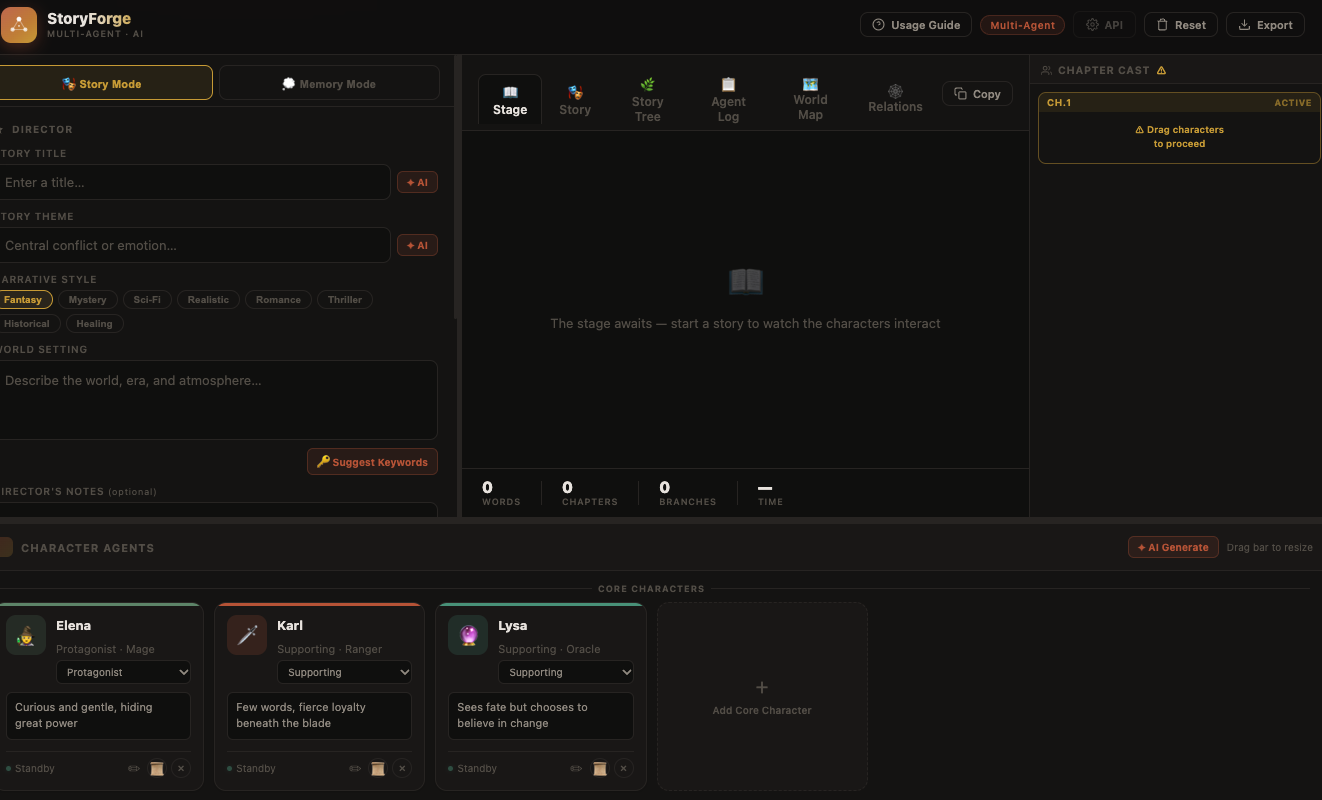
index.html(vanilla HTML/CSS/JS, no build). The UI has a resizable left panel (Director + options), a right panel (Stage / Story / Story Tree / Log / Map / Relations), and a draggable bottom bar (Character Agents + Chapter Cast). - Backend: Flask (Python 3.10+), one main blueprint for story APIs. Sessions and story state live in memory (with optional persistence). LLM calls go through a thin
llm_clientthat supports OpenAI and compatible APIs (Anthropic, Google) viabase_urland API key.
Pipeline (simplified)
- World Builder — From theme + tags + optional custom setting, one LLM call produces a structured world (name, description, key locations, atmosphere, therapeutic elements).
- Chapter Planner — From world + character list, another call produces a high-level plan for N chapters (we often start with N = 1 and extend).
- Director Agent (two phases)
- Gather private states: For each character, the Director (via LLM) asks for inner state — desires, fears, secrets — “visible only to the Director.”
- Direct scene: Given those states + the chapter plan, the Director outputs per-character stage directions (emotional beat, physical action, subtext).
- Gather private states: For each character, the Director (via LLM) asks for inner state — desires, fears, secrets — “visible only to the Director.”
- Character Agent — For each character, an LLM generates public action, private thought, dialogue, emotional state, and optional growth moment, conditioned on the Director’s instructions.
- Story Composer — One more LLM call turns (scene plan + Director directions + all character outputs) into literary prose (we target a “Denis Johnson / Ishiguro” style: concrete events, distinct voices, minimal filler).
- Safety Filter — Optional pass (e.g. IBM watsonx or keyword fallback) to downrank harmful or anti-therapeutic content.
- Decision point — If scene tension ≥ threshold, we stop the chapter, call generate-choices (3 options), and let the user choose. The next chapter can use extend_story to plan from the chosen branch.
Memory Mode
- User fills a short form (hometown, best friend, favourite place, happy memory, favourite activity, family member, season).
- We build
themeandcustom_settingfrom these answers, call/api/story/suggestwithtype: initial_charactersto get 3 characters, auto-fill the cast for Chapter 1, then call the same start and generate-chapter APIs. No separate “memory” backend.
Data flow
- Story, chapters, scenes, and character actions are in-memory Python objects; the frontend keeps session id, tree state, and cast per chapter. Export is a simple walk over chapters → scenes → prose to produce a
.txtfile.
Challenges We Faced
Keeping character voices distinct. Early on, every character sounded like the same “helpful narrator.” We had to tighten prompts (e.g. “Warrior: short, direct sentences. Prophet: poetic, concrete images”) and feed the Director’s per-character instructions explicitly into each Character Agent call.
Tension without breaking the mood. If the threshold was too low, we got a decision point every few paragraphs; too high, and the story felt flat. We tuned the threshold (and the way we compute τ from scene content) so that decision points land at natural “what happens next?” moments.
Streaming and UI state. The frontend had to handle out-of-order or partial SSE events (e.g. “progress” before “scene”), and avoid clearing the story panel when a new chunk arrived. We standardized event types (
progress,log,scene,chapter,decision_point) and made the UI append-only for story content.Scope creep on Memory Mode. We first built a separate “memory” backend (custom world + scene + choices). It duplicated logic and didn’t use the Director/Character pipeline. We scrapped it and made Memory Mode a different input UI that feeds the same pipeline — much simpler and consistent.
Cross-browser and CORS. Serving the frontend as a static file and the backend on another port meant we had to enable CORS and ensure the frontend used the correct
API_BASE(e.g.http://localhost:5001). We also had to test SSE in different browsers to avoid buffering issues.
Summary
StoryForge is a citizen expression tool with psychological healing value: it helps ordinary people say what matters through story — a deeper expression window — while expressive writing and narrative re-authoring support emotional regulation and re-authoring of memories. It uses multi-agent AI (Director + Character Agents + World Builder + Story Composer) to generate branching, user-steered stories. Themes can be protecting the environment, safeguarding endangered species, or (like Animal Farm) reflecting social issues — power, inequality, injustice — so users can express their stance through allegory and choice; Memory Mode adds a gentle path for reliving and re-authoring positive memories. A tension-based decision mechanism controls when the user must choose among three continuations; a Story Tree lets them backtrack and re-author. We built it to show that citizen storytelling can be collaborative, interactive, and grounded in one clear pipeline — and that “tell your story” can be a real window for deeper expression.
Built With
- ai
- chatgpt
- claude
- css
- flask
- gemini
- html
- ibm
- ibm-cloud
- ibm-watson
- javascript
- python


Log in or sign up for Devpost to join the conversation.