Inspiration
Writers hate AI writing. And they're right to.
AI prose is predictable. It reaches for the same metaphors, the same arc, the same emotional beats — run it ten times and you get ten versions of the same story wearing different costumes. Characters are hollow. They don't remember, don't scheme, don't have inner lives. There's no surprise, no betrayal, no moment where a character does something you didn't see coming. It reads like it was written by a machine. Because it was.
Now here's the secret from great writers like Stephen King for great stories. He puts characters in a situation — conflicting needs, not enough to go around, a ticking clock — and watches what happens. The story surprises him. That's also how the best board games work. Diplomacy, Coup, Cosmic Encounter — nobody writes the story. The designer builds the conditions. The story erupts from the collision.
So I stopped asking AI to write stories. I started asking it to grow them.
What it does
Everyworld doesn't generate fiction. It generates the conditions for fiction to emerge.
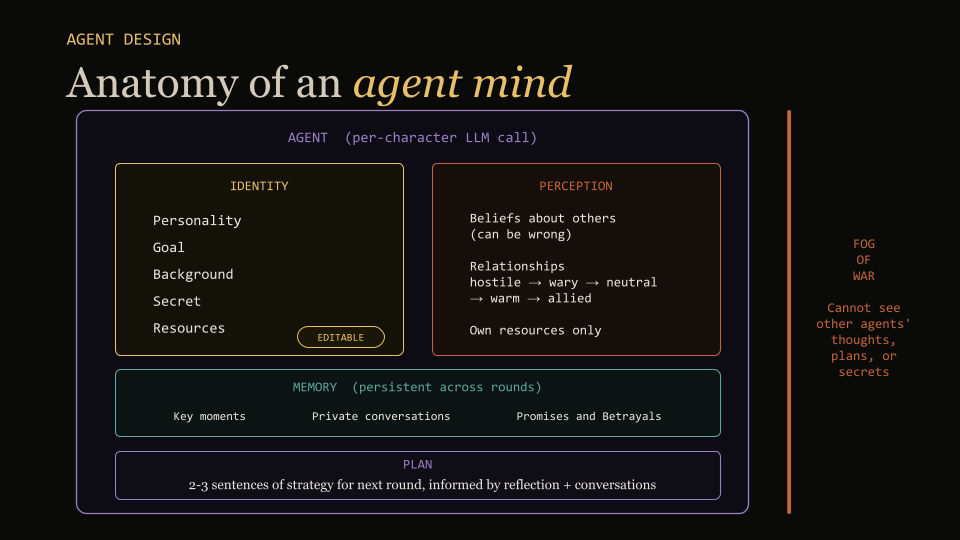
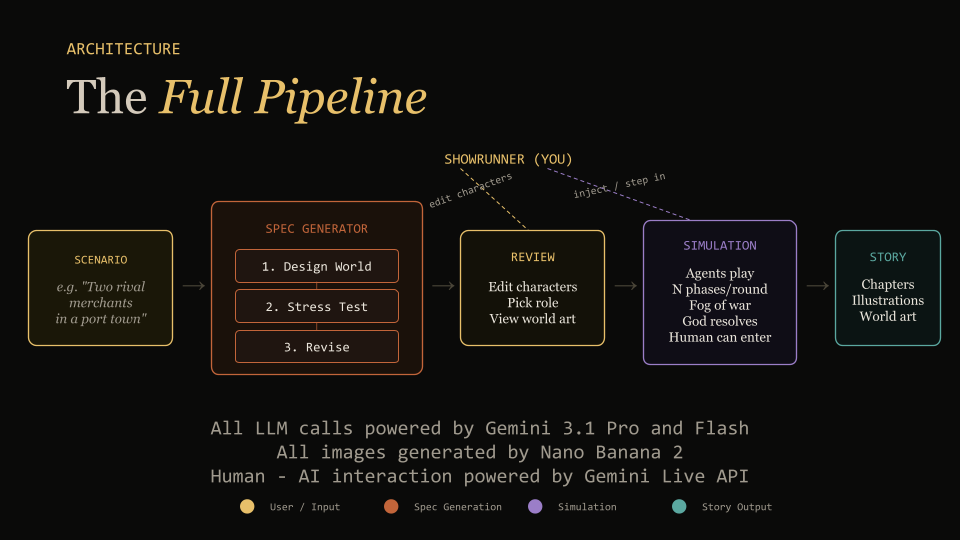
You describe a scenario. AI designs a complete game world — characters with secrets, scarce resources, actions with real consequences. Then AI agents inhabit those characters and play the game under fog of war. They think, remember, lie, betray, form alliances, break them. Every move follows from the personality and situation you gave them.
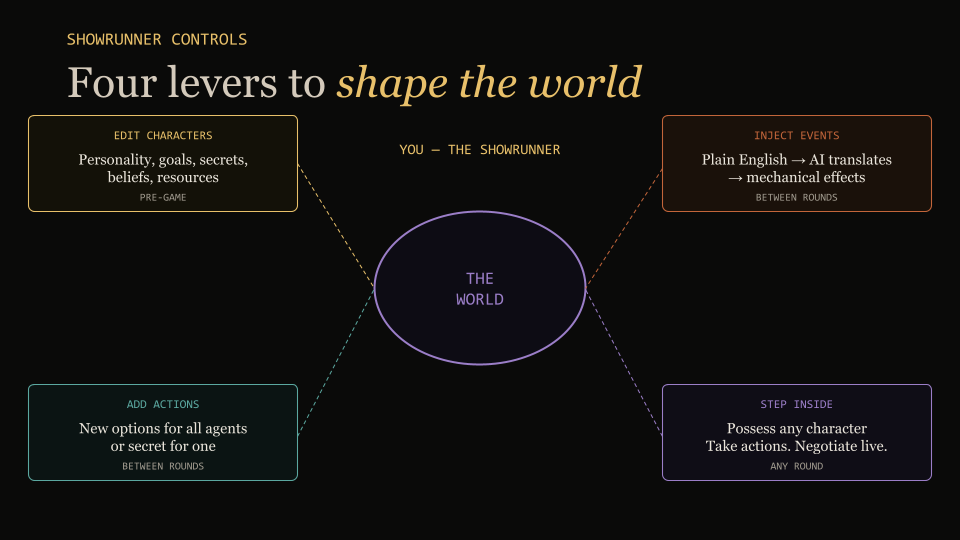
You're the showrunner, not the author. Sculpt characters before the simulation. Inject crises mid-game ("a fire destroys the warehouse"). Grant secret abilities to one agent. Or step into any character yourself — speak to the others live through Nova Sonic and Polly voice — then walk away. Every promise and lie you left behind stays in the world.
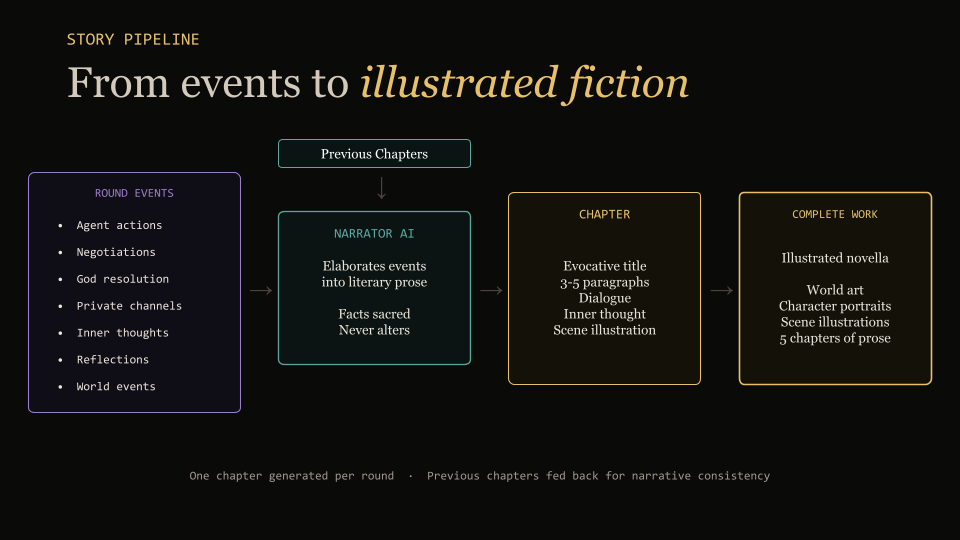
After each round, a narrator turns the raw events into a chapter of prose. But the narrator has one job: make the truth beautiful. It can never invent, only elaborate. The facts come from the simulation. The fiction comes from reality.
AI generates world art, character portraits, and scene illustrations. Every playthrough: a unique illustrated novella that no human wrote and no AI could have predicted.
For writers, this means: run a scenario ten times, harvest ten structurally different stories with plot twists, betrayals, and character arcs no single author would have invented. Use them as first drafts, steal the best moments, or just study how drama emerges from constraint. The agents' inner thoughts, private conversations, and shifting loyalties are a goldmine of psychological detail that flat AI prose can never produce.
How we built it
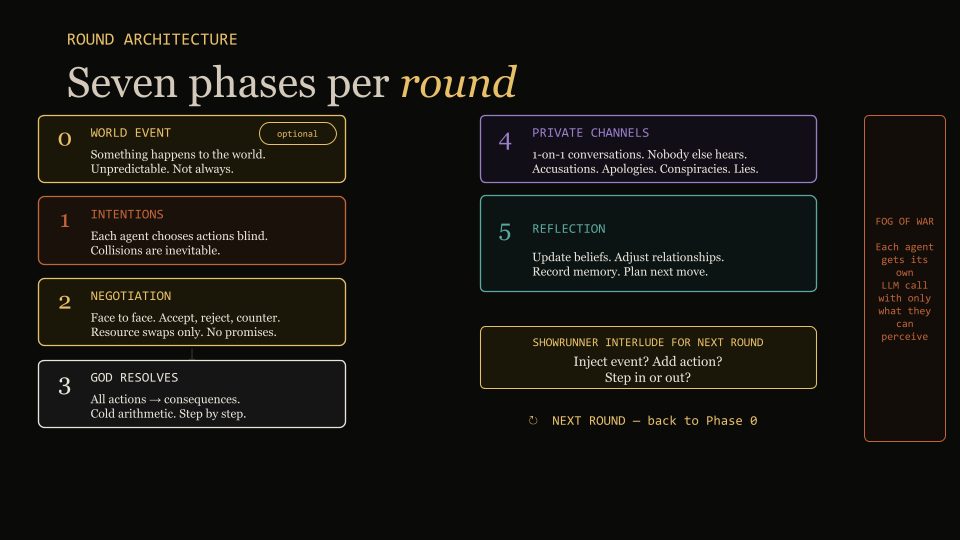
Amazon Nova 2 Lite drives the entire LLM pipeline — three-stage world design (create → stress-test → revise), agent decision-making, negotiation, private conversations, reflection, god-agent resolution, narration, and showrunner translators. A three-agent round fires 15+ calls. Nova Sonic powers real-time voice when the player possesses a character. Nano Banana 2 generates all art assets. Deployed on AWS.
Single-file React app. Four-strategy JSON parser handles truncated or malformed LLM output gracefully.
Challenges we ran into
AI agents don't want conflict. LLMs are trained to be helpful and agreeable — which makes them terrible at drama. Early playtests were polite negotiations ending in mutual cooperation. We had to engineer conflict at the system level: tight economies where not everyone can win, negotiation scoped to pure resource swaps with no promises, and grounding rules that force genuine structural tension into every world design.
Arithmetic in natural language. The god agent resolves every action's consequences with resource math. LLMs drift. We enforced rigid BEFORE → delta → AFTER bookkeeping, step by step, so errors can't compound silently.
Accomplishments that we're proud of
Stories that surprise their creator. Same scenario, dozens of runs, genuinely different outcomes. Not cosmetically different — structurally different. Different alliances, different betrayals, different winners. Change one character's secret and the whole trajectory shifts. This is what AI writing tools promise and never deliver.
Fog of war as architecture. Each agent gets its own isolated LLM call with only what their character knows. Deception works because the deceived agent truly lacks the information. This is why the stories feel real — nobody's omniscient.
The showrunner loop. You don't write the story. You tend the world. Seed it, grow it, prune it, shape it. The stories grow themselves.
What we learned
The reason AI writing feels dead is that it skips the part that makes stories alive: emergence. Real drama comes from characters with conflicting goals colliding under constraint — not from an LLM predicting the next likely sentence. When you give AI the right structure (a game, not a prompt), the output stops feeling generated and starts feeling grown.
Personality is flavor. Scarcity is structure. And voice changes everything — negotiating out loud with a character who might be lying to you is worlds apart from reading AI prose on a screen.
What's next for Everyworld
Thousands of agents, thousands of actions, running simultaneously. Infinitely long sessions that evolve over weeks. A community library where writers fork scenarios, change one variable, and harvest what grows differently.
The goal isn't better AI writing. It's making AI writing obsolete — by growing stories that no one, human or machine, could have written alone.
Built With
- amazon-web-services
- nova
- react
- vite

Log in or sign up for Devpost to join the conversation.