-
-
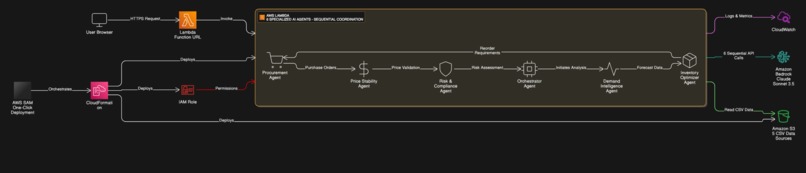
Stormguard AWS Architecture Diagram
Inspiration
Natural disasters expose fragile supply chains. I wanted to build a system that could reason, act, and recover autonomously - protecting human welfare while helping enterprises build resilient supply chains.
Hurricane Milton (October 2024) caused $50+ billion in losses and revealed the problem: manual supply chain coordination fails during disasters. Retailers face 300-400% demand surges while teams scramble with spreadsheets for 48 hours - but hurricanes hit in 48 hours. The US faces 15-20 major disasters annually. What if autonomous AI agents could coordinate decisions in 30 seconds instead of 48 hours?
What it does
StormGuard: six specialized AI agents powered by Amazon Bedrock Claude Sonnet 3.5 coordinate autonomously during supply chain disruptions.
- Demand Intelligence - Forecasts demand surges from disaster severity and sales patterns
- Inventory Optimizer - Identifies stores at stockout risk, calculates reorder quantities
- Procurement - Creates emergency purchase orders with vendor selection
- Price Stability - Prevents disaster price increases (0% markup enforcement)
- Risk & Compliance - Validates decisions, triggers human governance for high-stakes orders
- Orchestrator - Coordinates agents and synthesizes executive summaries
Key Innovation: Specialized agents with separation of duties. Procurement creates orders, Risk validates them, humans approve high-stakes decisions. Real supply chain teams at machine speed.
Results: 90%+ service levels (vs 60% baseline), <30 second decisions (vs 48+ hours), 0% price gouging, complete audit trail.
How I built it
AWS Stack:
- Amazon Bedrock - Claude Sonnet 3.5 with specialized system prompts per agent
- AWS Lambda - Python 3.12 serverless orchestration
- Amazon S3 - CSV data for transparency
- AWS SAM - One-click Infrastructure as Code deployment
Data Pipeline: Enterprise-scale synthetic retail data: 50 stores, 200 products, 1.4M transactions, 600K inventory items, Hurricane Milton event patterns (165% demand surge).
Agent Coordination: Sequential transformation pipeline - each agent builds on previous output:
S3 Data → Demand Forecast → Inventory Requirements →
Procurement → Price Validation → Risk Assessment → Executive Summary
Prompt Engineering: Specialized Bedrock prompts per domain - Demand Agent does forecasting, cannot make procurement decisions. Procurement Agent creates orders, cannot approve them. Strict boundaries prevent overreach.
Human-in-the-Loop: Risk Agent detects high-stakes decisions (>$500K spend, policy violations), pauses system, presents crisis justification for executive approval/rejection.
Challenges I ran into
Sequential Agent Dependencies - Six agents passing structured data cleanly required precise output formatting. Each agent's response must match the next agent's input requirements exactly.
Bedrock Prompt Engineering - Preventing agents from overstepping expertise was hard. Demand Agent tried making procurement decisions. Solved with strict system prompts defining boundaries.
Lambda Timeout Management - Six sequential Bedrock calls pushed Lambda's 5-minute limit. Optimized by reducing token counts and streamlining data transformation.
Accomplishments that I'm proud of
- True Multi-Agent Architecture - Sequential coordination where each agent builds on specialized output, not just parallel API calls
- Ethical AI Built-In - Anti-gouging agent enforces 0% price increases during crises
- Production-Ready - One-click deployment, enterprise-scale data, human governance included
- Measurable Impact - 90%+ service levels, <30s decisions, full cost/revenue tracking
- Complete Transparency - Every decision shows source data, reasoning, output for auditability
What I learned
- Multi-Agent > Single LLM - Specialized agents with verification are more reliable than one model doing everything
- Bedrock Claude Sonnet 3.5 Excellence - Exceptional at structured reasoning, data transformation, consistent JSON outputs
- AWS Serverless Speed - Lambda + Bedrock + S3 let me focus on agent logic, not infrastructure
What's next for StormGuard
3 months: Expand disaster types (wildfires, port closures, winter storms), real-time weather API integration, multi-region supply chains, Focus on Inspiring internal Enterprise-scale builds with AWS
6-12 months: Retail chain pilot, ERP integration (SAP/Oracle), mobile executive approvals, historical simulation training
12+ months: Multi-modal agents with Bedrock vision (satellite imagery), predictive inventory pre-positioning, cross-retailer collaboration platform, open-source agentic supply chain framework
Built With
- amazon-bedrock-(claude-sonnet-3.5)
- amazon-web-services
- aws-cloudformation
- aws-lambda
- aws-sam
- boto3
- python-3.12

Log in or sign up for Devpost to join the conversation.