-
-
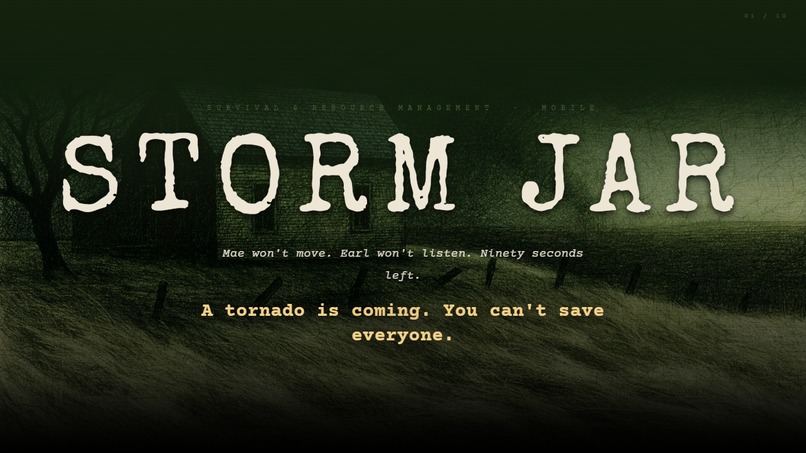
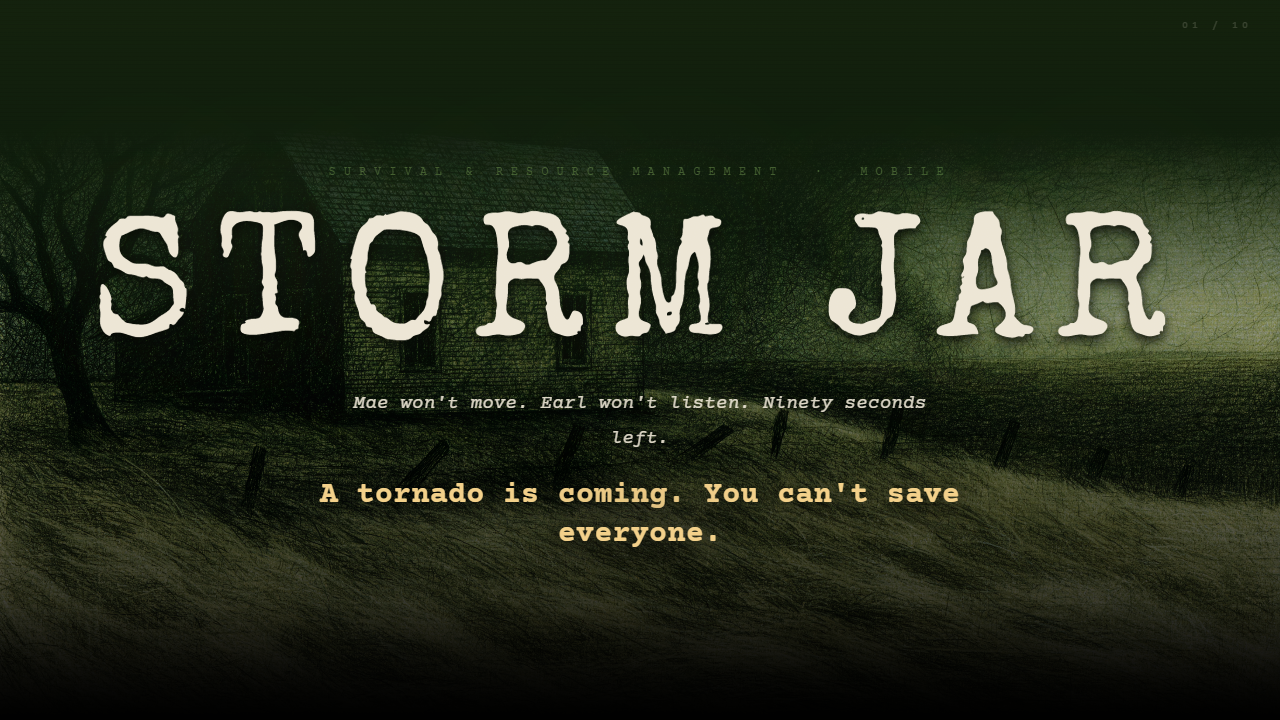
Survival and resource management for mobile. A tornado is coming, and you can't save everyone.
-
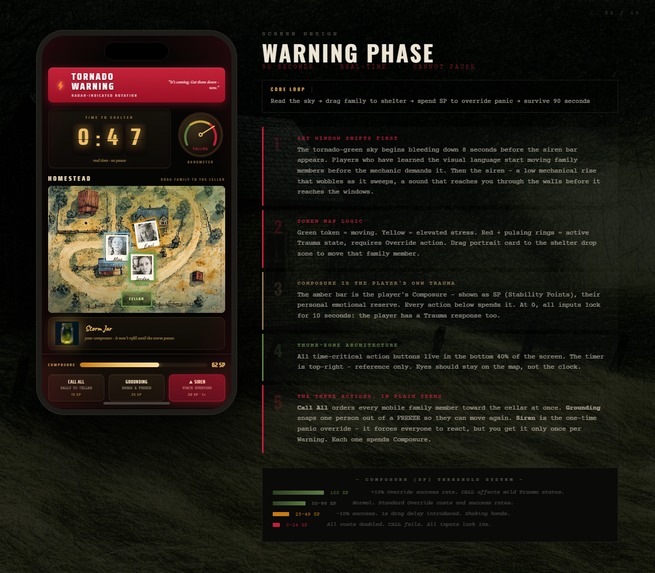
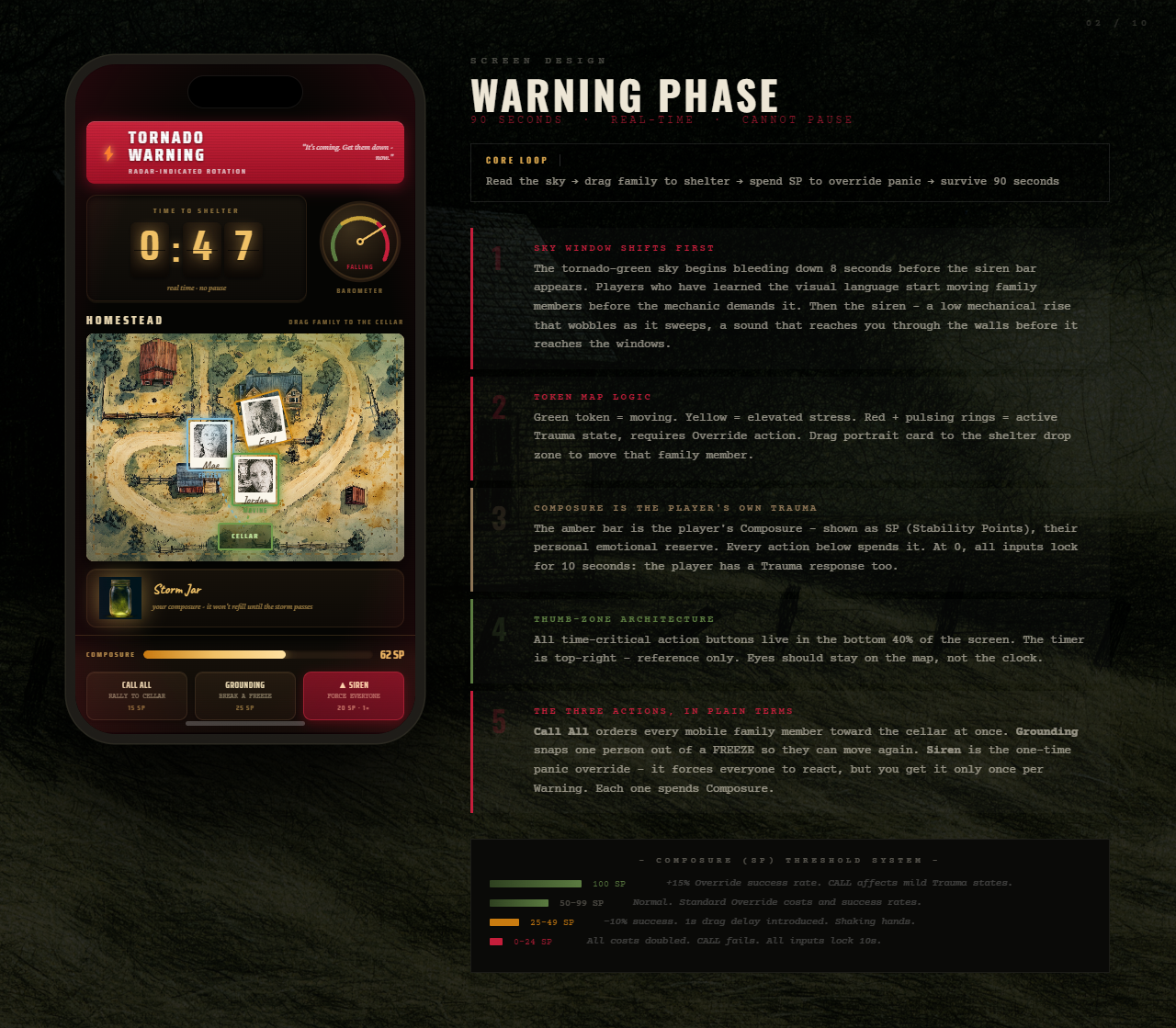
90 seconds, no pause. Three people who freeze, deny, and panic - and you can't save everyone.
-
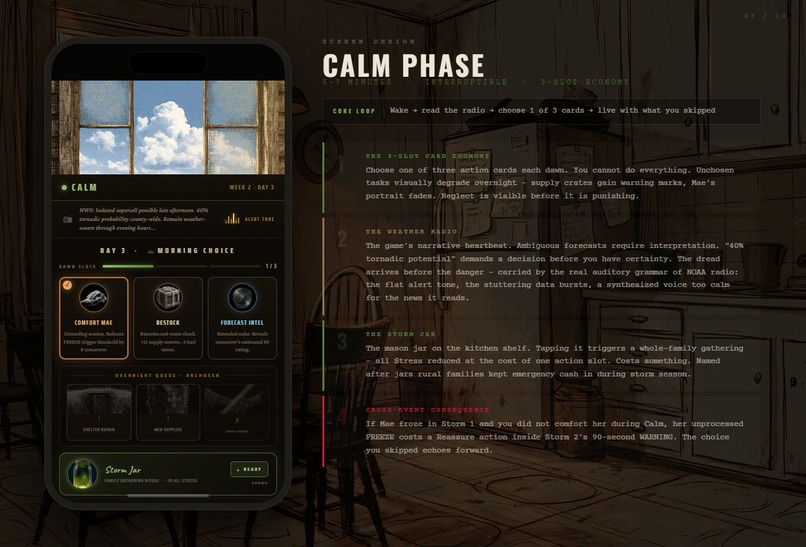
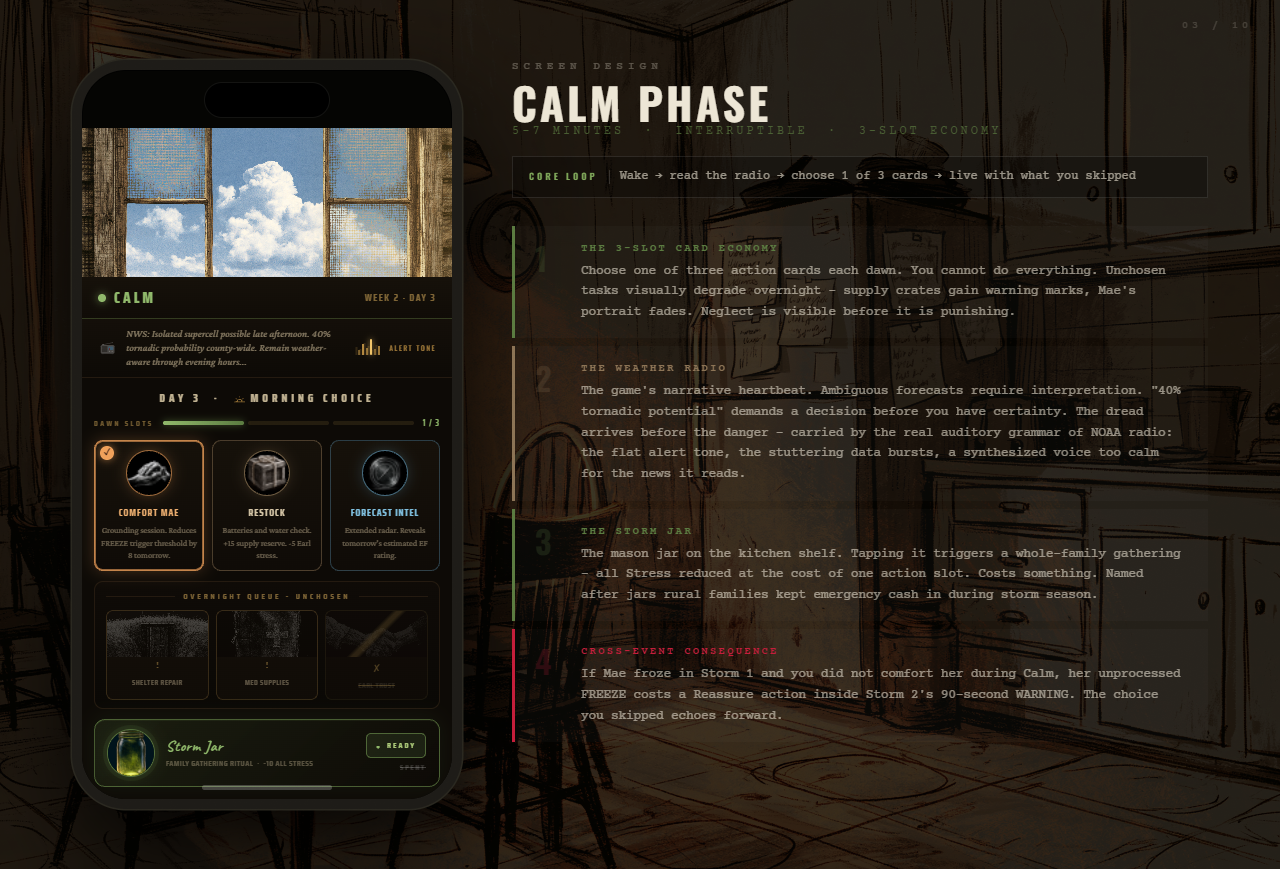
Between storms you rebuild the people, not just the shelter. Three daily actions, one ritual - neglect degrades in plain sight.
-
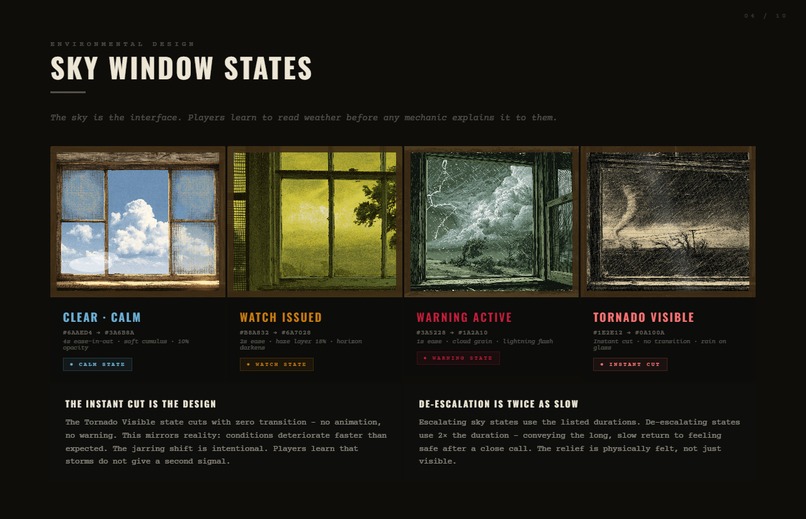
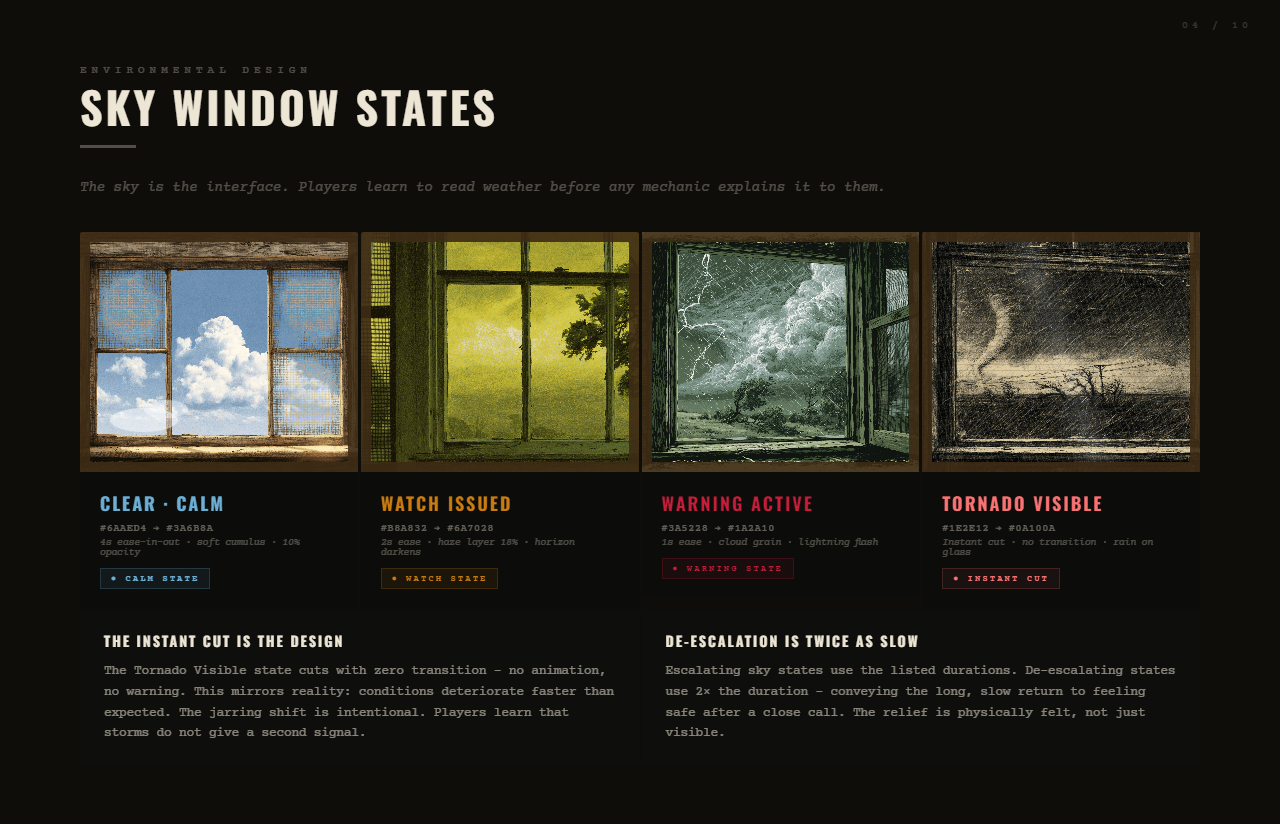
The sky is the interface. Four states - Calm, Watch, Warning, Tornado - that you learn by surviving, not from a tutorial.
-
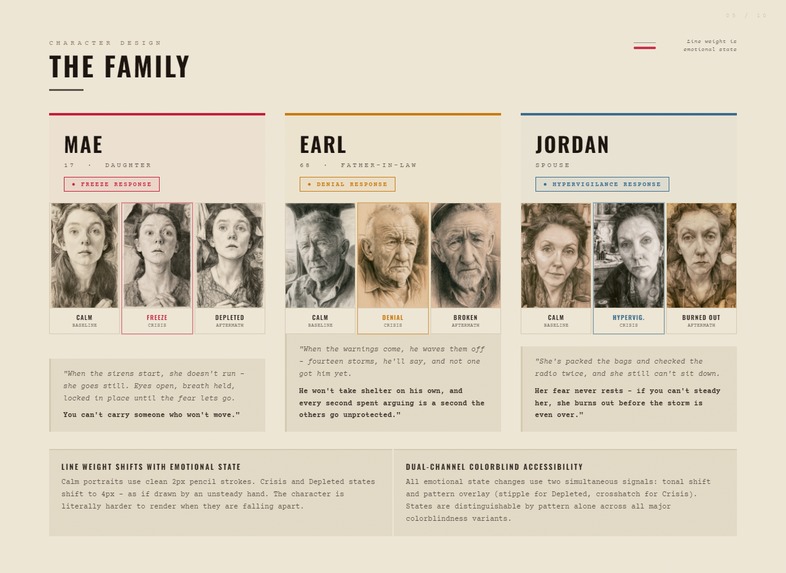
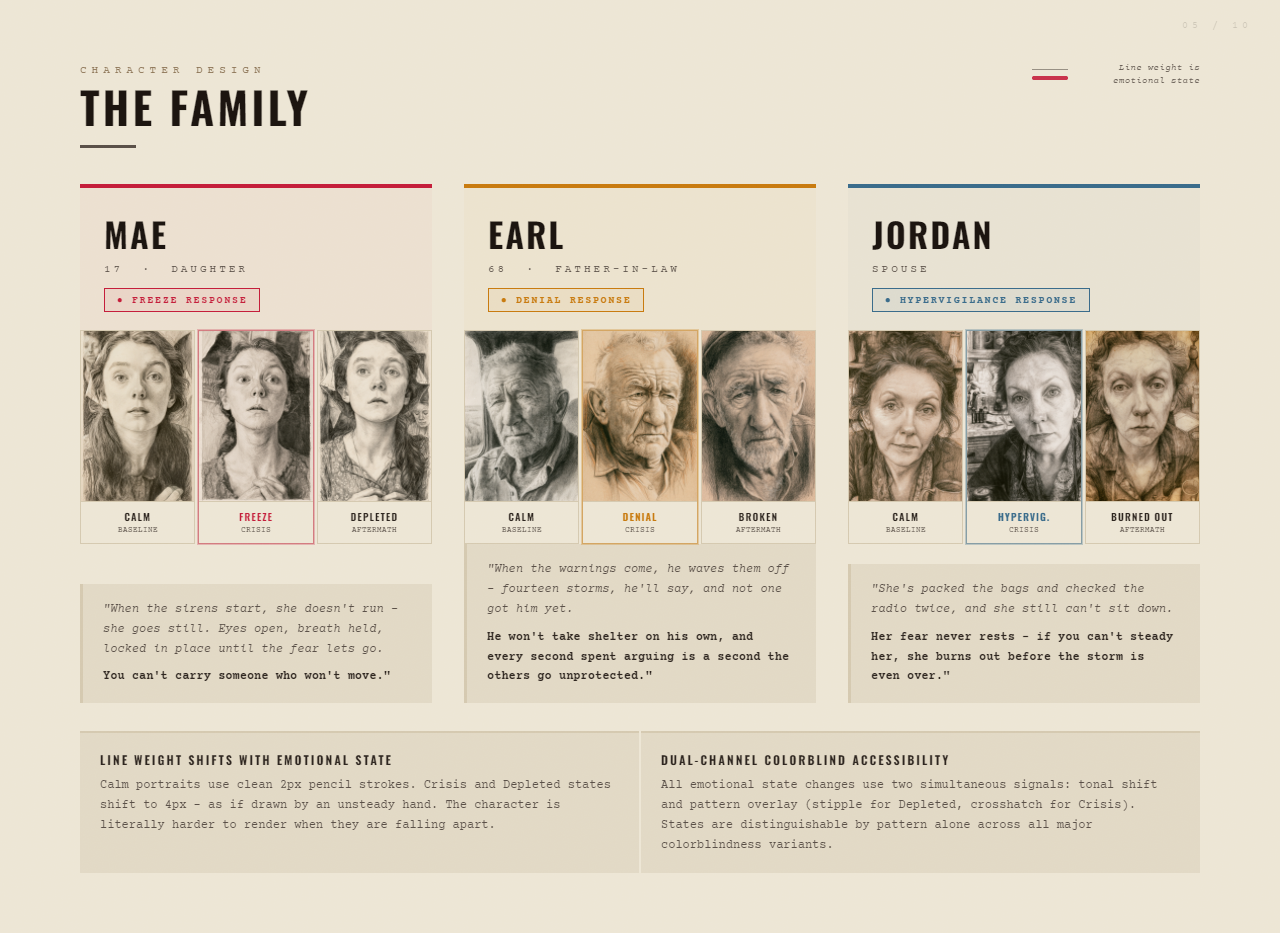
Mae freezes. Earl denies. Jordan over-prepares. Each trauma response compounds - and no single strategy beats all three.
Inspiration
I'm from tornado country. In a place like that, you don't just watch storms - you read them. You learn what a green sky means, what the silence before a siren sounds like, and how your body reacts the second the weather radio switches from advisory to warning.
But this game didn't come from living through a storm. It came from being a thousand miles away when one hit.
Years ago I was flying to Puerto Rico for work. The minute I landed, I got a call - multiple tornadoes had touched down in my hometown. I started calling everyone I knew. No one picked up. Call after call, nothing. I was standing in an airport on an island, completely helpless, while the people I loved were somewhere in the middle of it. I have never felt anything like that.
Then my neighbor finally answered. He was sitting at the top of the stairs in my storm cellar - the one spot in the whole house where he could catch a single bar of service. He told me everyone was safe. I still remember exactly how that relief felt - like the floor coming back under my feet.
That whole experience - the helplessness, the waiting, the flood of relief when someone finally picks up - is what Storm Jar is built on. Except this time you're not a thousand miles away. You're the one in the cellar, with ninety seconds and a family that doesn't all react the same way.
What it does
Storm Jar is a survival and resource management game set in rural Tornado Alley. You guide three family members through an eight-week storm season - not by outrunning disasters, but by managing the psychological weight each close call leaves behind.
The core tension lives in the WARNING phase: a 90-second window where you allocate deliberate actions across shelter, supplies, and family intervention while a storm closes in. Each family member carries a distinct trauma profile that compounds across events:
Mae (17, your daughter) - FREEZE response: becomes non-functional under extreme stress without active intervention Earl (68, your father-in-law) - DENIAL: refuses to acknowledge danger, bleeds Stability Points through inaction Jordan (your spouse) - HYPERVIGILANCE: over-prepares until exhaustion makes them unreliable when it actually matters
The Stability Point system tracks psychological health across the full season:
$$ SP_{remaining} = SP_{base} - \sum_{i=1}^{n} C_i + \sum_{j=1}^{m} R_j $$
The math is simple. The decisions that drive it are not. Storm Jar is designed to be learnable before it is challenging - Week 1 introduces one family member and one room before any trauma responses activate, so players master the physical interface before the emotional stakes arrive.
The game launches with a free first storm cycle - players feel the 90-second WARNING pressure firsthand before paying anything. Full 8-week season unlocks at $3.99.
How I built it
Solo design submission. The process was document-first: the GDD was written before any visual work, so every aesthetic decision has a mechanical justification behind it.
The folk-art pencil sketch visual language was defined in a full visual spec, then used as structured Midjourney prompt architecture rather than freeform generation. Each character has four emotional state portrait variants and dual-channel colorblind-safe indicators designed to communicate "this person needs intervention" within three seconds - no stat display required.
AI tools used: Claude Opus 4.8 (design iteration and document critique), Midjourney (visual concept package).
Challenges I ran into
Making trauma feel earned, not exploitative. The hardest design problem was finding the line between respectful simulation and entertainment. Every Trauma state needed a visible recovery path. The game's emotional contract is explicit from the first screen: you are not fighting your family. You are fighting for them.
The 90-second window. Too short and WARNING feels punishing. Too long and the tension evaporates. Even choosing 90 seconds as the design target required thinking about how many deliberate decisions a player can make under genuine stress before choice paralysis sets in. This is a cognitive load problem as much as a pacing one.
No dominant strategy. With three family members carrying incompatible trauma responses, the most common failure mode in early design was a single correct rotation that neutralized all three. Designing the family dynamics so managing Earl's DENIAL always costs something you needed for Mae's FREEZE required multiple passes at the action economy.
Accomplishments that I am proud of
The visual concept package. 10 illustrated slides in a consistent folk-art pencil sketch style, a UI grammar that communicates psychological states without a single stat display. For a solo developer using an AI-assisted art pipeline, getting a coherent visual identity across 10 slides that looks like a shipped game took real iteration.
The false alarm mechanic. After a WATCH escalates to WARNING that dissipates before striking, family Anxiety drops - but Trust in the forecast system erodes. Future WATCH phases trigger faster burnout and earlier DENIAL responses. That emergent behavior wasn't designed in. It fell out of the Trauma Marker compounding rules naturally.
What I learned
Weather anxiety is already a game 32 million Americans play involuntarily every spring... They don't need a tutorial. They need a game designed for them. And for everyone who's only ever watched the footage and wondered why anyone stays - this is the way in.
What's next for Storm Jar
Unity build begins at Phase 1 gate (Weeks 1-4): prove the 90-second WARNING creates tension, not tedium. The gate criterion is five playtesters each reporting at least one genuine hard choice during WARNING. If they don't, the decision space gets redesigned before any content is added.
Soft launch target: United States. Full release Q1 2027.


Log in or sign up for Devpost to join the conversation.