Inspiration
The internet was designed to connect us, but profanity has transformed it into a battleground of words and hate. This toxicity is measurable. A study of 51 million tweets revealed that one in 13 tweets contains curse words (Wang et al., "Cursing in English on Twitter," 2014). A 2023 Anti-Defamation League report found that 33% of American adults and 51% of teenagers experienced online harassment in the past year (ADL, "Online Hate and Harassment: The American Experience 2023"). Research has shown that profanity and hateful speech can be a detriment to mental health, especially for individuals who have pre-existing conditions such as depression (Geschke et al., 2019; Waldron, 2012). Children and teenagers are also at risk for negative mental health effects from social media or other websites with offensive content (Wachs et al., 2022). This creates the need for a product which can automatically filter out potentially harmful words or phrases online. Online aggression creates environments of mistrust and polarization, with studies showing particular impact on younger users who are still developing emotional resilience. Traditional profanity filters, which simply block specific words, fail to address the complexity of online hate speech, especially when it comes to contextual harassment, racial slurs, and subtle forms of discrimination. This inspired us to develop Stop the Hate, a Chrome extension that combines pattern recognition with AI analysis to detect not just explicit profanity, but also contextual hate speech across multiple languages. Hopefully we can give users control over their online experience, making daily online activities more inclusive and respectful.
What it does
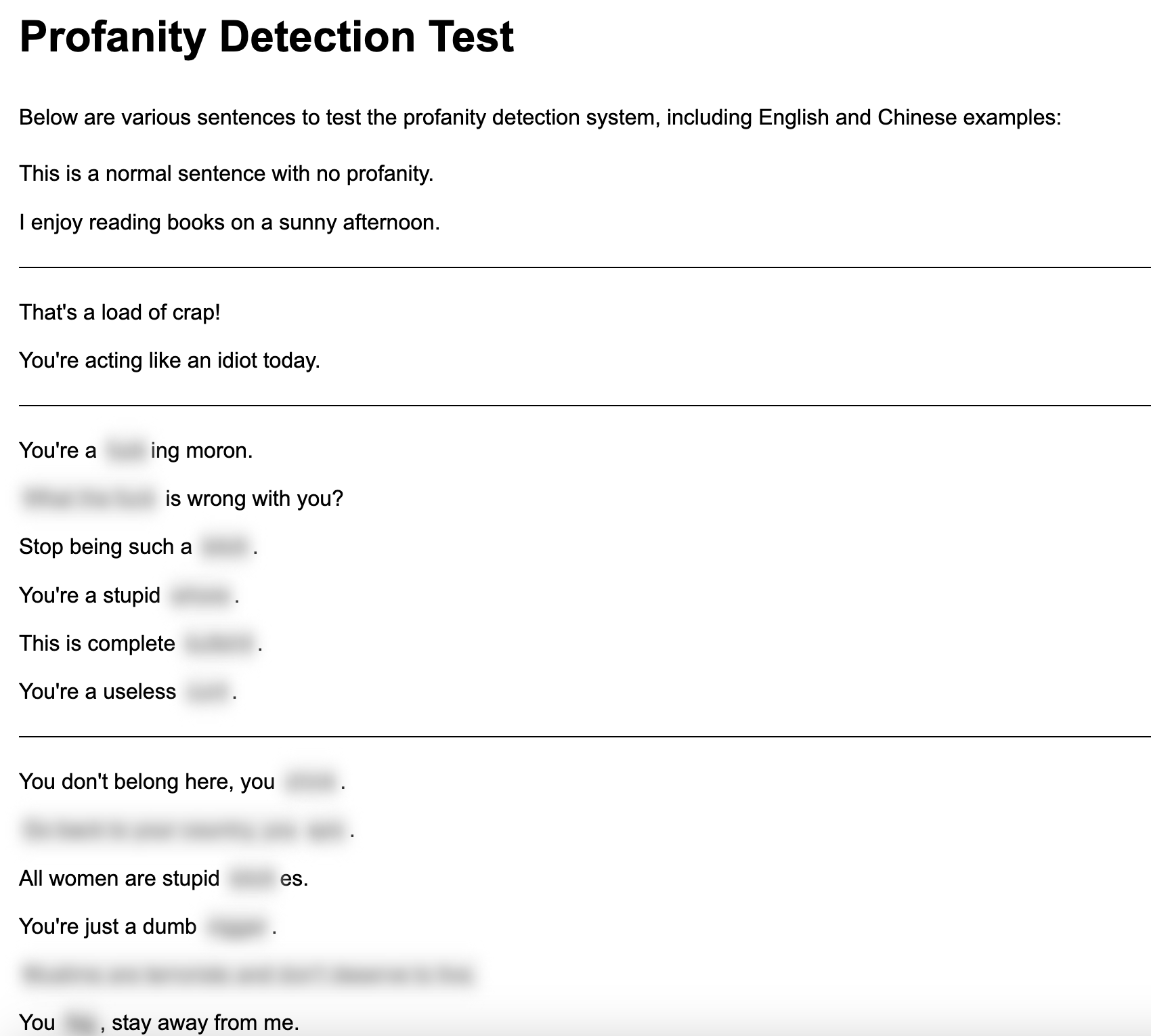
Stop-the-hate is a Chrome extension that provides real-time hate speech and profanity detection across multiple languages. Using a hybrid approach combining pattern matching and AI analysis, it creates safer online spaces by identifying and filtering harmful content.
Key Features
- Supports multiple languages (English, Chinese, Spanish, Arabic, Hindi)
- Detects profanity and hate speech across different scripts.
- Handles text obfuscation and variations.
- Real-time pattern matching for immediate filtering
- AI-powered contextual analysis using Google's Gemini API
- Detects: explicit profanity, slurs, discrimination (racial, ethnic, religious, gender, sexual orientation), complex hate speech, threats.
- Hover-to-reveal for user control
- In-page toggle button for easy enabling/disabling
- Instant local filtering for common patterns
- Intelligent caching for repeated content
- Minimal impact on page load times
- Efficient handling of dynamic content
How we built it
Planning and Architecture
We began by identifying the core requirements of our hate speech detection system:
- Real-time content analysis
- Multilingual support
- Minimal performance impact
- Privacy-conscious design
- Scalable architecture
This led us to choose a hybrid approach combining pattern matching and AI analysis, allowing for both speed and accuracy.
Tech Stack and Implementation
- Technologies: JavaScript, Chrome Extensions Manifest V3, Google Gemini 1.5 Flash API, Regular Expressions, LocalStorage, DOM Mutation Observer.
Core Components
- Pattern Matching: Unicode-aware regex system for fast, multilingual detection.
- AI Integration: Context-aware Gemini API integration with rate limiting, fallbacks, and caching.
- Performance: Optimized for speed with batch processing, debouncing, progressive scanning, and efficient caching.
Testing and Iteration
- Initial prototype with basic regex filtering
- Integration of AI capabilities
- Performance optimization phase
- Multilingual support implementation
We structured our code to be modular, well-documented, easy to debug, scalable for future enhancements
Challenges we ran into
Overall: This project presented several technical and logistical challenges. However, through iterative development, careful optimization, and effective teamwork, we successfully addressed these issues and built a robust and user-friendly content filtering solution.
Key Challenges:
- Gemini API Rate Limits: Encountered frequent 429 errors due to free-tier limitations. This hindered real-time hate speech detection, especially for complex analysis. Solutions: Multi-layered approach: primary regex filtering, caching, rate limiting, graceful degradation to regex-only mode. Long-term solution: migrating to pay-as-you-go tier, leveraging Google Cloud's startup credits.
- Multilingual Support: Initial regex patterns failed to accurately detect non-Latin characters, particularly in Chinese. Solution: Implemented Unicode-aware regex patterns with the 'u' flag and modified pattern construction. It was interesting how different writing systems are processed at the byte level.
- Real-time Performance: Initial implementation caused page load delays and CPU spikes. Solution: Implemented batch processing, debouncing, WeakSet-based node tracking, and progressive scanning.
- Content Reflow: Text replacement and blur effects led to jarring visual shifts. Solution: Implemented placeholder spans, smooth transitions, and optimized DOM manipulation.
- Time Zone Differences: Proactively found common meeting times and maintained flexibility to accommodate diverse schedules.
Accomplishments that we're proud of
- Hybrid Detection: regex pattern matching + Gemini API analysis. Seamless fallbacks, intelligent caching, and efficient processing.
- Contextual Intelligence: Advanced prompt engineering with Gemini API for accurate, nuanced hate speech detection.
- Performance Optimization: Near-instantaneous filtering with smooth handling of dynamic content updates and minimal impact on resources and page load times.
- Multilingual Capability: Unicode-aware pattern matching, cross-script detection, and support for multiple writing systems.
- Demonstrates the practical application of AI
What we learned
- Advanced regex pattern optimization for Unicode and multilingual text processing
- Real-world implementation of rate limiting and quota management strategies
- Practical application of AI content moderation
- Performance optimization techniques
- Efficient caching strategies
- Optimizing DOM operations for content-heavy applications
- Effective prompt engineering
- Handling API rate limits
- Balancing accuracy and performance in AI-powered applications
What's next for Stop The Hate
If we were to deploy this publicly and publish it on the Chrome Web Store, we would need to implement secure API key management. Rather than embedding API keys in the client-side code, the best practice would be to develop a lightweight backend proxy service to handle all Gemini API calls securely. To ensure financial sustainability, the extension would need a tiered subscription model. Users could access basic regex-based filtering in the free tier, while premium subscribers would unlock full AI-powered detection capabilities. This would help offset API costs while keeping the basic functionality accessible to everyone. One potential feature would be Optical Character Recognition (OCR) integration. Currently, extension only detects text-based content, but with OCR capabilities, we could extend our filtering to images such as Instagram carousels. By integrating Google Cloud Vision API, we could detect and blur offensive text within images, making our extension multi-modal.
Built With
- chrome-extensions-api-(manifest-v3)
- css3
- git-&-github
- google-gemini-1.5-flash-api
- html5
- javascript
- visual-studio-code


Log in or sign up for Devpost to join the conversation.