Inspiration
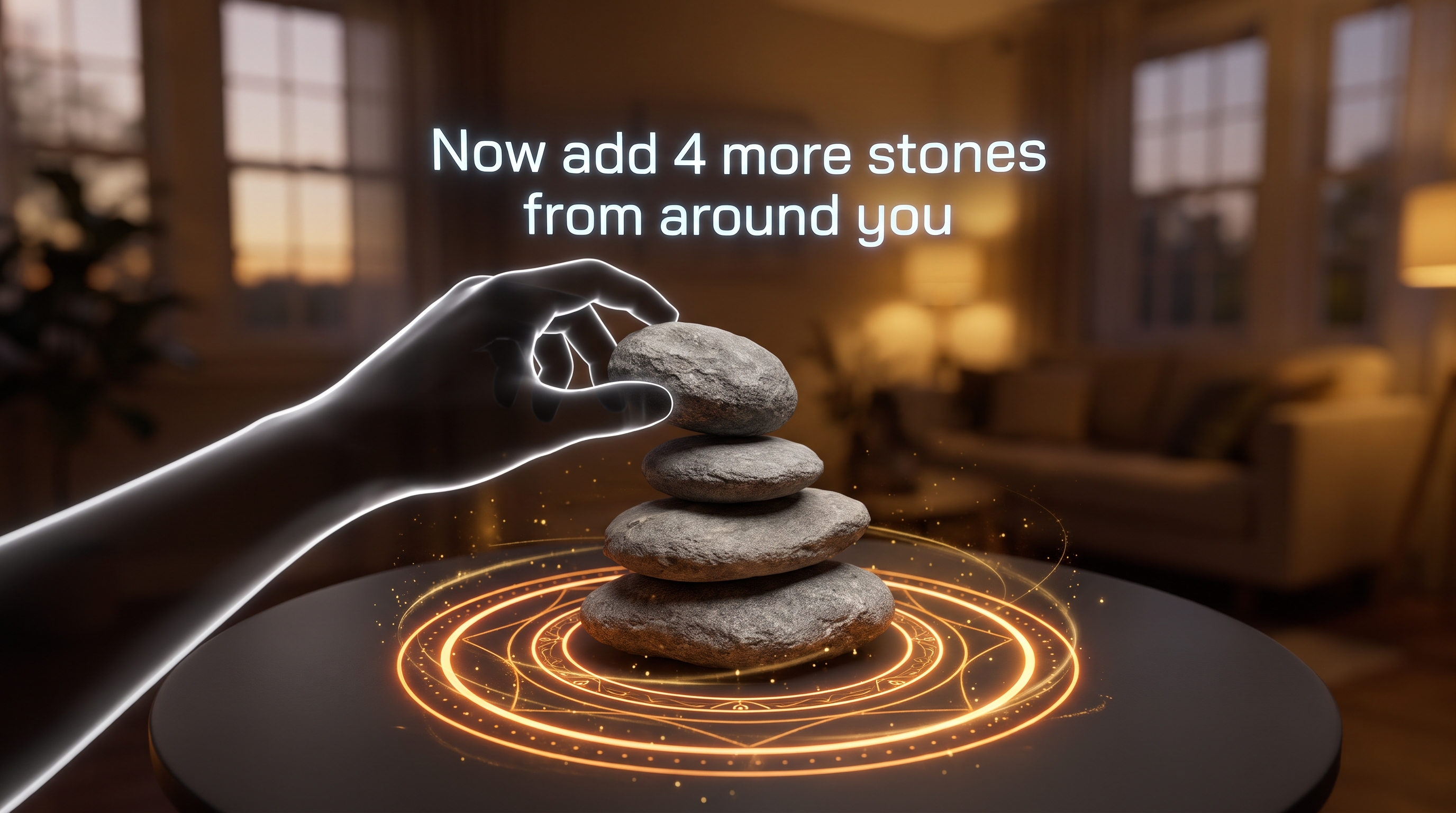
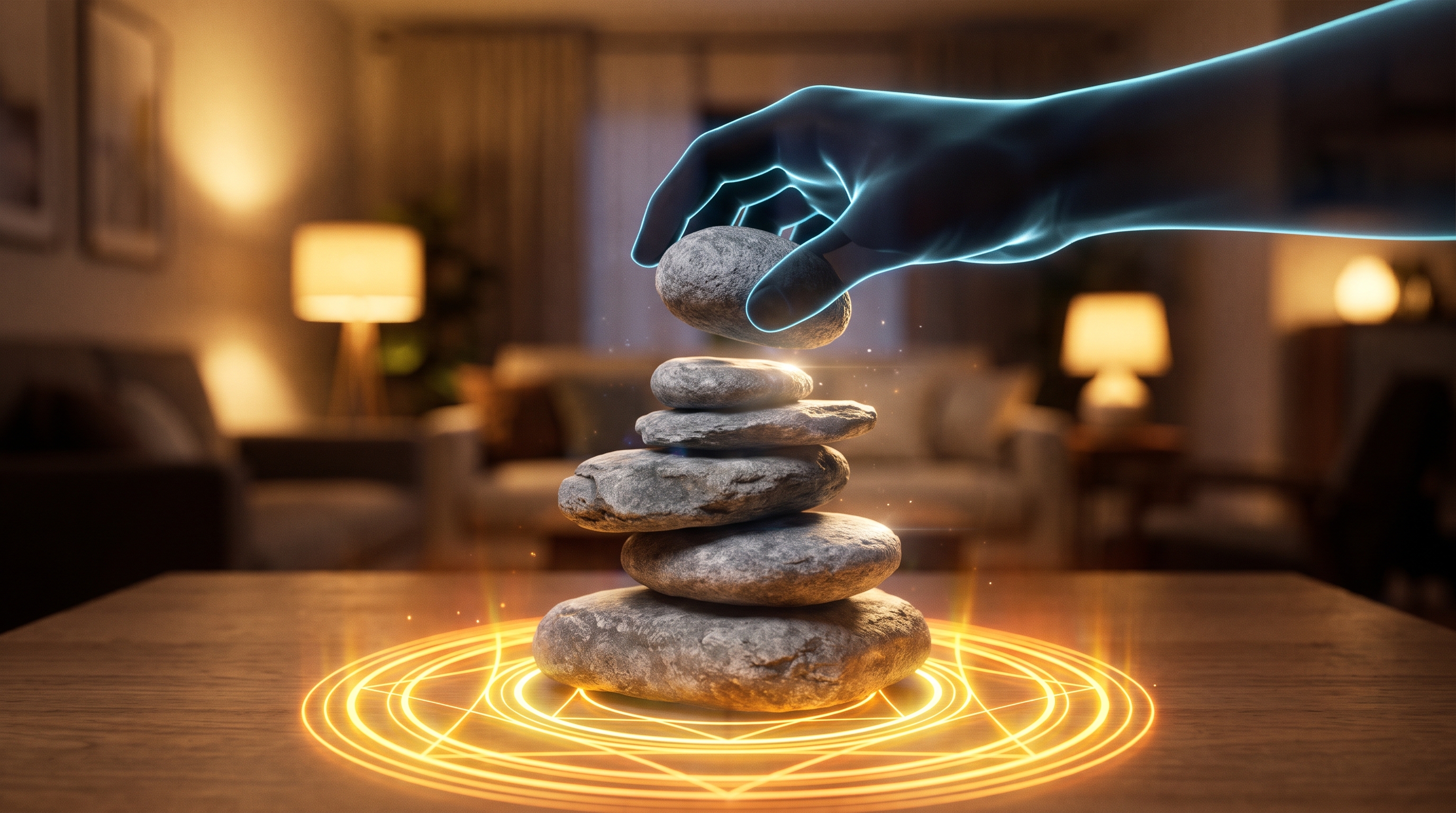
Stones began with a simple fascination with the quiet magic of real rocks—collecting physical stones, scanning and photographing them, and reconstructing them into digital meshes. Across cultures, balancing stones into cairns and playing traditional games like Seven Stones tap into a primal human urge: finding stillness, focus, and a small victory over gravity. I wanted to carry that tactile, ASMR sensation from nature into mixed reality, creating an experience that can be as meditative or as fiercely competitive as the player wants.
The concept originally started as a larger room-scale vision—collecting and piling mystical stones across surreal floating biomes, an early prototype of which I presented as part of an XR performance and interactive experience at Clipa Theatre. Entering the Meta Start Developer Competition challenged me to rethink everything around a seated, hands-first constraint. Rather than limiting the game, that constraint sharpened it: stripping away locomotion and sprawling worlds revealed that the true heart of the experience is the immediate, intimate joy of feeling two rough stones lock into balance right in front of you.
What it does
Stones is a tactile, ASMR mixed-reality stone-balancing game for Meta Quest 3 that blends zero-friction onboarding with graduated physical puzzles:
- Immediate Diegetic Onboarding: You enter your own living room in Passthrough to find a single stone gently bobbing in mid-air with a floating prompt: "Grab the stone to start." Reaching out and pinching it immediately pulls you into the physical loop with no menus or text walls.
- Graduated Constraint Challenges: Each phase introduces new stone geometries and physical constraints—constructing specific target silhouettes, inverting balance by stacking wide heavy stones atop a tiny base, building around a locked anchor stone that cannot be disturbed, and mastering irregular center-of-mass profiles. Players can approach challenges at a calm, meditative pace or in competitive play.
- Tactile ASMR Feedback & Payoff Juice: Every micro-adjustment is reinforced by spatialized, velocity-scaled stone clacks and rising harmonic chimes. Reaching a 7-stone cairn unlocks gratifying physical payoffs: you can shelf it by using hand-raycasting to mount a virtual shelf directly onto your real-world wall and curate a gallery of your sculptures, destroy it with a hand swipe to scatter the stones and trigger a fresh procedural arrangement, or advance to the next challenge.
How I built it
I built Stones in Unity 6 (URP) targeting Meta Quest 3, powered by the Meta XR All-in-One SDK (TouchHandGrabInteractable, Grabbable, Passthrough, and Synthetic Hands). As a solo developer working under tight constraints, I leaned heavily on AI-assisted tooling—integrating Claude Code, Unity MCP, and Meta VR CLI (metavr) to inspect live scene hierarchies, refactor C# physics logic, and deploy builds directly to the headset.
To make bare-hand rock balancing feel authentic rather than artificially magnetic or impossibly slippery, I:
- Generated stylized and photogrammetric stone meshes from real rock scans and photos using MeshyAI.
- Decomposed complex stone topologies into lightweight compound convex hulls via CoACD, eliminating redundant trigger colliders so the same solid convex hulls drive both PhysX resting contacts and bare-hand touch detection.
- Tuned high-friction PhysX materials ($\mu_s \approx 1.0$, $\mu_d \approx 0.9$, zero bounciness), Continuous Dynamic collision detection, and elevated solver iterations so stacked cairns settle cleanly without micro-jitter.
- Designed every interaction inside an FoV-aware seated ergonomic zone ($0.75\text{m}$ to $0.9\text{m}$ reach within the central $30^\circ$ to $60^\circ$ downward viewing cone) so players can play effortlessly from a chair or couch.
Challenges I ran into
My biggest challenge wasn't technical—it was scope discipline. Because stones as a physical medium offer endless possibilities, I initially built far too many systems at once: an AI rival with a modular floating avatar, throwing projectiles to disrupt opponent stacks, multiplayer shared-space prototypes, and complex environment morphing.
Trying to polish every branch simultaneously diluted the core loop. The breakthrough came when I stepped back, stripped away the excess mechanics, and focused strictly on boarding and core tactile feel—asking what actually feels fun in the first ten seconds of putting on the headset. On the technical side, achieving jitter-free stone-on-stone resting physics required careful iteration: eliminating duplicate trigger colliders, resolving NaN hand-pose edge cases, and balancing realistic mass ratios against forgiving friction so delicate stacks hold steady when released.
Accomplishments that I'm proud of
- Embracing "Less is More": While I am genuinely proud of the 1v1 AI rival battle system I built during development, I am even prouder of recognizing that the pure, constraint-driven balancing loop stands stronger on its own for this release.
- Precision Through Constraints: Turning the competition's seated requirement into a design superpower—resulting in a mixed-reality experience that feels effortless, comfortable, and immediately intuitive.
- Universal Appeal: Creating a tactile core that resonates across completely different audiences—from players seeking a quiet, ASMR stress-relief ritual to players chasing precision physics mastery.
What I learned
- Start from the First Five Seconds: Prototypes live or die by their immediate tactile hook. Testing core hand-to-stone physics before layering on secondary game modes saves massive development time and reveals what players actually love.
- Constraints Breed Clarity: Designing for seated mixed reality forced me to respect human ergonomics, FoV limits, and physical presence in ways that elevated the entire design.
- AI-Accelerated XR Iteration: Pairing Unity MCP and CLI tooling with Claude Code made it possible as a solo developer to compress the feedback loop between tuning physics parameters in code and testing them with bare hands on Quest 3.
What's next for Stones
- Shared Worlds & Natural Forces: Persistent shared landscapes where players place their cairns alongside others, collaborative multiplayer building to construct monumental formations together, and environmental challenges where stacks must withstand wind and rushing water.
- Collectibles & Tactile Tools: Unlockable Collection Rooms filled with rare stylized and hyper-realistic stones—inspired by real-world rock formations and surreal dreamscapes—paired with earnable building tools like binding glue, high-friction stones, and wooden support branches.
- Timed & Architectural Competition + Studio Growth: Adding competitive multiplayer modes focused on speed trials and building higher-complexity cairns under pressure, while expanding KattaKitta Studio from a solo prototype effort into a collaborative team to ship the full release.

