-
-
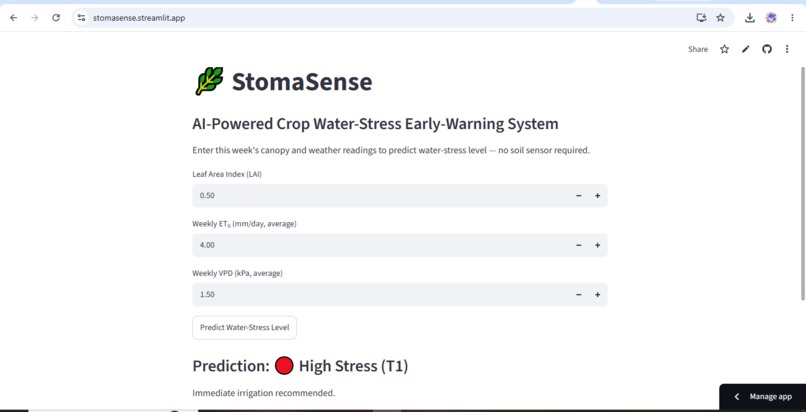
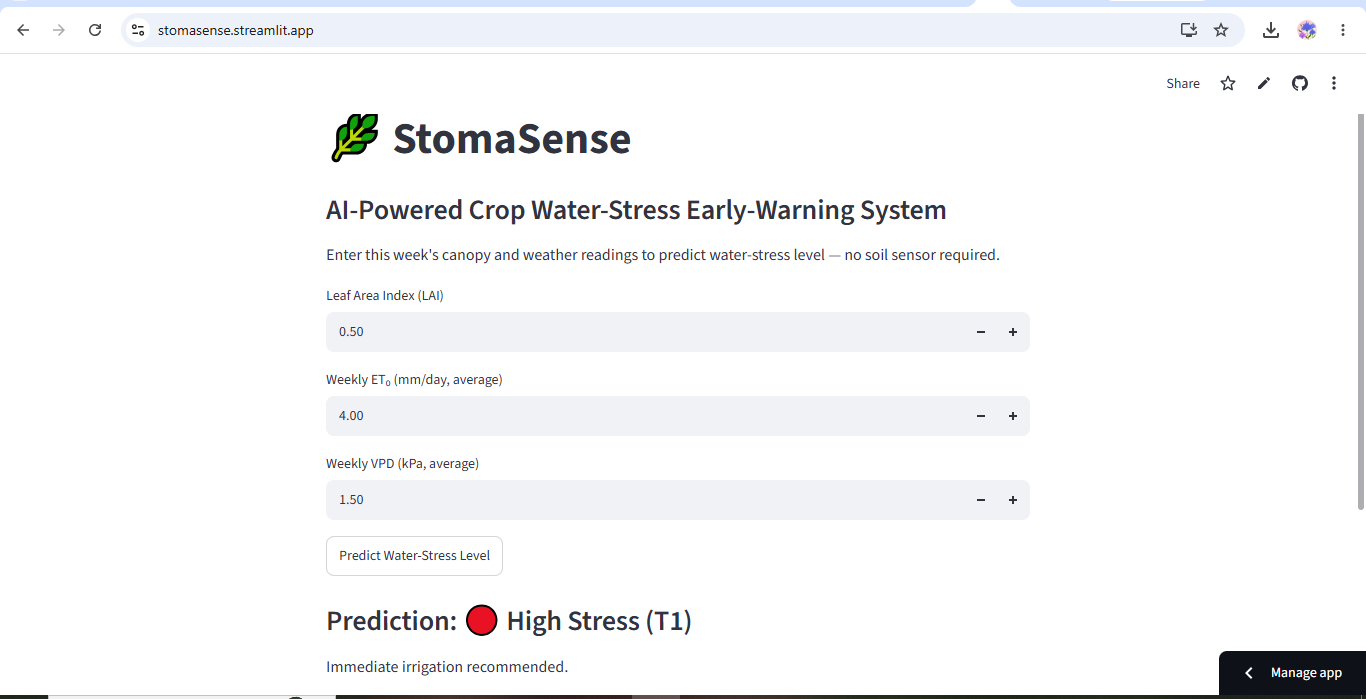
Predicting High Stress (T1) from low LAI and high VPD — irrigation recommended.
-
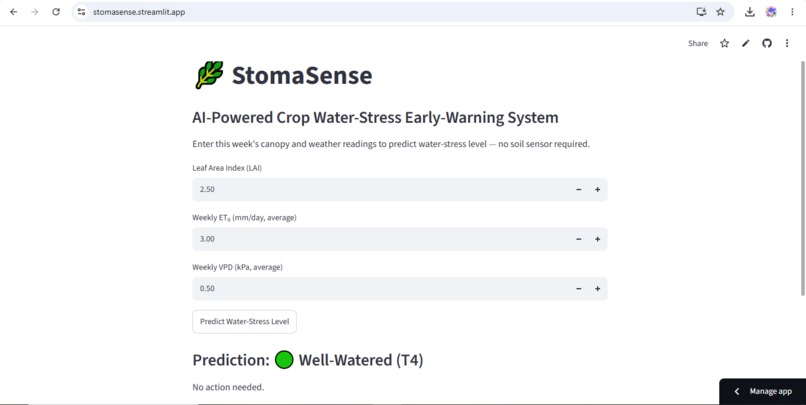
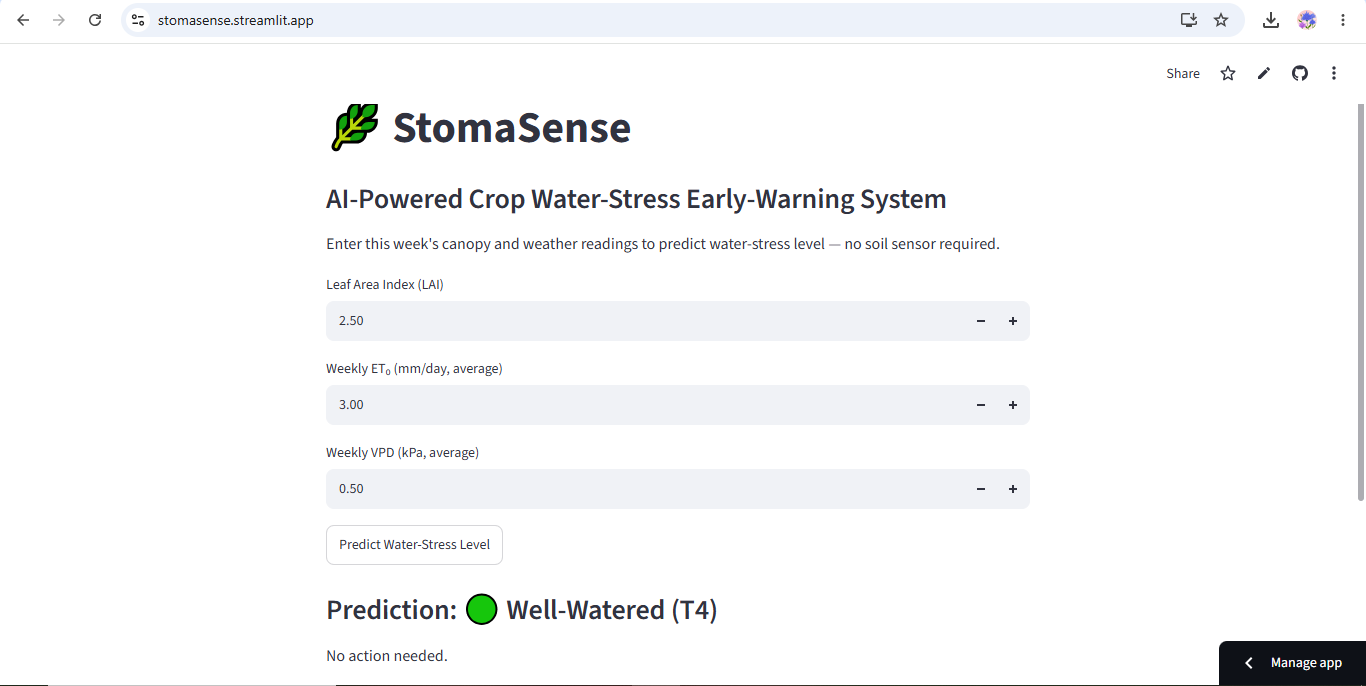
Predicting Well-Watered (T4) from high LAI and low VPD — no action needed.
-
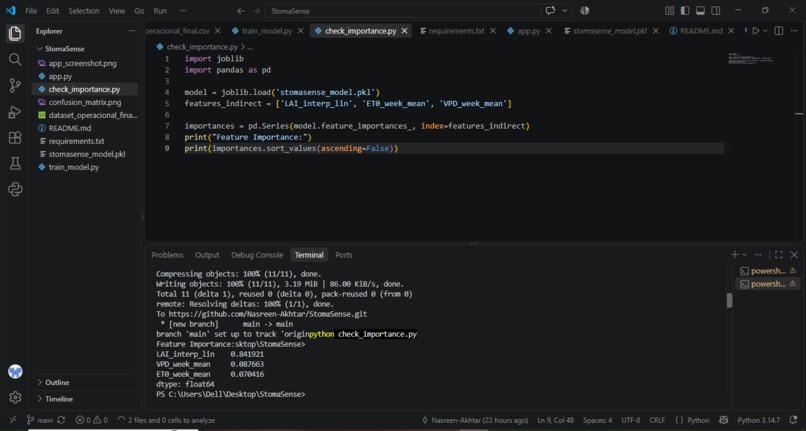
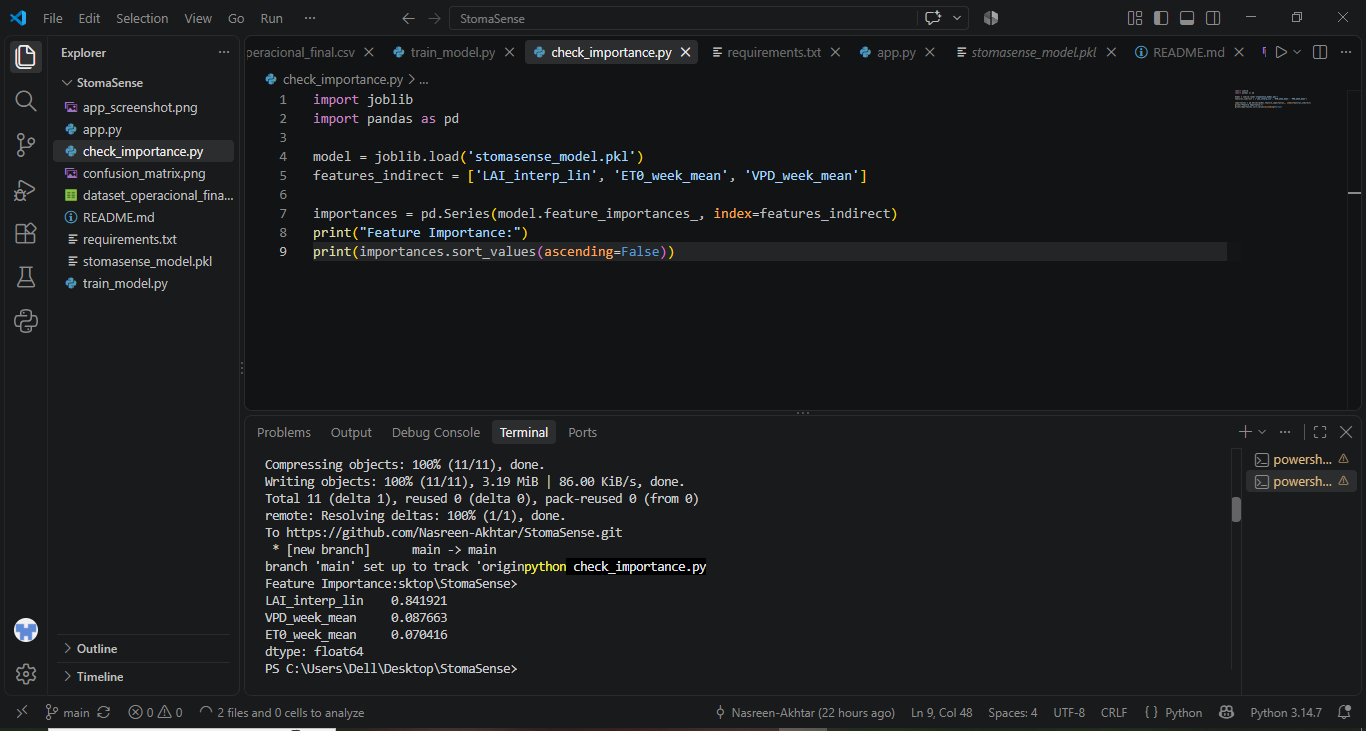
Feature importance: LAI drives ~84% of the prediction.
-
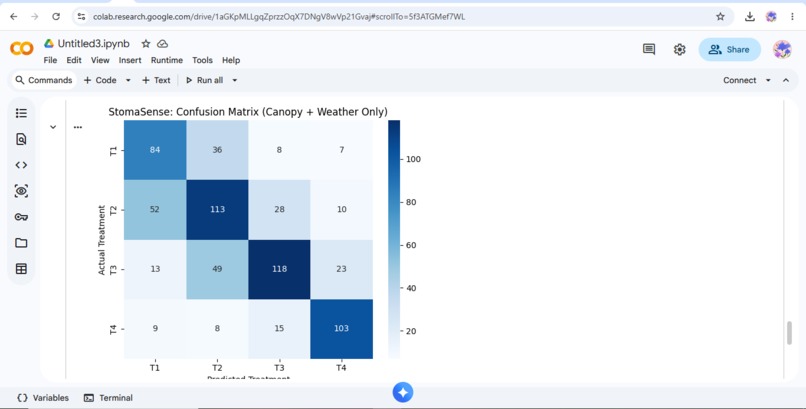
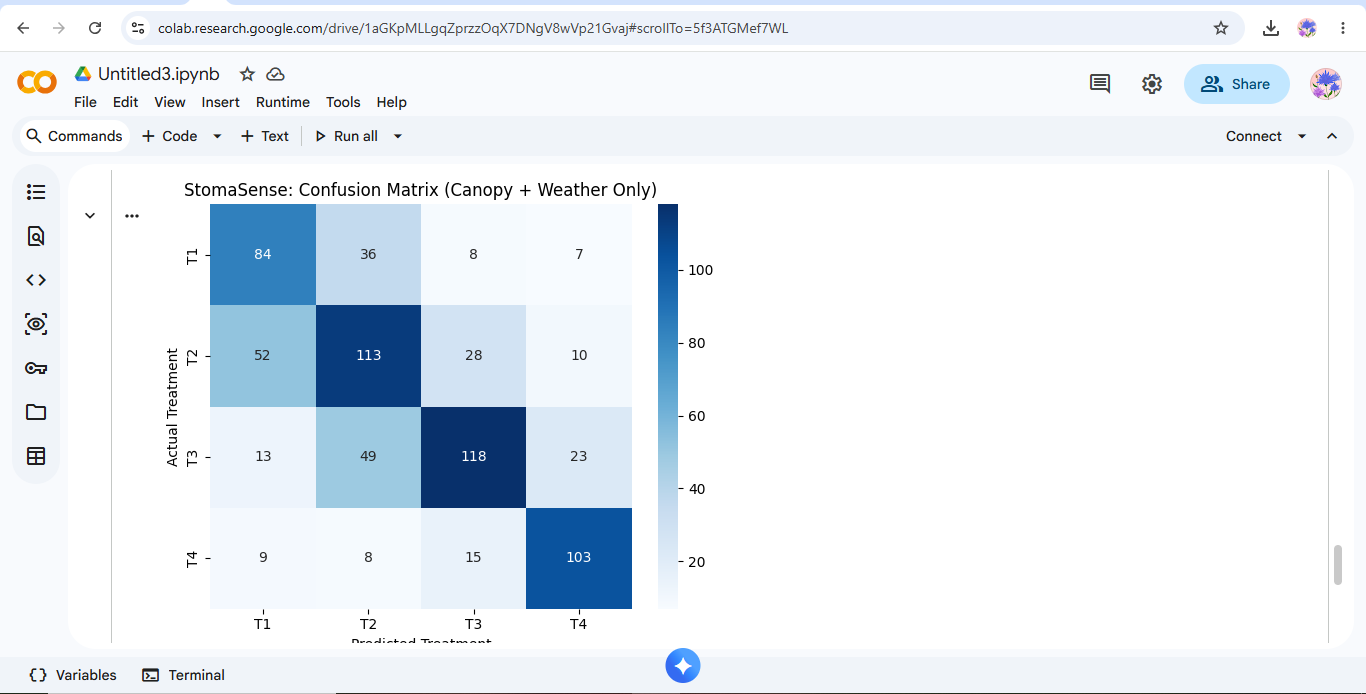
Confusion matrix: errors mostly between neighboring stress levels, not extremes.
-
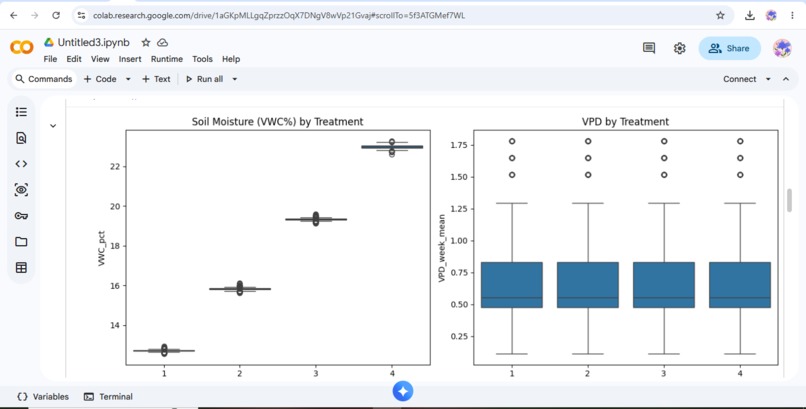
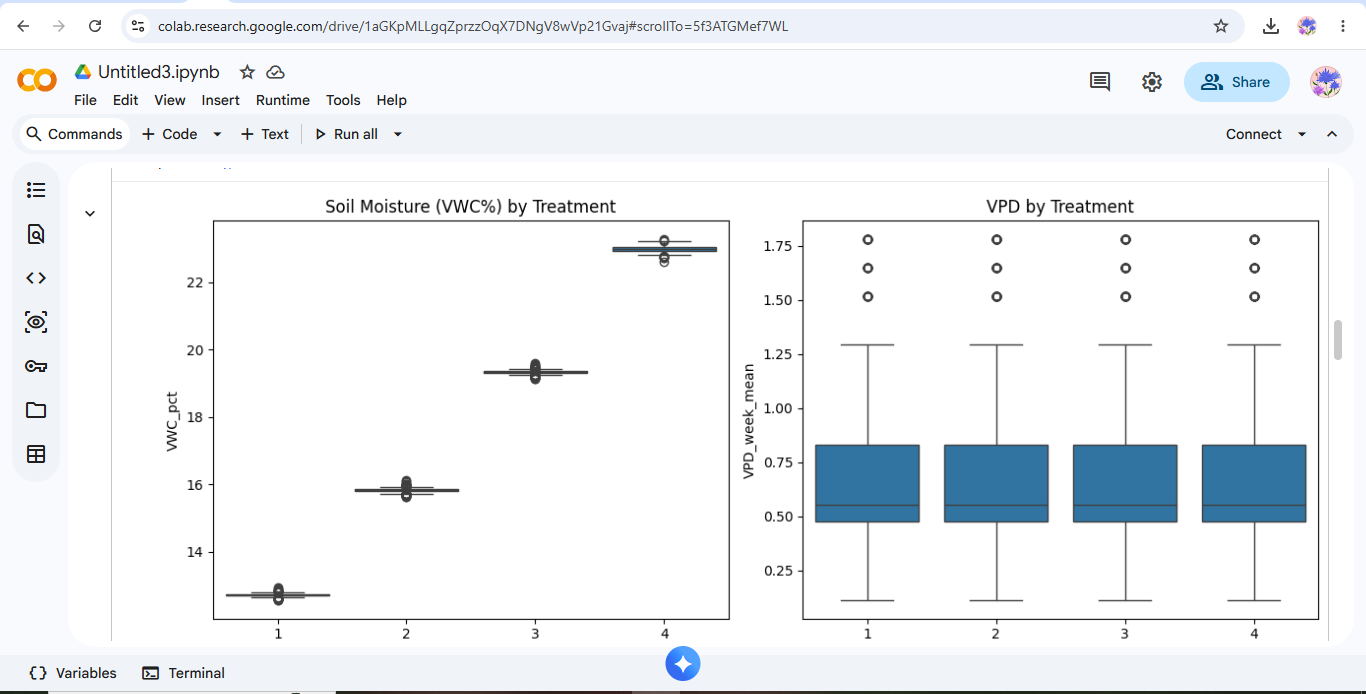
EDA confirming VWC separates cleanly by irrigation treatment.
Inspiration
As a botany student with research interests in stomatal biology and water-use efficiency, I kept coming back to the same practical gap: farmers usually only notice water stress once a plant visibly wilts by which point yield has already been lost. Soil-moisture sensors can catch it earlier, but they're expensive and impractical to install across an entire field. I wanted to ask a harder, more useful question: can water stress be detected remotely, using signals a drone or weather station can already capture, without needing soil access at all?
What it does
StomaSense predicts crop water-stress severity (on a 4-level scale) using only canopy structure (Leaf Area Index) and weather data (VPD, ET₀). It's built as a hybrid decision-support system: a Random Forest model does the prediction, and a Streamlit interface turns that prediction into a plain-language irrigation recommendation.
How we built it
The project went through several deliberate pivots:
- Dataset selection — I initially explored a synthetic plant-biosensor dataset, but its label was disease severity, not water stress. I switched to a real experimental dataset from a banana irrigation-deficit trial (Mendeley Data, Colombia), which has a native, ground-truthed water-stress label across four irrigation treatments.
- A red flag, caught early — My first model, trained with soil-moisture features included, scored 100% accuracy. Rather than celebrate, I treated this as a warning sign: in this experimental design, irrigation treatment directly determines soil moisture, so the model was essentially reading off the experimental setup, not learning biology.
- Reframing the problem — I deliberately excluded all soil-moisture-derived features and retrained using only canopy (LAI) and weather (VPD, ET₀) data the signals actually available without a soil sensor. This produced a more honest, harder, and more useful model.
- Building the interface — I built a Streamlit app around the retrained model, then deployed it on Streamlit Community Cloud so it's accessible without needing my local machine running.
Challenges we ran into
The near-perfect-accuracy trap: it would have been easy to ship the 100% accuracy soil-based model. Recognizing why that result was misleading rather than just accepting a good number was the most important technical decision in the project.
Environment setup: as a biology researcher newer to full ML pipelines, getting Python, pip, and the local environment correctly configured (PATH issues, version matching between Colab and local) took real troubleshooting.
Class imbalance: the four stress classes weren't evenly distributed, addressed using class_weight='balanced' in the Random Forest.
Accomplishments that we're proud of
- A model that achieves 62% accuracy on a genuinely hard 4-class problem (vs. ~25% random baseline) using only remotely-observable signals.
- A confusion matrix showing that nearly all errors occur between neighboring stress levels rather than extremes evidence the model learned a real physiological gradient, not noise.
- A live, deployed, interactive prototype , not just a notebook.
What we learned
The most valuable lesson wasn't a specific tool or library it was learning to be suspicious of results that seem too good, and to trace why a model performs the way it does back to the actual experimental design and biology behind the data, rather than just optimizing a metric.
What's next for StomaSense
- Extending training data to additional crop species beyond banana
- Incorporating UAV-derived vegetation indices (NDVI, NDRE) alongside LAI for richer canopy signal
- Field-testing the early warning thresholds against real-time deployment scenarios
Built With
- github
- google-colab
- joblib
- machine-learning
- matplotlib
- numpy
- pandas
- python
- random-forest
- scikit-learn
- seaborn
- streamlit
- streamlit-cloud
- visual-studio-code


Log in or sign up for Devpost to join the conversation.