-
-
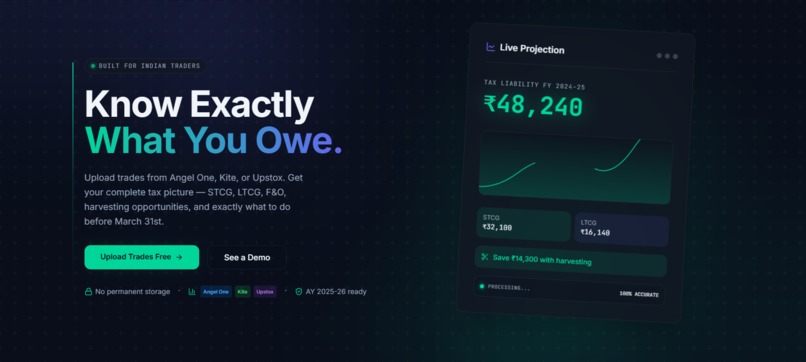
Landing Image
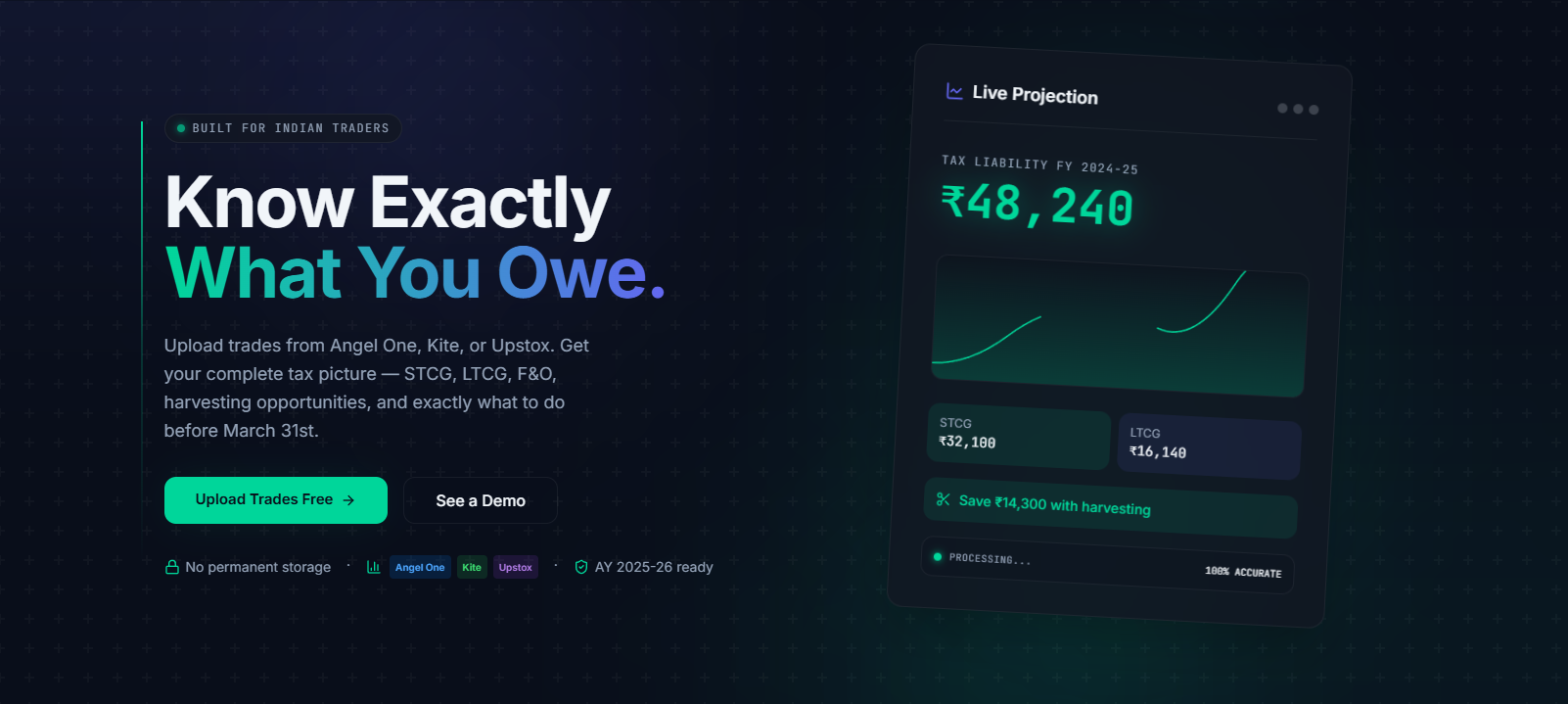
Inspiration
Every March, millions of Indian stock traders overpay tax — not because they have to, but because tax loss harvesting is complex, confusing, and no tool exists that actually does it intelligently for Indian markets.
I built StockTax Pro to fix that.
What it does
StockTax Pro is an AI-powered tax planning platform for Indian traders. Upload your broker P&L (Zerodha, Upstox, AngelOne) and the app:
- Calculates your exact STCG/LTCG tax liability
- Identifies unrealized losses that can legally offset your gains
- Runs an optimization algorithm to select the minimum stocks to sell
- Deploys an AI agent that analyzes your harvest plan across 4 dimensions: Risk Radar, Stock Intelligence, Opportunity Scanner, and Harvest Scorecard
- Generates ITR-ready Schedule 112A exports for tax filing
The AI Agent
The core of StockTax Pro is an agentic AI layer built on GPT-4o-mini. When a user runs "AI Tax Insights", 4 specialized agents fire in parallel:
- Harvest Scorecard Agent — grades the plan across Tax Efficiency, Timing, Cost-Benefit, Target Precision, and Future Value
- Stock Intelligence Agent — gives per-stock harvest/wait/skip recommendations with sector-aware reasoning
- Opportunity Scanner Agent — finds tax-saving opportunities the user is missing (unused LTCG exemption, optimal booking windows)
- Risk Radar Agent — identifies wash sale risks, execution risks, and generates a pre-harvest checklist
Each agent receives only the minimal pre-computed data it needs, keeping total token usage under 2,400 per analysis. Results are cached and rendered progressively as each agent resolves.
How I built it
- Frontend: React + TypeScript + Tailwind CSS + shadcn/ui
- State: Zustand with cross-page computed selectors
- Parsing: SheetJS for multi-broker Excel/CSV parsing with dynamic header detection (never hardcoded row numbers)
- AI: OpenAI GPT-4o-mini via 4 parallel async fetch calls
- PDF: @react-pdf/renderer for Schedule 112A generation
- Tax Engine: Custom rule-based engine handling STCG/LTCG offset rules, pre/post July 23 2024 rate splits, grandfathering, and carry-forward loss calculations
Challenges
Multi-broker normalization was the hardest problem. Each broker formats stock names differently ("TATA MOTORS LTD - EQ" vs "TATAMOTORS"), uses different column structures, and some files lack avg buy price entirely. Building a robust dynamic parser that works across all three brokers without hardcoding row positions took significant iteration.
Token efficiency for the AI layer required pre-computing all tax math on the frontend and sending only summarized JSON to GPT — keeping responses specific and fast rather than generic.
What I learned
Indian tax rules are surprisingly nuanced — the STCG/LTCG offset asymmetry, the July 23 2024 rate change mid-year, grandfathering for pre-2018 holdings, and the 8-year carry-forward window all required careful implementation. Building this taught me how to translate complex regulatory rules into reliable software logic.
Built With
- openai-gpt-4o-mini-(as-i-already-have-but-will-replace-with-gemini-soon)
- react
- recharts
- shadcn/ui
- sheetjs
- tailwind-css
- typescript
- vite
- zustand

Log in or sign up for Devpost to join the conversation.