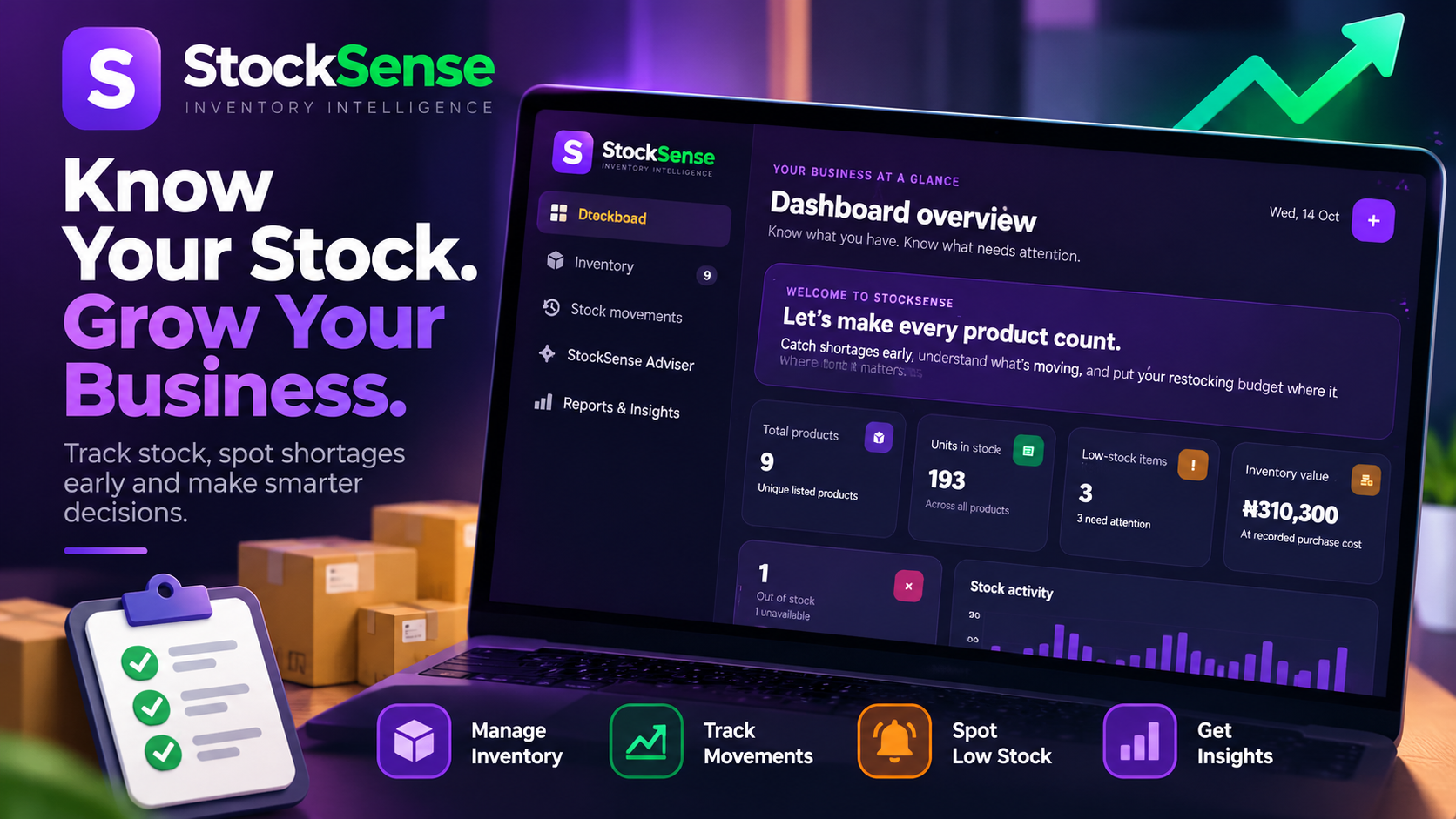
StockSense: Know Your Stock. Grow Your Business.
Inspiration
Many small business owners struggle to keep track of their inventory. They may not know which products are running low, what is selling fastest, or how to prioritize restocking when they have a limited budget. Poor inventory decisions can lead to missed sales, excess stock, and unnecessary losses.
StockSense was inspired by the need to make inventory management simpler and more practical for small businesses. We wanted to build a tool that goes beyond counting products and helps business owners make smarter decisions about their stock.
What it does
StockSense is an inventory management dashboard designed to help small businesses understand and manage their stock more effectively.
Its key features include:
- Inventory management: Add products and track quantities, purchase costs, selling prices, and minimum stock levels.
- Stock movement tracking: Record sales, restocks, and stock adjustments to maintain a history of inventory changes.
- Low-stock alerts: Identify products that need attention before stock shortages become a bigger problem.
- StockSense Adviser: Get rule-based restocking recommendations based on current stock levels, recorded sales activity, product costs, and an available budget.
- Reports and insights: View inventory value, recorded sales quantities, restocking activity, and overall stock health.
The goal is to help business owners move from guesswork to more informed inventory decisions.
How we built it
StockSense was developed as a lightweight web application using HTML, CSS, and JavaScript. We used a responsive dashboard layout to present inventory information in a clear, accessible way.
The interface features a dark visual theme with purple, green, and orange accents. It includes dashboard metrics, product tables, stock movement history, and a budget-aware restocking adviser.
We also set up Supabase for authentication and database storage, with PostgreSQL tables and Row Level Security policies intended to support user-specific inventory data. The database integration still requires further testing to verify that all inventory operations persist correctly.
Challenges we ran into
One of our main challenges was turning inventory information into useful recommendations rather than simply displaying numbers. The restocking adviser needed to consider stock urgency, recorded sales, unit costs, and the user's available budget.
Another challenge was working within limited development resources and time while building the application and preparing it for deployment. We had to focus on the core features that would make the MVP useful.
Connecting the existing frontend to a cloud database also introduced additional complexity, particularly around authentication, data persistence, and ensuring that stock quantities and movement records remain consistent.
Accomplishments that we're proud of
We are proud to have developed a working inventory dashboard that brings several important inventory tasks together in one place.
StockSense combines product management, stock movement history, low-stock identification, inventory valuation, reporting, and budget-aware restocking recommendations in a single interface.
We are especially proud of the StockSense Adviser because it addresses a practical business question: “With the money I have available, which products should I prioritize restocking?”
We also established the initial Supabase database structure and authentication flow, giving the project a foundation for future improvements.
What we learned
Building StockSense reinforced the importance of understanding a real business problem before choosing a technical solution.
We learned that inventory management is not only about recording quantities. Business owners also need context to understand what is urgent, how much restocking may cost, and how to make decisions when resources are limited.
We also gained experience building an interactive web application, designing a decision-support feature, structuring a database, and considering authentication, data security, and reliable persistence.
What's next for StockSense
Our next steps are to complete and thoroughly test the Supabase integration, ensure that inventory changes are saved reliably, and strengthen authentication and user-specific data protection.
We also plan to explore features such as:
- Sales and inventory trend analysis.
- Smarter demand forecasting as reliable historical data becomes available.
- Supplier management and purchase order tracking.
- Low-stock notifications and restocking reminders.
- Exportable reports for business planning.
- A mobile-friendly experience for business owners managing stock on the go.
Our long-term vision is to make StockSense a practical inventory intelligence tool that helps small businesses reduce avoidable stock problems, make better use of limited capital, and grow with greater confidence.

Log in or sign up for Devpost to join the conversation.