-
-
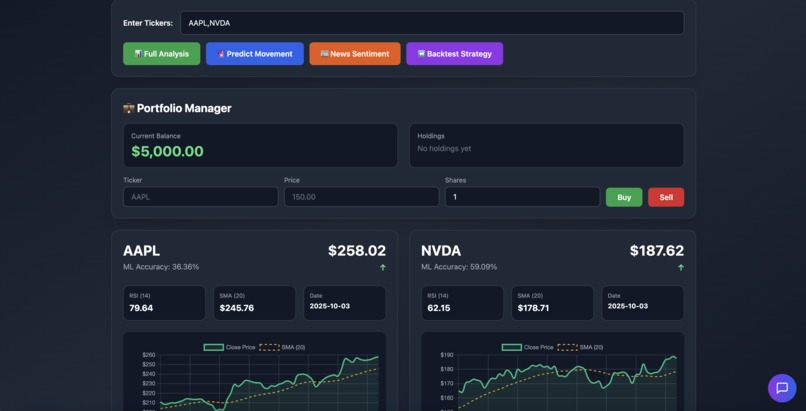
Trendlines/Current Values
-
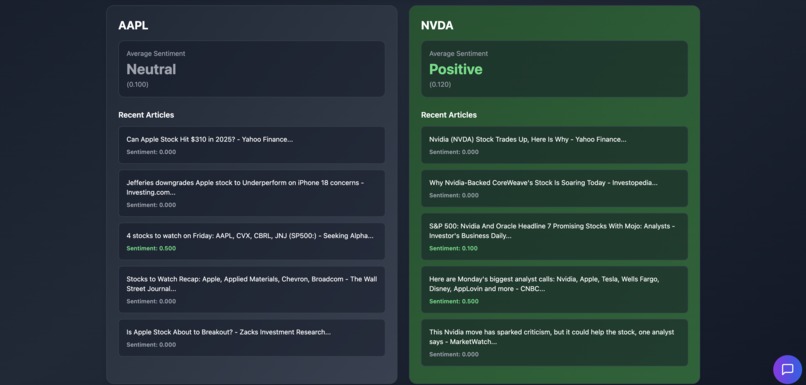
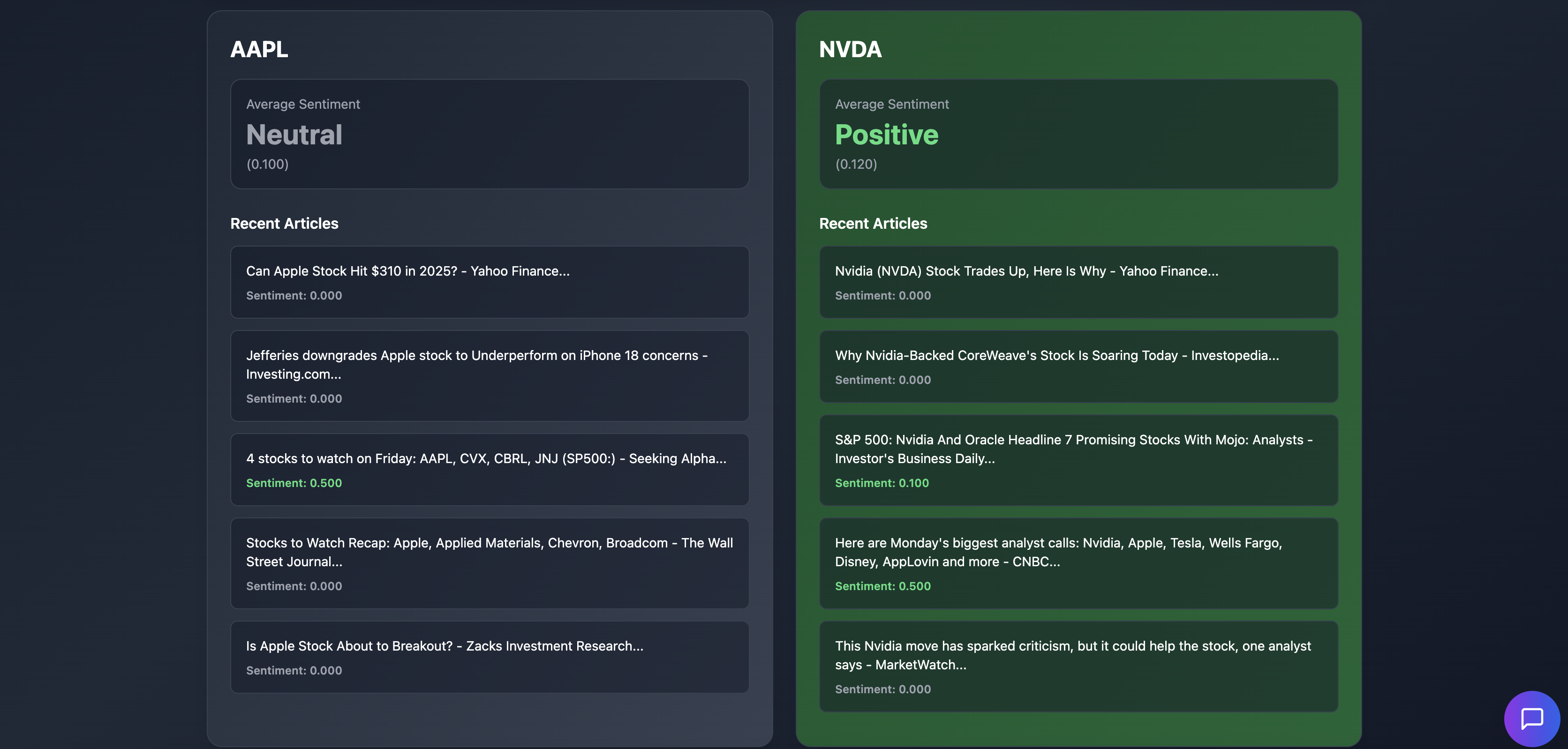
News Articles
-
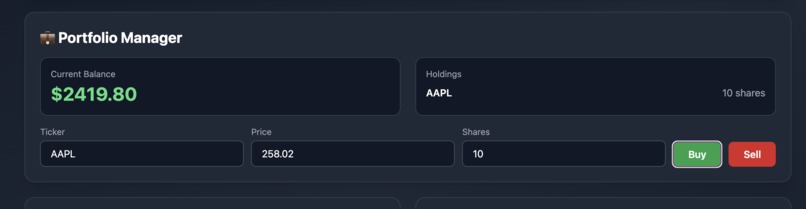
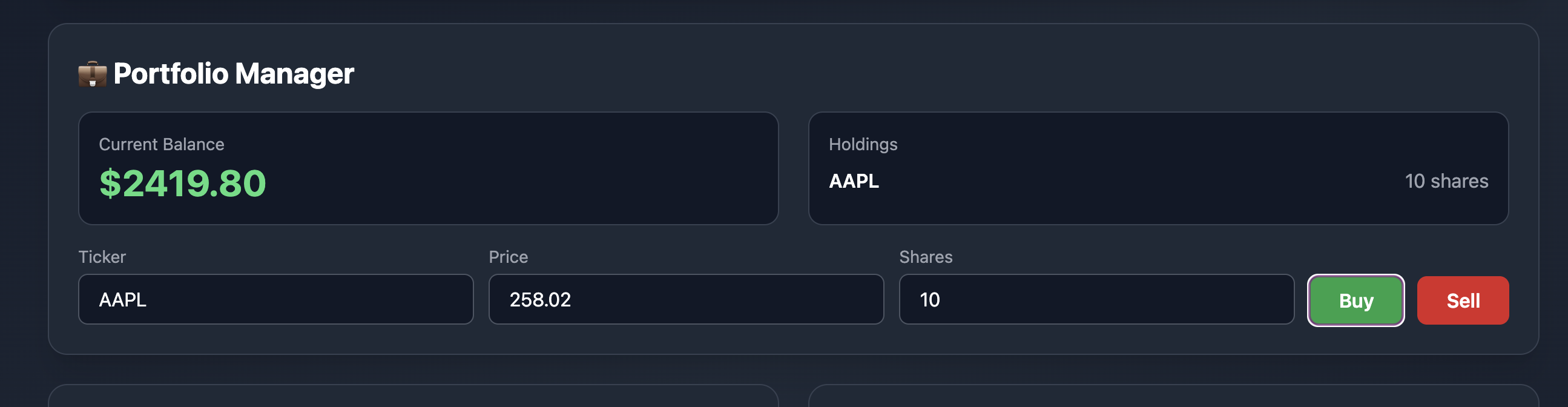
Paper trading feature
Inspiration
We were inspired by the motivation of understanding how to remove the guesswork of stock trading with AI and making a platform to practice trades that would be made in the real world.
What it does
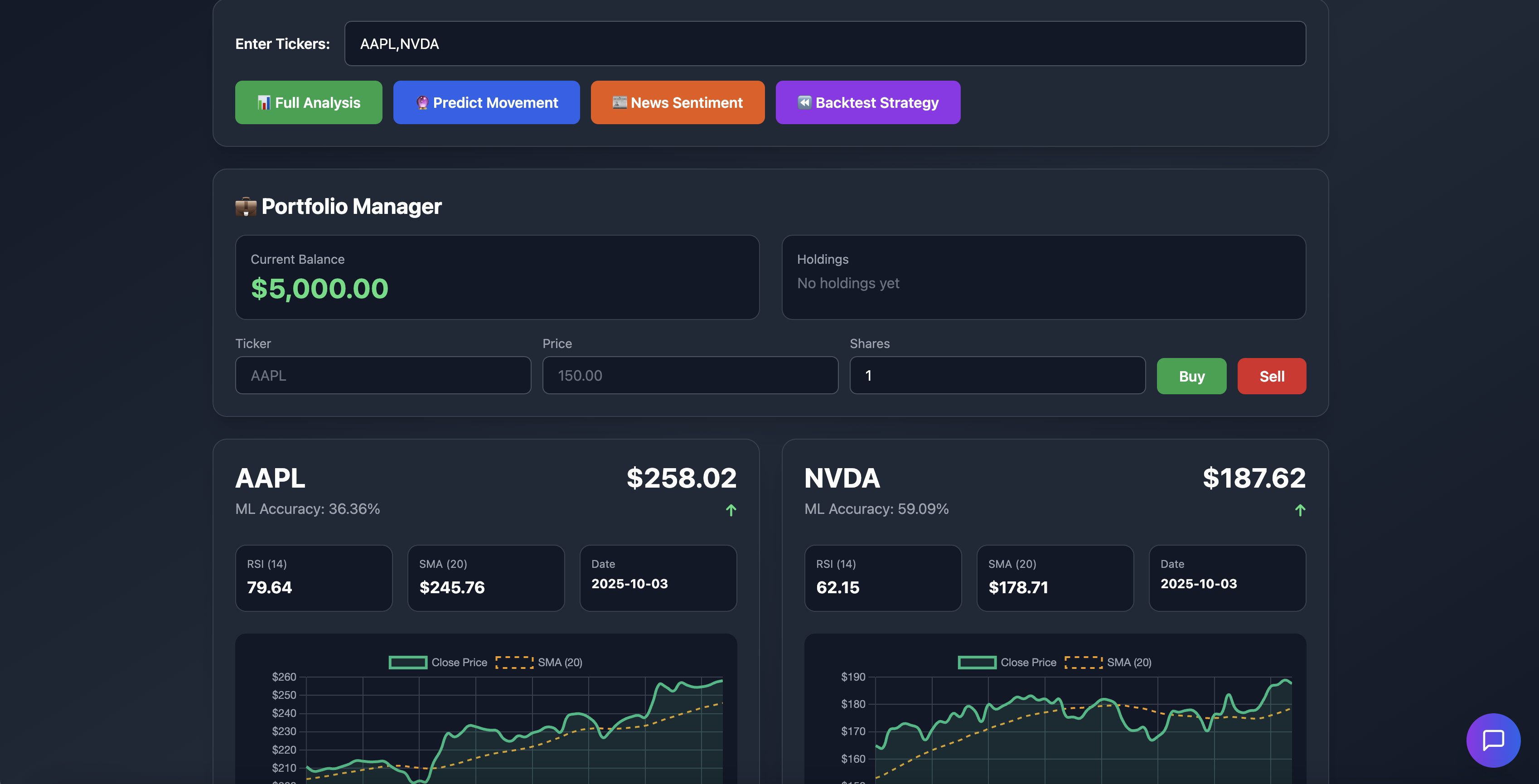
Given any number of tickers, the site will display the trend lines of any stocks, an AI prediction of whether the stocks are predicted to increase or decrease, and provide multiple articles regarding relevant news about each respective stock. Additionally, the news articles are graded by relevance to determine how closely related they are to each respective stock. Furthermore, there is an AI assistant built into the website that can simplify any complex topics about stocks that a new trader might have difficulty understanding.
How we built it
Data Collection and Integration: We began by researching and connecting to reliable stock market APIs that provide real-time and historical data. This required setting up API calls that could efficiently fetch live prices, trends, and metrics while also handling potential issues like missing or inconsistent data. By cleaning and organizing the information, we ensured that our platform had a solid foundation for accuracy and reliability.
Trend Visualization and Prediction: Once we had the data, we focused on turning it into something users could easily interpret. We developed interactive graphs and charts using visualization libraries, allowing users to explore trends across different timeframes. In addition, we implemented predictive algorithms trained on historical data to forecast potential increases or decreases in stock values. This gave the platform an analytical layer that combined past performance with forward-looking insights.
News and Contextual Information: To help users better understand market movements, we integrated financial news articles directly into the platform. By connecting to news APIs and filtering results with keyword-matching techniques, we were able to display relevant stories alongside stock data. This gave users not just numbers, but also the context needed to interpret why certain trends or predictions might occur.
Paper Trading and Portfolio Tracking: A key feature we built was the paper trading system, which allows users to practice investing without financial risk. We created a virtual currency environment where users could “buy” and “sell” stocks, track their transaction history, and monitor gains or losses over time. This required developing backend logic to simulate realistic trading behavior, while also building dashboards that give users a clear view of their performance.
Front-End and Back-End Development: To tie everything together, we focused on both the user interface and the system infrastructure. On the front end, we designed an intuitive layout with easy navigation between stocks, predictions, news, and trading features, ensuring a responsive design for multiple devices. On the back end, we set up servers and databases to store user information, manage trade history, and efficiently handle large amounts of stock data. Together, these layers created a seamless experience that balanced performance, usability, and scalability.
Challenges we ran into
One of the biggest challenges that we faced was combining the frontend and backend smoothly. Ensuring that API and database data translate smoothly to the user interface required extensive debugging and detail-oriented effort, especially when dealing with real-time stock prices. The second difficulty was implementing the paper trading feature, which needed to emulate buying and selling stocks without actual money. This was done by building correct transaction logic, managing virtual balances, and keeping trade histories intact consistently without losing out on the interfaceness of the interface. This problem was addressed by developing better technical problem-solving skills and the general stability of the platform.
Accomplishments that we're proud of
We are proud to have built a fully functional website that brings powerful tools to those learning stock trading. We developed predictive features that indicate potential increases or decreases in stock values, integrated relevant news articles to provide context, and created a system that tracks overall gains and losses for a clear financial picture. One of our biggest accomplishments is the addition of a paper trading platform, which allows users to practice trading strategies without risk. Altogether, these achievements showcase our ability to combine data analysis, financial insight, and user-friendly design into one cohesive tool.
What we learned
We learned how to integrate real-time stock data, predictive algorithms, and news sources into a platform that is both functional and easy to use. Along the way, we gained valuable experience in handling large datasets, designing user-friendly tools, and ensuring accuracy in financial simulations that reflect real market conditions. We also strengthened our teamwork and problem-solving skills, which were essential in overcoming challenges and bringing all these components together successfully.
What's next for Stocksense AI
In the future, we can provide a feature for users to interact with each other by displaying trades on a user's profile and allowing others to view them. Users can be able to follow each other and be notified about the trades of those they follow, while also having a feature to chat with other users regarding certain stocks they may be interested in. Additionally, we plan to add a feature for users to "favorite" a stock and join a group chat dedicated to those who have said stock favorited.



Log in or sign up for Devpost to join the conversation.