-
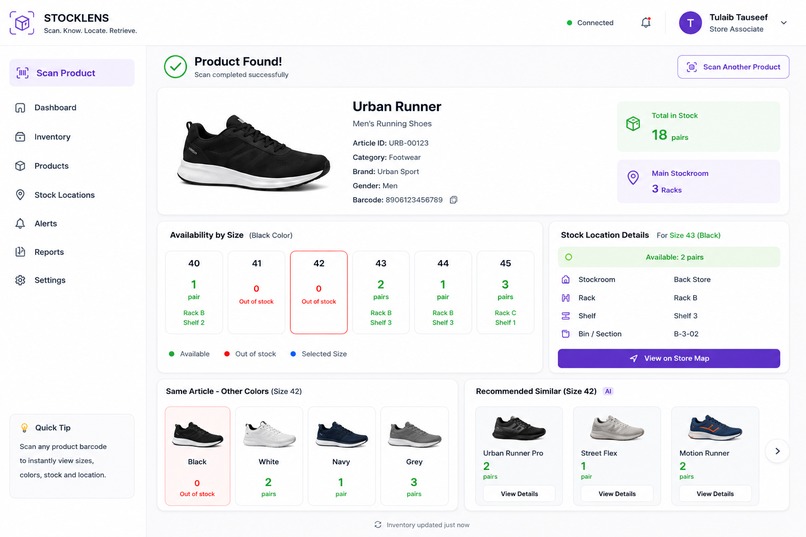
This design helps employees answer customers faster, improving the shopping experience while reducing staff effort and hassle.
-
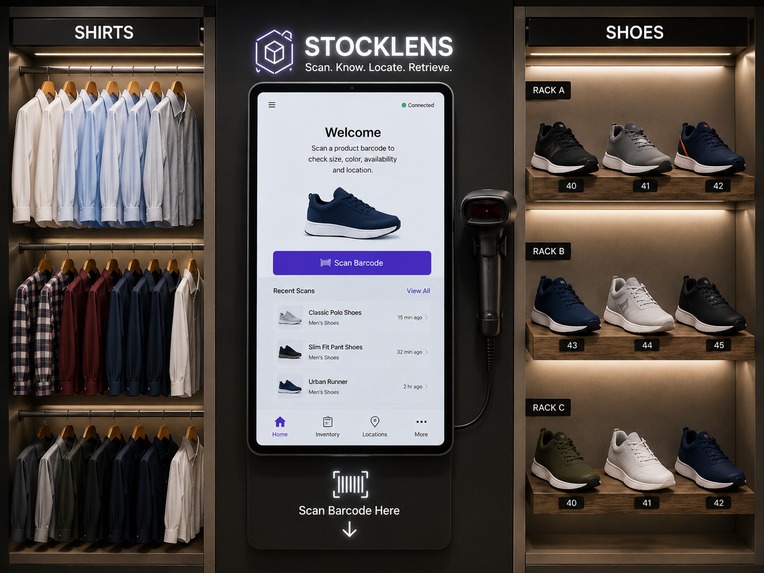
This is the concept like how it would look in the outlets
Inspiration
StockLens started with a real shopping experience.
I found a pair of shoes I liked and asked a store employee whether the same pair was available in my size.
The employee had no quick way to check that information from the shop floor, so he had to go into the stockroom, search through the boxes, check the available sizes, and then come back.
It took almost 10 minutes just to answer one simple question:
“Do you have these shoes in my size?”
What made the experience even more frustrating was what happened after the wait:
My size was not available.
So after waiting almost 10 minutes, I still couldn't buy the shoes I wanted.
That was the moment the problem became very clear to me.
The employee was not the problem. The process was.
If the employee had been able to check the available sizes instantly from the shop floor, I could have known within seconds that my size was unavailable. We could then have immediately checked another color, another suitable size, or a similar shoe instead of spending almost 10 minutes just discovering that the original option wasn't available.
That experience made me think about a much larger retail problem.
Large fashion and multi-category stores can carry hundreds or thousands of product variations. A single product may exist in several:
- Sizes
- Colors
- Styles
- Variants
Not all of that inventory can be kept on display.
This is especially noticeable with footwear. Shoes and their boxes take a significant amount of physical space, so stores may display only a sample while many of the actual sizes remain inside the stockroom.
But the same problem can also apply to:
- Shirts
- Jeans
- Jackets
- Kids' clothing
- Sportswear
- Accessories
- Other products with many variations
A customer may be standing directly in front of a product they like, while the information they actually need — size, color, quantity, and location — is still hidden somewhere in the stockroom.
That led to the idea behind StockLens:
What if an employee could scan any product and instantly know what is available and exactly where it is stored?
Our goal is simple:
Scan. Know. Locate. Retrieve.
What it does
StockLens is a proposed in-store inventory assistant designed for high-variety retail stores.
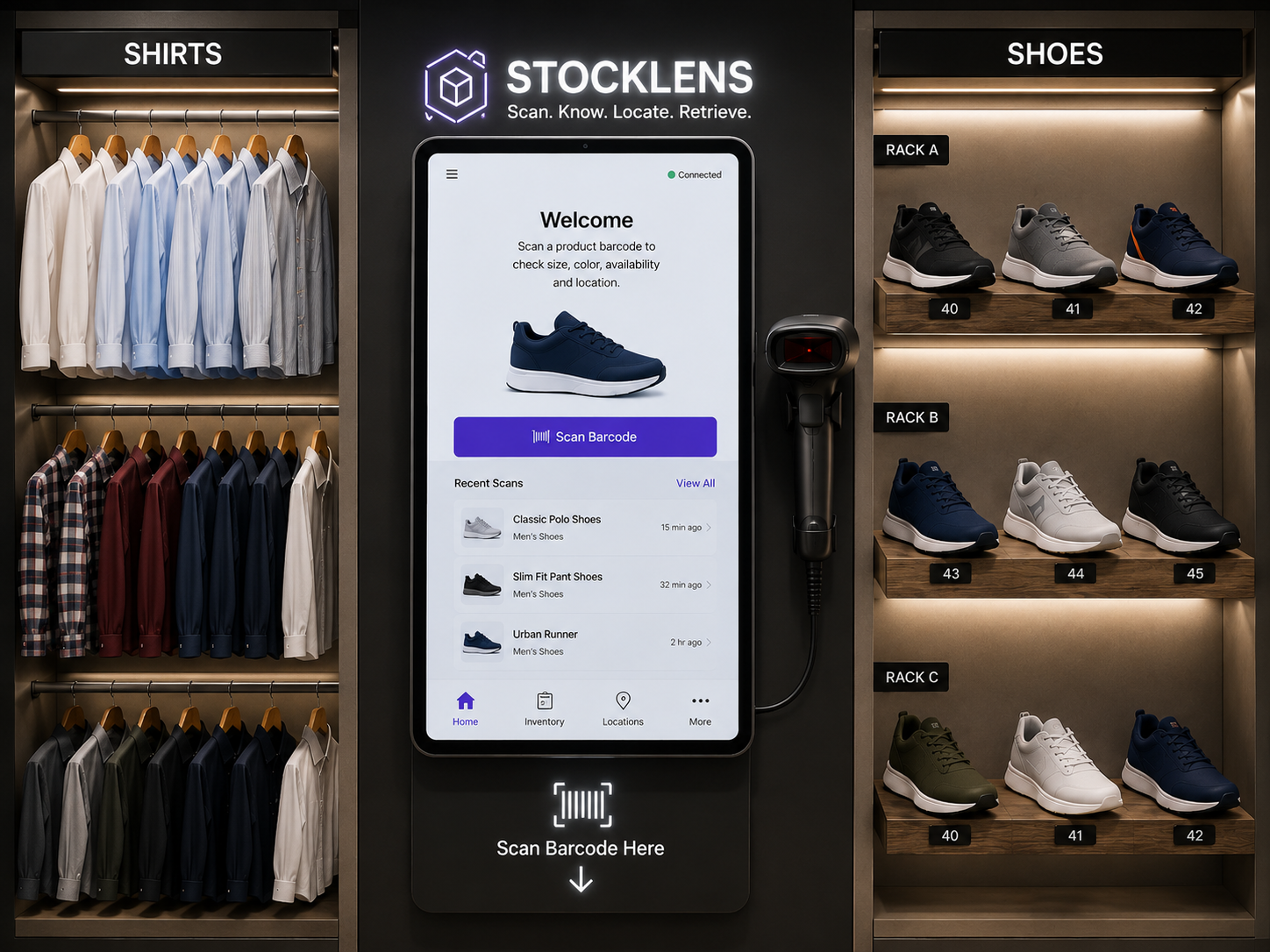
The idea is to place small StockLens stations at convenient locations around the shop floor.
Each station would include:
Barcode Scanner + Small Computer Screen
When a customer asks whether another size or color is available, the employee simply scans the barcode already attached to the product.
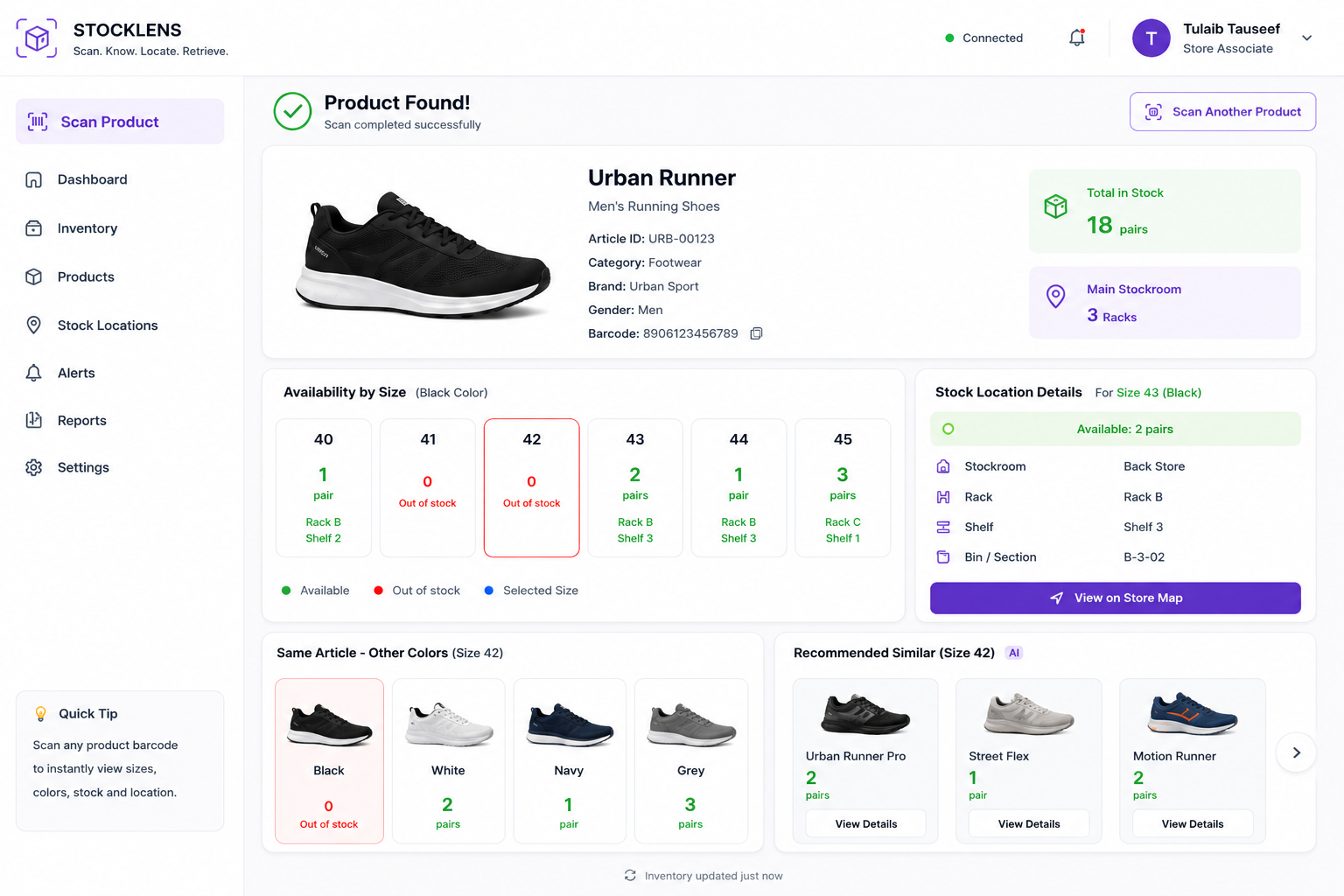
StockLens would then show:
- Product/article information
- All available sizes
- Available colors
- Quantity of each variation
- Out-of-stock options
- Whether the product is on the sales floor or in the stockroom
- Exact rack and shelf location
For example, imagine a customer likes a pair of black shoes.
StockLens could show:
| Size | Quantity | Location |
|---|---|---|
| 40 | 1 | Rack B — Shelf 2 |
| 41 | 0 | Out of stock |
| 42 | 0 | Out of stock |
| 43 | 2 | Rack B — Shelf 3 |
| 44 | 1 | Rack B — Shelf 3 |
Instead of checking only the size the customer originally asked for, the employee can immediately see the complete size range.
This can matter in real situations.
For example, a customer asking for Size 42 may sometimes also be comfortable trying Size 43.
The employee could immediately see:
Size 43 — 2 pairs available Back Store → Rack B → Shelf 3
Now the employee knows exactly where to go.
No blind search.
No unnecessary trip.
Same product, different color
If the customer's preferred size is unavailable in the selected color, StockLens would next check whether the same exact product is available in another color.
For example:
Urban Runner — Size 42
- Black — Out of stock
- White — 2 available
- Navy — 1 available
- Grey — 3 available
Instead of ending the conversation with:
“Sorry, we don't have your size.”
the employee can immediately say:
“We don't have Size 42 in Black, but the same shoe is available in White, Navy, and Grey.”
This gives the customer another option without forcing them to start their search again.
AI-powered similar-product recommendations
If the required size is unavailable in the same article, StockLens is planned to include an AI-powered recommendation system.
Instead of displaying dozens of random products, the system would suggest only 3–5 similar products that are actually available in the customer's required size.
For example:
This article is unavailable in Size 42.
Similar options:
- Urban Runner Pro — Size 42 available
- Street Flex — Size 42 available
- Motion Runner — Size 42 available
We intentionally want to keep the recommendation list small.
A customer who has already chosen one product probably does not want to suddenly compare 30 completely different options.
Too much choice can make a simple decision harder.
StockLens would therefore follow a focused recommendation order:
Exact product → Different color → 3–5 similar products
The goal is not to show the customer everything.
The goal is to help them find the closest available option quickly.
Why this becomes more important during big sales
This problem can become much worse during major sales and busy shopping periods.
More customers are asking employees for sizes.
Popular sizes sell quickly.
Stock changes throughout the day.
Employees repeatedly move between the shop floor and the stockroom.
Imagine this interaction:
Customer asks for Size 42
↓
Employee walks to the stockroom
↓
Searches for the article
↓
Discovers Size 42 is unavailable
↓
Returns to the customer
↓
Customer asks about another color
↓
Employee may have to check again
One simple purchase can create several unnecessary trips.
With StockLens, the employee could scan the product once and immediately know:
- Which sizes are available
- Which colors are available
- How many are left
- Where each variation is stored
- Which alternatives are worth showing
The workflow becomes:
Ask → Scan → Compare → Choose → Retrieve once
That difference becomes much more valuable when the store is crowded.
How we built it
StockLens is currently in the concept and system-design stage.
We started by looking closely at the real experience that inspired the idea.
The existing workflow looked something like this:
Customer asks → Employee goes to stockroom → Searches → Checks availability → Returns
We then asked:
How much of this process could be removed before the employee even enters the stockroom?
That gave us the proposed StockLens workflow:
Customer asks → Employee scans → StockLens checks inventory → Employee sees exact location → Retrieves once
The first prototype is planned around:
- Barcode scanning
- A small display interface
- Product and variant database
- Real-time inventory updates
- Size and color tracking
- Quantity tracking
- Rack and shelf locations
- Same-product alternatives
- AI-powered similar-product recommendations
The planned system flow is:
Scan product
↓
Identify article
↓
Check current inventory
↓
Show all sizes, colors, and quantities
↓
Show exact stock location
↓
If unavailable → Check same article in other colors
↓
If still unavailable → Recommend 3–5 similar in-stock products
For the hackathon prototype, we plan to create a realistic sample retail inventory instead of trying to integrate with a real retailer immediately.
That allows us to demonstrate the complete StockLens idea while keeping the prototype achievable and testable.
Challenges we ran into
One of our first challenges was making sure StockLens did not become unnecessarily complicated.
It would be easy to turn the idea into a huge retail platform with:
- Customer accounts
- Mobile applications
- Large dashboards
- Too many features
- Complicated workflows
But that would move away from the problem that created StockLens.
The original problem was simple:
The employee needs a faster way to answer a customer's stock question.
So the core interaction should also remain simple:
Scan the barcode.
Another important challenge was realizing that inventory quantity alone does not solve the complete problem.
If StockLens tells an employee:
“Size 43 — 2 available”
but they still have to search through the entire stockroom to find those two items, then only half of the problem has been solved.
That is why exact stock location is a core part of the concept.
We also had to think about the complexity of high-variety retail stores.
One product can have:
- Multiple sizes
- Multiple colors
- Different variants
- Different stock locations
The interface needs to display all of that without becoming difficult to understand.
Another challenge is recommendations.
If the requested product is unavailable, showing 20 or 30 alternatives could overwhelm the customer.
That is why our planned recommendation system focuses on only the 3–5 most relevant options.
Finally, stock information has to remain current.
A system is not useful if it tells an employee that three products are available when those products were already sold.
That is why real-time inventory updates are part of the planned StockLens prototype.
Accomplishments that we're proud of
StockLens is still at the concept stage, so our biggest accomplishment so far has been turning one frustrating shopping experience into a clearly defined retail solution.
The idea started with one pair of shoes.
But while exploring the problem, we realized it can apply to many high-variety retail environments.
We are also proud that StockLens is not designed around replacing retail employees.
It is designed around helping them.
The customer still asks the employee for assistance.
The employee still provides the service.
StockLens simply gives that employee better information before they walk into the stockroom.
We have also created a clear decision flow:
Check all variants → Locate the item → Check another color → Suggest only relevant alternatives
Most importantly, the experience that inspired StockLens took almost 10 minutes and still ended with:
“Your size isn't available.”
Our goal is to make that information available within seconds.
Even when the exact product is unavailable, the customer's time should not be wasted.
What we learned
The biggest thing we learned is that useful innovation does not always begin with complicated technology.
Sometimes it starts by noticing a small inconvenience that happens repeatedly.
One customer waiting almost 10 minutes might not seem like a major problem.
But imagine the same situation during a major sale:
- More customers ask for different sizes
- Popular products sell quickly
- Inventory changes constantly
- Employees repeatedly enter the stockroom
- Customers wait longer
- Employees have less time to help others
A small delay becomes a much larger operational problem when it happens again and again.
We also learned that solving the problem is not only about knowing whether something is in stock.
There are actually several questions:
Do we have it?
Which variations do we have?
How many are available?
Where exactly are they?
And if we don't have it, what is the best alternative?
StockLens tries to answer all of those questions in one place.
We also learned something important about customer choice:
More options are not always better.
If a customer already likes one product, they probably don't need to see dozens of unrelated alternatives.
That is why StockLens follows a focused path:
First: Find the exact product.
Second: Check another color.
Third: Show only 3–5 similar products.
The principle is simple:
Relevant choices, not maximum choices.
What's next for StockLens
Our immediate next step is to turn StockLens from a concept into a working prototype.
The first version will focus on the complete core journey:
Scan → Live Inventory → Variants → Exact Location → Smart Alternatives
We plan to implement:
- Barcode scanning
- Real-time inventory updates
- Multiple sizes and colors
- Quantity tracking
- Rack and shelf locations
- Same-product color alternatives
- AI-powered recommendations limited to 3–5 relevant products
Once the core prototype is working, StockLens could expand further with:
- Integration with existing POS and inventory systems
- Multi-store stock checking
- RFID-based stock tracking
- Low-stock alerts
- Demand analytics
- Most-requested unavailable variant reports
- Automatic restocking recommendations
- Sale-period demand forecasting
In the future, StockLens could also learn from the requests customers repeatedly make.
For example, if customers frequently ask for Size 42 in a particular product and that variation repeatedly goes out of stock, StockLens could highlight that pattern to store management.
That would help answer another important retail question:
What are customers asking for that we repeatedly fail to have available?
StockLens could eventually evolve from a product lookup assistant into a broader retail intelligence system.
Our long-term vision is:
Customer demand → Inventory information → Stock location → Employee action → Smarter retail decisions
But the core idea will remain simple:
Scan. Know. Locate. Retrieve.
Less searching. Less waiting. Better retail service.
Built With
- cloud-firestore
- firebase
- firebase-authentication
- html5
- next.js
- openai-api
- react
- typescript
- vercel
- zxing

Log in or sign up for Devpost to join the conversation.