-
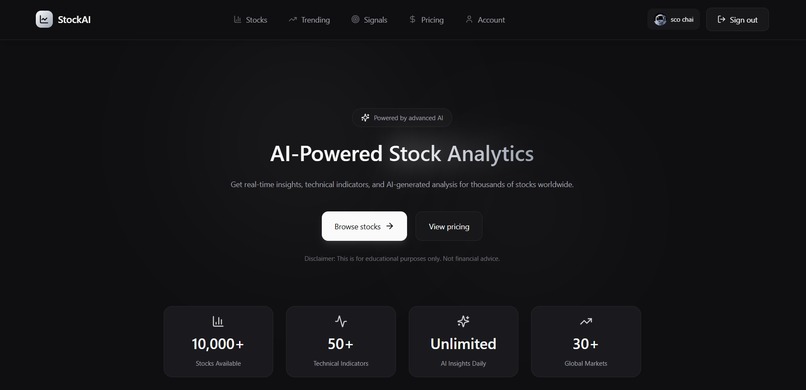
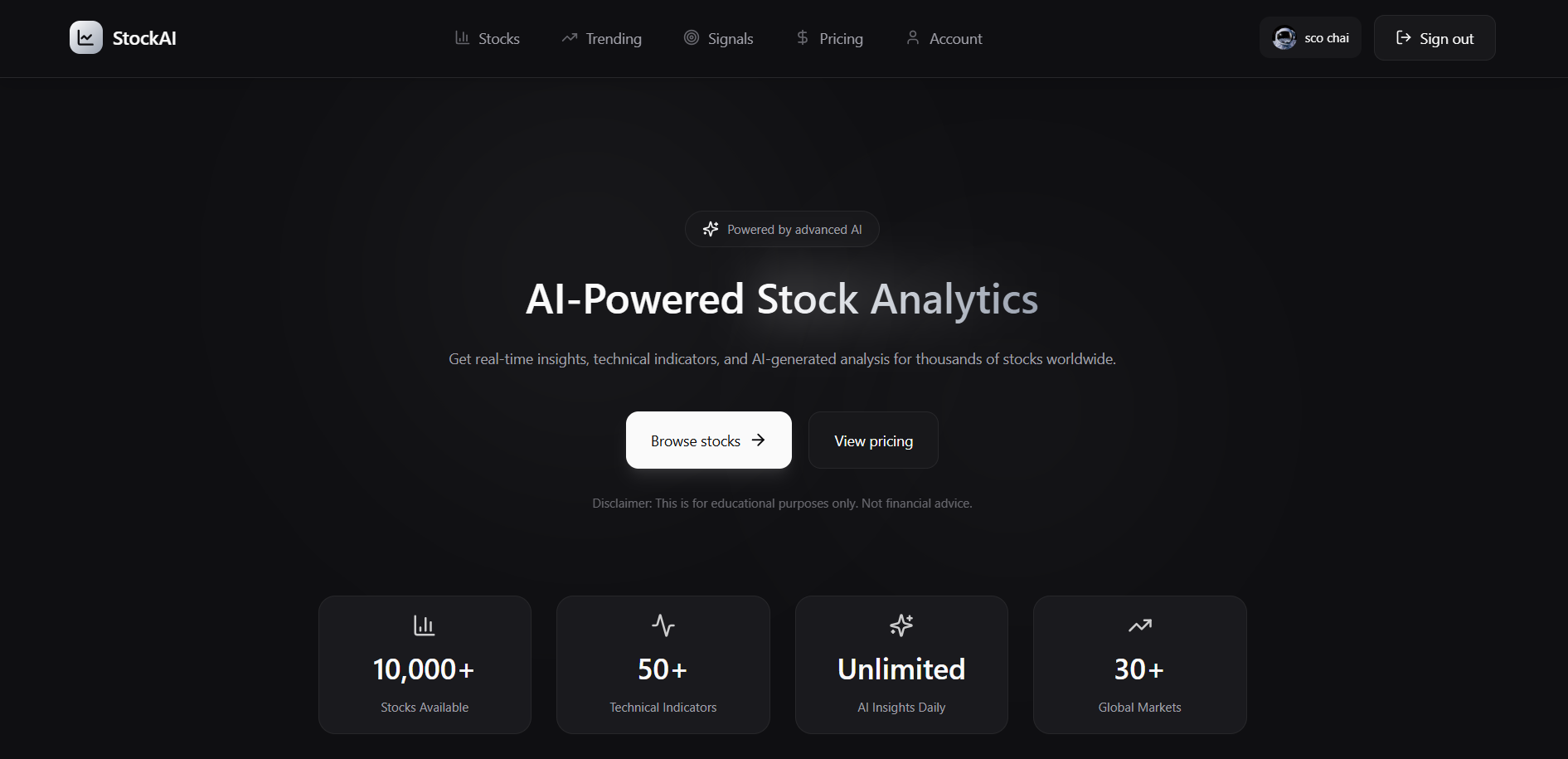
Landing page screenshot
Inspiration
Retail traders are often stuck guessing — reacting to headlines, hunches, or hype instead of data. Most professional-grade market analysis tools are locked behind expensive subscriptions or institutional access, leaving everyday investors to learn the hard way, often by losing money. I wanted to build something that levels the playing field: a tool that lets ordinary people make informed trading decisions using the same kind of systematic, risk-aware approach that professionals rely on, without needing a finance degree or a Bloomberg terminal.
What it does
StockAI continuously scans the market to surface potential trading opportunities automatically, so users don't have to manually sift through charts and news all day. Every opportunity it surfaces comes paired with proper risk management guidance, helping users understand not just what to trade, but how much exposure makes sense. Under the hood, a custom-built confidence grader scores each opportunity so the system can quickly gauge how strong a signal is before acting on it. The platform also includes full user authentication and Stripe-powered payments, making it a complete, production-ready product rather than just a prototype.
How I built it
I started by designing the full user experience in Figma, mapping out the flows for authentication, the market-scanning dashboard, and the payment experience before writing a line of code. From there, I built the frontend in React and the application logic in JavaScript, using Supabase for authentication and as the backend layer on top of PostgreSQL for storing user data, scan results, and subscription state. The confidence grading engine was custom-built to evaluate market signals and translate them into an easy-to-understand score, and Stripe was integrated to handle subscription billing end-to-end.
Challenges I ran into
Getting Stripe payments working correctly, including handling subscription states and edge cases, took significant trial and error. Setting up reliable automated emails (for things like account verification and user notifications) was another hurdle, since deliverability and timing issues aren't always obvious until you're live. Beyond the engineering, marketing turned out to be its own challenge entirely: building something is one thing, but getting real people to find it and try it is a completely different skill set.
Accomplishments that I'm proud of
Taking StockAI all the way from a Figma sketch to a fully working full-stack product with real authentication, a real payment system, and a real user base is something I'm genuinely proud of. So far the project has attracted over 1,000 unique visitors, which has been an encouraging signal that there's real demand for this kind of tool.
What I learned
This project taught me what it actually takes to ship a complete full-stack application end-to-end, not just the happy path, but the messy realities of payments, email infrastructure, and everything in between. Just as importantly, I learned that marketing and distribution are just as critical as the engineering itself; a great product means little if no one knows it exists.
What's next for StockAI
The next big milestone is building out an auto-trading system, so users can move beyond receiving recommendations and let StockAI act on high-confidence opportunities automatically, within the risk parameters they set.
Built With
- javascript
- postgresql
- react
- supabase

Log in or sign up for Devpost to join the conversation.