-
-
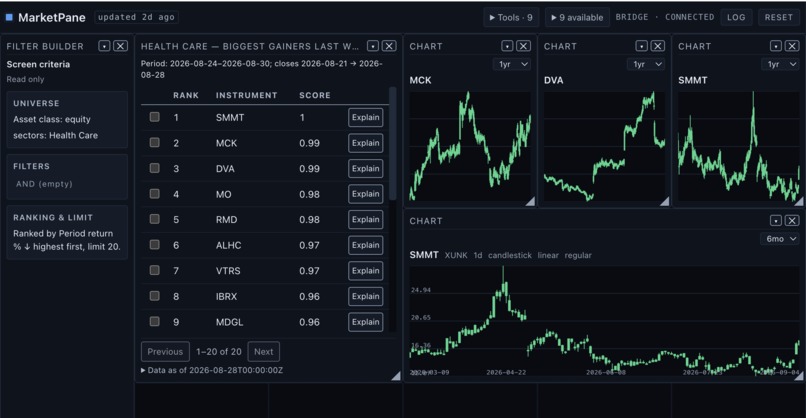
This is our current design, illustrating the grid and pane system
-
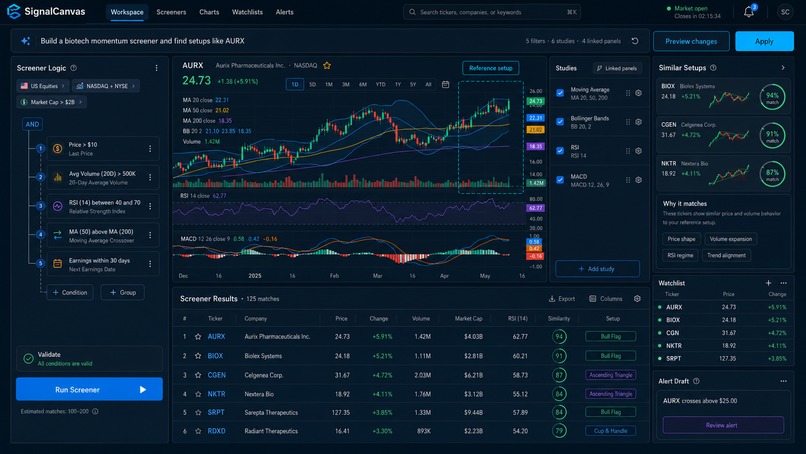
This is our design goal for a grid and widget based editable UX
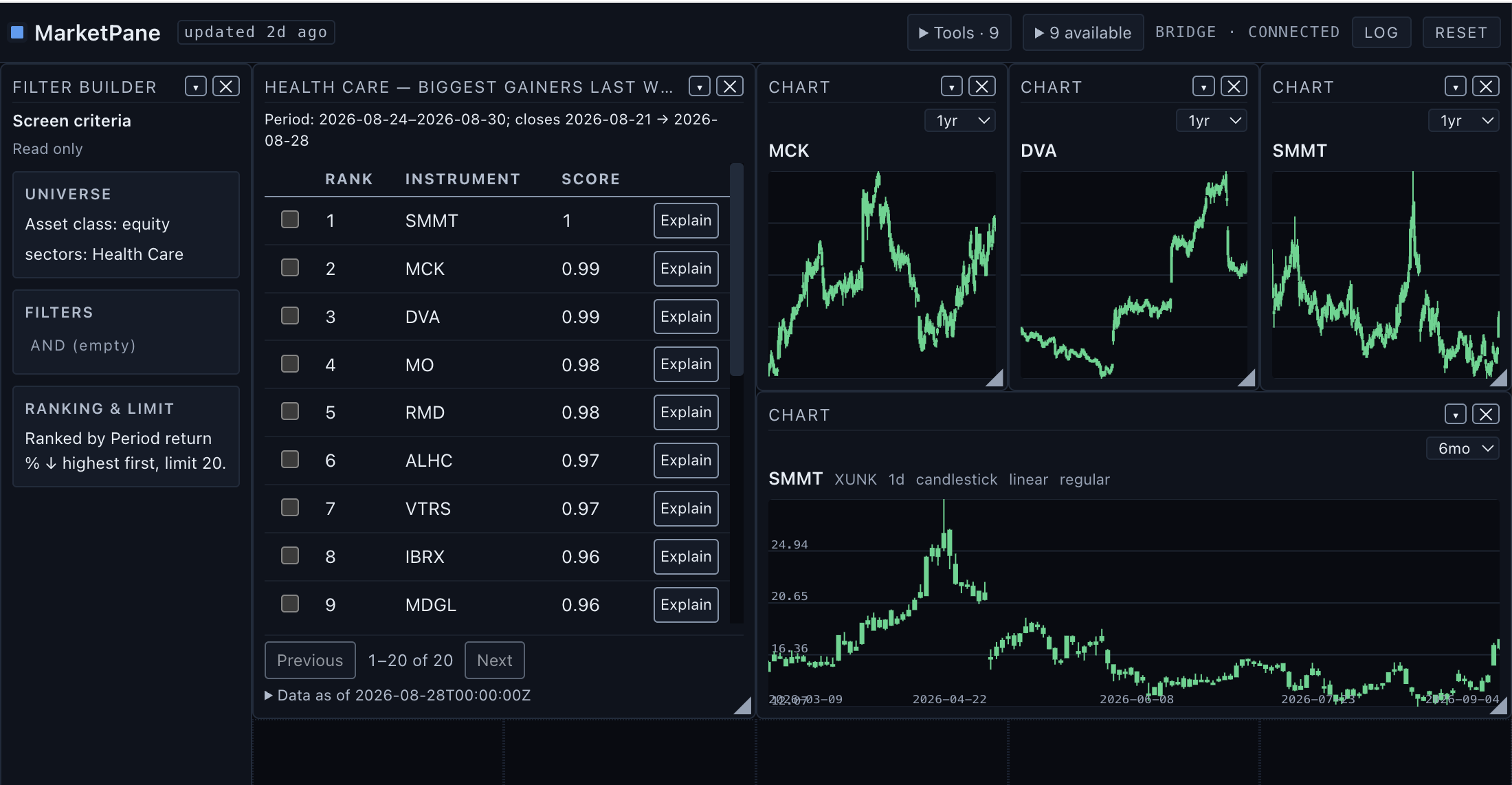
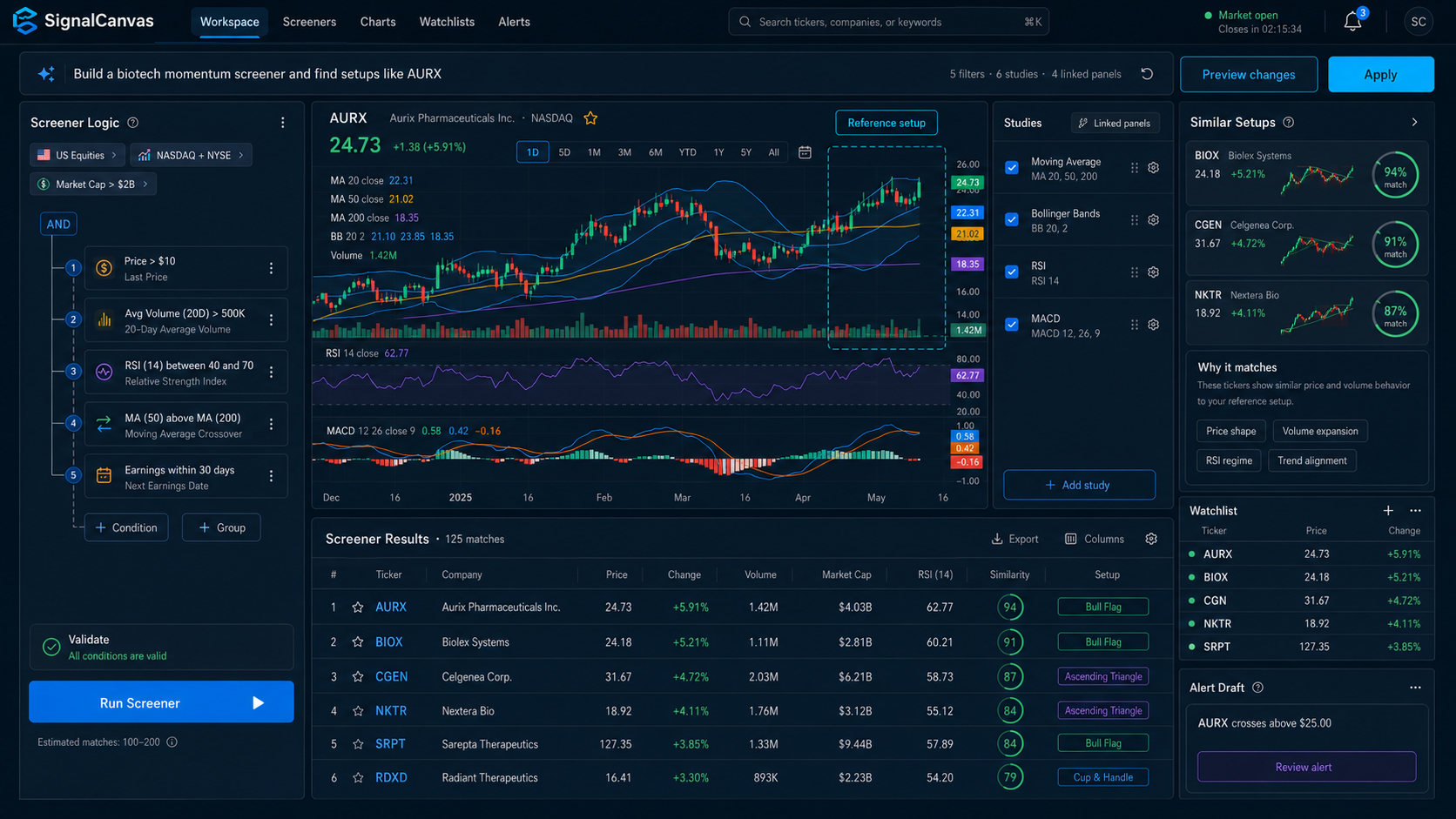
Inspiration
MarketPane, is an AI assisted research workbench for doing stock price analysis. Our goal is to build a tool that removes the barriers between an AI and the research canvas, so that a user can spend more time developing their hypothesis, and less time copying charts data back and forth. By putting the tools directly into the hands of an AI, we are basically shortening the iteration loop, allowing you to get to your goal faster.
What it does
MarketPane is a WebMCP-powered stock screener and research workbench shared between a human and an agent. Either one can define a screener over a universe of instruments (asset class, exchanges, sectors), build a filter tree of typed conditions, set a ranking, and run it to get a pinned, stable set of results. Results land in a panel grid: a results table the agent or the human can inspect, and — via drag-and-drop or a tool call — individual rows become live price charts on the same canvas. Every panel, chart, and result the agent creates is visible and rearrangeable by the human in real time, and vice versa.
How we built it
The frontend is SvelteKit 5 (SPA) with a browser-side panel/grid system and a workspace document that both the UI and the WebMCP tool layer read and write. WebMCP tools (define_screener, run_screener, get_screener_results, create_panel, resolve_ticker, search_catalog, get_canvas_state) operate on that same document, so an agent's actions show up as first-class panel changes instead of hidden side effects. The backend is a FastAPI service (Python, pandas) that evaluates screeners against an OHLCV panel of real market data (EODHD-sourced, object-store backed) and exposes a stateless /api/screener/run endpoint. A typed catalog of fields, operators, and universes keeps every filter condition validated rather than arbitrary code — the agent composes screeners out of known building blocks, it doesn't write expressions the backend has to trust blindly.
Challenges we ran into
There was a series of challenges that we ran into along the way. Firstly, we ran out of coffee half way through development and had to make an emergency trip to Costco. There were also a number of WebMCP specific challenges that we resolved:
- The browser was not aware of any WebMCP tools being available and kept trying to use UI elements. The agent has to query a document schema to know that the tools exist, and if it does not suspect them to be there it does not do this. We had to add specific UI elements to notify the agent.
- The browser did not support the number of tools that we initially created, and blocked them entirely. We had to minimize our implementation.
- It was very difficult to debug issues with the tools, especially in prod where we don't have all the BE logs handy. This is because issues are not just "bugs" in the app code, but problems with the sequence of actions that the agents take over time.
Accomplishments that we're proud of
We got a late start on the hackathon and had to build everything very quickly. Our AI enabled development platform has allowed us to achieve the capacity necessary to deliver a POC in time. We managed to add some not-so-simple features, and will continue to expand the feature palette.
What we learned
Building agentic tools is more than just developing the right workflow and backend scalability. It is also very much about giving the agent the proper awareness and context for the tools that you build. Without clean, self-explainable interfaces, agents will spend extra tokens going on detours or producing errors.
What's next for MarketPane
Next, we want to widen the live tool surface back toward the fuller design we already built and tested: similarity search ("find setups like this one"), chart annotation and capture, computed fields and custom studies, watchlists, alerts, and backtesting are all implemented behind feature flags today and just need to be wired back into the live composition root. We also want richer chart controls (timeframes, overlays, multi-ticker comparison) and stronger measurement tools so a user can move from spotting a pattern to testing it across cohorts, outcomes, and market regimes.
Built With
- fastapi
- numpy
- pandas
- pydantic
- python
- svelte
- sveltekit
- typescript
- vite
- vitest
- webmcp


Log in or sign up for Devpost to join the conversation.