-
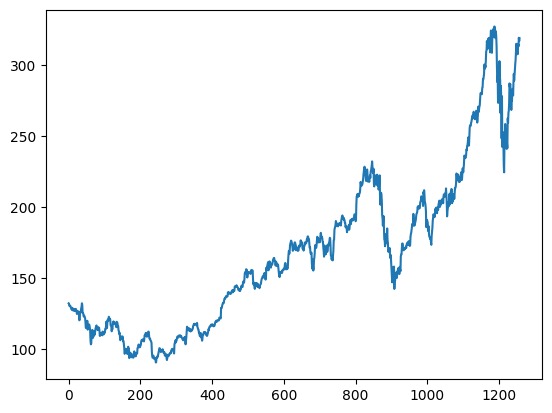
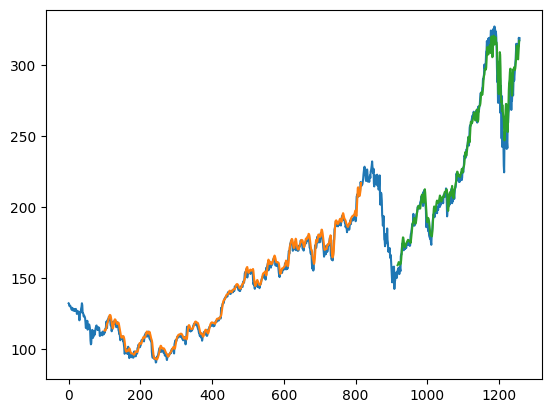
The training data of apple stocks over quite amount of time
-
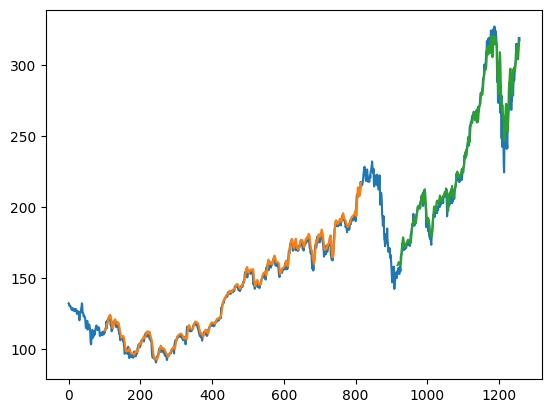
The performance of the model in predicting the Test data(Green is the Test and Blue is test)
-
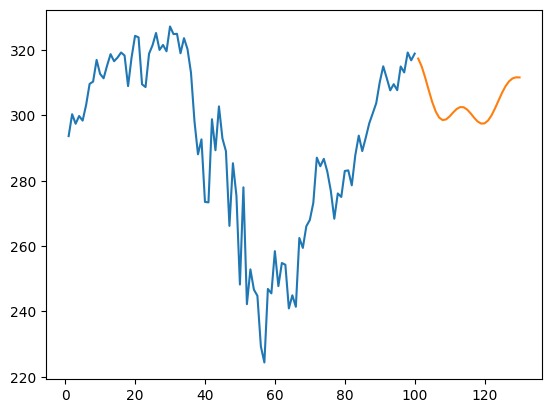
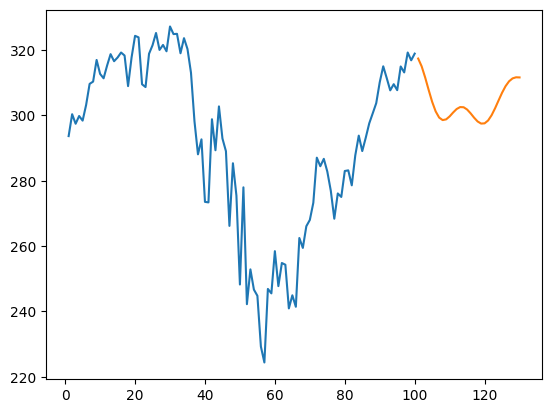
Forecasting the upcoming 30 days stock price of apple
Stock Market Prediction and Forecasting Using Stacked LSTM
Inspiration
The stock market is a dynamic and complex environment where timely, accurate predictions can make a significant difference for investors, traders, and financial institutions. Inspired by the need for smarter, data-driven decision-making in finance, we set out to automate stock price forecasting using the power of deep learning. Our goal was to build a robust model that could learn from historical data, capture intricate market patterns, and provide reliable predictions for future stock prices—empowering users to reduce risk and maximize returns.
What it does
This project automates the prediction of Apple Inc. (AAPL) stock prices using a stacked Long Short-Term Memory (LSTM) neural network. The model processes historical closing price data, learns both short-term and long-term trends, and generates forecasts for upcoming days. It not only predicts future prices but also visualizes the results, helping users clearly see how the model’s predictions align with actual market movements. By providing these insights, the project supports better investment strategies and risk management in the finance sector.
How we built it
Data Collection:
We fetched historical stock data for AAPL using the Tiingo API and stored it as a CSV file for easy access.Data Preparation:
The data was loaded into a pandas DataFrame, focusing on the 'close' price. We visualized the price trends to understand the dataset.Data Scaling:
To ensure optimal LSTM performance, we normalized the closing prices to a [0, 1] range using MinMaxScaler.Train-Test Split:
The dataset was split into training (65%) and testing (35%) sets to evaluate model performance.Sequence Creation:
We converted the time series data into sequences suitable for LSTM input, using 100 previous timesteps to predict the next value.Model Building:
A stacked LSTM model was constructed with three LSTM layers and one Dense output layer. The model was compiled with Mean Squared Error loss and Root Mean Squared Error (RMSE) as a metric.Model Training:
The model was trained for 100 epochs, with both training and validation performance tracked.Performance Visualization:
We plotted training/validation loss and RMSE curves to monitor learning progress.Prediction and Evaluation:
The model’s predictions were compared to actual prices, and RMSE was calculated for both training and test sets.Results Visualization:
We visualized the actual vs. predicted prices and demonstrated the model’s ability to forecast the next 30 days.
Challenges we ran into
- Data Preprocessing:
Ensuring the data was clean, properly scaled, and formatted for LSTM input required careful handling. - Model Tuning:
Selecting the right architecture, number of layers, and hyperparameters to avoid overfitting or underfitting was challenging. - Sequence Management:
Creating appropriate input sequences for the LSTM and managing reshaping operations was non-trivial. - Interpretability:
Making the results interpretable and actionable for users, not just technically accurate, was a key focus.
Accomplishments that we're proud of
- Successfully automated the end-to-end process of stock price prediction.
- Built a deep learning model that captures both short-term and long-term market trends.
- Achieved strong predictive performance, as demonstrated by low RMSE values and accurate future forecasts.
- Developed clear visualizations that make the model’s predictions easy to understand and use.
What we learned
- The importance of data preprocessing and scaling for deep learning models.
- How to structure and tune stacked LSTM networks for time series forecasting.
- The value of combining technical accuracy with user-friendly visualizations.
- That deep learning can significantly enhance traditional financial analysis and forecasting.
What's next for Stock Price Prediction Using Deep Neural Networks
- Expand to Multiple Stocks:
Apply the model to other stocks and financial instruments for broader applicability. - Incorporate More Features:
Integrate additional financial indicators (e.g., volume, technical signals) to improve prediction accuracy. - Real-Time Prediction:
Deploy the model for real-time forecasting and automated trading strategies. - Explainability:
Enhance model interpretability with explainable AI techniques, making predictions more transparent for users. - User Interface:
Develop a user-friendly dashboard for investors and analysts to interact with the model and visualize predictions.
This project demonstrates the transformative potential of deep learning in finance, paving the way for smarter, faster, and more reliable investment decisions.
What we learned
What's next for Stock Price Prediction Using Deep Neural Networks
Built With
- deep-learning
- lstm
- machine-learning
- python
- rnn

Log in or sign up for Devpost to join the conversation.