Inspiration
Most "stock market" games are either dry educational tools or luck-driven casino reskins. We wanted something different: a game that captures the actual feeling of running money — the morning briefing, the conviction calls, the discipline of knowing when to take profits and when to let a position run — but distilled into tight, mobile-friendly sessions anyone can pick up.
The breakthrough idea was fairness. Investing games are usually impossible to compare — everyone trades different things at different times, so "who's the best" is meaningless. We borrowed the insight behind Wordle: give everyone the same puzzle, then compare results. If every player faces an identical market — same prices, same news, same opportunities — then the leaderboard measures one thing only: the quality of your decisions.
What it does
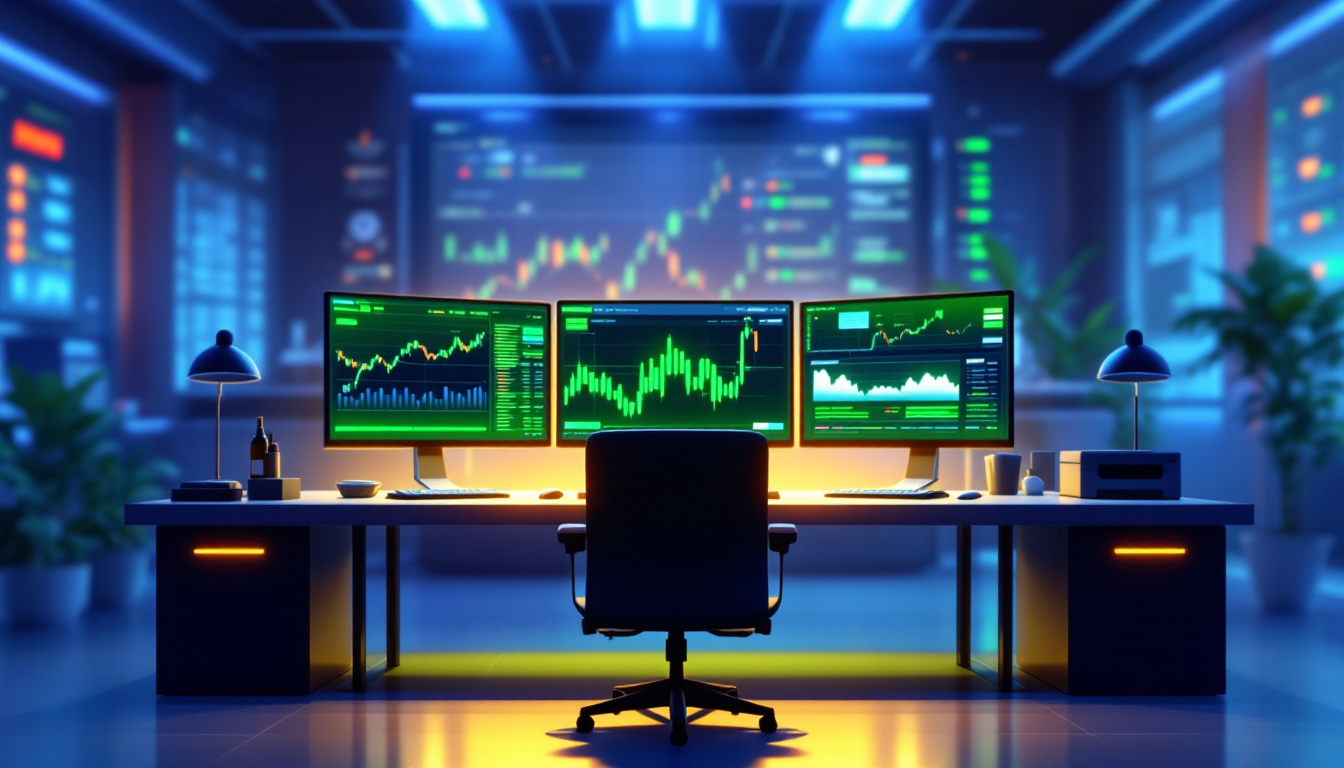
Stock Market Tycoon puts you in charge of your own fund, starting with $10 million in capital. Each session, you sit down at a living trading floor, advance time, and receive a Daily Briefing — your single most important screen. Your AI advisory team weighs in: Ava, your analyst, surfaces opportunities; Morgan, your portfolio manager, frames the day; and Ral, your head of risk, keeps you honest. You make a handful of high-conviction calls — taking the trades you believe in and managing the ones you already hold (hold, trim, or close) — and watch the outcomes unfold as time advances.
The signature skill is judgment under uncertainty. The analysts' targets are deliberately imperfect — good, not perfect — so the real game is deciding which calls to trust, how to size them, and when to exit. A position that hits its suggested target may still have room to run; one that stalls may be worth closing early. Take the analysts' suggestions and finish in two minutes, or study the workstation, read the news, research symbols, and place self-directed trades to beat them. Easy to play, hard to master.
Competitions run on seeds: fixed market configurations where every player starts with the same $10 million and faces the same opportunities over a roughly 30-day trading run. Pure skill, no luck advantage, no pay-to-win.
How we built it
The hardest constraint shaped everything: Horizon Worlds scripts run sandboxed, with no external network access. A live market data feed is simply impossible. So we built an offline AI pipeline that turns real market history into a fair, anonymized, fully self-contained simulation:
- Real market data (~2,700 trading days each across 100 companies) is ingested via EODHD into a PostgreSQL database of 30+ tables.
- Deterministic anonymization (salted SHA-256) transforms every real company into a consistent fictional one — preserving real price behavior and event timing while removing all real identities.
- A two-agent news system does the heavy lifting: a curator agent scores real news articles 0–100 on financial materiality and selects the few that genuinely moved markets; a rewriter agent anonymizes every entity and condenses each into a punchy blurb. Both run on Google Gemini via the Vercel AI SDK.
- Text-to-speech (ElevenLabs) voices the selected news so the trading floor's TV plays an actual broadcast.
- An opportunity engine scores setups on forward returns — what actually happened next in real history — then deliberately adds "analyst error" so the game rewards judgment, not omniscience.
- Everything is packaged into versioned, hash-verified data packs that ship inside the world — which is what makes seeded competitions perfectly reproducible.
The game itself is TypeScript running in the Horizon Worlds Desktop Editor: a deterministic simulation engine, a beat-based event system, NPC commentary generated from live portfolio state, and PPV-based persistence with a chunking layer to stay within Horizon's per-key storage limits. We validated the core loop early using a standalone browser-based test harness that renders the real UI driven by the real engine — letting us prove the game was fun before wiring a single gizmo.
Challenges we ran into
- No external data access. The defining constraint. We turned it from a limitation into a design strength — pre-generated packs are why the competition is fair and reproducible.
- Anonymization at scale. Keeping every person, product, and place consistently fictional across 100 companies and thousands of news items required a company-profile entity map and an unknown-entity flagging pass.
- Mobile performance with many live surfaces. Tickers, screens, and the briefing all update from a single authority via Horizon's broadcast events, rendering only at defined beats.
- Storage limits. Horizon's per-key PPV cap forced a chunking architecture to persist full portfolio history and resumable mid-session state.
Accomplishments that we're proud of
- A genuinely fair competitive investing game. Seeded, deterministic markets mean the leaderboard reflects skill alone — no luck, no timing advantage, no pay-to-win.
- A fully self-contained AI pipeline that runs inside a sandboxed world with zero network access, yet delivers anonymized real-market behavior, curated news, and a voiced broadcast.
- A complete, working prototype — not a concept deck. The simulation engine, NPC orchestration, tabbed trading workstation, AI data pipeline, and persistence layer are all built in TypeScript and run inside the Horizon Worlds Desktop Editor.
- One screen that carries the whole game. The Daily Briefing delivers the entire core loop in a tight, mobile-friendly format — everything else in the world is enrichment.
- Proving the fun before building the world — a browser test harness running the real engine and UI let us iterate on the core loop fast, backed by an extensive automated suite (100+ test files) anchored on seed determinism.
What we learned
The most valuable lesson was that constraints generate design. The sandbox's lack of live data pushed us toward pre-generated packs, which made deterministic seeds possible, which made a genuinely fair competitive leaderboard possible. The thing that looked like our biggest obstacle became the foundation of the most original part of the game.
We also learned how much a single well-designed surface can carry. The Daily Briefing alone delivers the entire core loop — everything else is enrichment.
What's next for Stock Market Tycoon
The headline feature on our roadmap is office and analyst progression: as your fund grows, you hire better analysts (which directly improves the AI-generated opportunities you receive) and your physical office expands to match your success — making your growth visible in the world itself. Beyond that: a dedicated educational layer, additional instruments (crypto, commodities), an intraday trading mode, an investor/LP character for narrative stakes, ambient trader chat, additional portfolio actions, and real-time synchronous multiplayer.


Log in or sign up for Devpost to join the conversation.