-
-
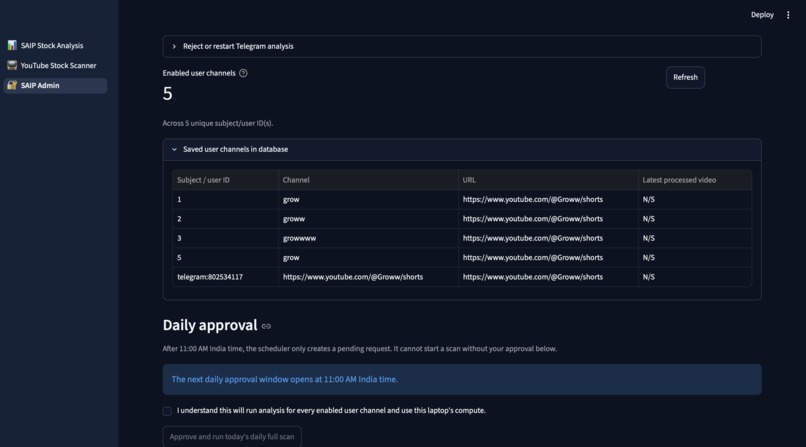
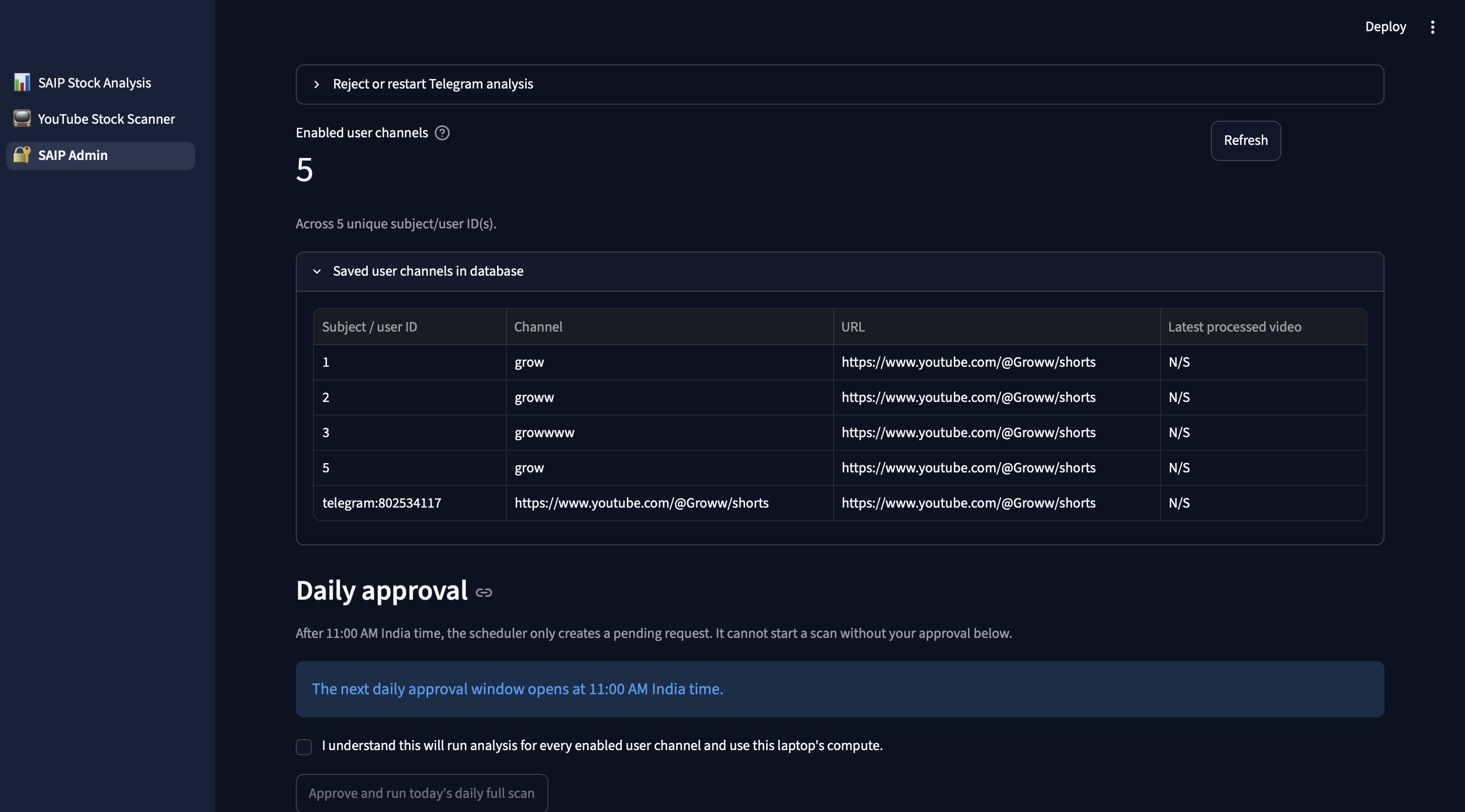
Keep compute under human control: inspect saved user channels and require explicit daily approval before an all-user scan runs.
-
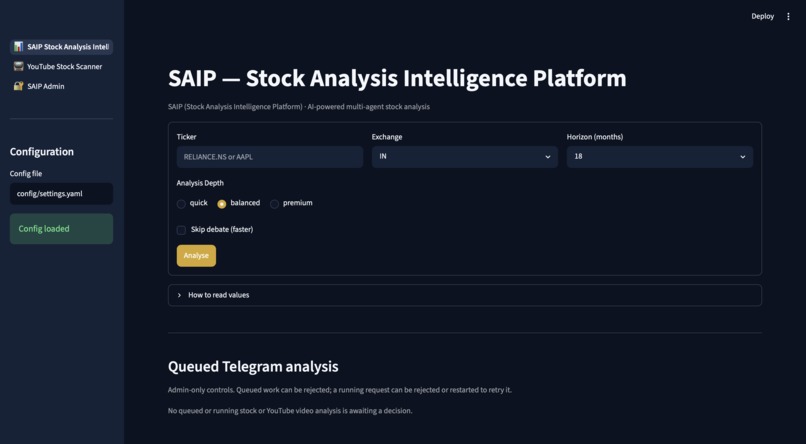
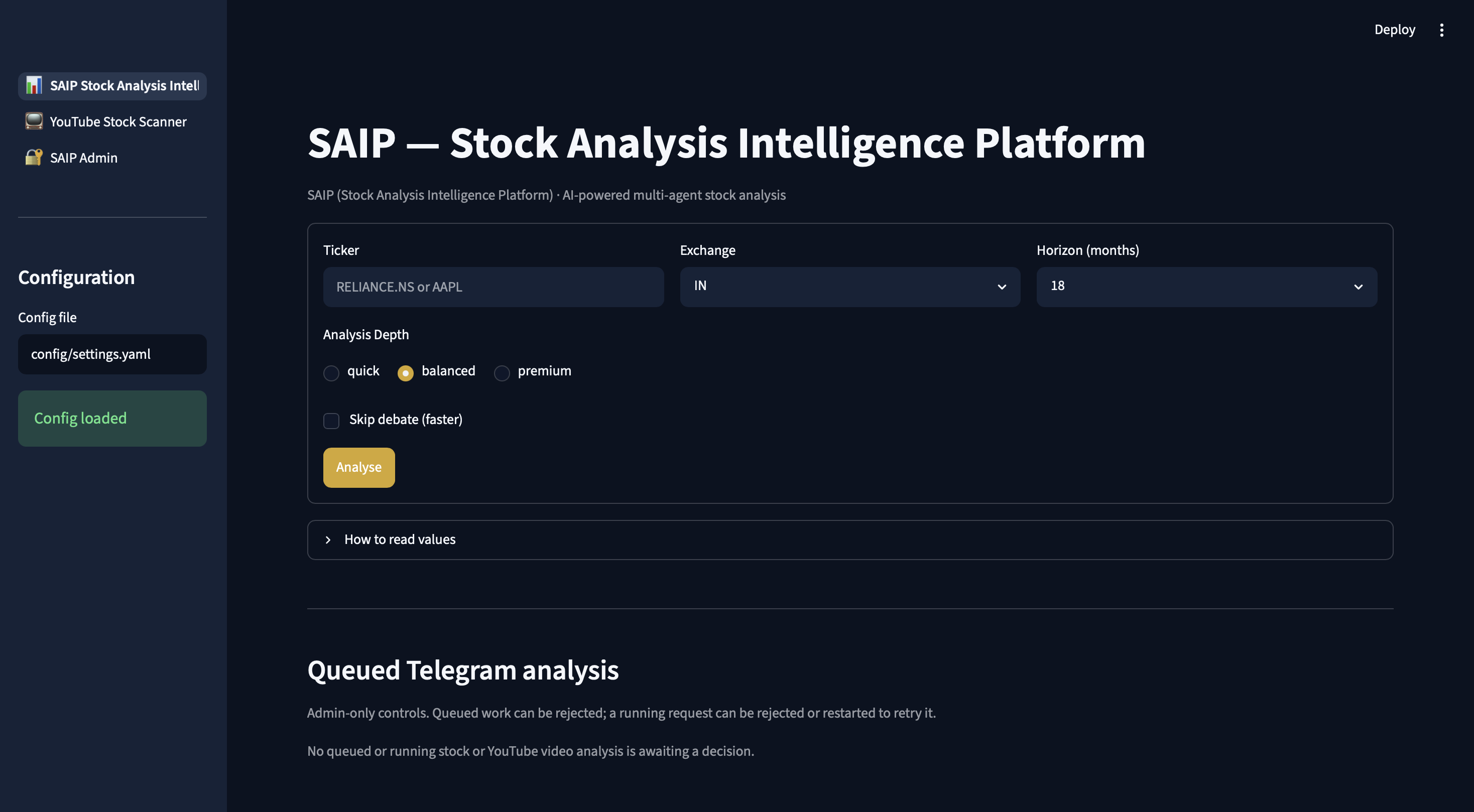
Configure a deep-dive: choose an NSE or US ticker, time horizon, analysis depth, and whether to run the bull/bear debate.
-
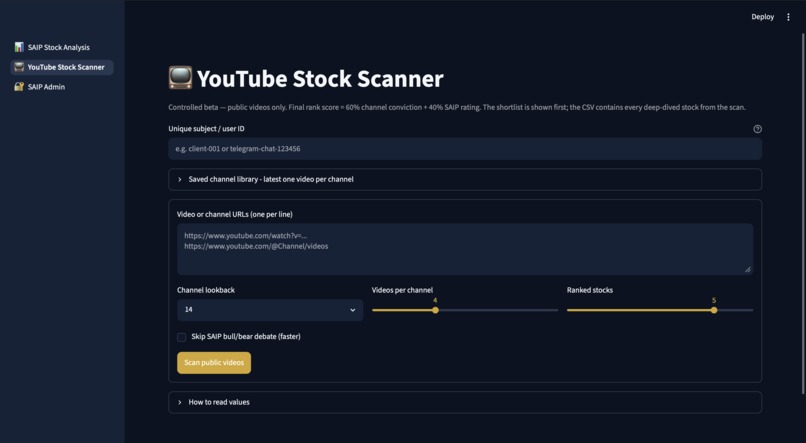
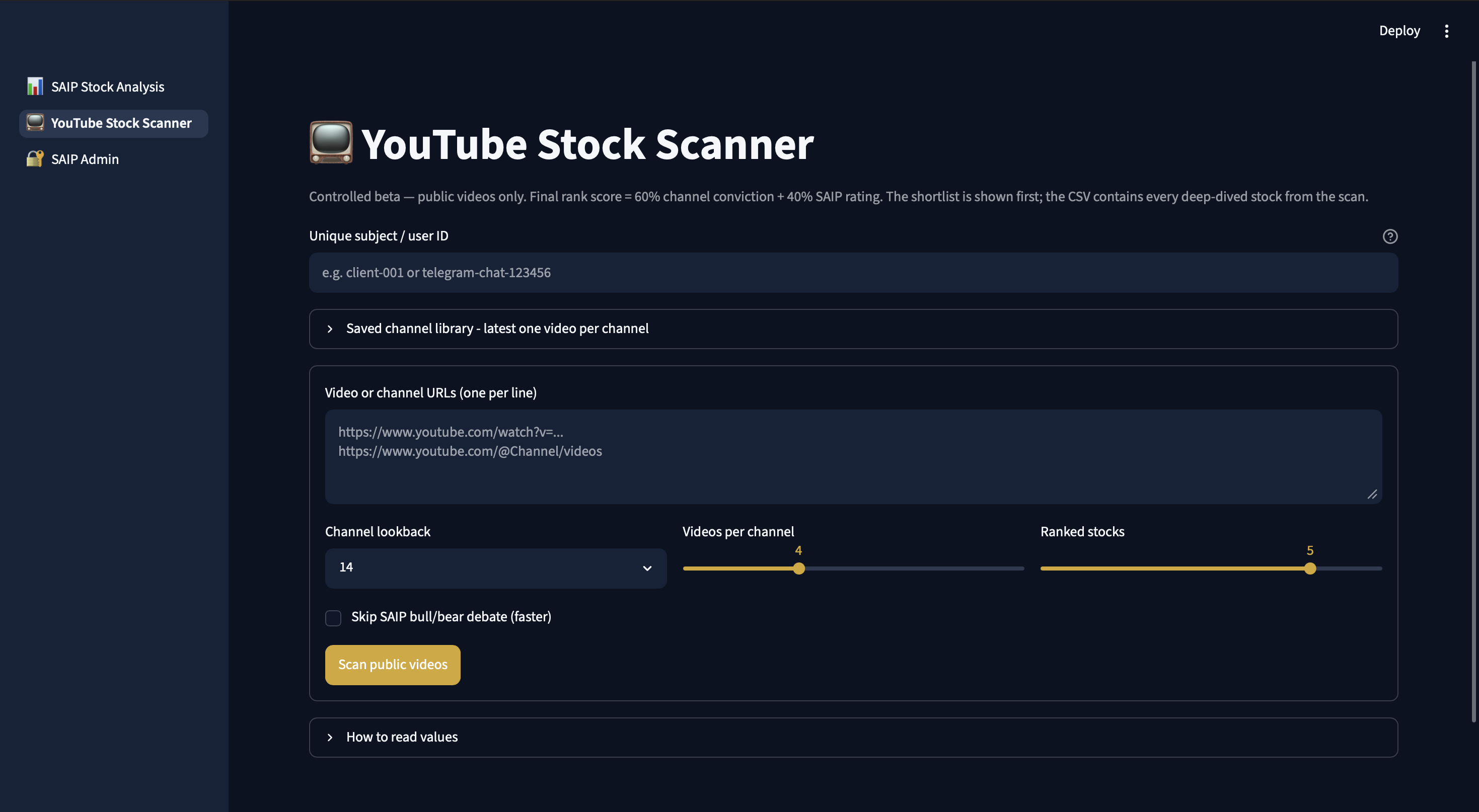
Turn videos into a research : scan public videos or saved channels, extract explicit stock calls, and rank candidates for SAIP analysis.
-
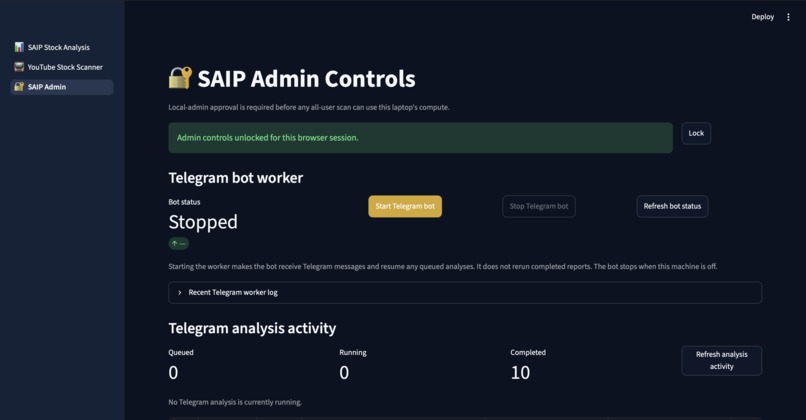
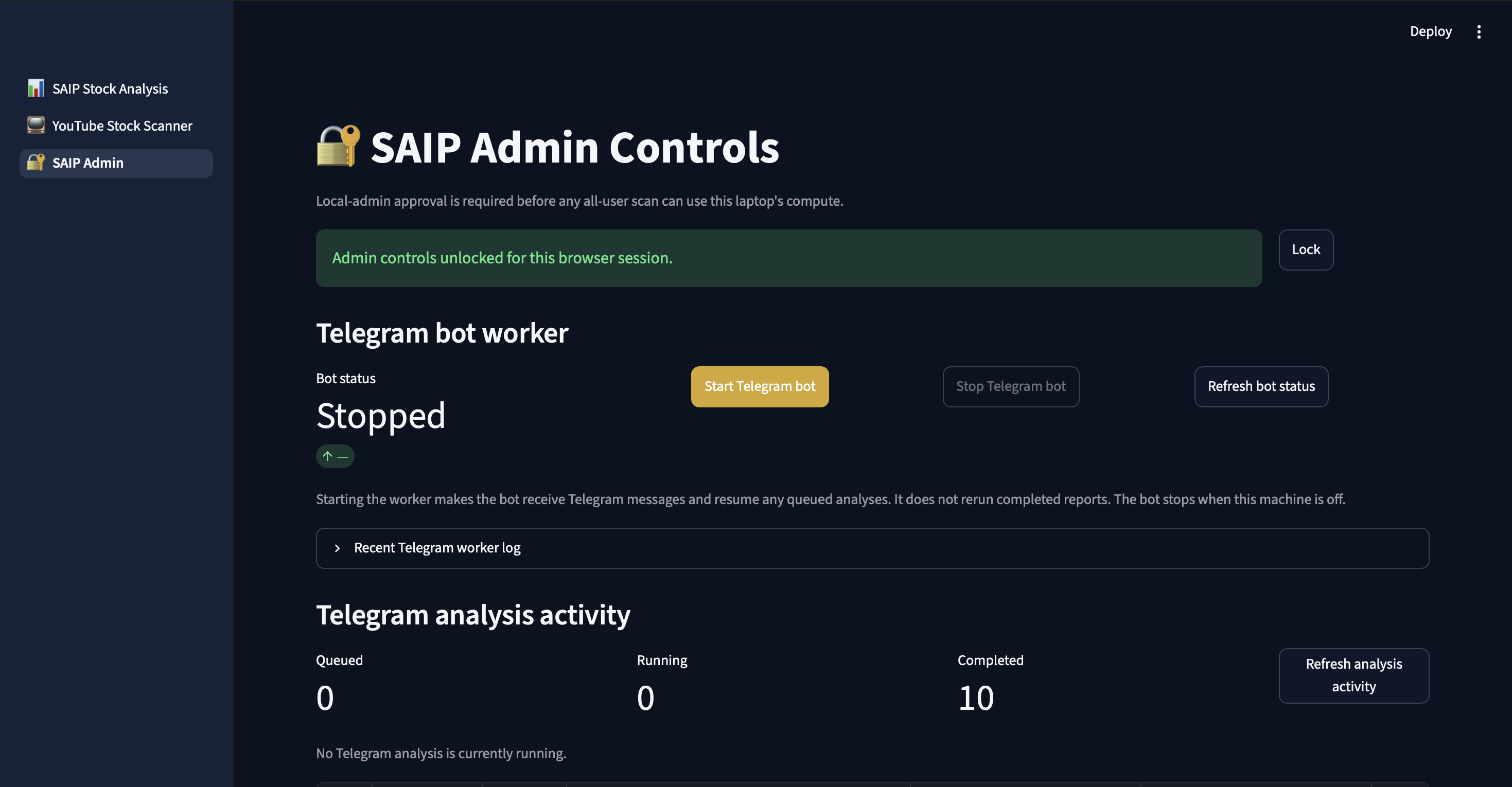
Operate private delivery safely: start or stop the Telegram worker and see queued, running, and completed private analyses.
Inspiration
Investment research is often scattered across price data, company fundamentals, market news, analyst views, and fast-moving video commentary. A single confident-looking answer can hide whether it used reliable evidence, whether another perspective disagreed, or even which market the stock belongs to. We wanted to build a research companion that makes this work more structured, explainable, and available from the surfaces people already use.
What it does
SAIP analyses NSE and US equities through a multi-agent workflow and produces a private, downloadable PDF report. Its public YouTube scanner finds explicit Indian-stock calls in videos or monitored channels, keeps uncertain ticker matches unresolved instead of guessing, and ranks shortlisted names using $60\%$ channel conviction and $40\%$ SAIP rating. Its Telegram bot lets users ask for an analysis in a private chat, select the intended market, manage channel subscriptions, and receive the completed summary and report.
How we built it
The application is built in Python with Streamlit for the operator interface and SQLite for durable local state. A shared KnowledgeGraph combines market data, news, regime context, and deterministic risk calculations. Specialist agents cover fundamentals, macro, moat, growth and valuation, risk narrative, and market regime; an Evidence Auditor checks their claims before a structured bull/bear debate and CIO synthesis.
The YouTube workflow uses public-video discovery, captions or speech-to-text, conservative extraction and ticker resolution, aggregation, ranking, CSV/PDF export, and an explicit admin approval gate for all-user runs. The Telegram worker persists requests, processes them first-come-first-served, and reuses a matching completed report for seven days.
OpenAI Codex, powered by GPT-5.6, was our development collaborator. We used it to inspect the architecture, implement and test the Telegram workflow, strengthen ticker/market disambiguation, add queuing and report reuse, improve PDF output, and make the admin interface observable and controllable. GPT-5.6 is not presented as SAIP's runtime investment model; runtime model routing is configurable and every result is clearly labelled as informational research, not investment advice.
Challenges we ran into
The difficult part was not generating a recommendation; it was making the workflow trustworthy and operable. We handled incomplete market data without turning missing values into misleading zeros, made ticker selection explicit when a name could point to more than one market, retained unresolved video mentions rather than silently guessing, and designed the queue so stuck work can be rejected or restarted visibly.
Accomplishments that we're proud of
- Built a multi-agent research loop where a shared market-intelligence record, evidence audit, bull/bear debate, and CIO synthesis work together instead of producing one opaque model answer.
- Made stock identification safer across NSE and US markets by asking users to select a market before normalising a ticker, and by keeping uncertain YouTube ticker matches unresolved rather than guessing.
- Connected the workflow to the places users work: public YouTube signals become a ranked research shortlist, while private Telegram requests receive summaries and PDFs through a durable first-come-first-served queue.
- Added practical operating controls: seven-day report reuse, live queue visibility, saved-channel ownership, explicit daily approval for all-user scans, and reject/restart controls for stuck work. ## What we learned AI research tools need provenance, clear uncertainty, human approval for expensive background work, and interfaces that explain what the system is doing while it is doing it. Building the controls and evidence trail alongside the analysis made the result far more useful than a single opaque recommendation.
What's next for Stock Intelligence & Recommendation Platform
Next, we plan to evolve SAIP from research on one stock into a portfolio intelligence layer. Planned work includes a portfolio manager with holdings, allocation, and risk views; historical backtesting for recommendation and strategy evaluation; and portfolio monitoring that sends Telegram updates when thesis, risk, price, or allocation conditions change. We also plan to support personalised watchlists, scheduled follow-ups, performance attribution, and clearer portfolio-level explainability while keeping human approval and evidence quality central to the workflow.

Log in or sign up for Devpost to join the conversation.