Inspiration
In a hospital, a wound that won't heal can be life or death. Nobody has the luxury of guessing. But long before any treatment reaches a patient, it's tested in a lab: scientists scratch a layer of cells in a dish and film it for a day to see if it closes. Today's tools only measure the result after the run. We wanted to know hours early, and to know how far to trust the answer.
Who it's for: scientists running wound-healing (scratch) assays, the standard lab test for how cells close a wound in cancer, fibrosis and wound-healing research.
What it does
Upload a few photos from the start of a wound-healing experiment. Stitch:
- reads your protocol: paste the Methods paragraph and a fine-tuned model fills in the settings (time between photos, pixel size, cell type) for you to confirm
- checks every photo and refuses blank or blurry ones, or ones where the wound can't be found cleanly, and says why
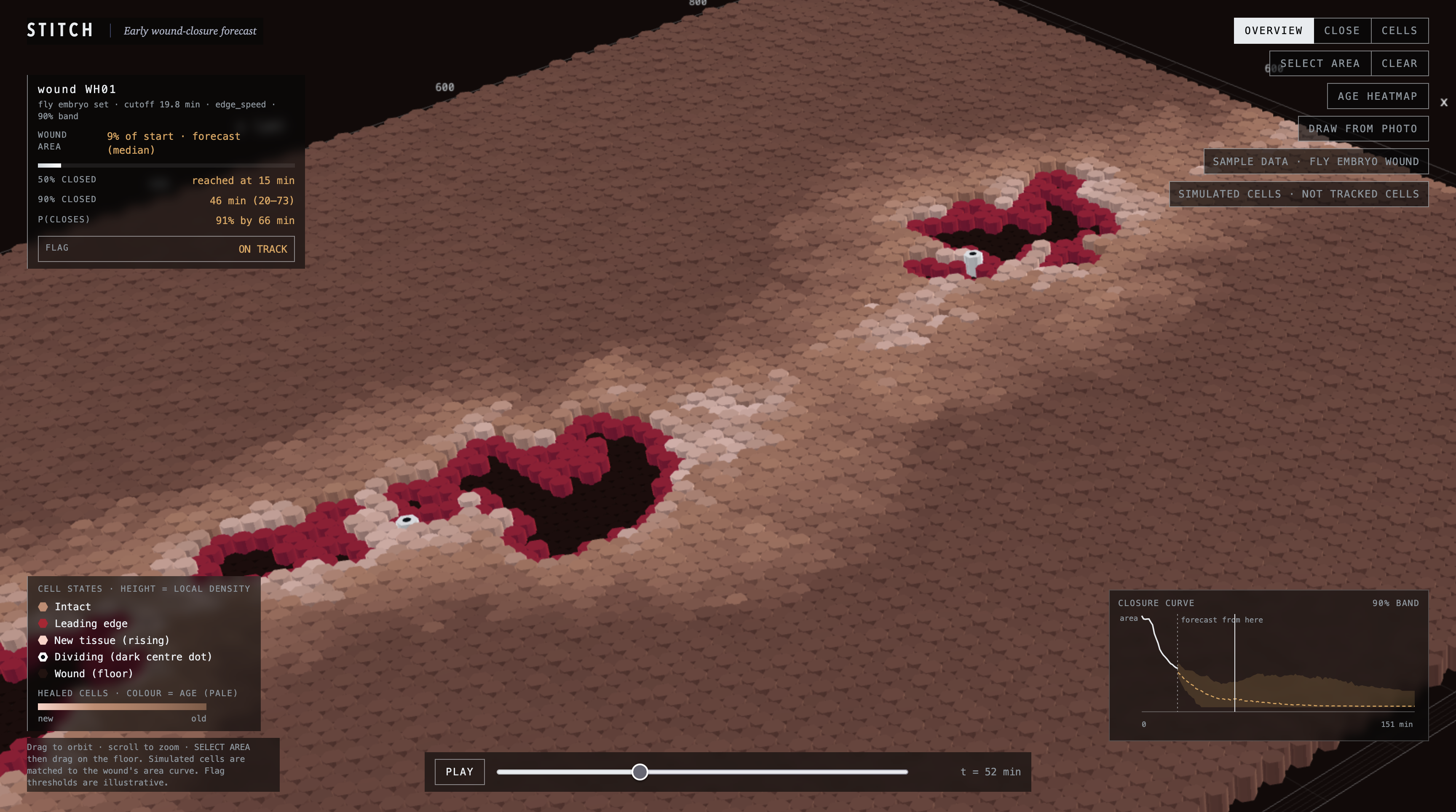
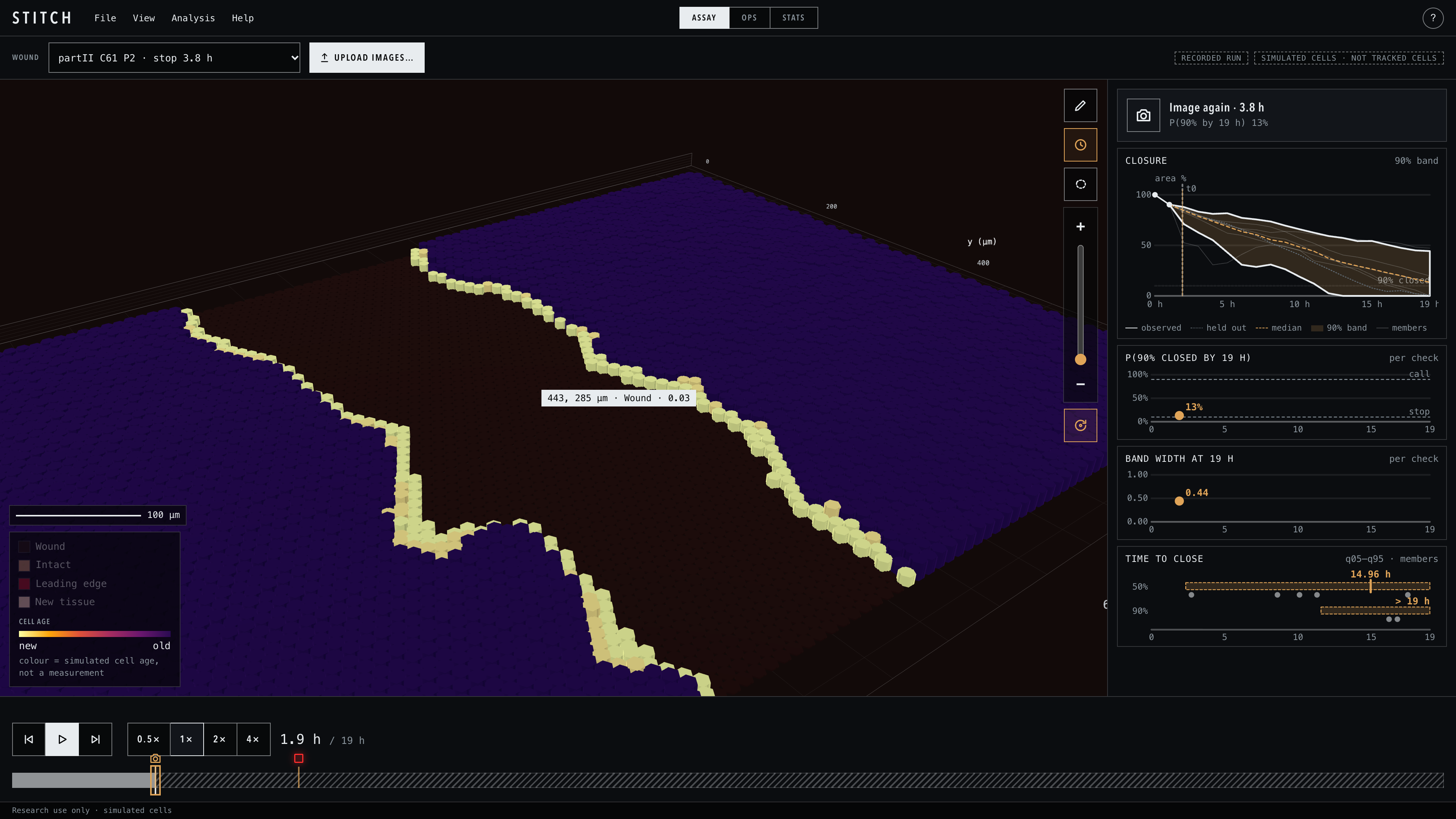
- finds the wound and predicts the rest of the healing: a 90% range, when it will be half and 90% closed, and the chance it's 90% closed by the end of the run
- warns when a wound stops healing
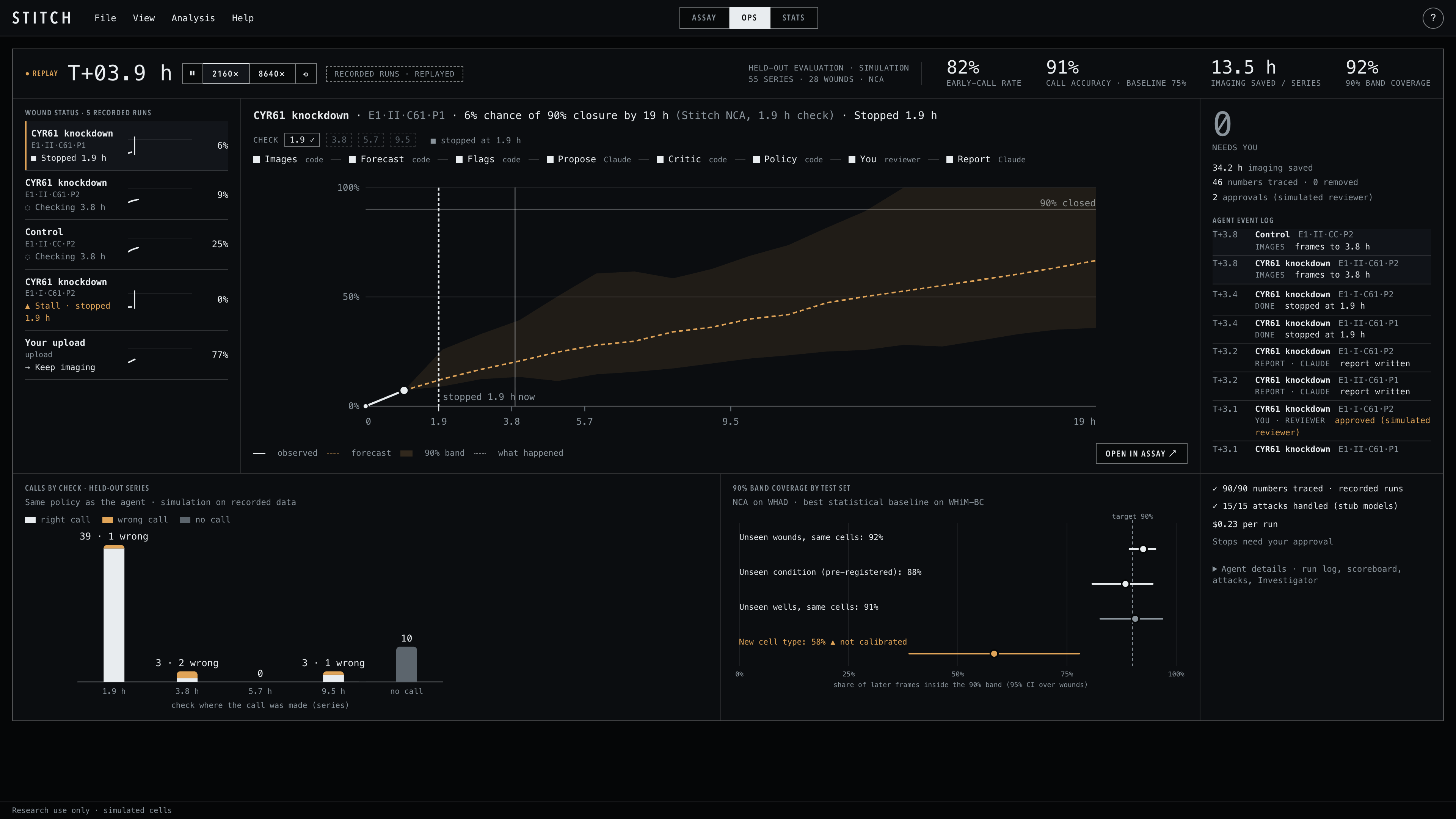
- runs an AI assistant (Claude, by Anthropic) that suggests the next step: take another photo, or stop early. Anything that stops an experiment waits for a person to click Approve, and a code checker deletes any number the AI didn't get from a tool.
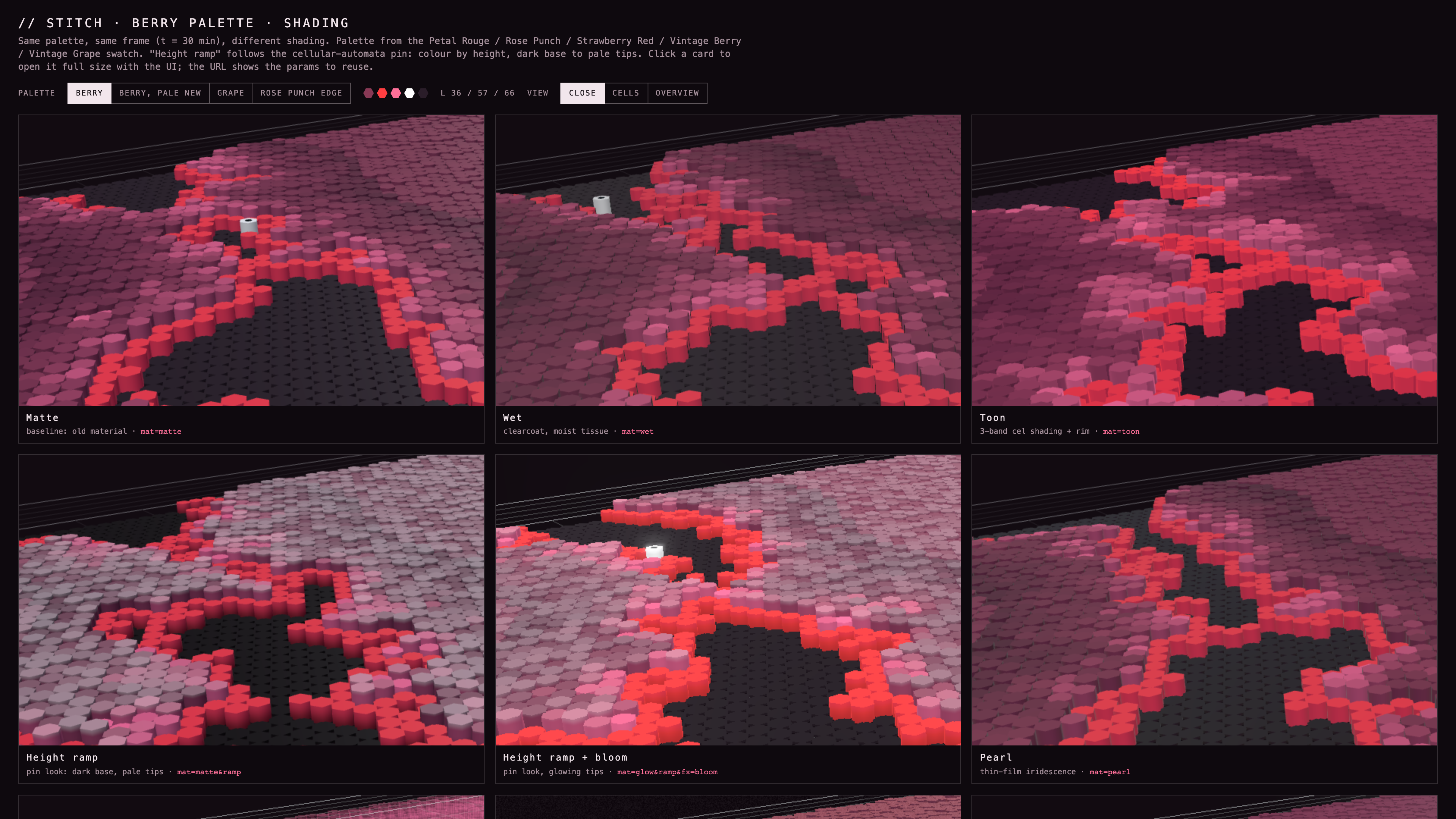
Three views: Assay (upload or try a sample, see the forecast, approve the decision), Ops (every run, logged and replayed) and Stats (how good the forecasts really are). You can also draw your own wound and watch simulated cells close it, live in the browser.
How the live demo runs: photo checks, wound finding and the forecast run live in your browser, with no keys and nothing uploaded. The AI assistant's decisions are real runs recorded with Claude and played back, and the protocol reader shows a result saved from our fine-tuned model, so the demo works for anyone, offline.
How we built it
- Real data: WHAD, real microscope time-lapses of human breast cells closing a scratch (28 wounds), plus three more open datasets to check the results hold elsewhere and a fifth to set up our cell simulator.
- The model: a neural cellular automaton, a small neural net that learns how cells fill a gap, step by step. We trained it on our own cell simulator, then fine-tuned it on the real lab time-lapses. Every wound was tested by a version that had never seen it.
- Honest uncertainty: each forecast's 90% range is built from the mistakes the model made on other wounds, so the range is earned, not assumed.
- A test we set before we looked: a model only ships if it's within 10% of the best simple formula and its 90% range really holds about 90% of the time.
- Fine-tuning with Adaption: a lab's Methods paragraph goes in, the upload settings come out. We fine-tuned Qwen3.5-2B with Adaption AutoScientist (run
695c8c20). On 30 real Methods paragraphs it never saw, it got 80.4% of fields right vs 47.4% for the base model (all fields right: 20% vs 0%; platform win rate 0.9471). It still makes mistakes, so it shows each setting next to the sentence it came from and a person confirms it. - Designed in Figma first (file): every screen was wireframed before we wrote code. We kept a dense first version of the main screen next to a calmer second one, and that comparison is why the app now shows the decision first and hides secondary panels in menus. The style guide (colour, type, buttons, honesty labels) became the app's design tokens directly. One amber accent means "forecast or needs you", nothing relies on colour alone, and the cell colours were checked for colour blindness.
- Built in Python (NumPy, SciPy, PyTorch) and plain JavaScript with three.js. No build step: clone, run one local server command, open the page.
Challenges we ran into
- Our AI lost first. Trained only on simulation, it did 30% worse than a two-parameter formula and failed our own test. Retraining on real lab time-lapses is what made it competitive.
- Hidden leaks. In the dataset, some wounds were recorded in two parts that looked like separate wounds, and one folder had two microscope positions spliced together. We caught both and changed how we split the data, so no wound is ever scored by a model that trained on it.
- A new condition broke the range. On cells with a gene knocked down, the range held only 72% of the time at the latest check. Calibrating on all the other conditions brought it back to 90%.
Accomplishments that we're proud of
- The 90% range held 92% of the time on 28 wounds the model had never seen.
- On one unseen wound, what really happened stayed inside our prediction at 15 of the next 16 photos.
- Fine-tuned on real data, our model is within 3% of the best simple formula and better at the earliest and latest checks.
- Replaying past experiments, when Stitch called early that a wound wouldn't close, it was right 91% of the time, vs 75% for always assuming the worst.
- We attacked it ourselves 15 different ways: hidden instructions, bad photos, broken files, off-topic requests, made-up numbers. Using stand-in AI models, so we were testing the safety rules and not luck, it handled all 15.
- The whole benchmark rebuilds from a fresh clone, byte for byte.
What we learned
- Simple models are hard to beat on small biological datasets. Honest uncertainty matters more than a bigger model.
- Saying where it fails makes it more useful. On a faster-closing cell type, our range held only 58% of the time, so every lab needs to calibrate Stitch to its own cells. The stall warning is right only half to three-quarters of the time it fires, which is why it asks a human instead of acting.
- Wound size alone can't tell you why a wound is slow. We tested it: it can't separate cells moving less from cells dividing less, so we don't claim to.
What's next for Stitch
- Calibrate on a lab's own microscope and cell line (a few dozen wells per condition looks like enough).
- Test on more cell types: diabetic, infection and fibrosis models, and drug screens.
- Extend the Adaption fine-tune to the rest of the agent.
Research use only, not for diagnosis or treatment. Code (MIT): https://github.com/ephemerallyCaden/imperial-ai-hack
Rand, Caden, Joanne
