-
Stillwave: contactless sleep and breathing tracking from a 60 GHz radar on your nightstand. Nothing to wear, no camera.
-
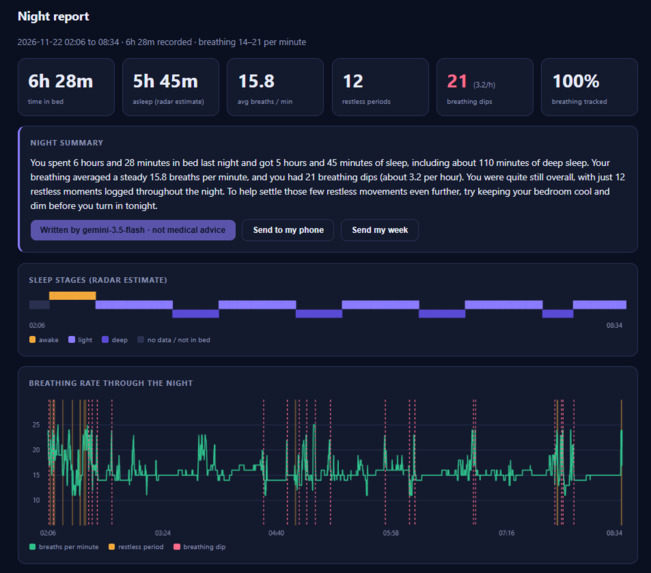
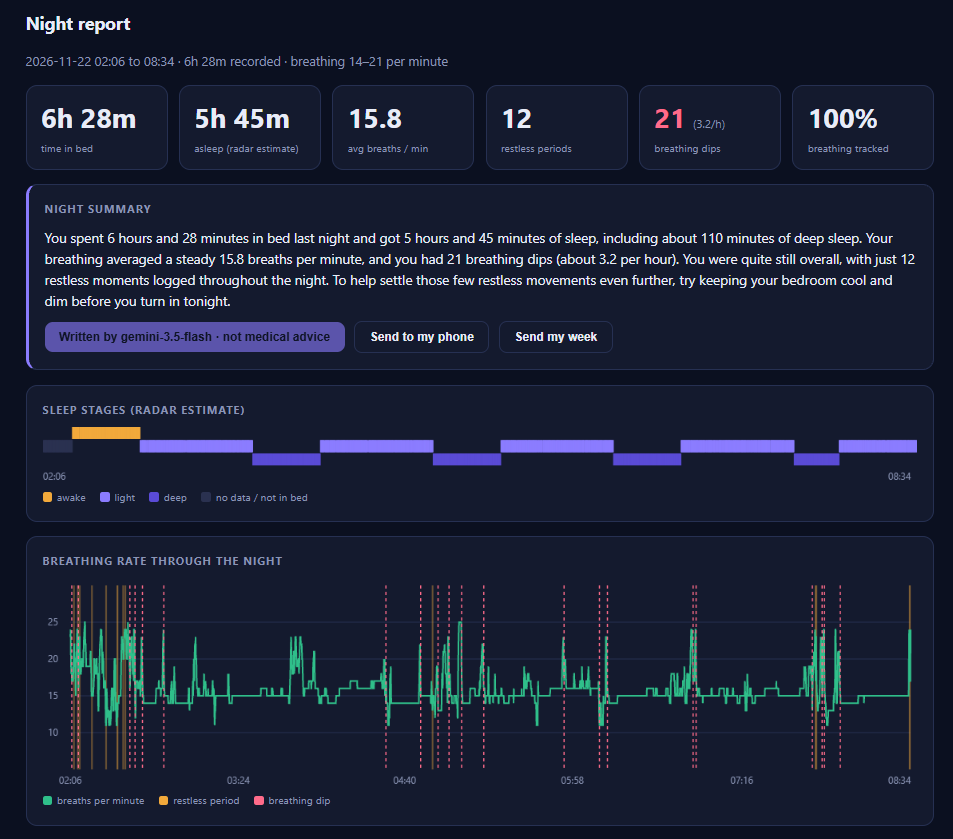
The real morning report from Stillwave's dashboard: sleep stages, breathing rate through the night, and a Gemini-written summary.
-
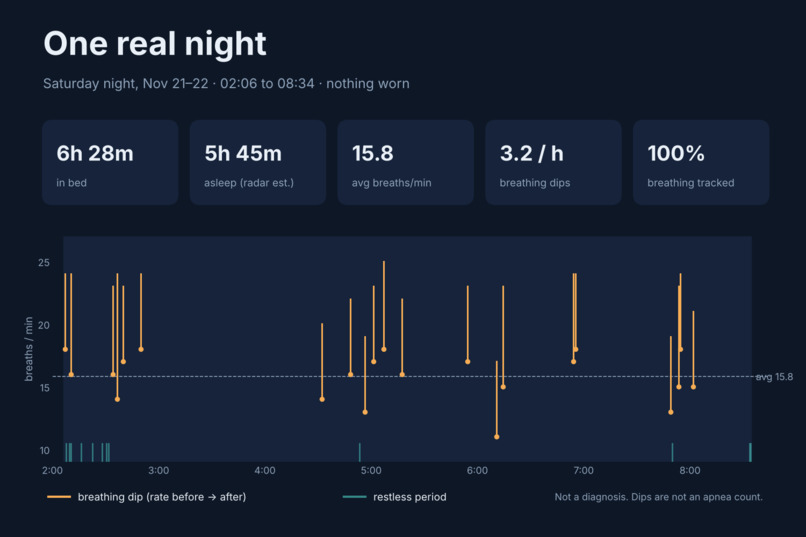
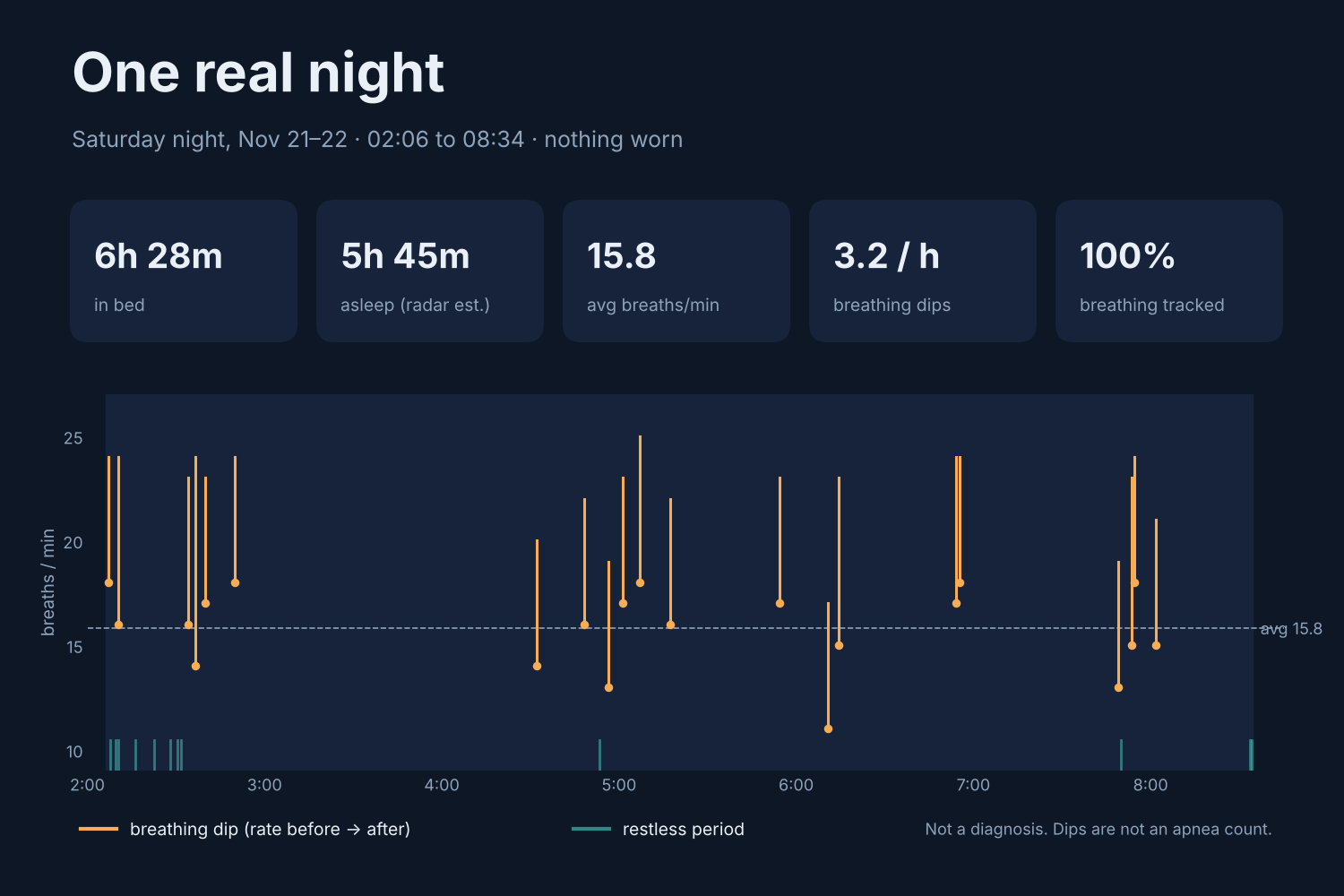
A real night of my sleep: 21 breathing dips (3.2/h) over 6.5 hours, with breathing tracked 100% of the time. Not an apnea count.
-
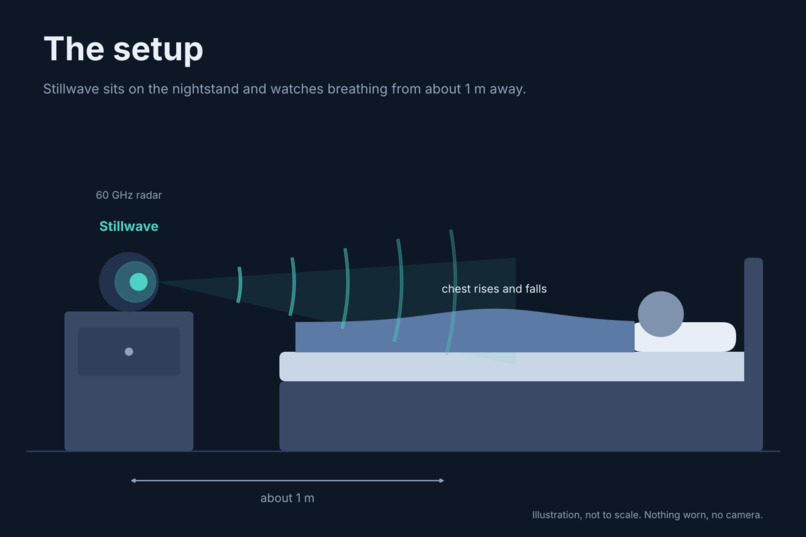
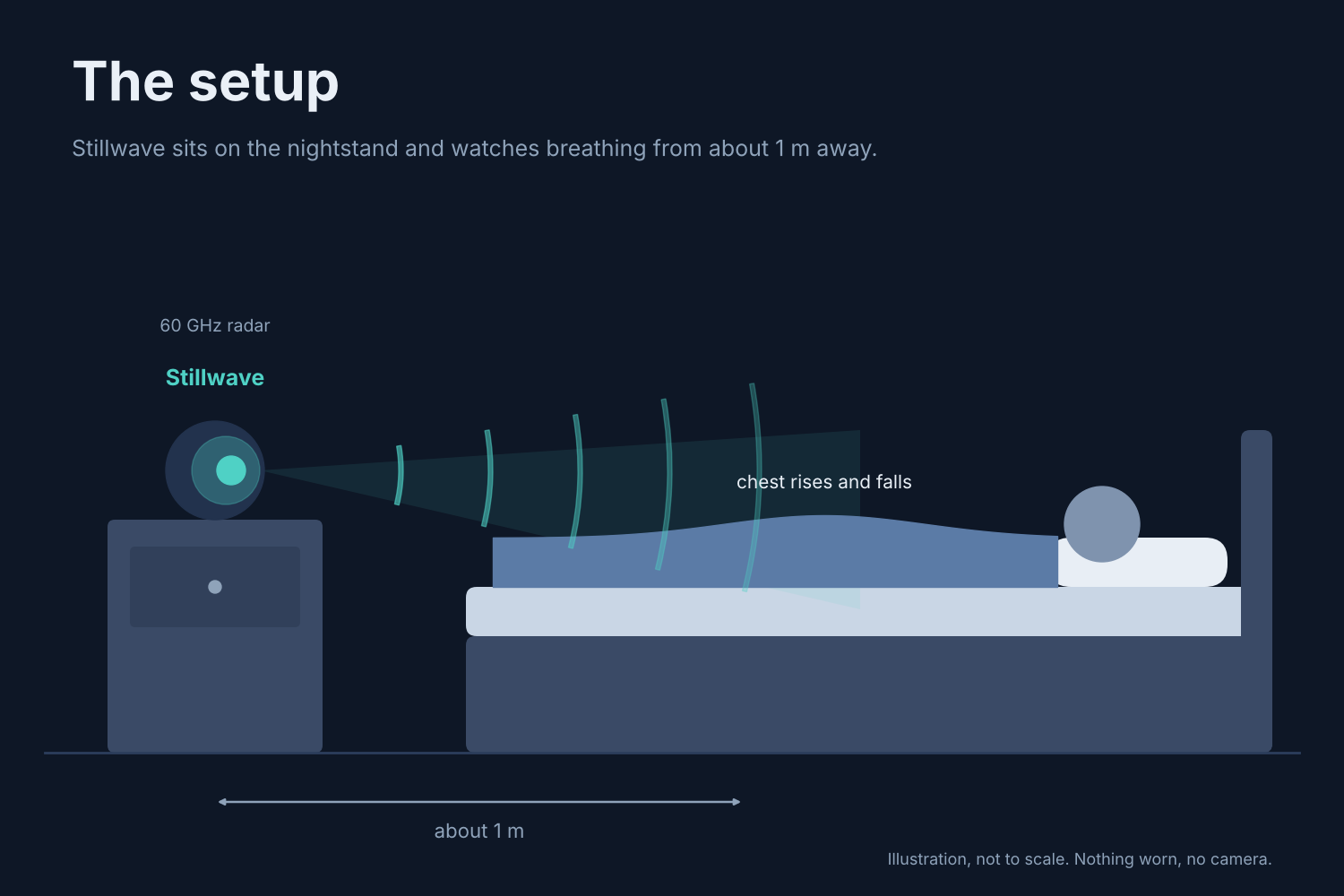
Illustration of the setup: the orb sits on the nightstand about 1 m from the bed and reads chest movement by radar.
Inspiration
About 936 million adults worldwide are estimated to have obstructive sleep apnea, and most cases are never diagnosed. Finding out usually means a night with sensors strapped to you. I wanted to see how much a bedside device could notice with nothing worn at all.
What it does
Stillwave sits on your nightstand and watches your breathing from about a meter away with a 60 GHz radar: no camera, nothing to wear.
- Live dashboard: breathing rate, whether you're still, restless or asleep, and breathing dips (sharp slow-downs in breathing).
- "Try it" challenge: hold your breath on cue and watch Stillwave catch it, with a running tally of holds caught.
- Morning report: time in bed, time asleep (radar estimate), breathing range, restless periods, dips per hour, and a plain-language summary written by Gemini.
- Phone notifications: 10 minutes after you get up, the night's numbers and Gemini's summary arrive on your phone, plus a weekly roll-up on Sundays, like Screen Time.
How we built it
- Hardware: ESP32 and a DFRobot C1001 60 GHz mmWave radar, in a 3D-printed orb with a fabric front. The case is generated in Python (manifold3d).
- Firmware: the ESP32 reads the radar over serial and sends presence, movement, breathing rate, a heart-rate estimate and sleep state to the laptop.
- Laptop: a Python FastAPI server saves each night to CSV, streams live data to the dashboard over a WebSocket, and builds the night report.
- Breathing dips: the radar's breathing rate falls by 6 or more breaths per minute within 30 seconds, after at least 40 seconds of stillness.
- Gemini: the report's summary numbers go to the Gemini API with strict rules: 3 to 4 sentences, one practical tip, never diagnose, never call a dip apnea.
- Notifications: the server pushes the summary to the ntfy app on my phone. Only totals and averages leave the laptop.
- Built solo, with Claude as a coding assistant.
How well it works
- Caught 8 of 8 deliberate breath holds (most timed at 25 to 40 seconds), with 1 false dip during a 15-minute test session.
- About 5 dips an hour in an hour of normal sleep, and 3.2 an hour over 6.5 hours on Saturday night.
- Tested on one person (me). The stillness rule was tuned on the first recordings, so Saturday night was the fresh test.
Challenges we ran into
The plan was to detect breathing pauses live. Four tests showed this radar can't: its breathing rate is a smoothed average updated about every 6 seconds, it never dropped to zero during a 40 second hold, its waveform output was flat, and its built-in apnea counter stayed at 0. A hold does cause a sharp drop in the rate, so I built the dip detector around that, measured its false alarms, and named it honestly.
Accomplishments that we're proud of
A live demo where you hold your breath and watch it get caught, a report from a real night of my own sleep, and a finished device in a printed case instead of a breadboard.
What we learned
- Test what a sensor really outputs before designing around it.
- A "dip" with a measured false-alarm rate is more useful than a "pause" count that would label healthy sleep as apnea.
- Physical design matters: a sensor that works on a breadboard needs testing again once it's behind fabric in a case.
What's next
Audio snoring detection (suggested by a friend who studied sleep), more nights and more people, comparing against a home sleep test, and WiFi so it runs without a laptop.
Limits
Not a medical device and does not diagnose anything. One person in range at a time.
Built With
- 3d-printing
- arduino
- c++
- dfrobot
- esp32
- fastapi
- gemini-api
- google-gemini
- html5
- javascript
- manifold3d
- mmwave-radar
- ntfy
- pyserial
- python
- websockets
