Inspiration
A visitor may need to know what happens between the entrance, counter, tables and retreat space before arriving. A venue can offer operational changes without knowing whether its plan still conflicts with a visitor's preferences. Stillroom makes those questions explicit before the door opens.
What it does
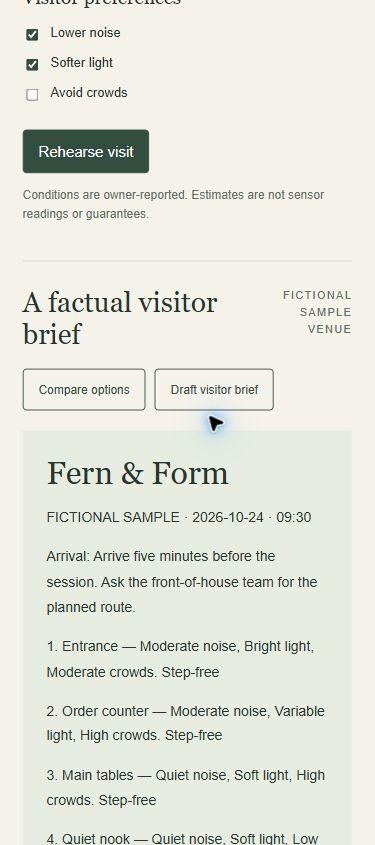
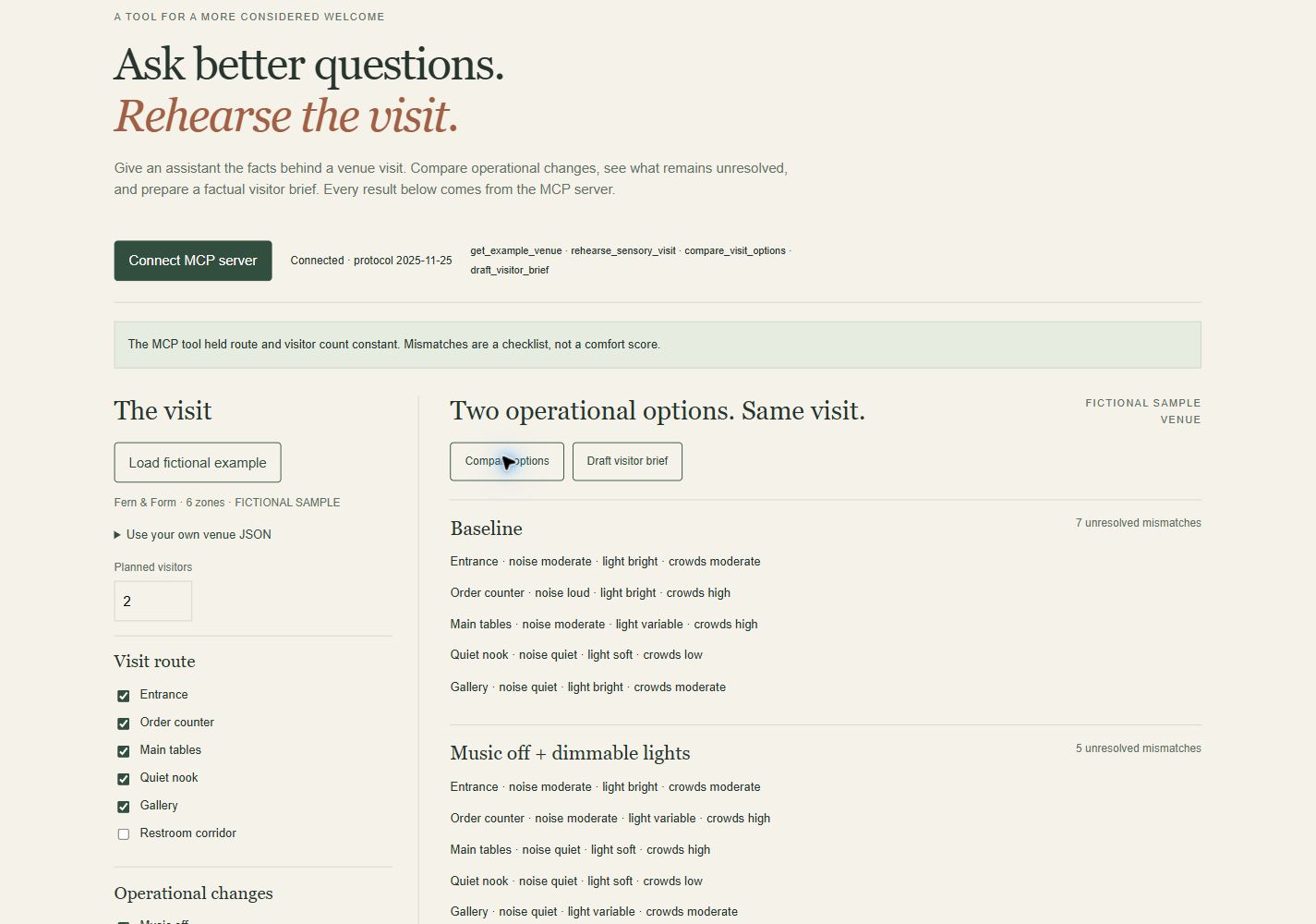
The companion gives an assistant four bounded, read-only tools. It loads a clearly fictional example or accepts supplied venue data, rehearses an ordered route, compares operational options at the same visitor count, and drafts a factual arrival and access brief. It exposes unresolved noise, light and crowd mismatches rather than an invented comfort score. The workbench displays actual MCP requests and responses.
How we built it
TypeScript, the official Model Context Protocol SDK 1.32.1, Express and Zod serve a stateless Streamable HTTP endpoint negotiating protocol 2025-11-25. Existing Stillroom planning functions provide explicit categorical rules. The browser workbench is a real JSON-RPC client. Integration checks use the SDK's client transport over HTTP, not mocked tool outputs.
What is new
The base visual planner was previously built for Bolt Builders Week. The new October 20 work comprises the MCP server, bounded input schemas, tool definitions, comparison workflow, planning resource, assistant prompt, protocol workbench and live tests. Bolt and Codex assisted the base app; Codex assisted the new companion. There is no actual Alexa+ client connection or spoken agent demonstration, and no Amazon endorsement is implied.
Challenges and learning
Protocol compliance needs a real negotiated connection and complete tool calls. A working UI alone is insufficient. Shared route and visitor-count inputs make option comparisons interpretable. Unknown access details and remaining mismatches must survive into the visitor brief rather than being hidden by an optimistic summary.
Try the working MCP companion
Source, MIT license and complete local setup: https://github.com/shpetimhaxhiu/stillroom-mcp
Use Node 22+, run npm ci and npm run mcp, then open http://127.0.0.1:3165. Connect, load the fictional venue, rehearse, compare options and draft a visitor brief. Run npm run mcp:test in a second terminal. No credentials, Amazon device or paid service is needed.
Fourteen live MCP integration checks and nine existing domain/export regression checks passed. MCP typecheck and production build pass. Lint has ten existing warnings in original React files and no new MCP warnings.
Boundaries
All venue conditions are owner-reported; operational changes are planning estimates. No sensor readings, medical advice, safety or accessibility certification, booking, messaging or comfort guarantees. Venue inputs are not retained by the stateless server. The video shows a real MCP protocol workbench, not an Alexa+ client or a model-driven conversation.
What is next
Test with consenting venue owners, improve the collection of access details and validate assistant-client interoperability before claiming a connected Alexa+ experience.

Log in or sign up for Devpost to join the conversation.