Inspiration
Food-waste has been determined as one of the biggest contributors to a greenhouse gas, methane, which has 21 more times global warming potential than carbon dioxide. Each year, around $31 billion of food are wasted every year in Canada, which about half of these wastes are produced at households. And sometimes we throw these food away because we have forgotten its expiry date. If there exists an assistant that can notify users to eat the food before its expiry date, we could reduce food waste by a great amount.
What it does
StillGood is a voice activated Google Assistant service that keeps track of your grocery purchases and predicts when they are good or expired. Using this information, StillGood is able to notify users before food has gone bad to prevent it from being wasted. It can also suggest recipes using those ingredients in order to enable users to use their goods to their full extent. StillGood can then offer you more sustainable alternatives as well to what you already have in your fridge in order to help you shop better and buy more sustainable products that are healthier and/or have a smaller carbon footprint.
How I built it
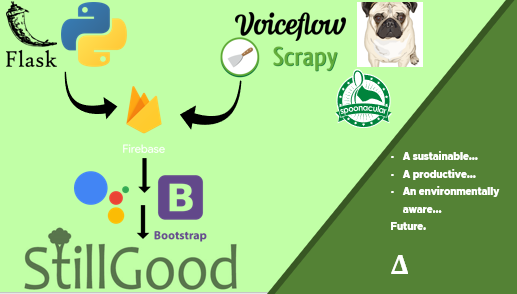
After we decided on the idea that we were going to build upon, we split the team into groups of two, with two working on the web interface and two working on the voice control and data processing of the product. One team-member was web-scraping for useful and reliable data sets to serve as sample set of our product; one team-member was learning how to connect voice-control in Google Home Mini to our system; one team-member was learning and working on the front-end of the web interface while the other member was responsible for the back-end of the web interface and the overall structure of the system.
Challenges I ran into
The main challenges the team ran into is how to design for best user experience. The service should be easy to use and to understand, and there shouldn't be any additional steps that require the users to complete in order to get the answers they want. We have experienced hard time trying to find reliable data through web scraping.It is also a brand new field for us to incorporate smart home into our application. Besides the voice control functionality of StillGood, we have also tried to maximize the user experience with the web interface as additional support.
Accomplishments that I'm proud of
To build something practical that could potentially tackle real-world problem. At the moment when we finished this project, it helps us gain a better understanding of how we could actually use the technical skills we have learned in class into something useful and could perhaps benefit the society as a whole. We also have the opportunity to work with technology that we have never worked with before(i.e. Alexa).
What I learned
All of the team were willing to take on tasks that they have never done before. Being exposed to new materials, we have practices our problem-solving skills and cooperate as a team. Some of us worked on web development while others worked on voice automation; tasks that we had never done before!
What's next for StillGood
As a product that is created within 24 hours, StillGood certainly has a lot of aspects that need to be polished and finalized for better use. Next steps for StillGood is going to be shaping it towards a smart fridge. The current method of determining expiry date of fruits and veggies is still vague and usually inaccurate. And currently we still require users to checkoff the food they have eaten by themselves. In the future, we hope to incorporate computer vision to monitor the status of inside of the fridge, providing accurate prediction of expiry dates by using machine learning and reducing users' work to record data. We also hope to add a point system that would offer users promotions if they obtain points from StillGood.


Log in or sign up for Devpost to join the conversation.