-
-
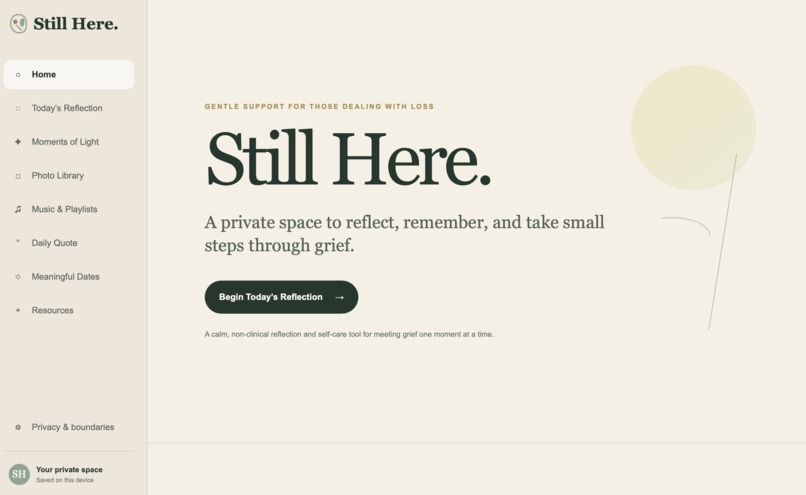
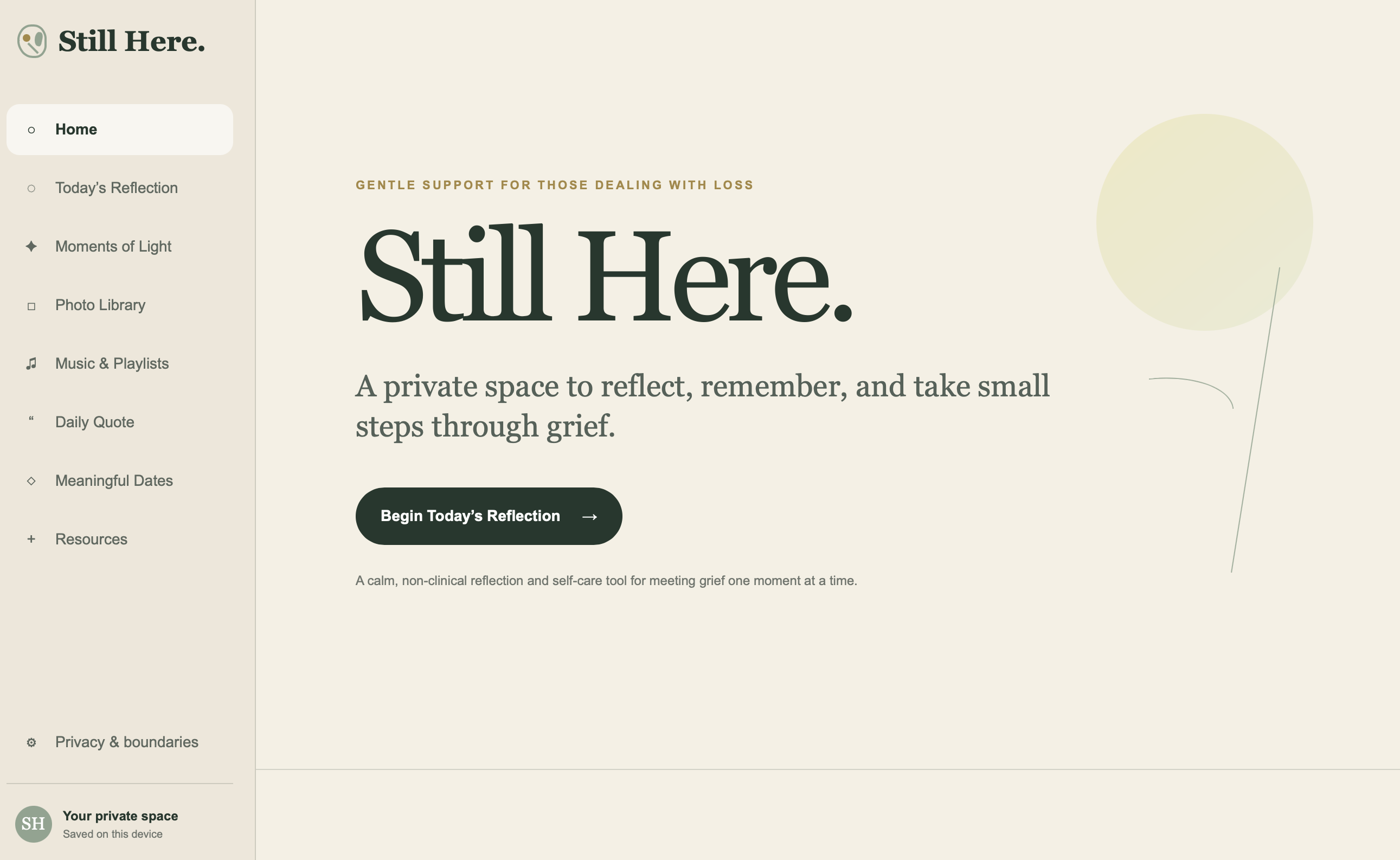
LANDING PAGE
-
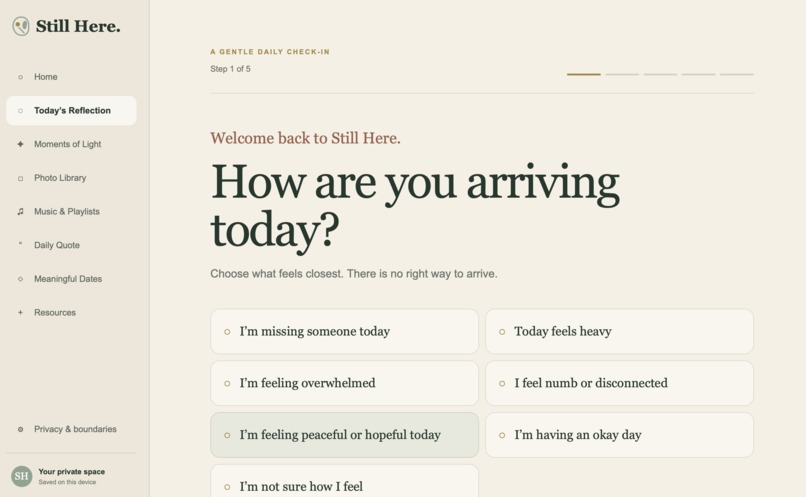
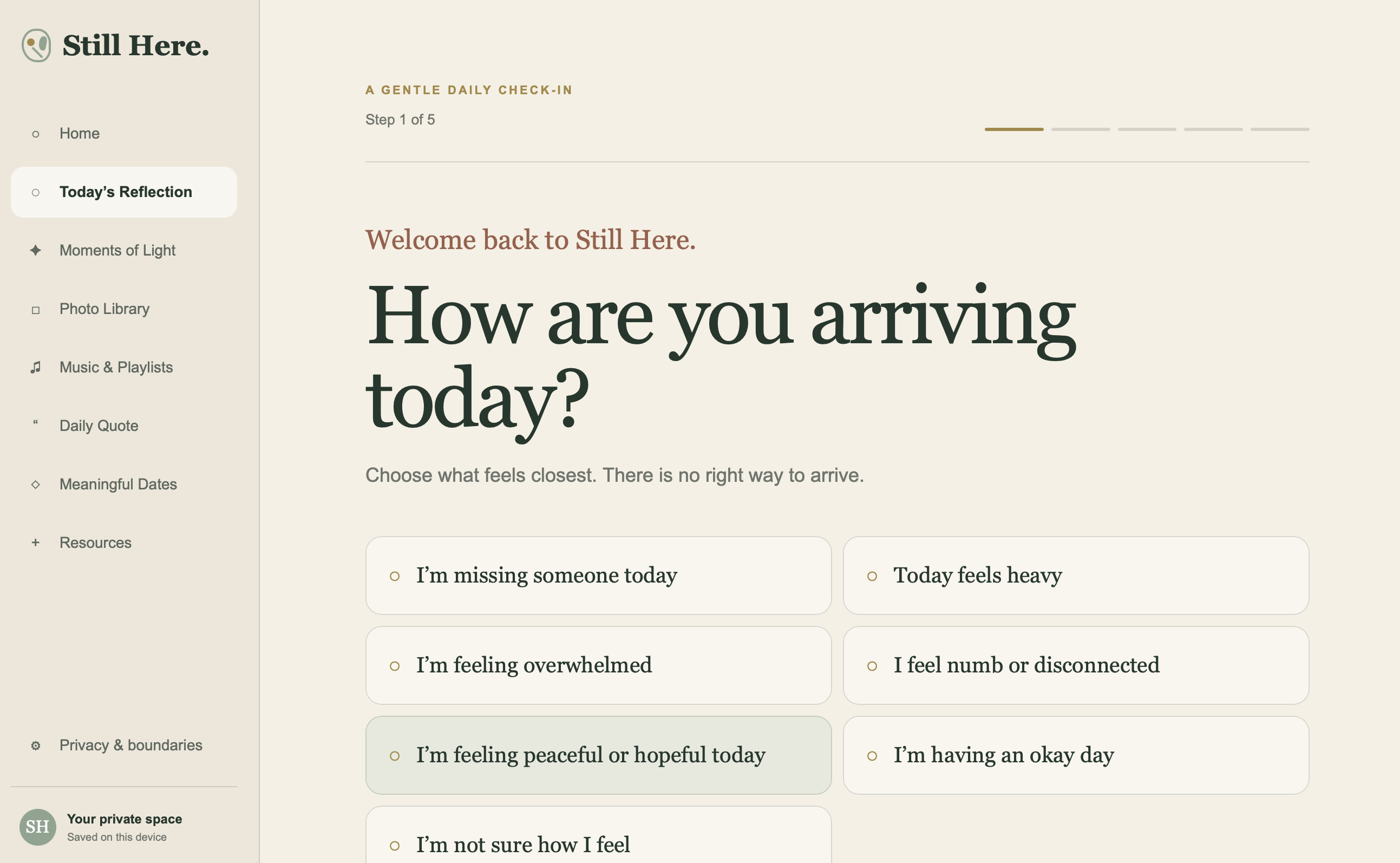
TODAY
Inspiration
Still Here is a daily reflection and self-care tool designed to support people navigating grief after losing someone they love.
The inspiration for this project came from the loss of my own mother a few months ago. Her passing affected me deeply, and as I moved through my own grief, I began connecting with others who were experiencing their own losses.
I saw how overwhelming grief can be—not only emotionally, but physically and mentally. Simple daily tasks can become difficult, and many people struggle with knowing how to care for themselves while carrying the weight of losing someone important.
While therapy, grief counselling, support groups, and the love of family and friends are incredibly valuable, there is often a gap between those moments of support and the everyday reality of grief.
As the initial support from family and friends naturally begins to fade, many people are left navigating difficult days on their own.
Still Here was created to help fill that space. Still Here was created to help fill that space.
What it does
The app provides a gentle daily check-in beginning with one simple question:
"How does today feel?"
Users can share what feels heavy, describe their energy level, choose what kind of support they need, or simply express what is on their mind.
Using AI, Still Here transforms those reflections into one small, personalized next step. This may include:
- Drinking water
- Taking a walk
- Listening to music
- Creating something
- Reaching out to someone trusted
- Reflecting on a memory
- Noticing a small moment of joy
Over time, Still Here becomes more personalized by learning from user preferences and feedback. AI can help organize meaningful moments, photos, voice notes, songs, and written memories while preserving the user’s own words and meaning.
Still Here is not therapy and does not diagnose, treat, provide medical advice, or replace professional care. It is designed to complement:
- Therapy
- Grief counselling
- Support groups
- Trusted personal relationships
The app never recreates the person who died, speaks as them, invents memories, or encourages emotional dependence. Still Here uses AI not to replace human connection, but to provide personalized, practical support during the everyday moments when people need it most. The goal is not to tell someone how to grieve or when they should move forward. The goal is to help people remain connected to:
- Themselves
- The memory of the person they love
- The life that continues around them ## How I built it
How I Built Still Here
Still Here was created through a collaboration between human experience, design thinking, and AI-assisted development using ChatGPT and Codex.
The idea began with a personal loss, the passing of my mother and the realization that while grief support exists through therapy, counselling, support groups, and loved ones, many people still struggle through the quiet, everyday moments in between. I wanted to create a tool that could provide meaningful support during those moments without attempting to replace human care.
Using ChatGPT
ChatGPT was used as a thought partner throughout the process: helping transform a personal experience into a structured product concept, exploring responsible AI boundaries, designing user journeys, refining language, and developing an experience centered around compassion, personalization, and trust. Key areas where ChatGPT helped shape the experience:
- Designing daily reflection and check-in flows
- Developing personalized support experiences
- Creating activity suggestions based on emotional context and energy levels
- Refining memory and reflection features
- Establishing responsible AI guidelines and safety boundaries
Using Codex
Codex helped transform the vision into a working application by accelerating development, testing ideas, debugging, and iterating on features. This enabled rapid experimentation across:
- User interface development
- Conversation flows
- Interactive features
- Personalized recommendations
- User experience improvements ## Why AI Was Essential The most important role of AI was not simply generating code. It enabled a faster cycle of imagining, testing, learning, and improving allowing a deeply personal idea to become a functional product. Still Here demonstrates how AI can help bridge the gap between human needs and technology: creating experiences that are more personalized, accessible, and responsive while keeping human connection at the center.
Challenges I Ran Into
Building Still Here presented unique challenges because the goal was to create technology that supports people during one of the most vulnerable experiences they may face: grief.
One of the biggest challenges was finding the right balance between offering meaningful support while maintaining responsible boundaries. Still Here needed to feel warm, personal, and helpful without positioning itself as a replacement for therapy, grief counselling, professional care, or human relationships.
Another challenge was designing an experience that recognized how unpredictable grief can be. Grief does not follow a schedule, and people may have very different needs from one day to the next. Creating an AI experience that adapts to someone's emotional state, energy level, and personal preferences required careful thought around language, recommendations, and user control.
I also focused on ensuring AI was used appropriately. The app needed to support reflection, self-care, and memory preservation without recreating lost loved ones, inventing memories, or encouraging emotional dependence.
From a development perspective, I faced the challenge of turning a deeply personal idea into a simple, accessible, and meaningful user experience. Using ChatGPT and Codex helped accelerate iteration, test ideas quickly, refine interactions, and transform the concept into a working application.
The biggest challenge, and the most important one, was remembering that the technology should serve the human experience. Every decision was guided by one question:
Does this help someone feel a little more supported during a difficult moment?
```markdown id="c8h4x2"
Accomplishments That I'm Proud Of
Building Still Here has been one of the most meaningful projects I have created because it started from a deeply personal experience and evolved into something that could help others facing similar challenges.
One of my proudest accomplishments is transforming a personal loss into a tool designed to support others. Losing my mother showed me how difficult the everyday moments of grief can be, and creating Still Here allowed me to turn that experience into something purposeful.
I am proud of creating an experience that balances technology with empathy. Instead of building another chatbot, I focused on creating a thoughtful daily ritual that helps people reflect, care for themselves, preserve memories, and take one small step at a time.
I am also proud of the responsible approach taken with AI. Still Here was designed with clear boundaries: it does not attempt to replace therapists, counsellors, loved ones, or human connection. AI is used to personalize reflection and provide practical support while respecting the complexity and individuality of grief.
From a technical perspective, I am proud of how quickly an idea moved from concept to a working application using ChatGPT and Codex. The ability to iterate, test, refine, and bring a meaningful idea to life demonstrates the potential of AI as a creative and development partner.
Most importantly, I am proud that Still Here was built with compassion at its core. The goal was never to tell people how to grieve, but to create a space that helps people feel a little less alone during the moments when they need support most.
You're right. The wording should not imply that other projects lack empathy or that empathy is the only measure of good technology. The lesson is about what this project required and what we learned while building it. Here is a more balanced version:
What I Learned
Building Still Here taught me the importance of deeply understanding the people and experiences a product is designed to support. When creating technology for a sensitive and personal experience like grief, thoughtful design, careful language, and responsible use of AI become especially important.
I learned that grief is highly individual and does not follow a predictable path. People may need different types of support depending on the day, their energy level, their emotions, and their personal circumstances. This led us to design an experience that adapts to the individual rather than providing generic recommendations.
I also learned the importance of creating clear boundaries when applying AI to meaningful human experiences. Still Here was designed to complement, not replace, professional support, relationships, and existing resources. AI can provide personalization and guidance while keeping the user in control of their own experience.
From a technical perspective, I learned how powerful AI tools like ChatGPT and Codex can be throughout the entire product development process. They helped us explore ideas, refine user experiences, accelerate development, test solutions, and iterate quickly.
Most importantly, I learned that successful AI products require a balance between technology and human understanding. The strongest solutions come from combining thoughtful design, responsible AI, and a clear understanding of the people they are built to serve.
What's next for Still Here
For a hackathon submission, I would make this more forward-looking, ambitious, and founder-like. It should communicate that the prototype is only the beginning.
## What's Next for Still Here

This is just the beginning for Still Here.

I am excited to continue developing this project by expanding research, gathering feedback from people with lived experience of grief, and working with professionals in grief support to ensure the experience is thoughtful, responsible, and genuinely useful.

The next phase will focus on beta testing with real users, learning from their experiences, refining the design, improving personalization, and continuing to build features that support people through the everyday moments of grief.

Future development will include:
- Expanding and refining daily check-in experiences
- Improving AI personalization based on user feedback
- Developing richer memory and reflection features
- Testing how different activities and prompts support users
- Continuing to strengthen privacy, safety, and responsible AI practices

The goal is to move Still Here from a working prototype into a product that can meaningfully support more people navigating loss.

I believe there is an opportunity to create a new type of digital support—one that does not try to replace human connection, but helps people feel supported during the quiet moments between conversations, appointments, and support systems.

The next step is listening, learning, improving, and ultimately bringing Still Here to the people who need it most.
Built With
- ai-for-good
- ai-personalization
- artificial-intelligence
- chatgpt
- codex
- conversational-ai
- digital-health
- emotional-wellbeing
- generative-ai
- grief-support
- human-centered-ai
- memory-preservation
- mental-wellness
- natural-language-processing
- openai
- personalization
- reflection
- responsible-ai
- self-care
- user-experience

Log in or sign up for Devpost to join the conversation.