Inspiration
I’ve made a lot of presentations myself, and the part I dislike most isn’t actually presenting the idea — it’s turning the idea into slides. You have to think about the structure, write prompts, search for visuals, fix layouts, and keep editing whenever your idea changes. I wanted to see if I could make presentations work more like an actual conversation.
What it does
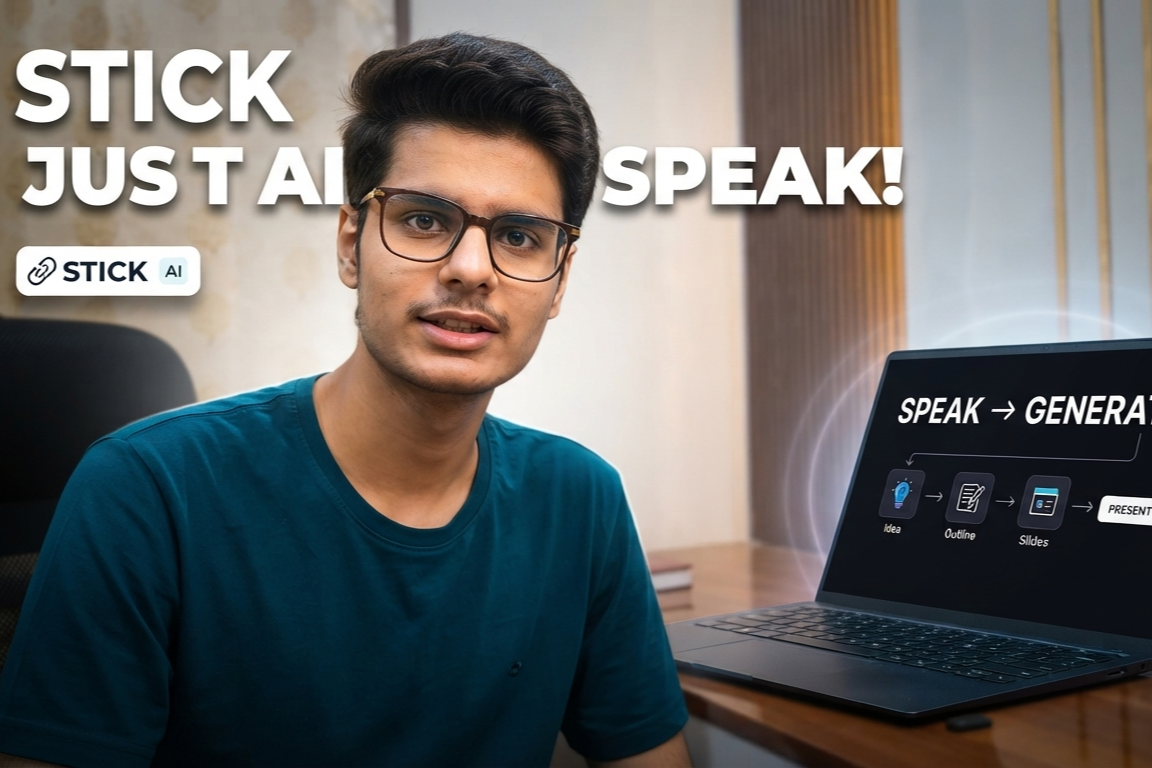
STICK lets you build a presentation by simply talking. As I explain my idea, it understands the context, decides what the presentation needs next, and updates the slides accordingly. I can change my mind, add new points, or ask it to restructure something without having to write a new prompt every time.
How we built it
I built STICK around an agent-based architecture. The voice input is handled in real time, then a semantic layer understands whether something meaningful has changed. The planner decides what the next slide should look like, while the presentation state keeps the whole deck consistent. I also added memory using Neon PostgreSQL, a critic for more complex changes, SVG-based visual generation, and PPT Master for generating editable PowerPoint files.
Challenges we ran into
The hardest part was making all these pieces work together without the presentation becoming inconsistent. We had to deal with things like duplicate inputs, failed LLM calls, memory failures, keeping different sessions separate, and making sure a failed generation never destroyed a valid slide. Getting the PPT generation pipeline connected to the real PPT Master workflow was another challenge.
Accomplishments that we're proud of
The biggest thing I’m proud of is that STICK is more than just an AI prompt wrapper. The presentation can actually evolve during a conversation. We also got the real Neon memory integration and real PPT Master export working, including editable PPTX generation. We built reliability and session handling into the system instead of leaving them for later.
What we learned
We learned that building an agentic product is much more than just calling an LLM. The hard part is managing state, context, memory, failures, and the flow between different components. We also learned that giving the model the right context at the right time is just as important as the model itself.
What's next for STICK
There’s still a lot I want to improve. The next step is making the live experience much smoother and faster, improving the visual quality of generated slides, and adding richer media such as images, narration, TTS, and eventually video generation. I also want STICK to become better at understanding the story of a presentation rather than just generating individual slides.
Built With
- agentic-ai
- ai-agents
- ai-memory
- ai-presentation
- conversational-ai
- fastapi
- generative-ai
- javascript
- llm
- neon
- next.js
- openai
- openai-realtime
- postgresql
- powerpoint
- ppt-master
- pptx
- presentation-automation
- python
- real-time-ai
- semantic-search
- svg
- voice-ai
- webrtc


Log in or sign up for Devpost to join the conversation.