-
-
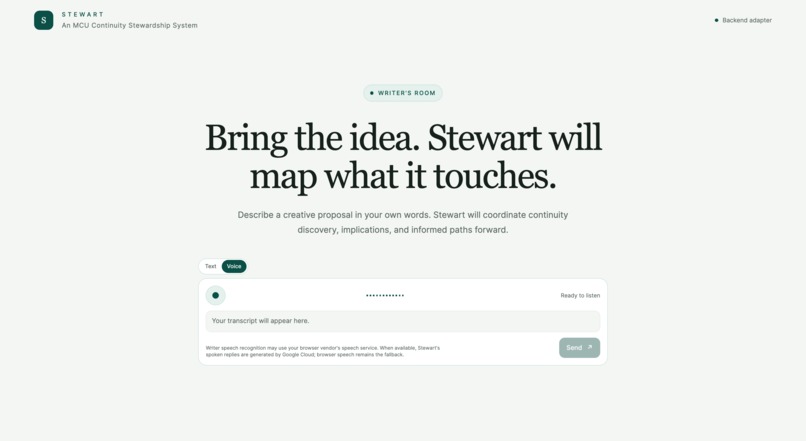
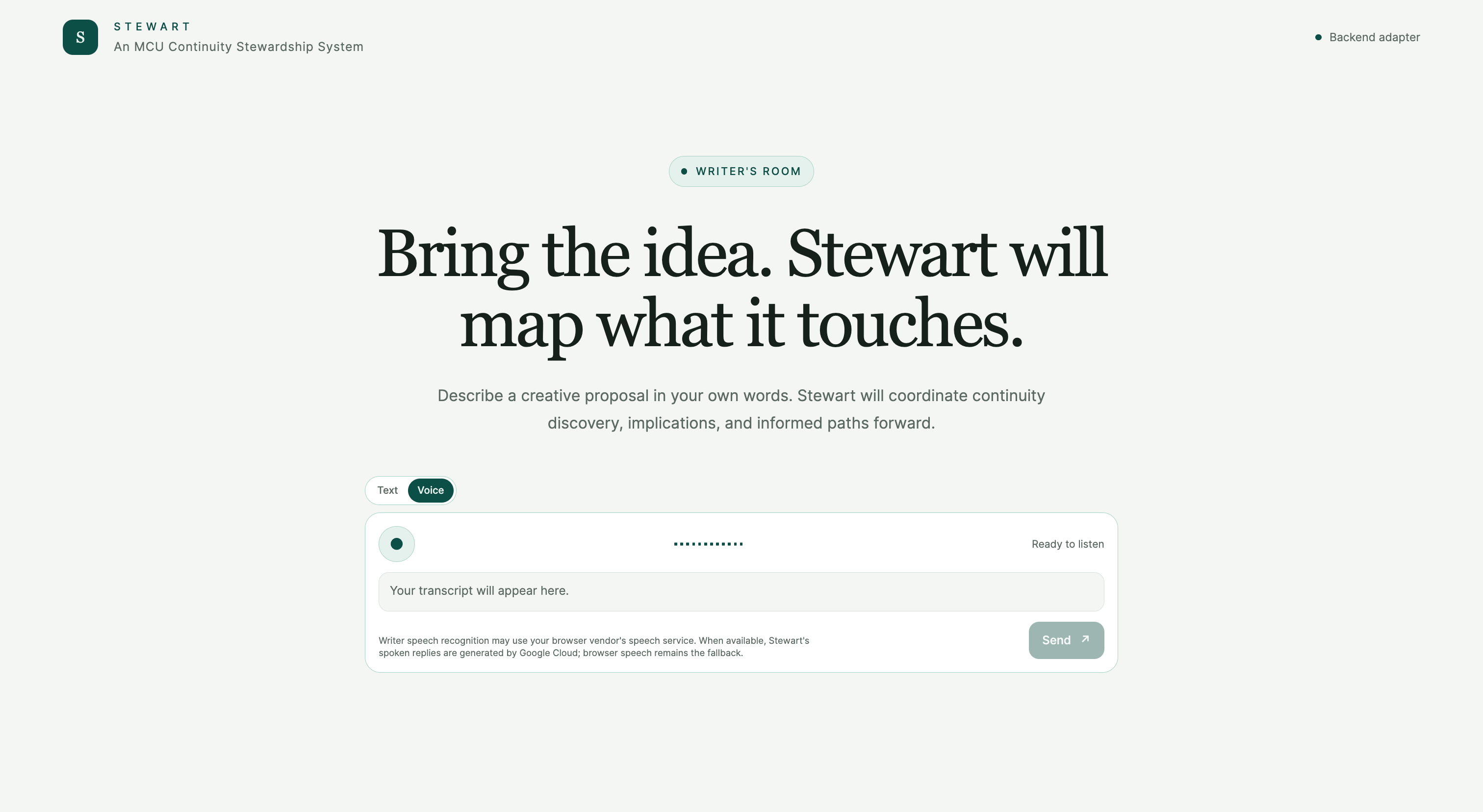
Stewart Landing page
-
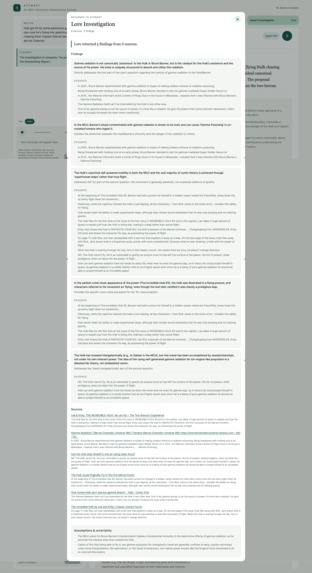
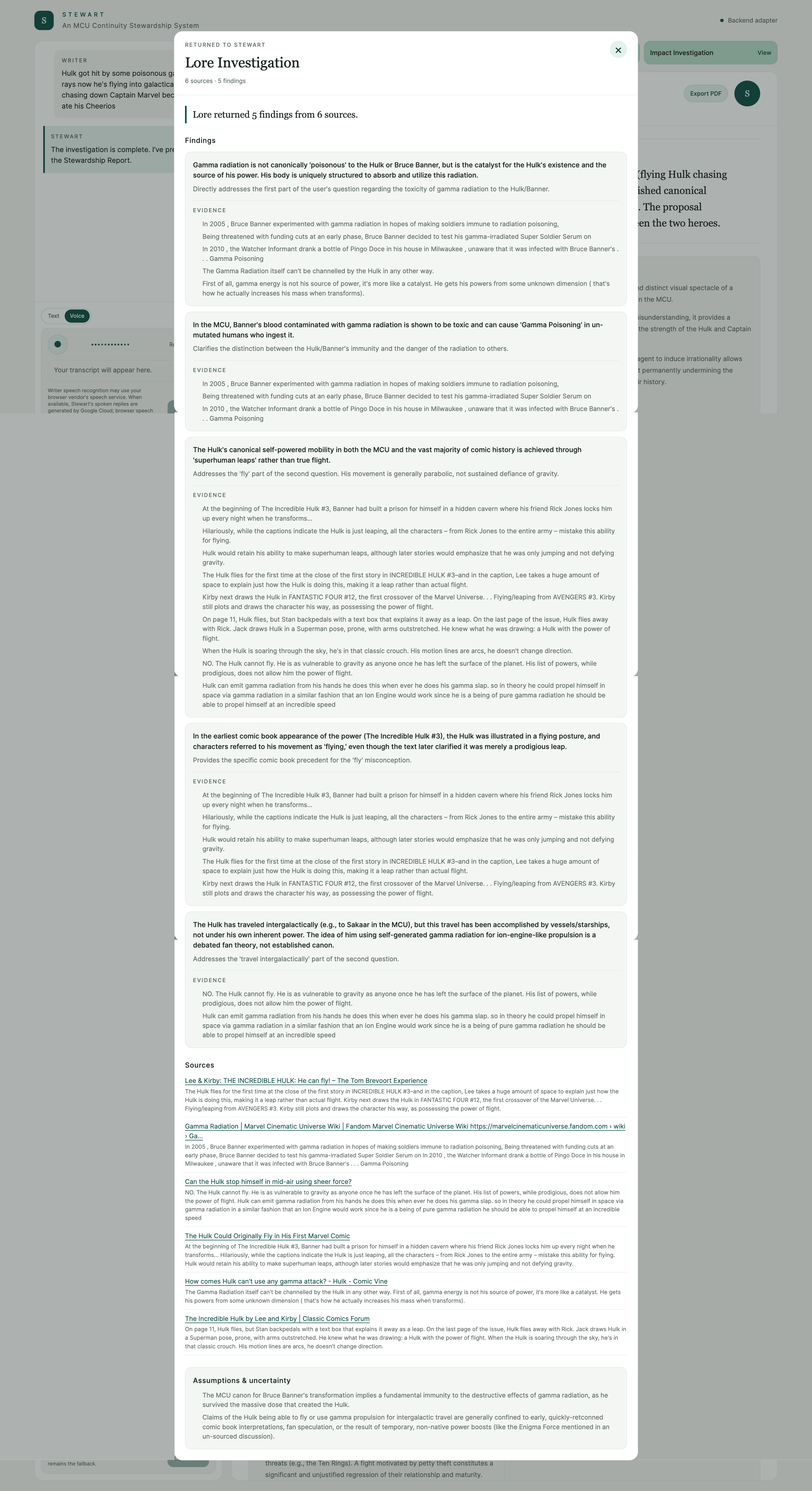
Lore Agent Investigation
-
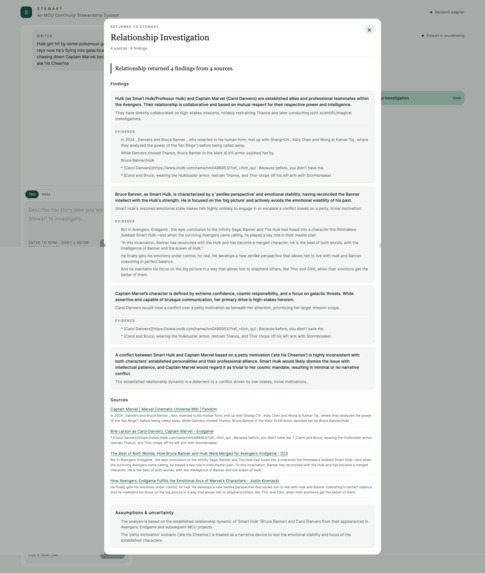
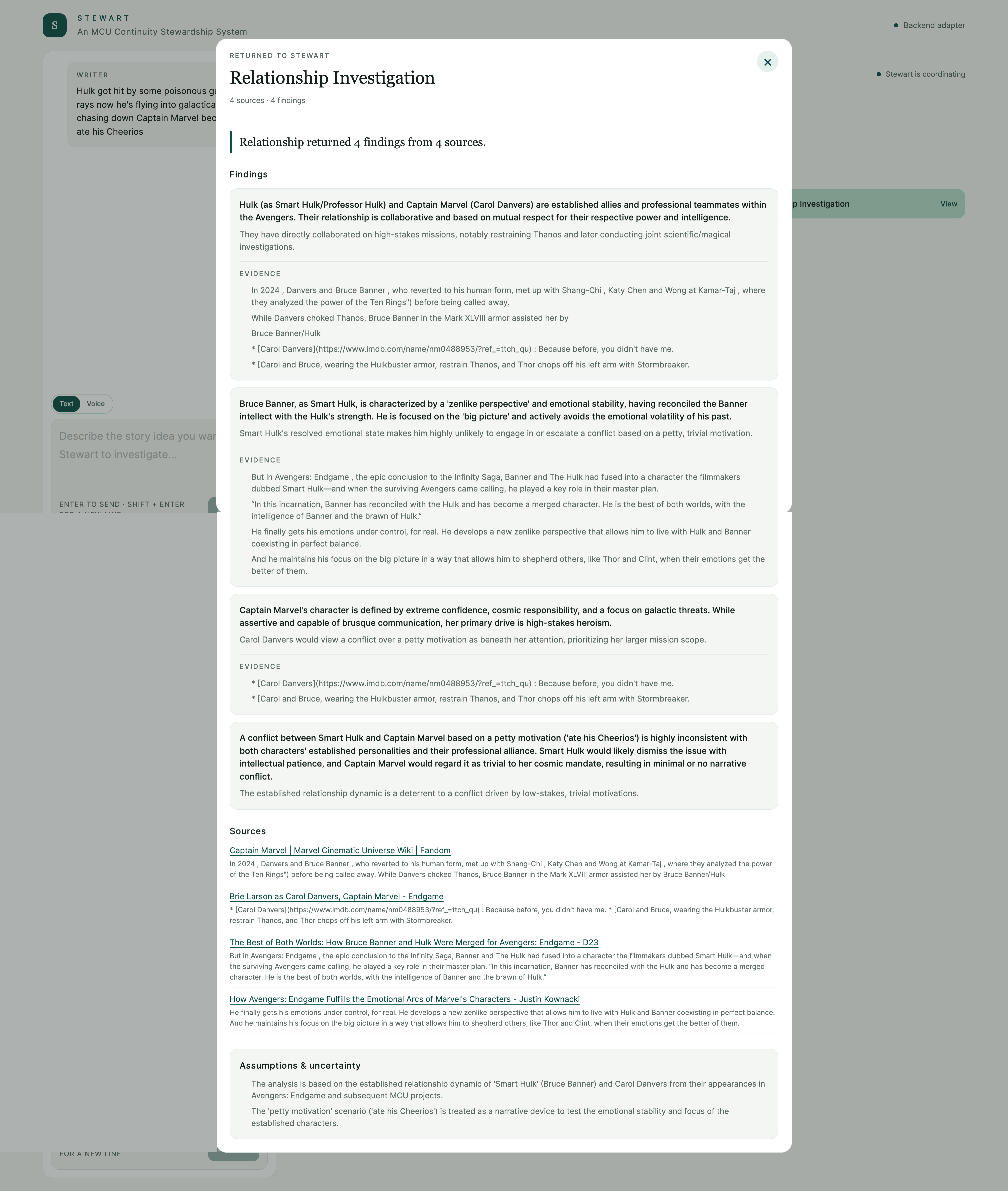
Relationship Agent Investigation
-
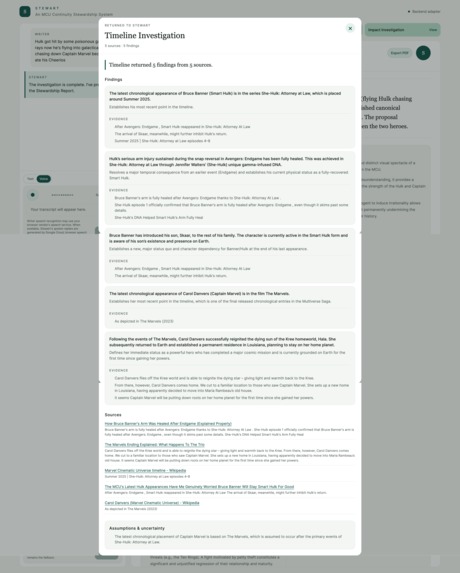
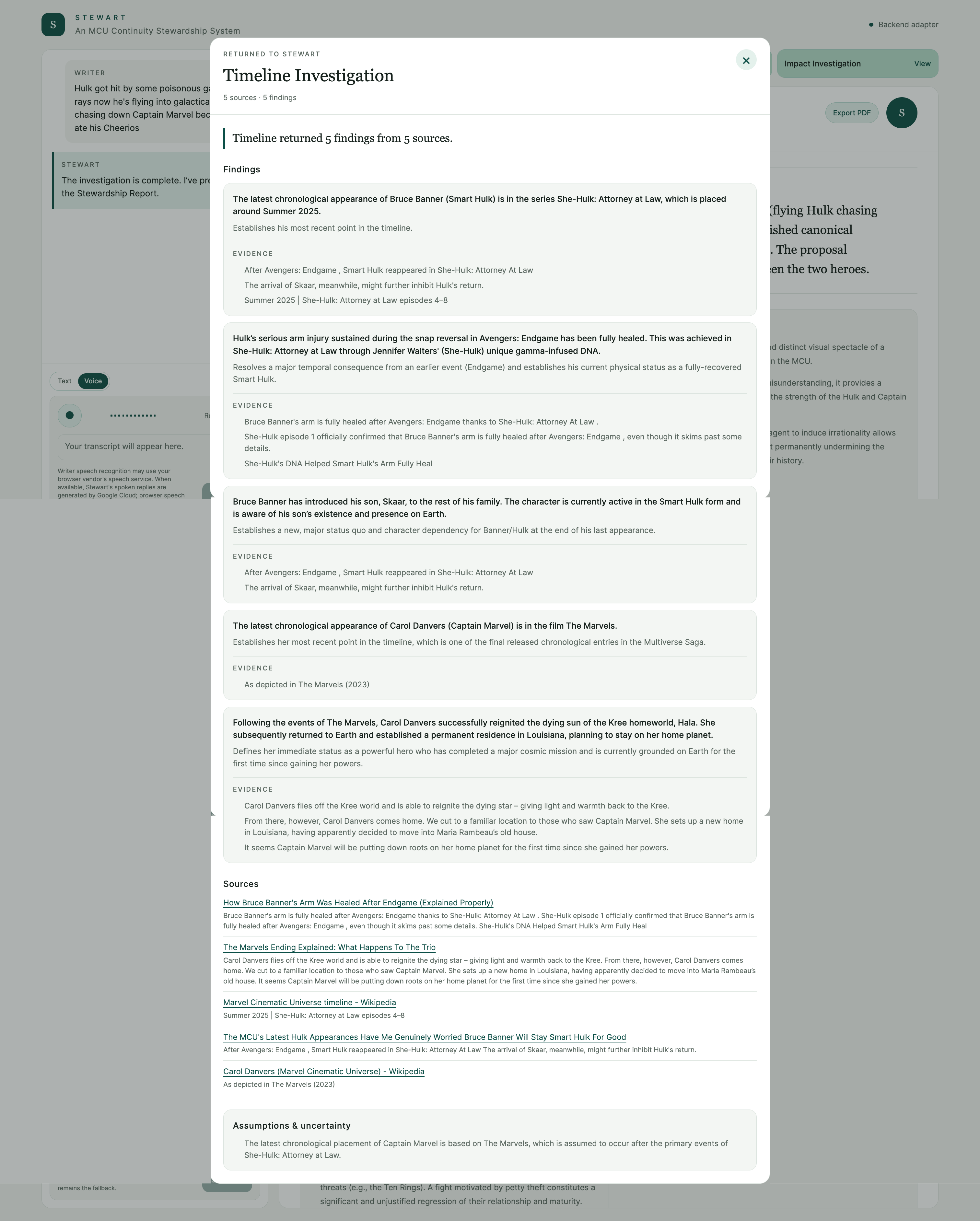
Timeline Agent Investigation
-
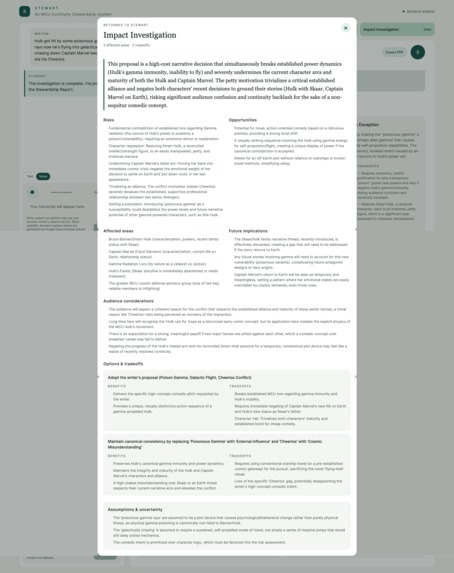
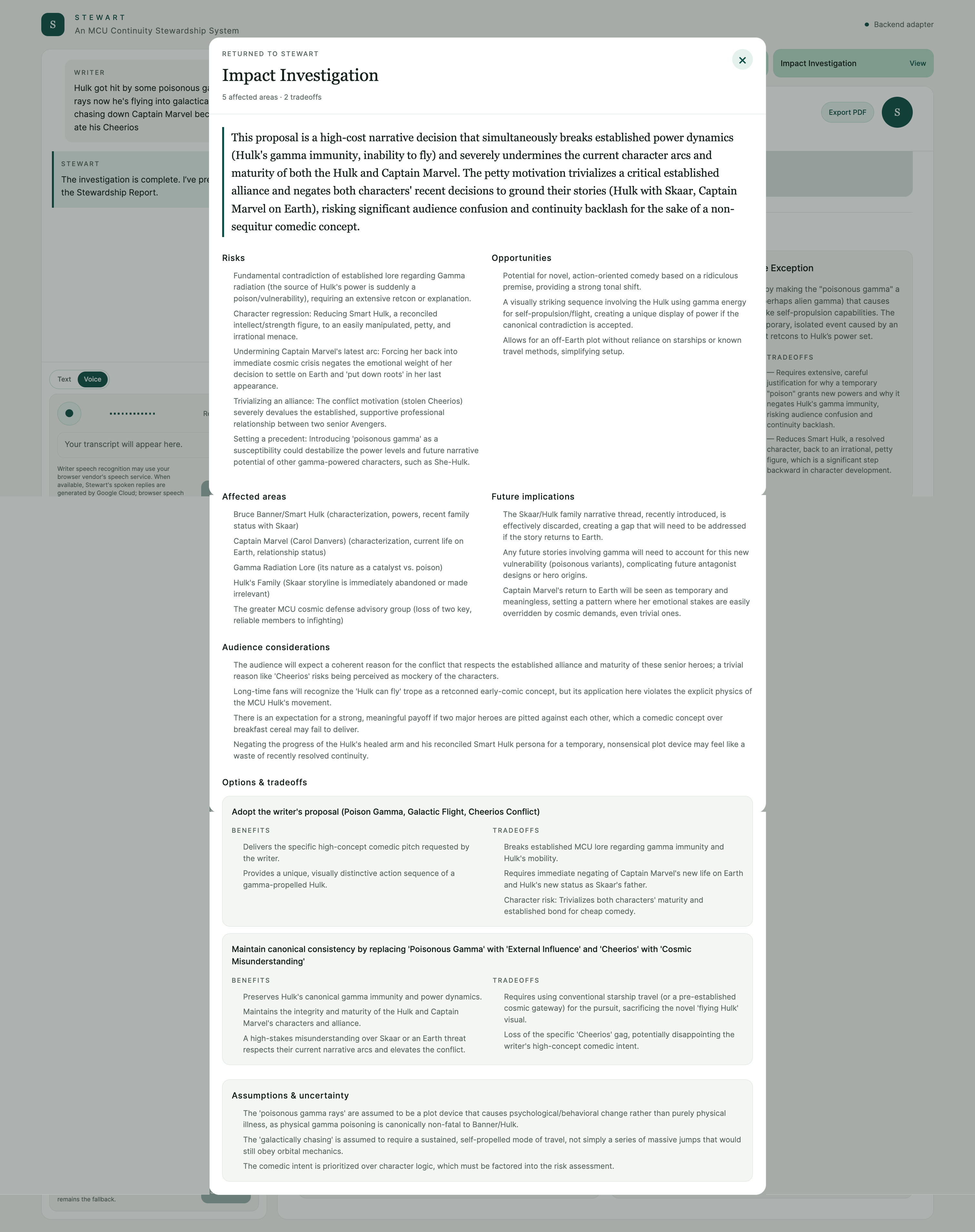
Impact Agent Investigation
-
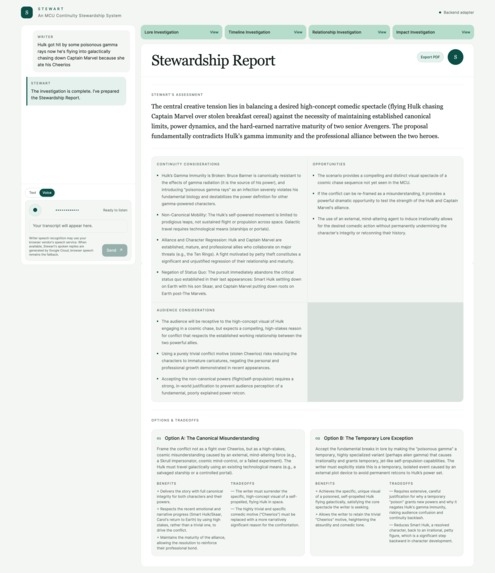
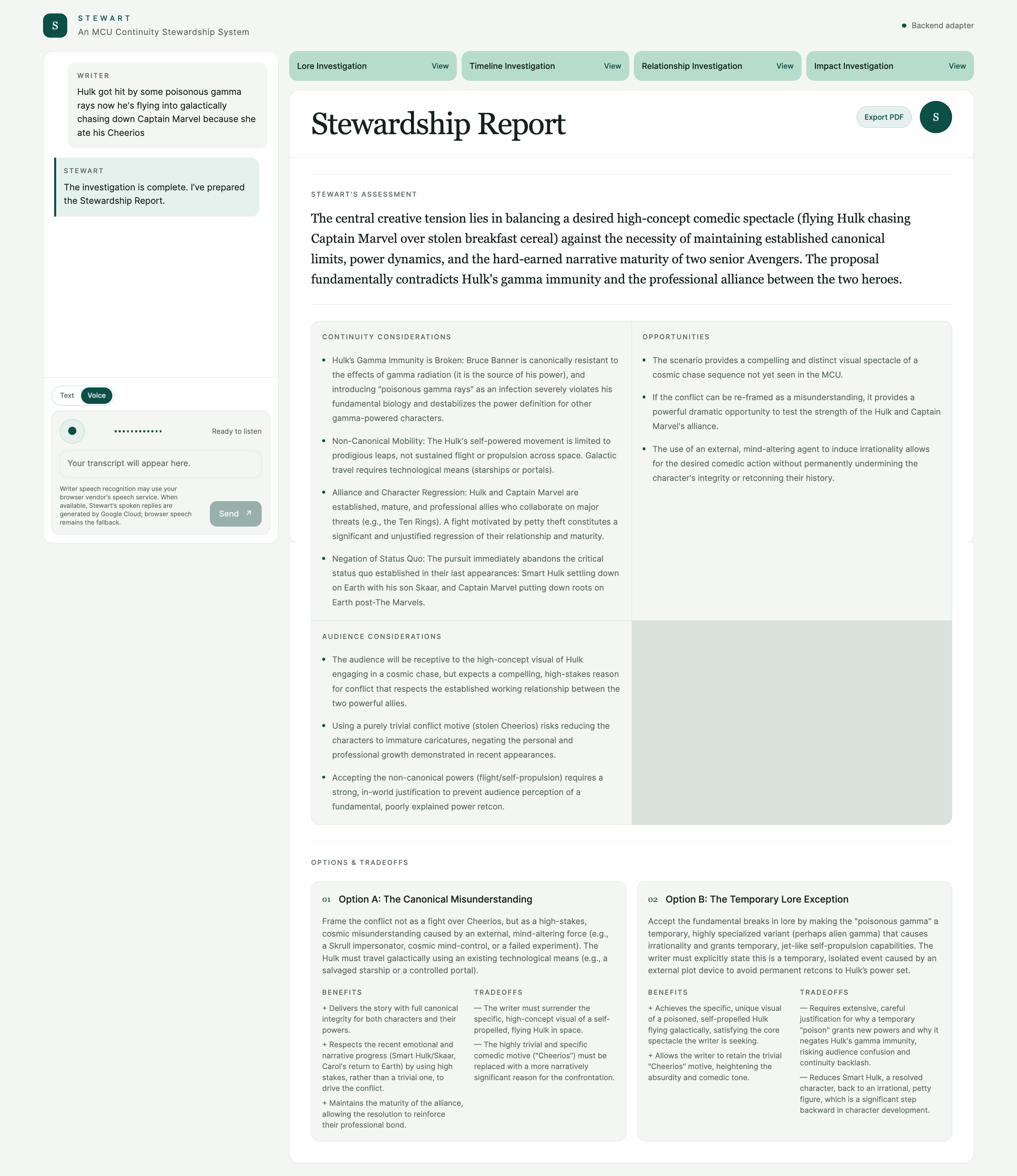
Stewart Report
Inspiration
Large story universes create a particular kind of creative problem: one seemingly small decision can ripple through years of established lore, timelines, character relationships, and audience expectations.
The writer still needs the freedom to ask, "What if?"
But someone also has to ask, "If we do this, what else does it touch?"
That became the idea behind Stewart, an agentic continuity stewardship system designed for an MCU writers' room.
The goal was not to build an AI that writes the story for the writer. It was to build a system that can investigate the continuity surrounding a creative decision, surface its implications, and return that context to the humans who remain responsible for the story.
Hence the question that became Stewart's working philosophy:
Let's ask Stewart.
What it does
Stewart gives writers a conversational interface for investigating proposed story decisions.
A writer can describe an idea naturally, including ideas that intentionally bend, reinterpret, or challenge existing continuity.
Stewart first determines whether the proposal contains enough information to investigate. If something important is ambiguous, Stewart asks the writer for clarification rather than allowing the investigation agents to make assumptions on the writer's behalf.
Once the proposal is ready, Stewart coordinates a team of specialist agents:
- Lore Agent investigates established canon, characters, events, artifacts, locations, and relevant story facts.
- Timeline Agent examines chronology, sequencing, temporal dependencies, and where the proposal fits within established events.
- Relationship Agent investigates character relationships and how the proposed decision may affect established dynamics.
- Impact Agent examines the combined specialist findings and identifies risks, opportunities, affected areas, future implications, audience considerations, assumptions, and meaningful creative tradeoffs.
Stewart then synthesizes those findings into a writer-facing Stewardship Report.
The report does not simply dump agent output back onto the writer. Stewart prioritizes the continuity considerations, identifies opportunities, and presents decision options with their benefits and tradeoffs.
The writer still decides what happens.
Stewart helps them understand what that decision touches.
How we built it
Stewart is built as an agentic system rather than a single prompt wrapped in a chat interface.
The backend uses Google Agent Development Kit (ADK) and Gemini on Vertex AI to coordinate Stewart and its specialist agents.
Lore, Timeline, and Relationship investigations can execute in parallel. Their findings are then provided to Impact for cross-cutting analysis before Stewart performs the final synthesis.
Parallel Search API provides web research capabilities for continuity investigation.
The frontend is a purpose-built Writer's Room interface that exposes the investigation lifecycle instead of hiding the multi-agent work behind a generic loading spinner. Writers can see specialists begin and complete their investigations, inspect investigation results, continue their conversation with Stewart, and review the final Stewardship Report.
We also built a Voice Mode so the interaction can feel more natural inside a writers' room. Writers can speak their proposal, review the transcription, and submit it through the same conversation path used by Text Mode. Stewart responds using a fixed Google Cloud Text-to-Speech voice and provides spoken lifecycle cues as the investigation progresses.
Completed Stewardship Reports can also be exported as PDFs directly from the browser.
Why agents?
Continuity is not one problem.
A creative decision can be perfectly reasonable from a lore perspective while creating a timeline contradiction. It can fit chronologically while fundamentally changing a character relationship. And even when all three individually work, their combined consequences may create larger narrative or audience implications.
That made continuity stewardship a natural multi-agent problem.
Each specialist receives a focused investigative responsibility. Impact reasons across their combined findings. Stewart remains the single writer-facing coordinator responsible for clarification and final synthesis.
This separation also creates an important boundary: specialist agents investigate; Stewart stewards the decision with the writer.
Challenges we faced
One of the biggest challenges was preventing a multi-agent system from becoming a collection of impressive-looking agents that simply repeat one another.
We had to establish clear responsibilities and contracts between specialists, Impact, and Stewart so that each stage added something distinct to the investigation.
Another challenge was preserving writer agency.
When a proposal is ambiguous, it is easy for an AI system to quietly fill in the missing information and continue. Stewart instead needed to recognize when a missing detail materially affected the investigation and return to the writer for clarification before launching specialists.
Streaming the investigation introduced another challenge. The frontend needed to represent concurrent agent activity, completed investigations, Impact analysis, clarification, and final synthesis while maintaining one coherent writer conversation.
Voice introduced its own set of browser and interaction challenges, including speech-recognition availability, browser autoplay restrictions, deterministic voice identity, and sequencing spoken feedback with the visual investigation. We ultimately combined browser-native speech recognition with Google Cloud Text-to-Speech for Stewart's consistent voice.
What we learned
The most important lesson was that useful agentic systems are not defined by how many agents they contain.
They are defined by responsibility boundaries, coordination, and judgment.
Parallelism was valuable where investigations were genuinely independent. Sequential processing mattered when Impact needed the combined specialist findings. Human interaction mattered when Stewart needed clarification before either of those things should happen.
We also learned that showing the agentic process can be part of the product experience. In a writers' room, seeing which continuity dimensions are being investigated helps communicate why Stewart's final assessment deserves attention.
Most importantly, we learned that AI does not need to replace creative authority to provide meaningful creative infrastructure.
Stewart can investigate the universe.
The writers still decide what happens in it.
What's next for Stewart
The hackathon version establishes the core stewardship workflow: clarification, coordinated specialist investigation, impact analysis, synthesis, voice interaction, and an exportable Stewardship Report.
A larger continuity system could extend that foundation with persistent studio-owned canon repositories, production-specific knowledge sources, richer evidence provenance, additional specialist domains, collaborative writer sessions, and continuity tracking across evolving drafts.
The larger vision is not an AI that decides what stories should be told.
It is an intelligent stewardship layer that helps creative teams understand the consequences of the stories they choose to tell.
Let's ask Stewart.
Built With
- cloud-run
- fastapi
- gemini
- google-adk
- google-cloud
- google-cloud-text-to-speech
- intel-parallel-studio
- pydantic
- python
- react
- typescript
- vercel
- vertex-ai
- vite
- web-audio-api
- web-speech-api

Log in or sign up for Devpost to join the conversation.