-
-
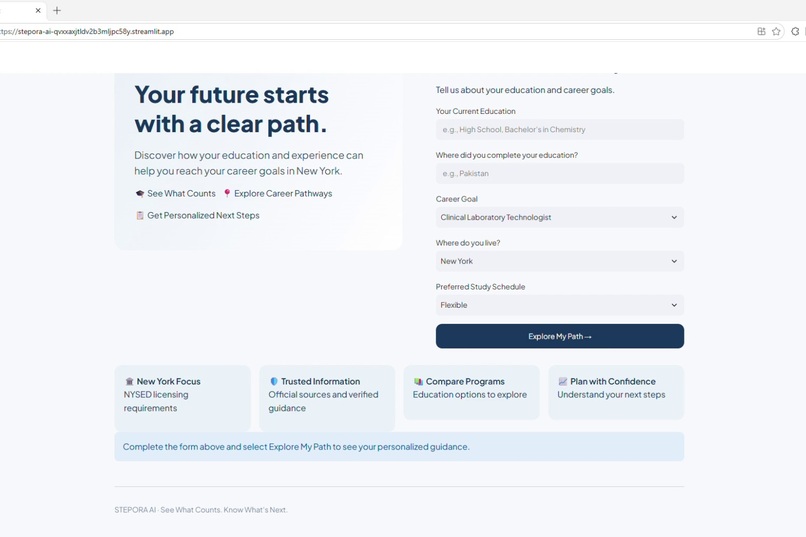
STEPORA AI – Career Pathway Builder
-
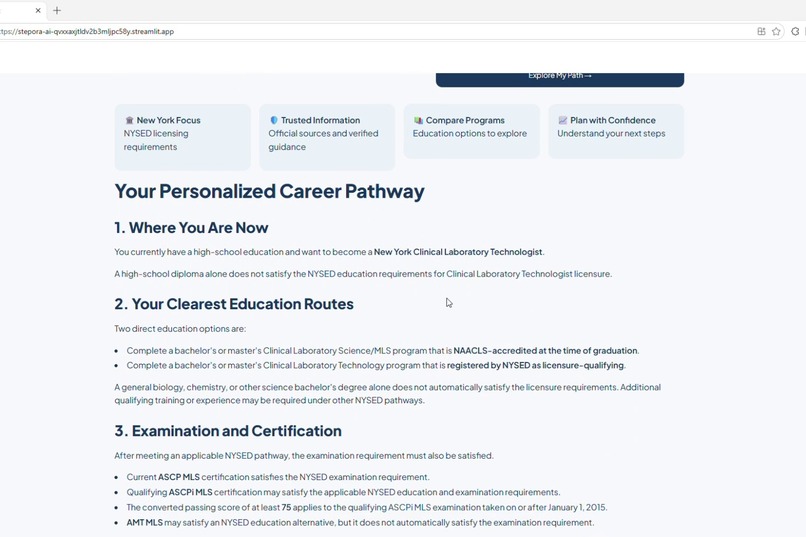
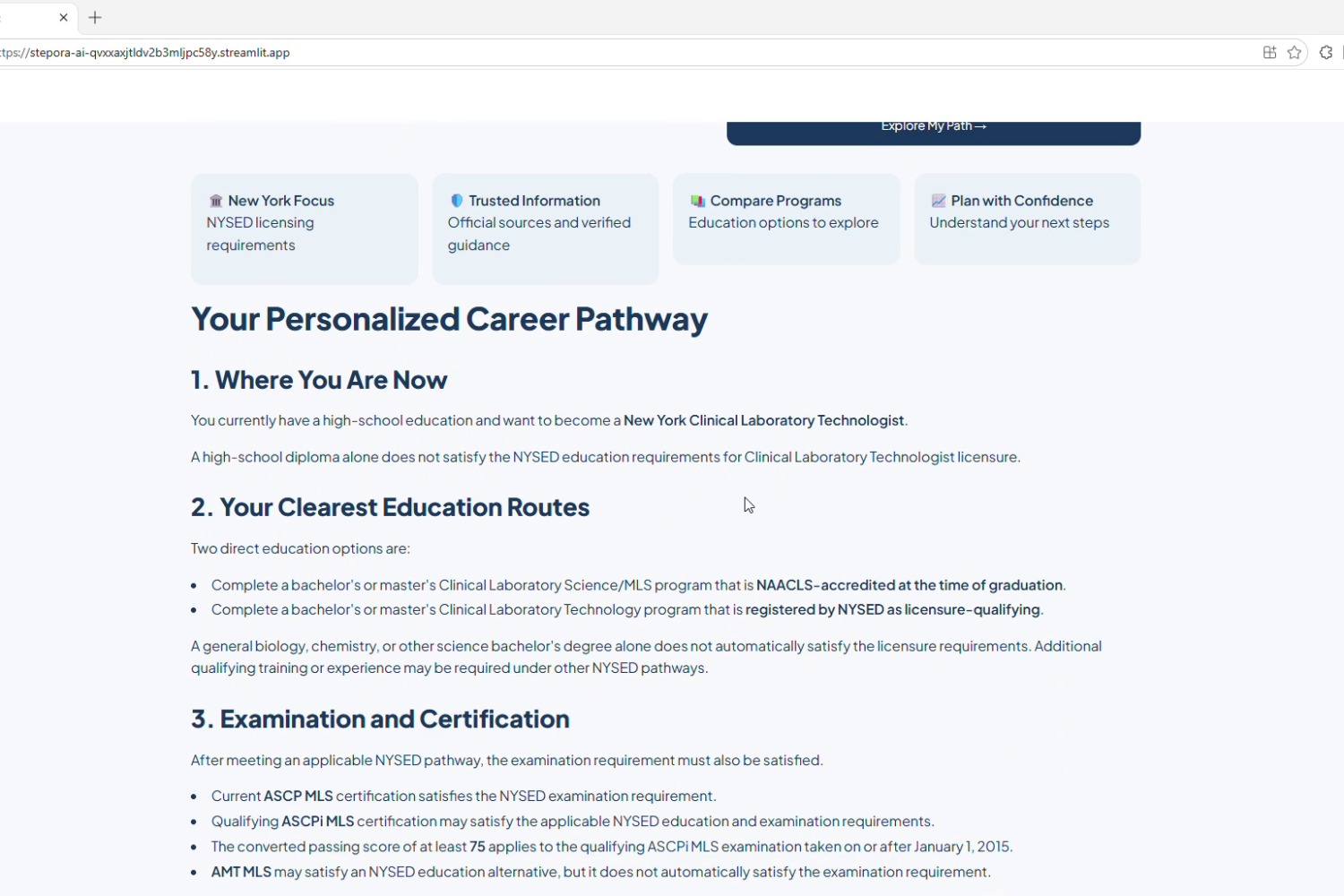
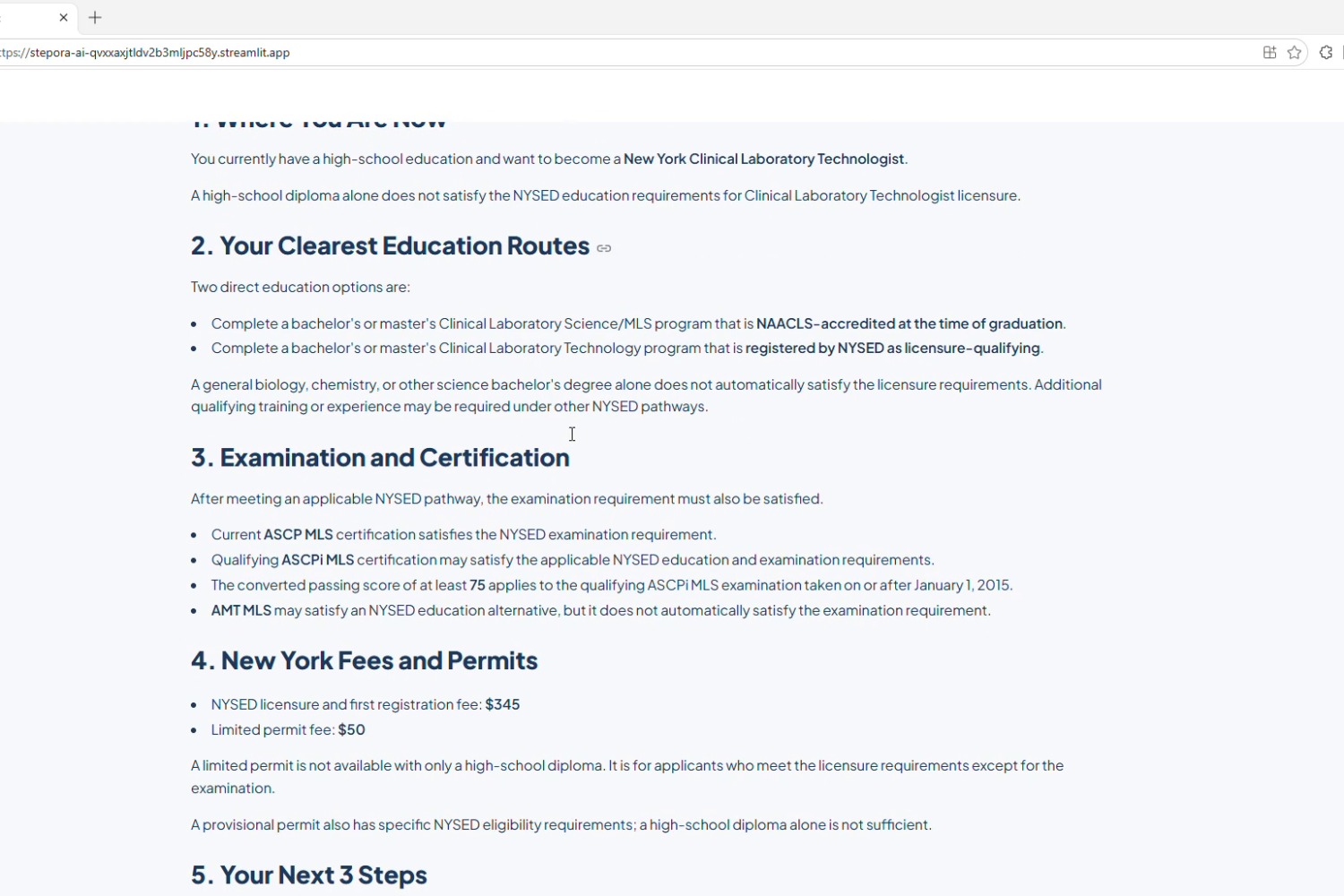
High School Starting Point – Personalized Pathway
-
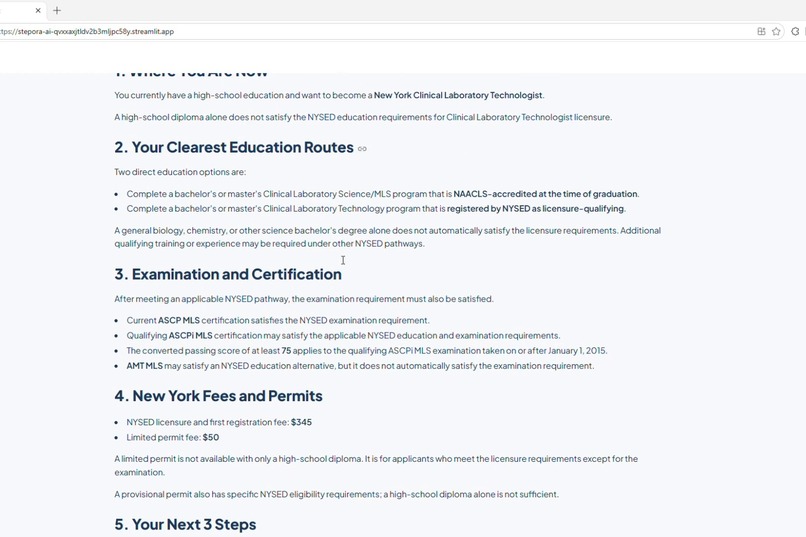
What Counts, What’s Missing & Next Steps
-
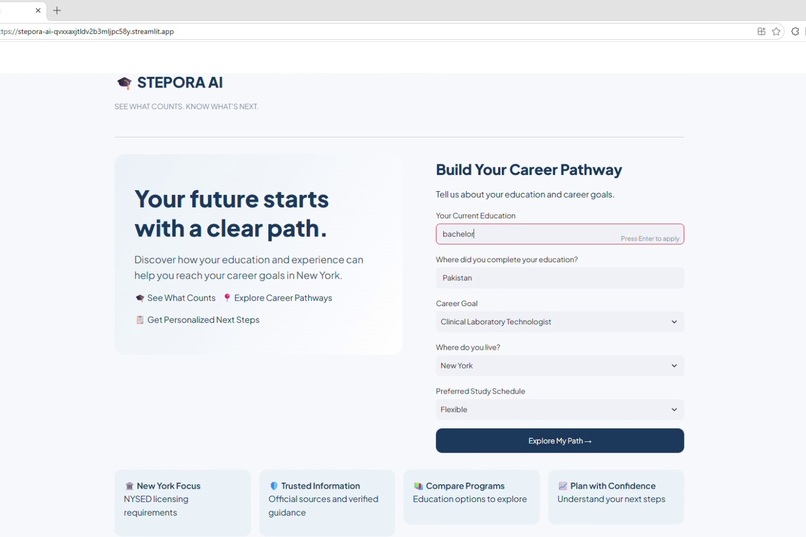
Bachelors in chemistry – Different Starting Point
-
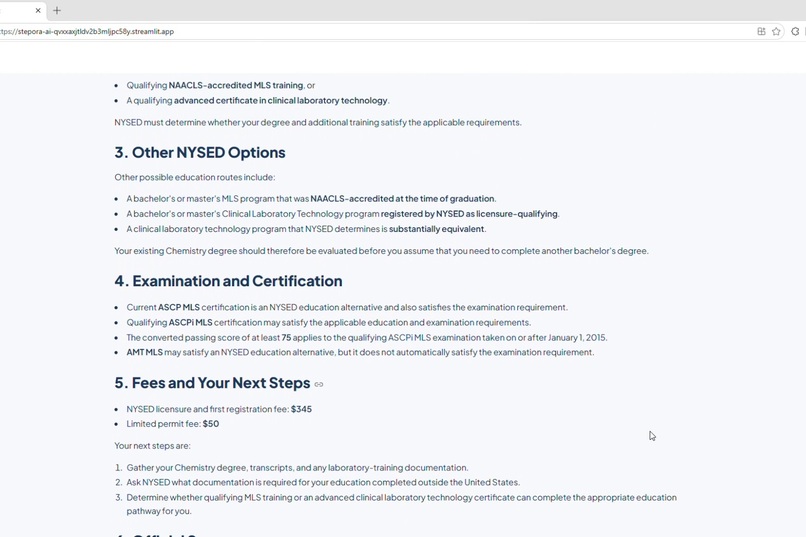
Personalized Guidance Based on Existing Education
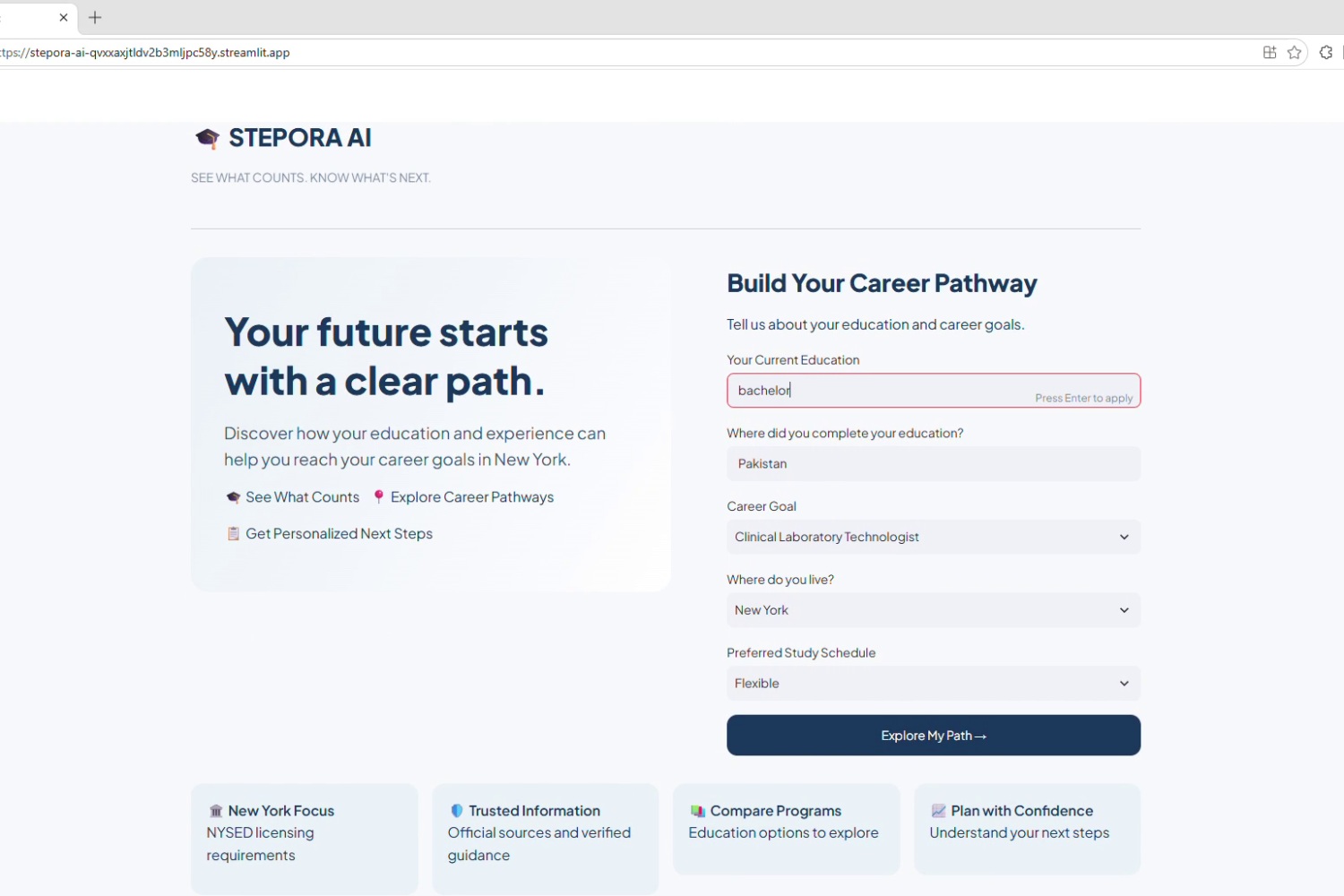
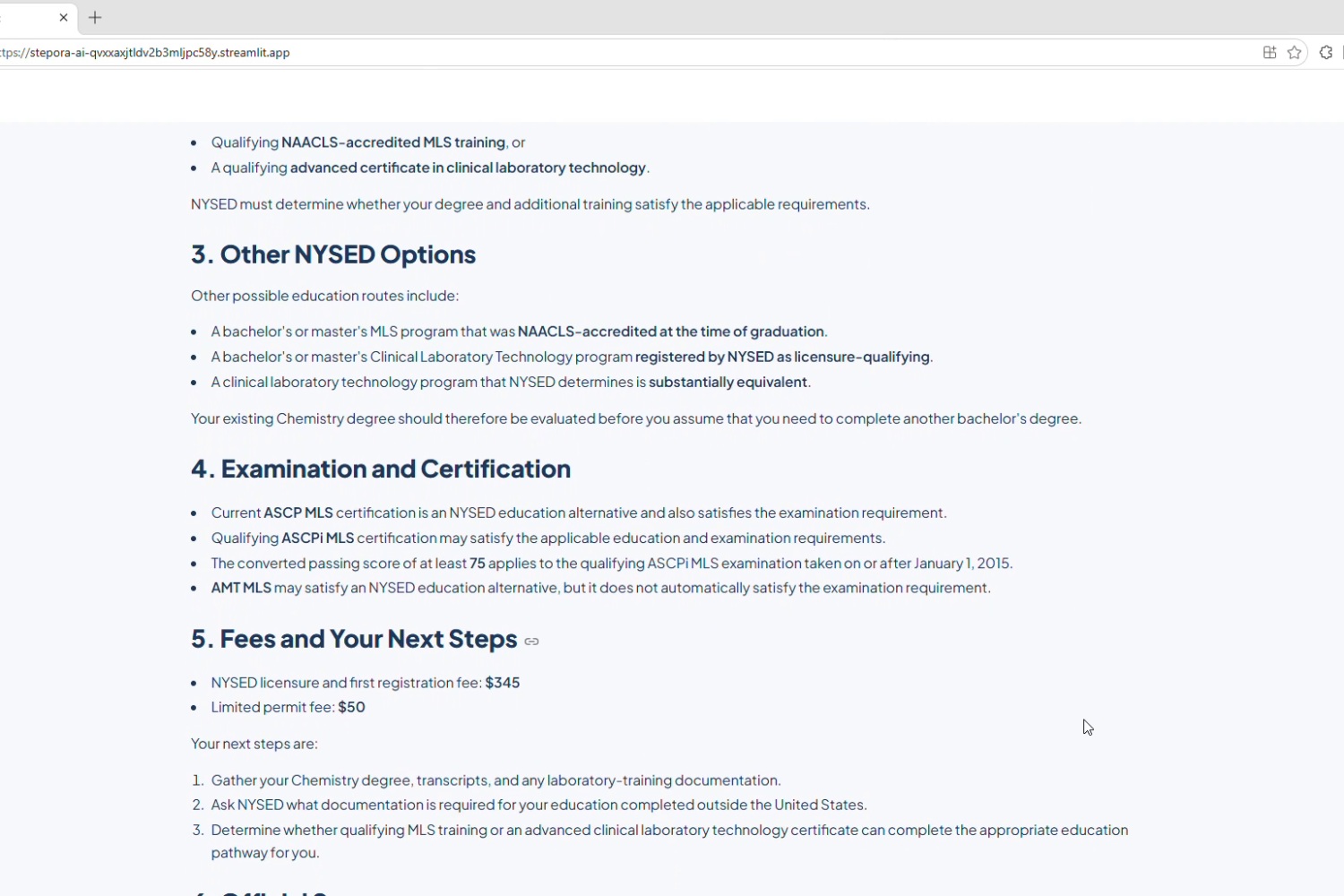
Inspiration STEPORA AI grew out of my own experience. I am a Clinical Laboratory Technologist, a full-time worker, a full-time Master of Public Health student, and a mother of young children. My life is already very busy, and before this hackathon, I had no background in software engineering, coding, or AI development. Still, when I saw this opportunity, I wanted to take it.
I did not come into this hackathon as a coder. I came in as someone who knew the problem.
For years, I have had to figure out education requirements, career pathways, credentials, licensing rules, and what steps make sense next. I know how frustrating it can feel to work hard, earn degrees and experience, and still ask yourself:
What actually counts? Do I need to start over? What should I do next?
Over time, I realized I was not the only person asking these questions. Many people around me came to me asking about degrees, licenses, transferring credits, and whether their previous education could still help them move forward. That is when I understood this problem was much bigger than my own experience. When we are growing up, almost all of us are asked the same question:
“What do you want to be when you grow up?”
As children, many of us have an answer. We imagine a future for ourselves. We dream about becoming a doctor, teacher, scientist, nurse, engineer, or something else that feels meaningful to us.
But when we grow older and finally reach the point where we have to turn that dream into a real career, the path is not always clear. That is the moment when guidance matters most. Sometimes we need a roadmap. Sometimes we need someone to explain the next step. Sometimes we simply need a small light to help us see the path in front of us.
For many first-generation students, immigrants, and families where English is not the first language, that guidance can be especially difficult to find. Parents may deeply want to help their children but may not understand the education system, licensing requirements, credit transfers, or professional pathways themselves. The student is often trying to figure everything out for the first time.
I want STEPORA to be part of that answer. I want it to help connect the dream someone had as a child with the practical steps they need as an adult. Not by choosing a future for them, but by helping them understand how to move toward the future they already imagined for themselves.
These challenges are especially common for immigrants and internationally educated professionals, but they are not limited to them. Students, career changers, people returning to school, people transferring into another program, and people entering regulated professions can face the same confusion.
Even with work, school, and raising my children, I wanted to use this hackathon as an opportunity to turn my own difficult experience into something useful for others.
That became "STEPORA AI"
My goal is not simply to build an application. I want to make a path that once felt confusing and difficult for me clearer for the next person.
If STEPORA can help someone understand what they already have, avoid unnecessary steps, save time and money, and move forward with more confidence, then building it is worth it.
What it does
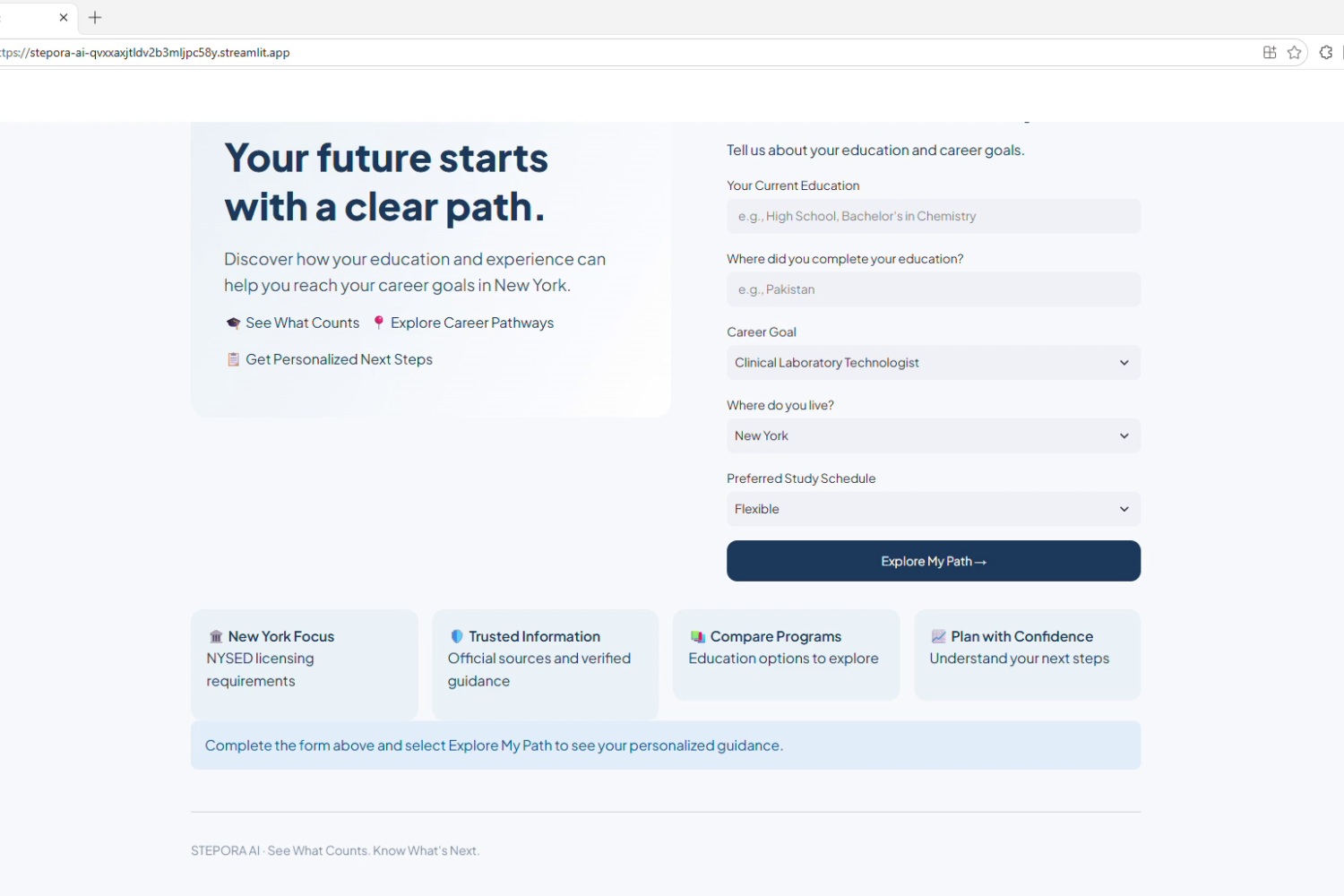
STEPORA AI is a personalized career-pathway navigator designed to help users answer three important questions:
- What already counts?
- What is still missing?
- What should I do next? A user enters their education, where they studied, their career goal, location, and preferred study schedule.
STEPORA then turns that information into a clearer pathway instead of giving every user the same generic answer.
For this hackathon prototype, I focused on the Clinical Laboratory Technologist pathway in New York, because this profession and my own journey are very close to my heart.
Someone with only a high-school education should not receive the same guidance as someone who already has a bachelor’s degree in Chemistry or Biology. Their starting points are different, so their pathways should be different too.
STEPORA recognizes that difference and provides guidance based on what the user already has.
The goal is not to automatically tell people to start over. The goal is to help them understand what they may already be able to build on.
How I built it STEPORA AI was built using Python and Streamlit.
It uses NVIDIA Nemotron-3-Nano-30B-A3B through Nebius Token Factory for AI-powered explanation and personalization.
STEPORA makes live runtime inference calls through Nebius Token Factory’s OpenAI-compatible API. This allowed me to use NVIDIA Nemotron without having to provision or manage my own GPU infrastructure.
During development, I learned something very important: generative AI can produce an answer that sounds confident, professional, and convincing while still being inaccurate.
For regulated careers, that can be a serious problem. Incorrect licensing guidance could cost someone time, money, or lead them toward an unnecessary educational path. That changed the way I built STEPORA.
Instead of allowing the model to freely generate critical regulatory information, I created a hybrid approach.
Important licensing rules and pathway logic are grounded in verified information and controlled pathways. Generative AI is then used where explanation and personalization add value.
For the current prototype, I created controlled pathways for users starting with high school education, a bachelor’s degree in Chemistry, and a bachelor’s degree in Biology within the New York Clinical Laboratory Technologist pathway.
The application still makes live Nebius/NVIDIA model calls, but critical regulatory facts are protected by verified logic rather than depending entirely on generative output. That became one of the most important ideas behind the project:
AI should be powerful, but it also needs boundaries when the information matters. Challenges I ran into
The first challenge was technical. Before this hackathon, I had never built an AI application. I had to learn how APIs work, how to connect an AI model, how GitHub works, how deployment works, how to troubleshoot errors, and how to think about responsible AI. There were many moments when the application did not work the way I expected. I dealt with API configuration issues, deployment problems, model-output problems, and code that sometimes behaved differently from what I intended. But every problem forced me to learn something new.
The second major challenge was accuracy. Early AI responses sometimes sounded believable but did not fully match official licensing requirements.
That was a turning point for STEPORA. It made me realize that building something that simply produces an answer is not enough. The answer also needs to be trustworthy.
That led me to strengthen the architecture by adding validation logic, verified regulatory rules, and controlled pathway responses for high-stakes information while still keeping a live Nebius/NVIDIA model call in the application.
The hardest part was not just getting STEPORA to run.
It was getting STEPORA to become something I could trust enough to show someone else.
Accomplishments I’m proud of
I am proud that STEPORA became a working public prototype.
It can respond differently based on a user’s educational background and provide a clearer pathway without treating every person as though they are starting from the same place.
I am also proud that STEPORA uses NVIDIA Nemotron through Nebius Token Factory in a real deployed application while combining generative AI with controlled, verified pathway logic for important regulatory information.
But one of my biggest accomplishments is simply that I built it.
I came into this hackathon as a Clinical Laboratory Technologist, an MPH student, a full-time worker, and a mother. I did not come in as a software engineer.
I started without coding experience, without an AI background, and without ever having built a product like this before.
And I still managed to turn an idea that mattered deeply to me into a functioning application that other people can actually use.
That means a lot to me. What I learned
This project changed the way I think about technology.
I learned that responsible AI is not only about choosing a powerful model. It is about understanding where AI should have freedom and where it should not. I also learned that testing is not just about asking, “Does the app run?”
It is also about asking, “Can I trust what it is telling someone?” I learned that domain knowledge and lived experience matter.
You do not always have to begin as a software engineer to build something meaningful. Sometimes the starting point is understanding a real problem deeply enough to know what a useful solution should look like. I came into this hackathon with lived experience, professional knowledge, curiosity, persistence, and a problem I cared deeply about solving.
That was enough to begin.
What’s next for STEPORA AI
Clinical Laboratory Technologist is only the beginning.
My larger vision is for STEPORA to become a platform that helps people navigate many different career pathways, including nursing, teaching, radiologic technology, dental hygiene, and other regulated professions.
Future versions could include stronger verified-data pipelines, education and program comparisons, credential guidance, credit-transfer support, cost information, financial-aid resources, and partnerships with universities, career centers, professional associations, and community organizations.
I want STEPORA to become a place where someone can arrive feeling confused and leave with a clearer sense of direction.
A place where someone can say:
“This is what I have. This is where I want to go. Show me what comes next.”
A place where people can understand what they have already accomplished instead of automatically assuming they need to start over.
A place that helps people save time, avoid unnecessary costs, and move forward with more confidence.
Winning a prize would be exciting, and any recognition or support could help STEPORA move forward.
But I do not want STEPORA to end with this competition.
The reason I built it is bigger than the hackathon.
I have seen how uncertainty around education and career pathways can affect people’s lives. I have lived that uncertainty myself. And I believe this is a problem worth continuing to work on.
When we are young, many of us know what we dream of becoming. Sometimes what we need later in life is simply a clearer path to help us get there.
That is what I want STEPORA to become.
Because starting over is hard enough. Finding your path shouldn’t be.

