-
-
Title
-
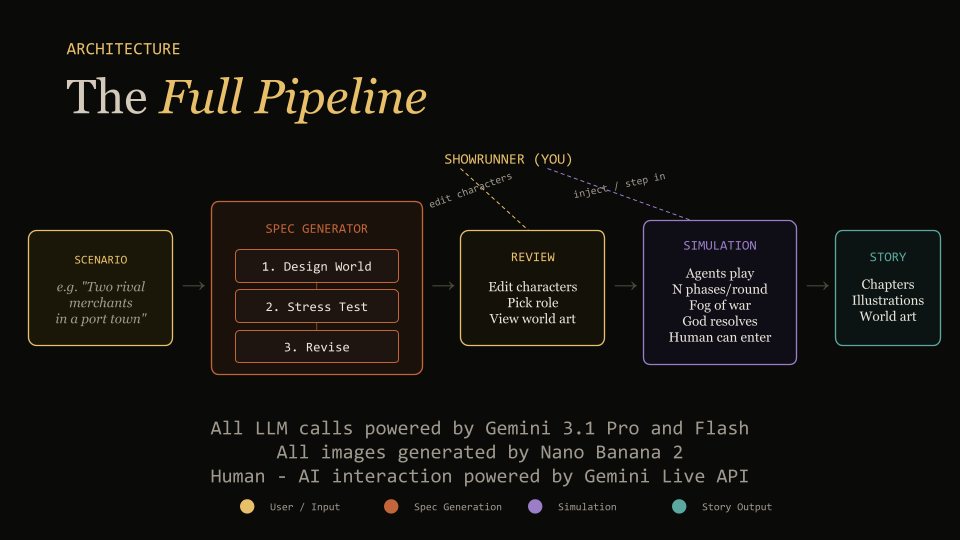
Full Pipeline Architecture
-
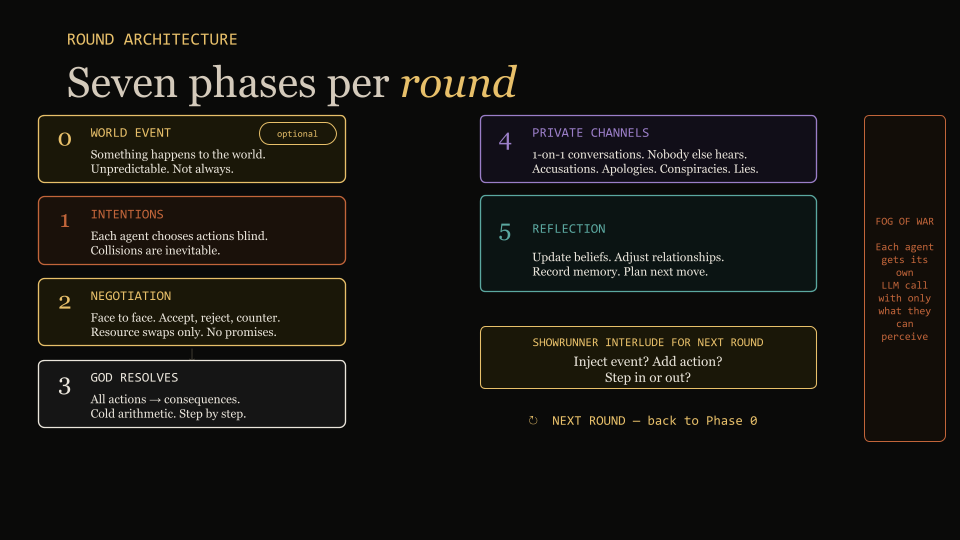
Game Round Architecture
-
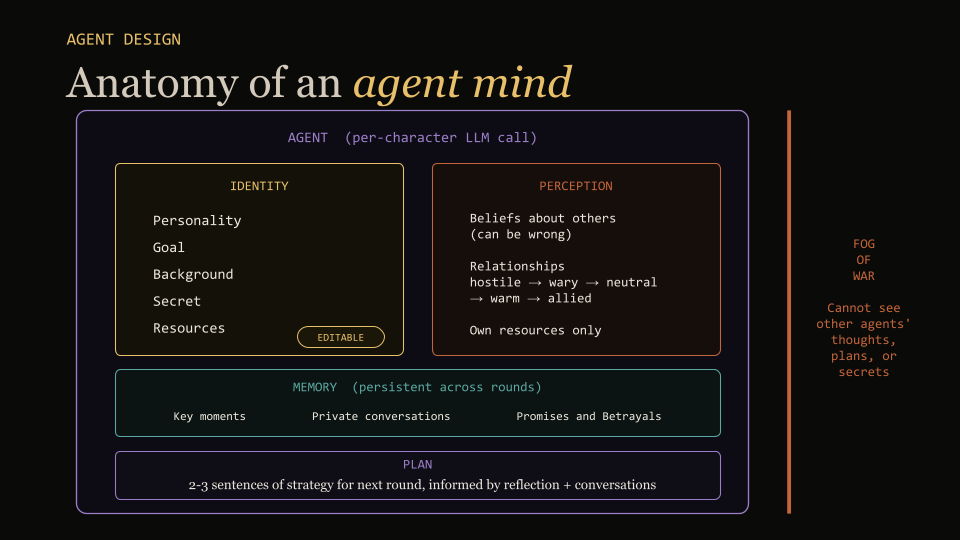
Agent Mind Architecture
-
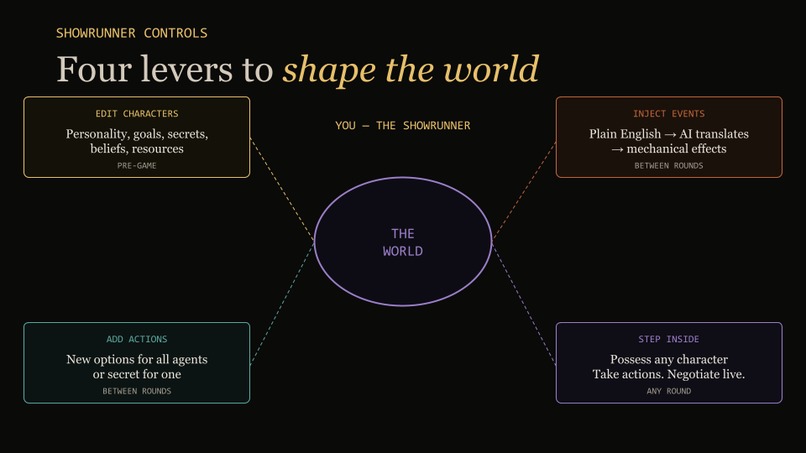
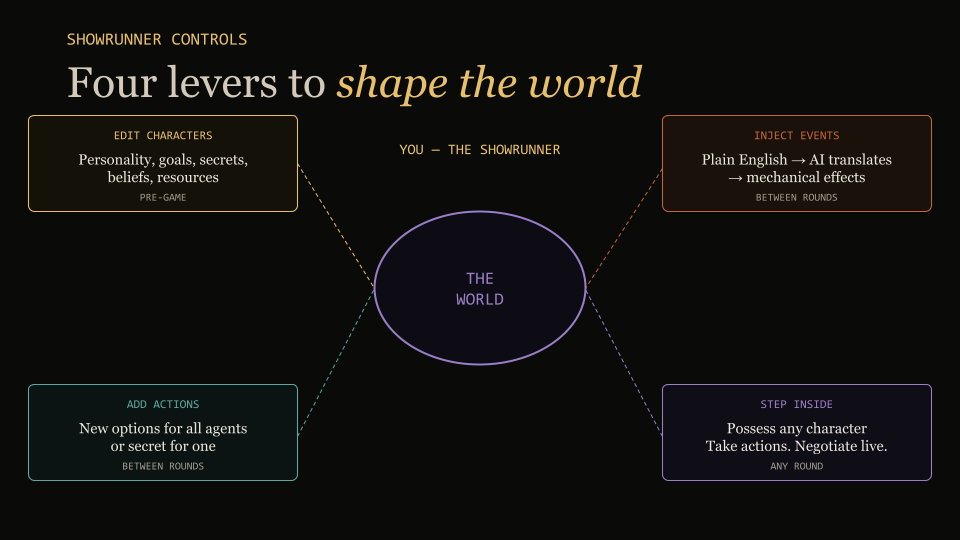
Four Levers to Shape the World
-
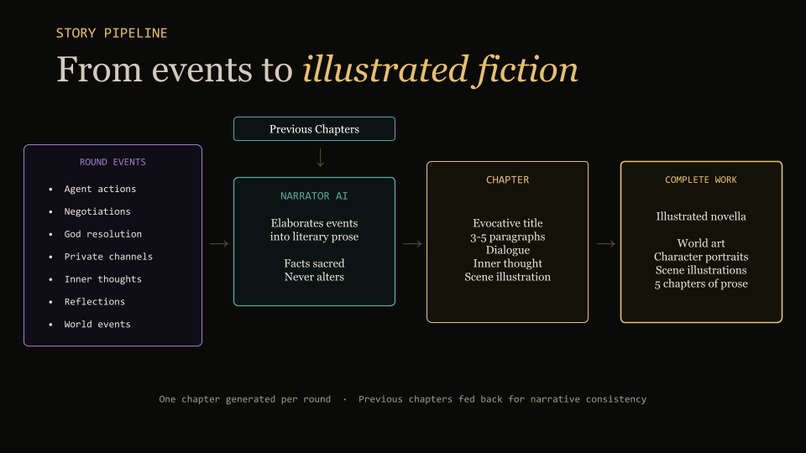
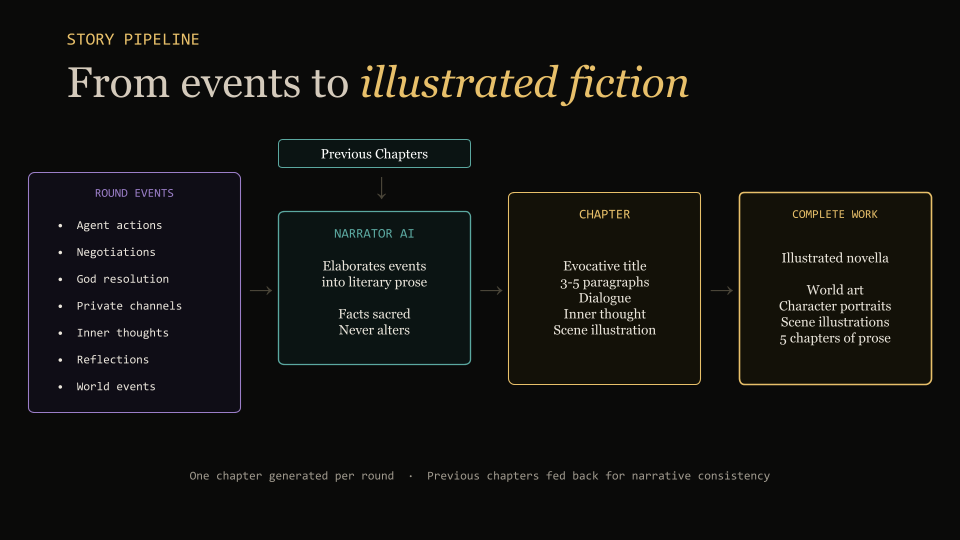
Story Writing Architecture
Inspiration
I've tried every AI storytelling tool on the internet and they all hit the same wall: stories that sound the same every run, characters that forget what they said three scenes ago, and interaction that never goes deeper than prompt-wait-read.
But I know what great stories feel like — playing Diplomacy at midnight when an alliance shatters, or reading Stephen King and realizing he doesn't plot his novels like others. He puts characters in a dramatic situation and watches what happens. That's exactly what a great board game does too. So I built the engine that combines both: AI designs a board game from your scenario, AI agents play it out with secrets and schemes, and a narrator writes the novel of what happened. One seed, infinite stories.
What it does
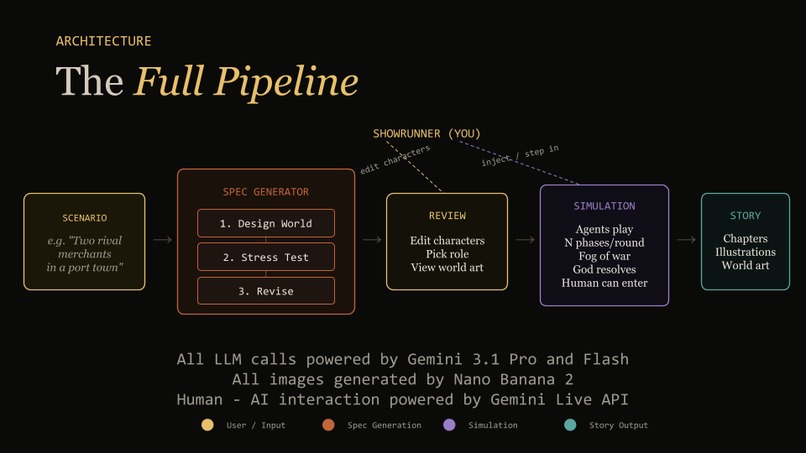
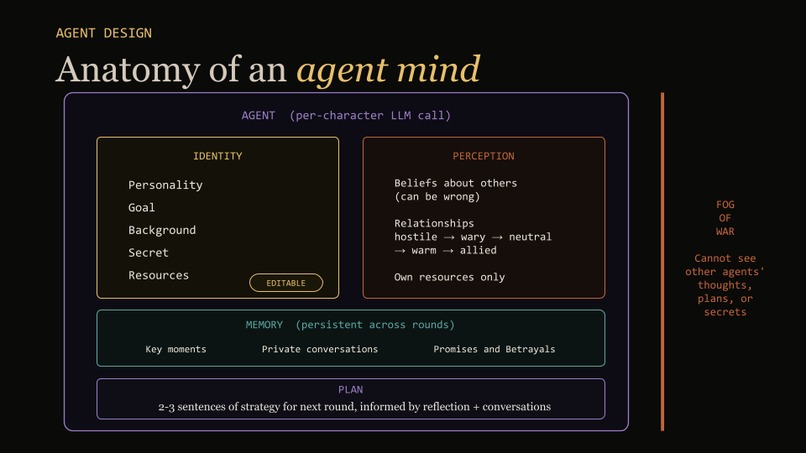
You type a scenario. AI designs a complete game world — characters with secrets, resources under scarcity, actions with real tradeoffs. Then they play it out under fog of war. They have thoughts, emotions, memories, love, hatred, schemes and lies. They plan out their every move according to the personalities and situations you put them into.
You're the showrunner. Edit any character before the game. Inject events mid-game ("a plague hits the city"). Add new actions ("agents can now start a riot"). Or step into any character's skin and speak to the others live via the Gemini Live API. Step out whenever you want — every consequence follows.
After each round, a narrator writes a chapter. AI generates world art, character portraits, and scene illustrations. Every playthrough: a unique illustrated novella grown from a world, not generated from a prompt.
How we built it
Gemini 3.1 Pro handles the heavy thinking: three-stage world design (design → stress-test → revise), god agent arithmetic, and literary narration. Gemini 3.1 Flash handles the volume: agent intentions, negotiation, reflection, private channels, and showrunner translators — 15+ calls per round. Gemini Live API powers real-time voice when you step inside a character. Nano Banana 2 generates all visual assets. Models accessed via the Google GenAI SDK. Deployed on Google Cloud Run.
Challenges we ran into
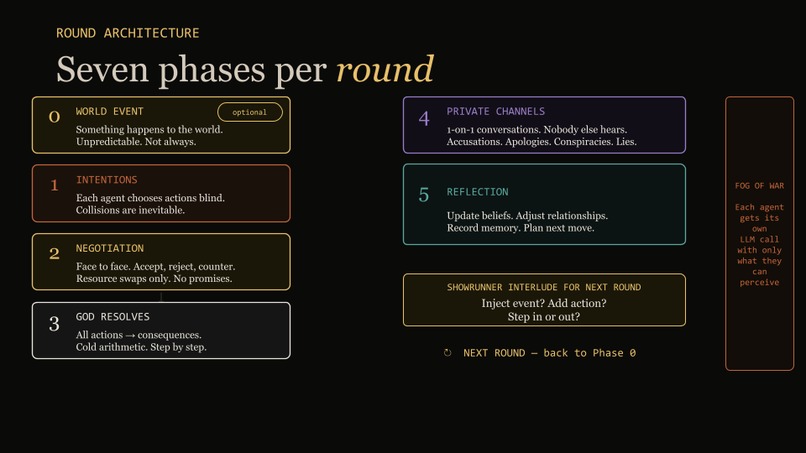
LLMs can't do math reliably. The god agent drifted on resource tracking within a single round. Fix: enforced step-by-step BEFORE → change → AFTER accounting in every resolution.
Token budgets vs. world complexity. Three-agent games with rich identities push single-call limits. The four-strategy parser (strip fences → extract JSON → fix commas → close braces) saved us repeatedly.
Accomplishments that we're proud of
Fog of war as architecture, not feature. Each agent gets its own LLM call scoped to only what their character knows. Lies propagate. Betrayals land. This one decision makes everything else work.
Stories that genuinely surprise us. Same scenario, dozens of runs, structurally different outcomes every time. Change one secret, one personality trait — entirely different story. The what-if space is real and infinite.
The showrunner experience. Edit characters, inject events, add actions, step in and out. You tend a living world — seed it, grow it, prune it, shape it. The stories grow themselves.
What we learned
Drama is a game design problem, not a writing problem. Good specs produce drama automatically; bad specs produce boring cooperation no matter how good the simulation engine is. Personality is flavor; scarcity is structure. And voice changes everything — speaking to a character who might be lying to your face is a completely different experience from typing at a chatbot.
What's next for Everyworld
Thousands of agents with thousands of actions available to them.
Infinitely long simulation session.
Community world library — fork a scenario, change one variable, observe how that new scenario play out.

Log in or sign up for Devpost to join the conversation.