
Inspiration — When a Delivery Becomes a Barrier
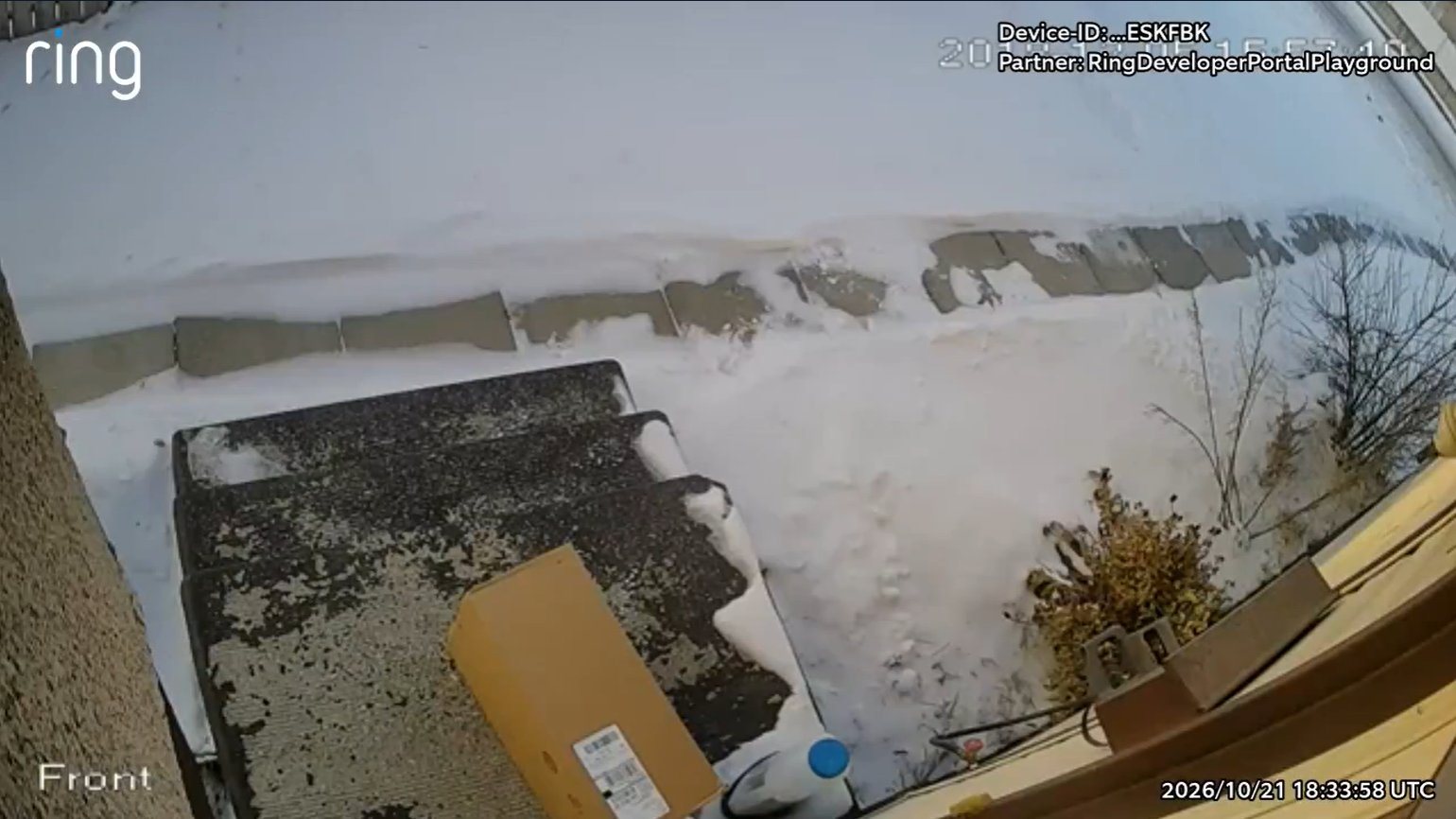
A parcel left at someone's doorstep is usually a convenience. But for someone using a wheelchair, walking frame, or other mobility aid, that same parcel can become an unexpected obstacle.
Smart doorbells already tell us when someone arrives or a package is delivered. But knowing that a package exists is different from understanding whether it might obstruct the particular route someone uses to enter or leave home.
What if a Ring camera could do more than watch a doorstep? What if it could help identify potential accessibility barriers?
That's why I built StepClear — AI Doorway Accessibility Agent.
StepClear explores a new, non-security use for Ring: helping residents and carers assess visible doorway obstructions using Amazon Bedrock AI, explainable geometric analysis, and human judgement.
What It Does
StepClear turns Ring camera footage into a personalised accessibility-focused obstruction assessment.
The application follows a five-step workflow:
1. Connect to Ring
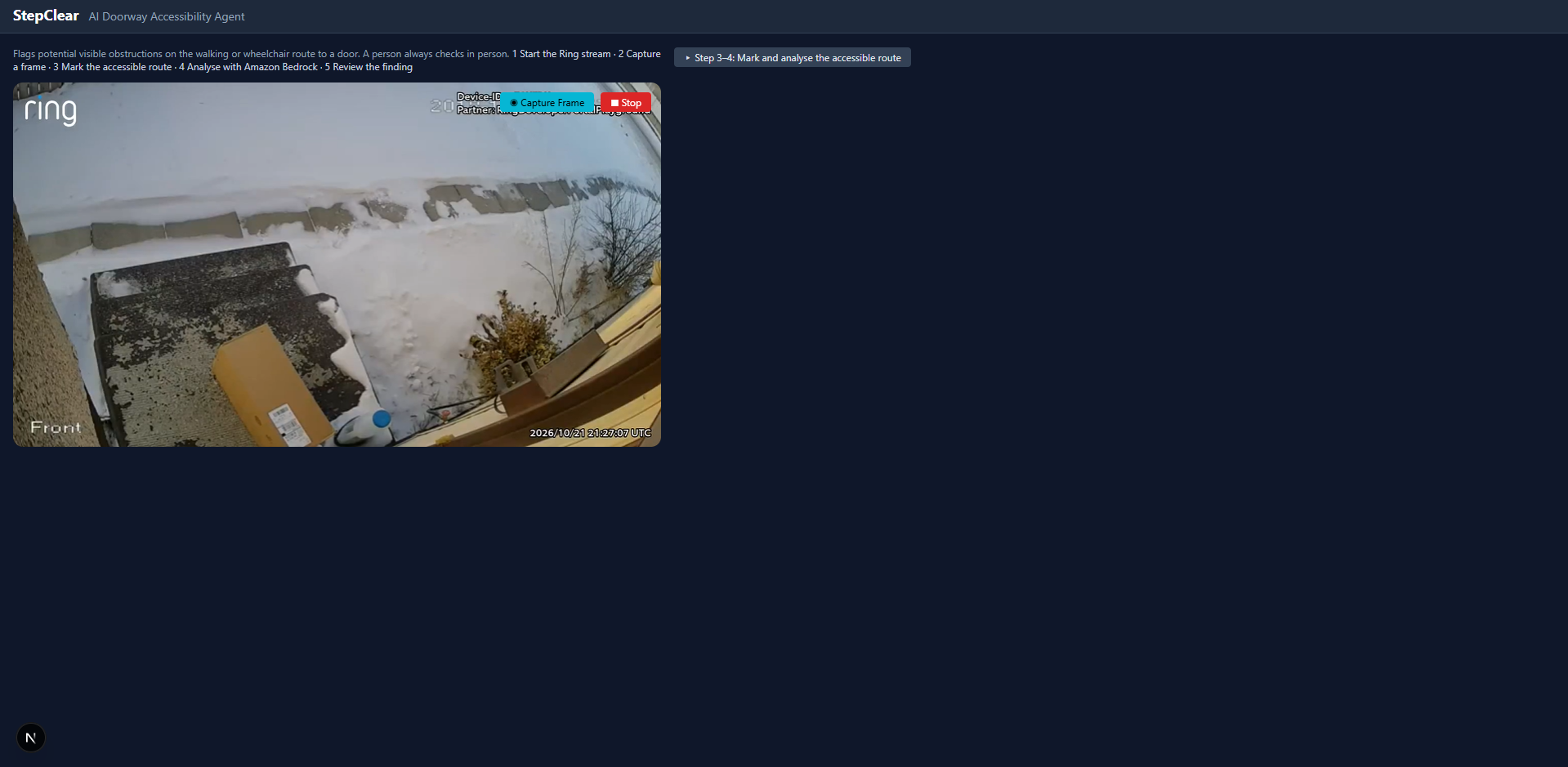
StepClear establishes a live video session through the Ring Partner API using WHEP/WebRTC. The demonstration uses the Ring Developer Playground, so no physical Ring device is required.
2. Capture a Doorway Frame
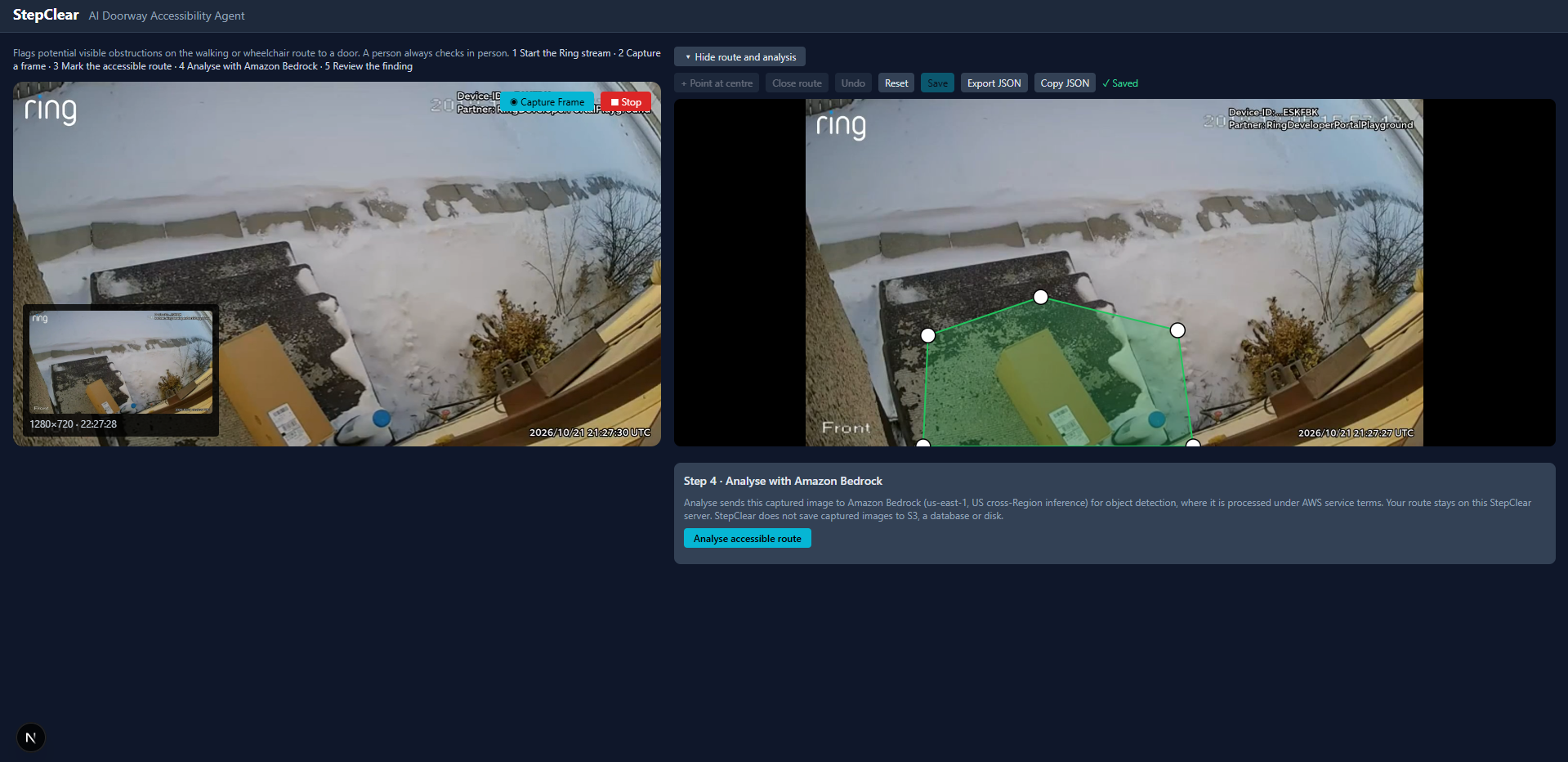
A resident captures an image directly from the live stream. StepClear handles the streaming lifecycle, including session failures and expired connections.
3. Define the Accessible Route
Instead of assuming that every visible object is an obstacle, StepClear lets the resident draw a polygon around the actual walking or wheelchair route.
The polygon can be edited, validated and saved for the device.
4. Detect and Assess Potential Obstructions
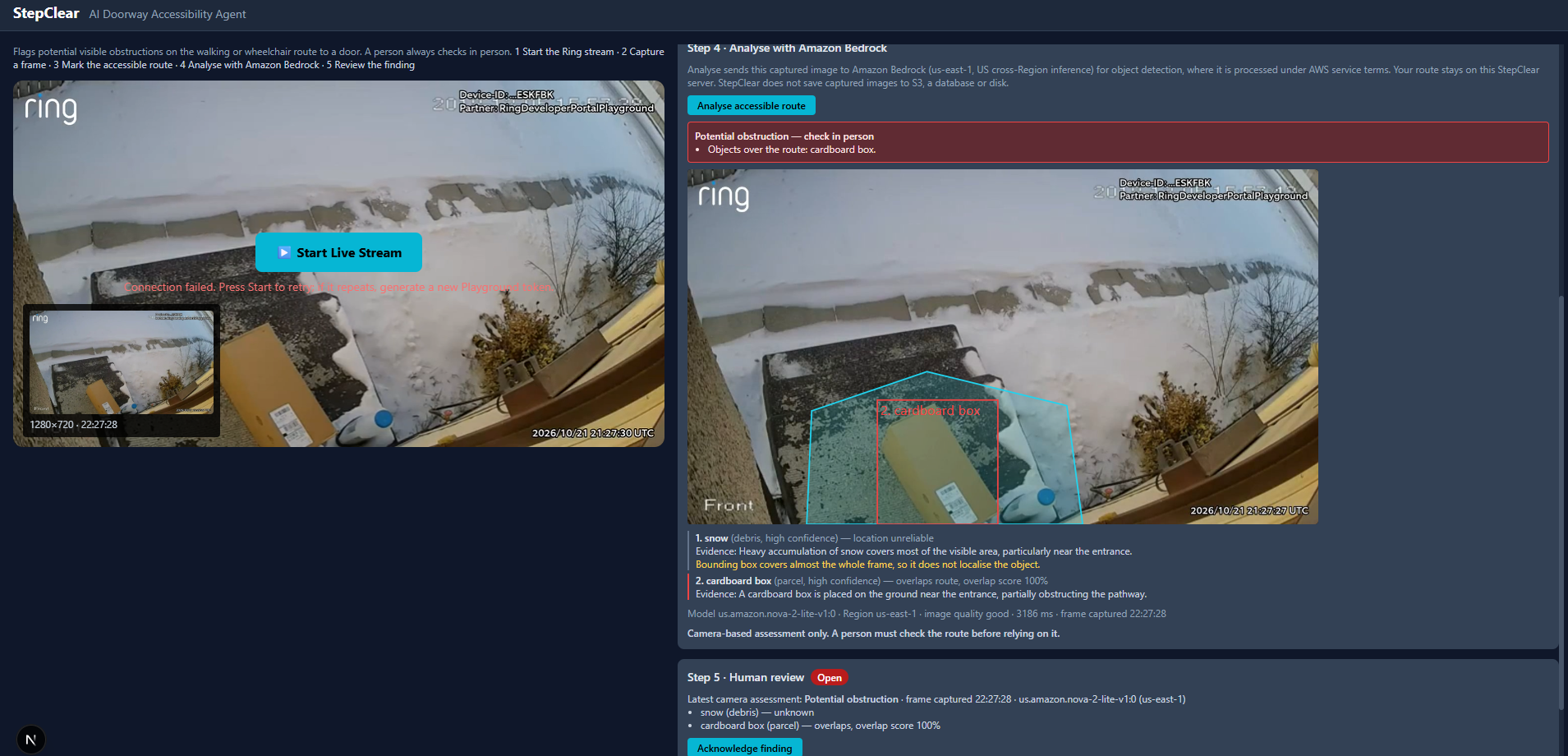
StepClear sends the captured image to Amazon Bedrock, where Amazon Nova 2 Lite identifies visible objects and estimates their locations.
StepClear then uses its own deterministic geometry to calculate how detected objects overlap the marked route.
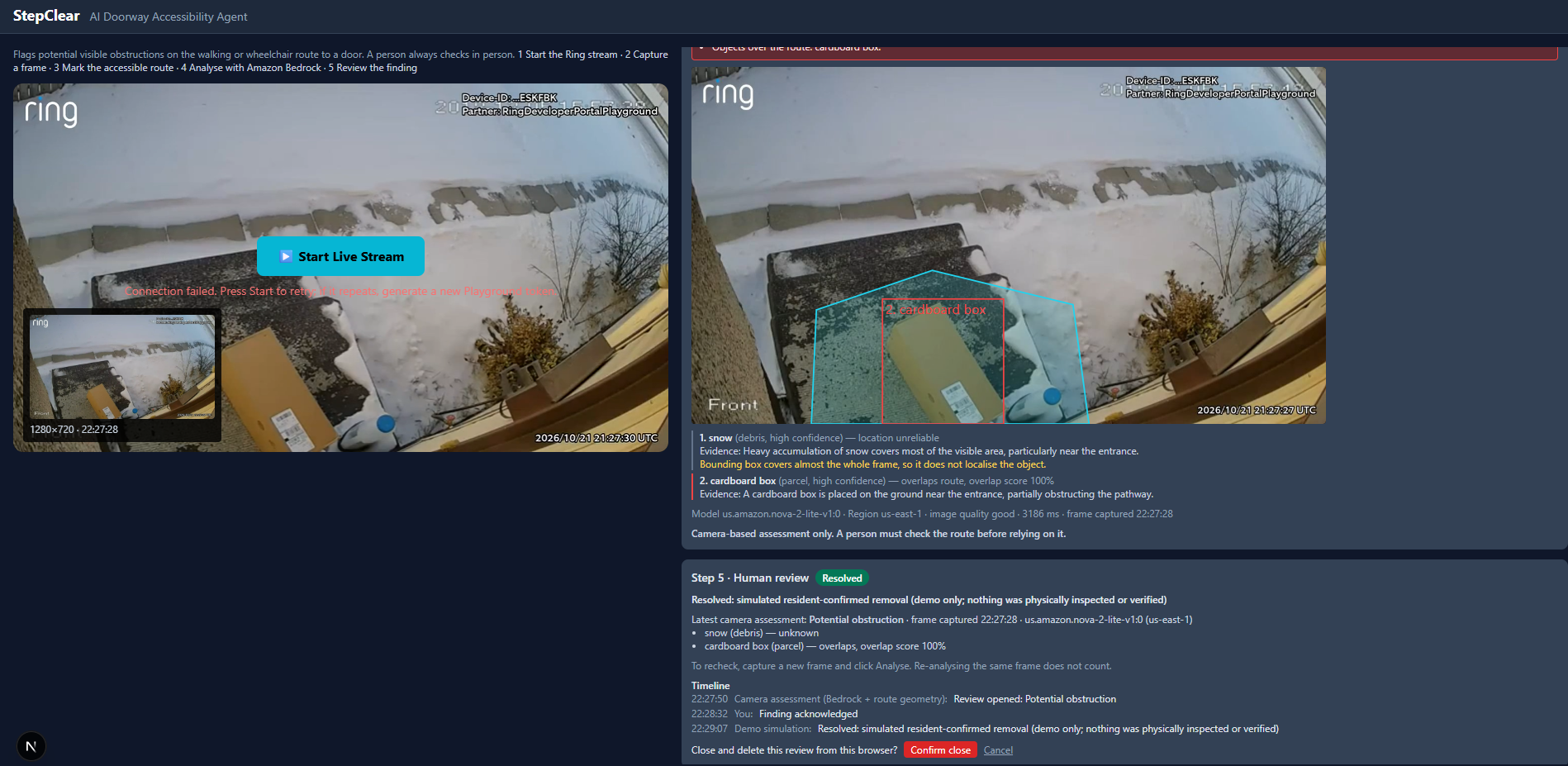
In the recorded demonstration, Nova 2 Lite identifies a cardboard parcel, and StepClear calculates a 90% geometric overlap score, flagging a potential obstruction.
The model also reports a large snow region. Rather than trusting an unreliable location estimate, StepClear identifies the oversized bounding box as unsuitable for precise localisation.
5. Human Review and Resolution
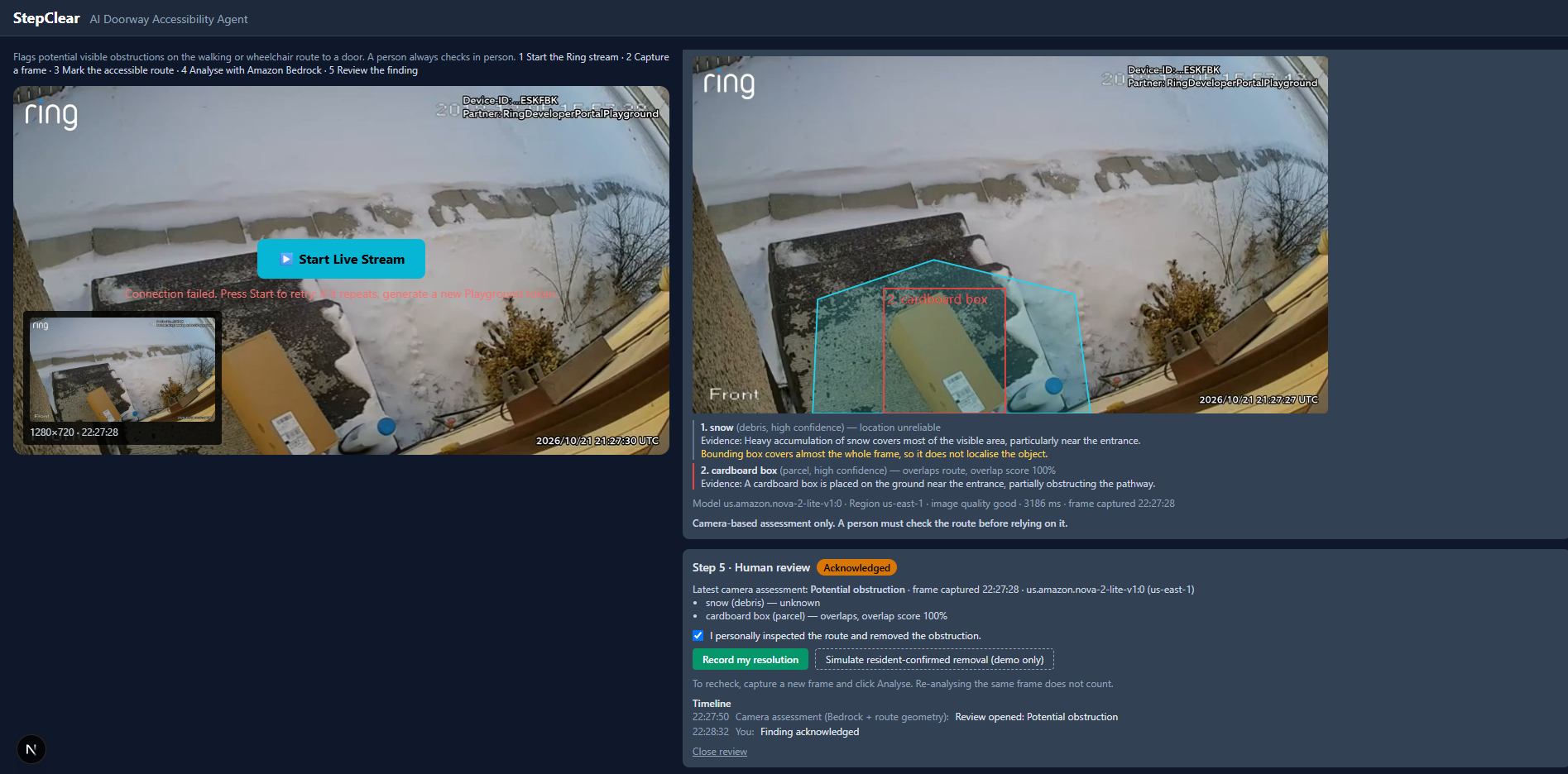
The resident can acknowledge the finding and record follow-up actions.
StepClear maintains a review timeline and distinguishes genuine user-attested resolution from an explicitly labelled demo simulation.
A new camera capture can be used to reassess the scene.
StepClear never claims to certify that a doorway is safe. A person must always verify the physical environment.
How I Built It
StepClear is a full-stack application developed using Next.js, React and TypeScript, extending Amazon's MIT-licensed Ring API Hello World starter.
Its architecture deliberately separates AI perception from deterministic assessment.
Ring Partner API and WebRTC
Ring provides the live camera stream through its Developer Playground and WHEP/WebRTC integration.
The server manages Ring authentication and streaming sessions. Credentials are kept server-side rather than exposed to browser code.
Amazon Bedrock and Nova 2 Lite
I integrated Amazon Nova 2 Lite through the Amazon Bedrock Converse API using AWS SDK for JavaScript v3.
The implementation uses a dedicated AWS IAM Identity Center profile, explicit credential selection, strict response validation, request timeouts and controlled inference execution.
Explainable Geometry
The AI identifies objects, but StepClear performs the route-overlap calculations.
A user-defined polygon represents the relevant entrance route. StepClear compares detected object bounding boxes with this polygon using deterministic geometric calculations.
This separation is important: the model provides visual perception, while application code evaluates geometric overlap.
The overlap score is not a probability of danger or a measurement of actual physical clearance.
Human-Centred Design
The application includes a keyboard-accessible polygon editor, conservative handling of uncertain detections, persistent review state and explicit separation between physical-resolution attestation and simulated demo actions.
Saved routes and limited review metadata use browser LocalStorage. Captured images are not stored by StepClear in S3 or an application database.
Challenges I Faced
Reliable Ring streaming: Implementing the WHEP session lifecycle required handling authentication, session expiry, frame capture and variations in the streaming session URL.
Amazon Bedrock inference configuration: Nova 2 Lite required the appropriate inference profile and cross-Region IAM permissions. Explicit AWS profile selection was also necessary to avoid unintentionally using an unrelated development identity.
Accurate visual geometry: The route polygon needed to remain aligned with the captured image across different screen sizes, while avoiding invalid polygon configurations.
Handling uncertain AI predictions: The snowy doorway image demonstrated why visual object localisation cannot always be trusted. StepClear handles unreliable bounding boxes conservatively rather than blindly treating them as precise detections.
Recognising AI limitations: Small, low-contrast or partially obscured objects may be detected inconsistently. This reinforced the importance of human verification.
Accomplishments I'm Proud Of
- Built a working Ring-to-Amazon-Bedrock application rather than a static or mocked demonstration.
- Created an accessibility-specific route editor that makes obstruction assessment personal to each doorway.
- Combined multimodal AI perception with deterministic, explainable geometric analysis.
- Implemented an end-to-end human-review workflow with acknowledgement, persistence, rechecks and demo-safe resolution.
- Added privacy-conscious handling of camera images and credentials.
- Completed 82 passing automated tests, TypeScript checks and a successful production build.
- Demonstrated the complete workflow using real Ring Developer Playground integration and Amazon Nova 2 Lite inference.
What I Learned
The biggest lesson was that trustworthy AI applications need more than a powerful model.
AI can identify what might matter. Deterministic code can explain the assessment. Humans must remain responsible for real-world decisions.
Building StepClear also deepened my understanding of Ring's developer APIs, Amazon Bedrock visual inference, secure AWS integration and the challenges of accessibility-focused product design.
Built During the Hackathon
StepClear was built during the October 2026 hackathon period using Amazon's Ring API Hello World sample as its starting foundation.
I added the following capabilities:
- M1: Secure Ring streaming lifecycle and frame capture.
- M2: Interactive accessible-route editor and polygon validation.
- M3: Amazon Bedrock Nova 2 Lite integration and geometric obstruction assessment.
- M4: Human review, persistence and demo-safe resolution.
- M5: StepClear branding and judge-facing documentation.
- M6: Automatic route-editor expansion following frame capture.
- M7: Responsive two-column desktop experience.
The result is a substantially expanded, accessibility-focused application—not simply a rebranded live-view sample.
What's Next
StepClear is currently a proof of concept.
Potential future capabilities include event-driven obstruction assessments, scheduled checks before someone leaves home, accessible notifications, optional caregiver workflows, support for multiple entrances and validation across diverse real-world doorway environments.
Production deployment would also require stronger authentication, security hardening and testing with mobility-aid users.
The vision: make doorway accessibility a first-class capability of the smart home.
The project uses simulated Ring Developer Playground camera footage through a real Ring API integration. The promotional thumbnail is conceptual artwork; the demonstration shows the working application. No physical parcel removal or accessibility certification is claimed.
Source code: StepClear on GitHub
Original starter: Amazon Ring API Hello World
Built With
- amazon-bedrock
- amazon-nova-2-lite
- aws-iam-identity-center
- aws-sdk-for-javascript
- next.js
- node.js
- react
- ring-developer-playground
- ring-partner-api
- tailwind-css
- typescript
- webrtc
- whep
- zod


Log in or sign up for Devpost to join the conversation.