-
-
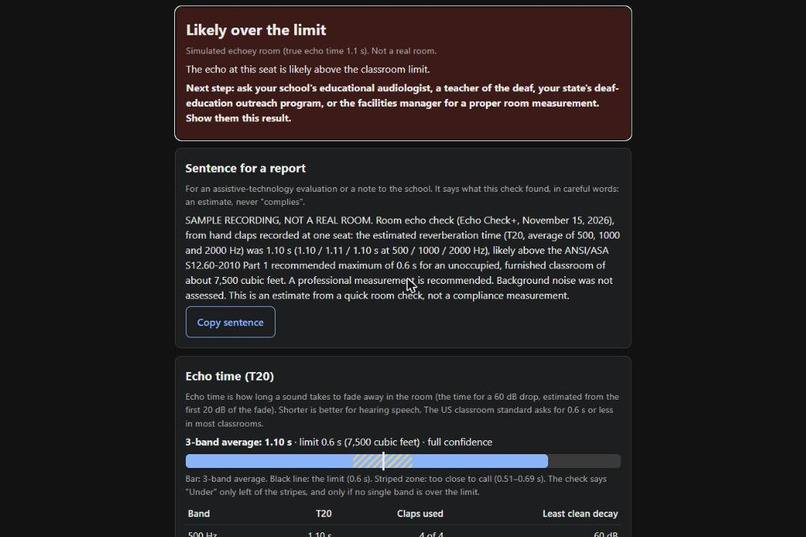
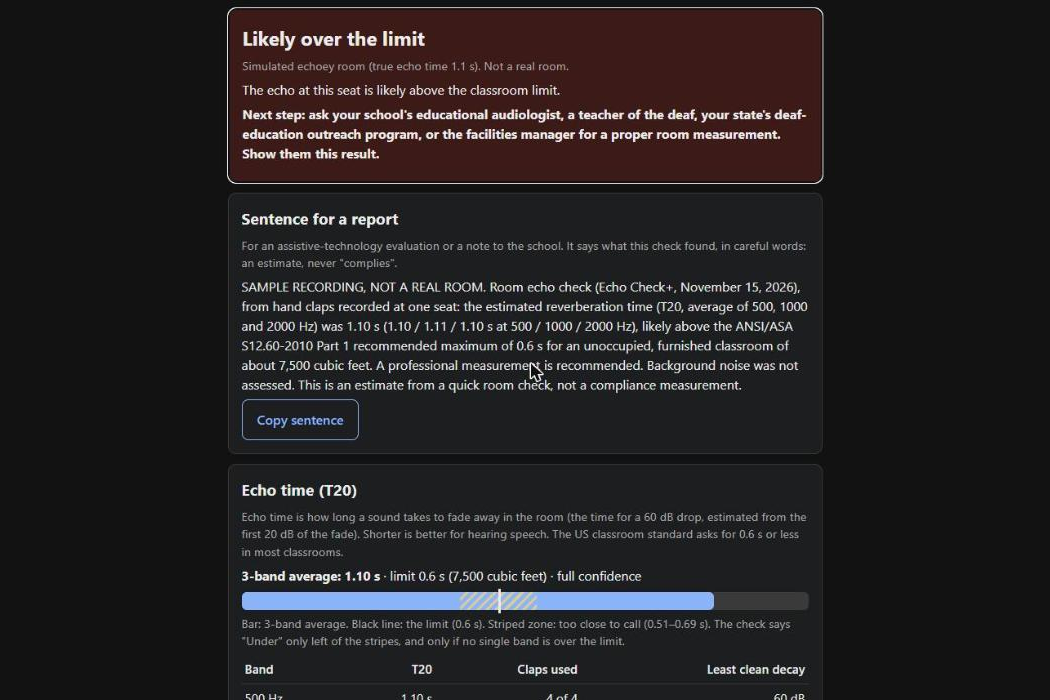
Result: the verdict, the next step, and a sentence to copy into an assistive-technology evaluation
-
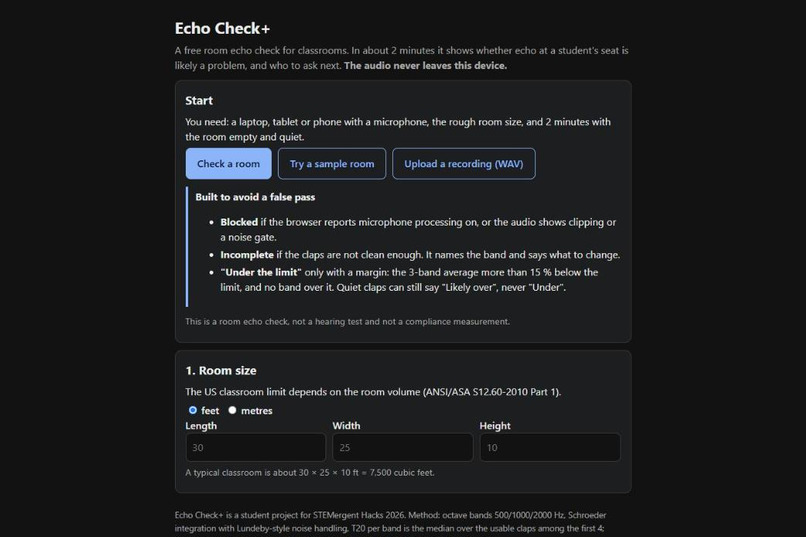
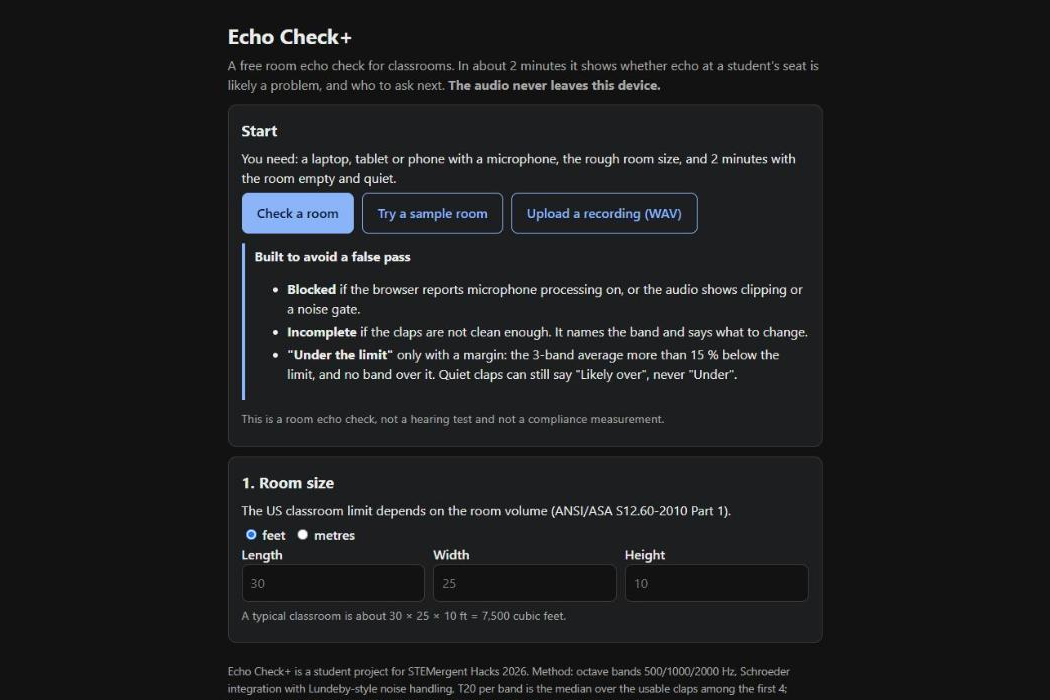
Start page: the three rules built to avoid a false pass
-
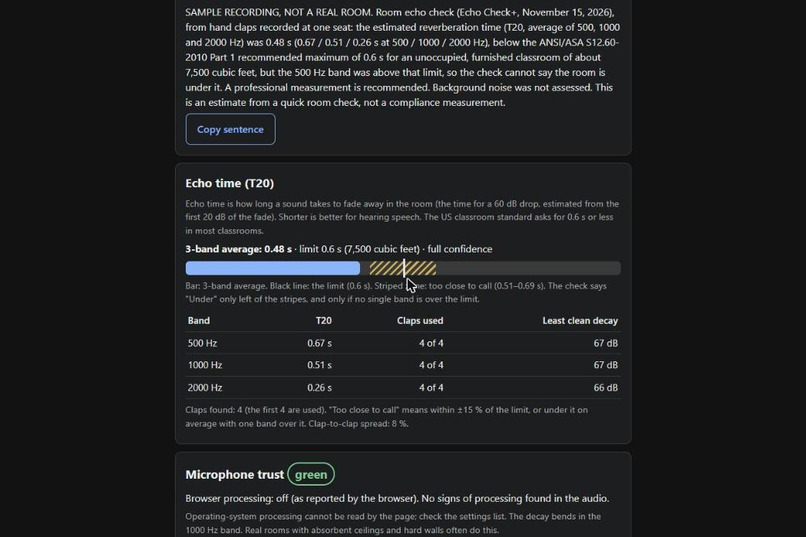
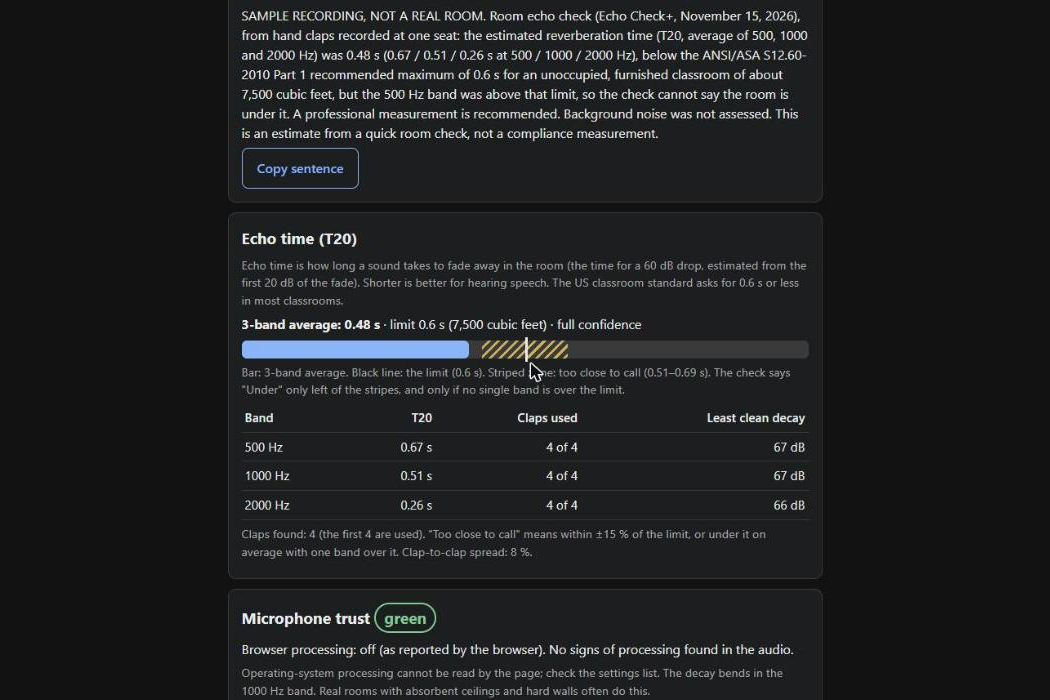
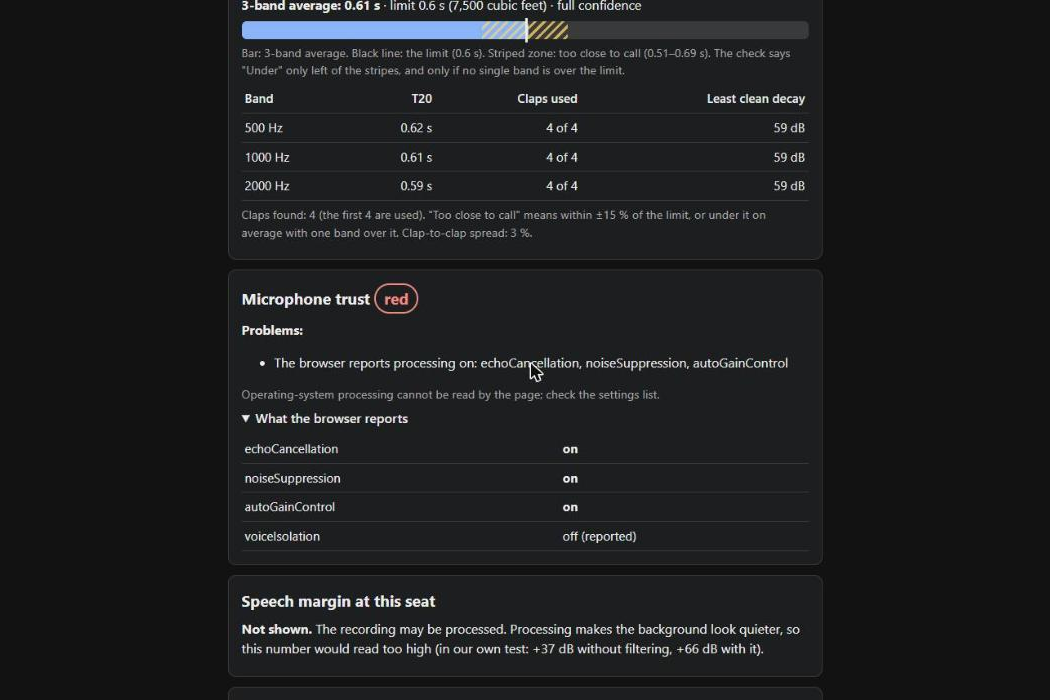
Uneven room: the average is under the limit but the 500 Hz band is over it, so the verdict is "Too close to call"
-
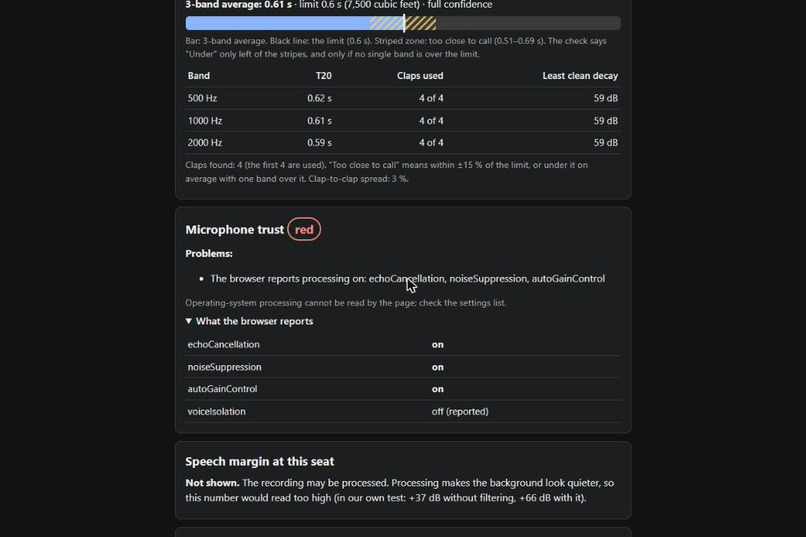
Trust check: the browser reports microphone processing on, so the verdict is Blocked
-
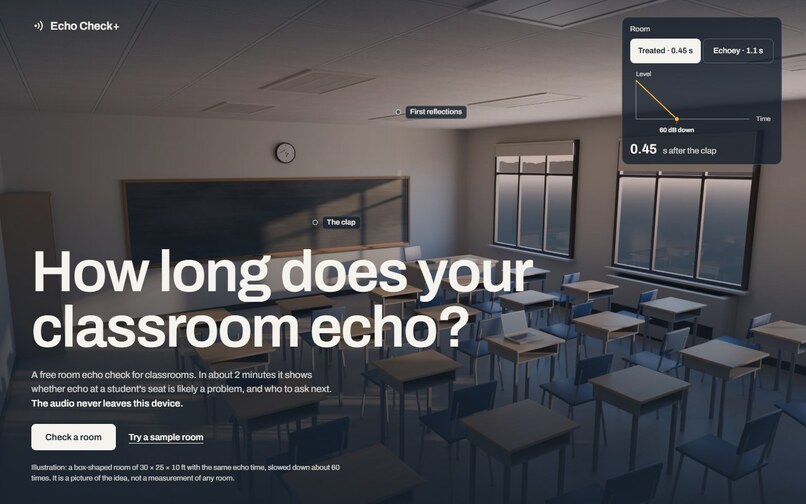
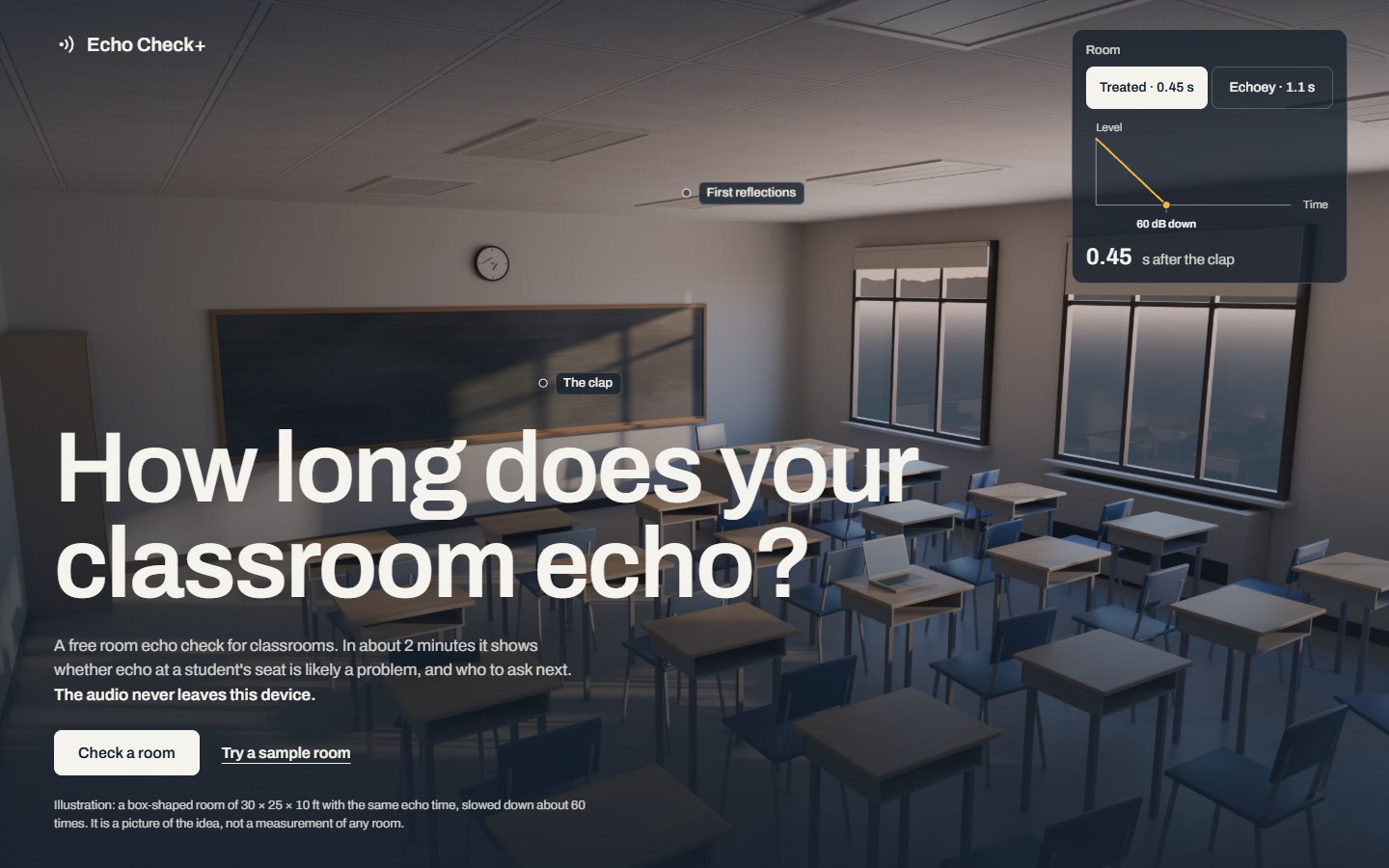
First screen: one clap fades at the room's echo time (treated 0.45 s or echoey 1.1 s). An illustration, not a measurement.
Echo Check+ is a free web page that tells a teacher or an educational audiologist, in about two minutes, whether a classroom's echo is likely over the US classroom limit, from four hand claps and a laptop, and it says "no verdict" instead of guessing when the evidence is weak.
Demo video (2 min, captioned): https://youtu.be/hjKIbJ4PJBY
Try it (no microphone needed: press "Try a sample room"): https://kniggukniggu-droid.github.io/echo-check/app/
Code: https://github.com/KnigguKniggu-droid/echo-check
In 30 seconds
- The problem: echo makes speech harder to follow in class, and the US classroom standard sets 0.6 s for most classrooms. Schools rarely pay for an acoustics consultant, and in one survey 88 % of educational audiologists were unsure about or had no access to equipment to measure echo time.
- What it does: four claps give the echo time in three frequency bands, one of five verdicts, a microphone trust badge, the next step, and one sentence to paste into an assistive-technology evaluation.
- Why you can trust what it says: it refuses to guess ("Incomplete"), weak evidence can only say "likely over" and never "under", a pass needs a 15 % margin, and the verdict is blocked when the browser reports microphone processing.
- How we tested it: measured rooms from four university datasets with simulated claps, simulated classrooms, and our own home test. We publish the no-verdict rate next to every false-pass count.
- Who checked it: an audiology professor on the S12.60 committee, an audiology department chair, an architectural acoustics firm, and four acoustics graduate students. We changed the app after each review.
Inspiration: the problem and who has it
- Echo (reverberation) makes speech harder to follow in a classroom. The American National Standard for classroom acoustics, ANSI/ASA S12.60-2010 Part 1 (voluntary unless a state or district adopts it), sets a maximum reverberation (echo) time for an unoccupied, furnished classroom: 0.6 s up to 10,000 ft³, and 0.7 s from 10,000 to 20,000 ft³. For students with hearing loss it also asks that smaller rooms be readily adaptable to 0.3 s (AAA position statement, 2011).
- In a survey of 220 K-12 classrooms in five districts in Iowa and Nebraska, 91 % had unoccupied background noise above the ANSI 35 dBA limit (one-minute measurement), and 15 % did not meet the 0.6 s reverberation limit (Brill, Smith and Wang, Acoustics Today 14(3), 2018; districts per Brill and Wang, Frontiers in Built Environment 7:688395, 2021).
- The people who notice the problem are teachers and educational audiologists.
- Erin C. Schafer, Ph.D., CCC-A, an audiology department chair, told us: "In terms of audiology, there's no standard guideline that an educational audiologist would use for assessing classroom acoustics. I wish there was!" On hiring an acoustics consultant: "It's very unlikely funding would even exist for this request in public schools (very tight budgets!)." (Quoted word for word, with permission, Sat 2026-11-14.)
- Audiologists already have a method, but most lack the equipment for it. The American Academy of Audiology's 2011 hearing-assistance-technology guideline (Supplement B) describes a three-step room check: a listening checklist, then basic noise and reverberation measurements at 500, 1000 and 2000 Hz from an impulse such as a popped balloon or clapped boards, then referral to an acoustical consultant. In a survey of 34 educational audiologists, 88 % were unsure about or had no access to equipment to measure reverberation time (Latham and Blumsack, Journal of Educational Audiology 14, 2007/2008). Echo Check+ turns a laptop into a tool for the reverberation part of that middle step (at one seat, where the guideline uses five positions; it does not measure the noise part).
- Under IDEA, an assistive technology service includes "a functional evaluation of the child in the child's customary environment" (34 CFR 300.6(a)). The classroom is that environment.
- ASHA and the Educational Audiology Association recommend one educational audiologist per 10,000 students; a 2025 paper (Dillmuth-Miller, Seaton and Gustafson, JEPRA) estimates the US needs 3,785 more to meet that ratio.
What it does
Echo Check+ is a free web page. A teacher or an educational audiologist enters the rough room size, puts a laptop on a student desk about 3–5 m (10–16 ft) from where they will clap, walks to the front, and claps four times. One recording takes about 45 seconds. Audio never leaves the device.
The page shows:
- Echo time (T20) in the 500, 1000 and 2000 Hz bands, and the 3-band average against the S12.60 limit for that room size.
- Five verdicts, never a bare pass or fail: Likely over the limit / Too close to call / Under the limit (weak evidence) / Incomplete / Blocked.
- A microphone trust badge. Browsers can filter the microphone (noise suppression, echo cancellation, gain control), and filtering changes the echo time. The page asks the browser to turn processing off, reads back what the browser reports, and blocks the verdict when the browser reports processing on. It cannot see operating-system processing (for example Windows Voice Clarity), so the setup step lists those settings.
- Speech margin at the seat (empty room, best case). The page shows a caution when the badge is amber and hides the number when it is red.
- A next step: "Likely over" and "Too close to call" both say: ask the school's educational audiologist or facilities manager for a proper measurement.
- A limitations box: the check cannot measure the 35 dBA background-noise limit (a phone microphone is not calibrated), and noise is often the bigger problem. It compares with the 0.6/0.7 s limit, not the stricter 0.3 s target for students with hearing loss. An "Under the limit" result is weak evidence and must never be used to deny accommodations.
- A sentence for a report: one copyable sentence for an assistive-technology evaluation, in careful words ("an estimate", never "complies"), with the date, the room size and the limit.
- No microphone needed to try it: simulated sample rooms, published data from university rooms, and WAV upload.
What is different
Echo Check+ is built around the one harm an acoustics consultant named for a tool like this: a false pass. Four rules follow from that, and each one is a button in the app ("Try a sample room"):
- It refuses to guess. Each band (500, 1000, 2000 Hz) needs 2 claps with at least 30 dB of clean decay. If not, the result is "Incomplete", with the band, the level reached and what to change. We publish this no-verdict rate next to every false-pass count. (Demo: "Quiet claps: treated room".)
- Weak evidence only points one way. When the claps are too quiet for the full measurement, the early decay can still say "Likely over the limit" (lower confidence), but never "Under". The early decay read about 5 % shorter than T20 in our tests, so a high value is safe evidence of "over", and a low value is no evidence of "under". This is guarded rejection, a decision rule from measurement science (JCGM 106:2012). (Demo: "Quiet claps: echoey room".)
- It checks its own microphone. In our browser tests (Chrome's real processing, applied to recorded test takes through a fake microphone), the processing moved the echo time by up to 18 %, and the audio alone did not reveal it. The page asks for processing off, reads back what the browser reports, and blocks the verdict when the browser reports processing on. It cannot see operating-system effects, and it says so. One of us has built spoofing and intrusion detectors for GPS and car networks; the badge asks the same question of a microphone. (Demo: "Browser filtering on".)
- A pass needs a margin. "Under the limit" needs the 3-band average more than 15 % below the limit and no single band over it. This is guarded acceptance (JCGM 106:2012). An audiology professor on the S12.60 committee said of the ±15 % band: "That error band sounds good." (Demo: "Uneven room: one band over"; the echo-time bar shows the zone as stripes.)
And one output an audiologist asked for: a sentence to paste into an assistive-technology evaluation, in careful words.
In a search on 13 and 15 November 2026 we found free clap apps for phones (Akustikkollen, ClapIR, ClapReverb) and a browser tool that checks uploaded impulse responses against S12.60 (AcoustiVision Pro), but no free web page that records claps live, compares the result with S12.60 and blocks the verdict when the browser reports microphone processing. This is what we found, not proof that none exists.
What the experts told us
- Peggy Nelson, professor of audiology and member of the S12.60 standards committee (Professor Nelson served on the Acoustical Society of America's Task Force on Classroom Acoustics), called it "A good method of estimating reverberation." We asked whether our ±15 % "too close to call" band is reasonable for claps recorded on a laptop. The answer: "That error band sounds good." (quoted with permission)
- Erin C. Schafer, Ph.D., CCC-A, Department Chair, Audiology & Speech-Language Pathology, University of North Texas: "If I were still a practicing educational audiologist, I would use this screening check to evaluate a classroom's acoustics as part of an assistive technology evaluation for a student (to determine whether they need hearing technology in the classroom)." We asked what such a report needs. The answer: "They would just include a simple sentence stating whether or not the classroom met recommended levels." That is why the result page now offers a sentence to copy into a report (careful wording: "estimate", never "complies"). (Quoted word for word, with permission; not an endorsement.)
- The principal of an architectural acoustics firm told us that it helps if it sends people toward a measurement and never replaces one, and that a false pass is the harm. (shared with permission; advice, not an endorsement)
- Architectural-acoustics graduate students at a US university reviewed the method and the live app on Sunday morning. They saw no glaring issues in the method. Their suggestions, which we built the same day: cue each clap with a countdown and leave about 4 s between claps; describe the timing with the countdown numbers the page shows; say in one line why the page records claps and speech; explain the terms in plain words.
How we tested it (always both numbers: false passes and the Incomplete rate)
Read this first: in every dataset test below, the room's echo was measured by a university (ACE, MIT, HOMULA-RIR, PAN-AR) or simulated (pyroomacoustics), but the claps were simulated by us. The background noise was simulated too, except in the ACE tests, which use each room's own recorded noise at set levels. The only real claps so far are our own device test at home (1 device).
| Test | What it covers | Result |
|---|---|---|
| Synthetic decays with known answers | The maths | 27 of 27 tests pass |
| pyrato (pyfar, an open room-acoustics library) on a real take | Agreement with an independent implementation | 3-band average within 3.5 % (0.412 vs 0.398 s); single bands up to 8.6 % |
| ACE Challenge corpus (Eaton et al., IEEE/ACM TASLP 2016), 7 measured rooms × 2 positions, simulated claps | Real measured rooms with published T20 values | 0 false passes. With 45 dB of clean decay: 12 of 14 give a verdict, median error 3.2 %. With 35 dB or less, almost all are Incomplete |
| The real app in headless Chrome with a fake microphone that plays our simulated takes (ACE rooms, simulated claps), 14 takes × processing off/on | The real browser path and Chrome's real processing | Off: 12 of 14 give a verdict, 0 false passes, median error 3.2 %. On: Chrome's processing moved T20 by up to −17.8 %; the badge blocked all 14 through the browser's own report |
| MIT IR Survey (Traer & McDermott, PNAS 2016), 102 measured responses from real indoor rooms, including 35 classrooms | Real homes, offices and classrooms | 0 false passes. Harsh setup: no verdict in 35 of 102 files. Back-row-like setup: no verdict in 2 of 102; median error 5.9 % |
| Simulated classrooms (pyroomacoustics, EPFL), 39 rooms × 3 seats × clap levels × 35/45/50 dBA background (2 × 1,053 takes) | The app's own geometry: clap at the front, device on a desk; absorption data of real finishes | With a forceful cupped clap (about 92 dB at 1 m, from the literature): a verdict at all 39 middle and all 39 back seats at 35 dBA, and at 37 of 39 back seats at 45 dBA. Median error about 1 %. Each clap set had 2 false passes, all at a seat 1.8 m from the clapper; with the tail guard added on Sunday, 0 false passes in both sets (the review that led to the guard looked at these same sets, so this is not an independent test; the app also asks for 3–5 m) |
| Simulated claps in 3 real rooms measured by two universities: HOMULA-RIR (Politecnico di Milano seminar room, 25 seats × 2 sources) and PAN-AR (University of Milan classroom and meeting room), 60 measured echo responses | Our clap model at 3 levels and HVAC-like noise at 3 levels (35/45/50 dBA) added to the measured responses (1,080 test files). Nobody clapped in these rooms. All 3 rooms are over the limit, so this test cannot show how the check handles rooms that pass | 0 false passes. Median error about 1 % when a verdict is given. With a 92 dB clap: 46 of 50 seat responses (25 seats × 2 loudspeakers) give a verdict at 35 dBA, but only 12 of 50 at 45 dBA (9 of 10 in row 1, 3 of 10 in row 2, none farther back) |
What we have not tested: real laptop and phone microphones beyond one device, operating-system processing (Windows, macOS, ChromeOS), occupied rooms, and the real loudness of a clap in a real classroom (our clap level is an assumption).
Potential impact
- Educational audiologists get a number for the reverberation step of the room check that their own 2011 guideline describes, without buying equipment, and a sentence for the evaluation report that an audiology department chair asked for.
- Teachers get a concrete reason to ask the school's audiologist or facilities manager for a measurement or for hearing technology, instead of a feeling that the room is hard to talk in.
- Any school can try it today: it is free, runs in a browser, and sends no audio anywhere. A pass is never a reason to deny an accommodation; the page says so on every result.
Feasibility
- It runs today, for free: a static web page in Chrome on a laptop. No install, no account, no server, no running cost; audio never leaves the device.
- Who can use it tomorrow: an educational audiologist or a teacher with a laptop and the room's rough size; one check takes about 2 minutes.
- Before wider use: more real devices, real classroom takes compared with a professional measurement, and a pilot with educational audiologists (their AAA 2011 room check already has a reverberation step).
- It will not become a compliance measurement. It stays a screening estimate that points to a proper measurement.
How we built it
- Capture:
getUserMediawith echo cancellation, noise suppression and auto gain control requested off; raw samples through an AudioWorklet (ScriptProcessor fallback); 45 s with on-screen prompts. The page cues every clap ("Clap 1 of 4 in 3… 2… 1… CLAP NOW"), 4 s apart, so each decay has more than twice a long classroom echo time and quiet background after it. - Clap detection: a 200 Hz high-pass and a 5 ms energy envelope find the claps.
- Per band (500, 1000, 2000 Hz): third-order Butterworth octave filters; the background level before each clap; Lundeby-style truncation with noise subtraction; Schroeder backward integration; T20 by linear regression from −5 to −25 dB.
- Quality gates: each clap needs 37 dB of clean decay for full confidence (30–37 dB: lower confidence; under 30 dB: not used). Per band, the verdict uses the median T20 of the usable claps among the first four detected; each band needs at least 2. ("Clean decay" = how far the clap's echo falls before it reaches the background noise, in dB.)
- Trust checks: browser-reported processing (red), clipping (red), the background dropping after the claps (red when 2 or more claps show it, a sign of a noise gate). Amber: processing state unknown, clap spread over 10 %, a rising background, an implausibly high speech margin, a phone or tablet.
- Verdict (guarded acceptance, JCGM 106:2012 §8.3.2): the 3-band average against the limit, with a ±15 % "too close to call" zone, and a per-band guard: an "Under" becomes "Too close" if any band is over the limit. A pass needs a margin, not only a value under the line. A tail guard (added Sunday): at lower confidence, if a slow late echo is still above the background after the noise cut-off, "Under" becomes "Too close to call". A false pass is an "Under the limit" result for a room whose reference value is over the limit or too close to call.
- Early-decay rescue (one way only; guarded rejection, JCGM 106:2012 §8.3.3): when the claps are too quiet for T20, the early decay (EDT) can still say "Likely over" when the 3-band EDT average is at least 1.3 × the limit and every band's EDT is at or above the limit. EDT read 4.9 % shorter than T20 (median, 437 test takes), so it errs toward "under": a high EDT is safe evidence of "over", a low EDT is not evidence of "under". It can never give "Under". In every test set (simulated claps), no early-decay result came from a room that is close to or under the limit.
The engine is about 615 lines of dependency-free JavaScript (engine/echo-engine.js) with 27 automated tests.
Challenges we ran into
- Browsers filter microphones. Chrome's processing (echo cancellation, noise suppression and gain control together) moved the echo time by up to 18 % in our tests, and the audio alone did not reveal it. The page now reads the browser's own report and blocks the verdict when the browser reports processing on.
- A clap is a weak sound source. Near the clapper, the direct sound can hide the room's echo. The page gives "Incomplete" instead of a guess, names the band, and tells the user what to change.
- "Zero false passes" can hide a high no-verdict rate. We publish both numbers.
- An independent review of our own engine found a false pass, and we fixed it the same day. On Sunday we asked a reviewer agent, briefed as a room-acoustics expert, to attack the engine. It built decays with two slopes (fast early, slow late) where our single-pass noise cut-off fell too early: T20 read 0.49 s for a decay whose true T20 is about 1.0 s, and the page said "Under". All such cases had only 30–37 dB of clean decay ("lower confidence"). We added a tail guard (it can only turn "Under" into "Too close to call") and a test that fails on the old engine. The same review found that on 44.1 kHz devices claps were timed 20–57 ms late, which hid short clipping; that is fixed too. Measured rooms (540 takes) and MIT rooms (206 takes) gave the same verdicts before and after; in the simulated classrooms (2 × 1,053 takes) the 4 false passes became "Too close to call", and 2 correct "Under" results did too. Some extreme two-slope cases still pass the guard, so "Under" stays "weak evidence".
- A clap is not loud, and our clap detector missed some. In simulated rooms and with simulated claps in measured rooms, a far seat or running ventilation leaves too little clean echo to measure. We also found and fixed a detector bug: far from the clapper, echoes build up for 30–50 ms, and the old rule missed loud, clear claps. The page now says why a result is Incomplete and what to change (quieter room, loud cupped claps, a seat 3–5 m away).
What we learned
- How reverberation time is measured (ISO 3382-2 Schroeder integration and T20, plus Lundeby's noise truncation).
- How to test a measurement tool honestly against independent references and real datasets.
- That the people who use a tool define what "harm" means: here, a false pass.
How we used AI
- Claude Code (Anthropic) wrote most of the code and most of the text, under our direction. William's session (Claude Fable 5.2) researched problems and scored ideas. Kartikeya's session (Claude Opus 5.5) built the engine, the app, the recorder, the 27 tests and the test harnesses, and drafted this page.
- We made the decisions: the idea and its scope, what the page may and may not claim, and which expert advice to follow. Kartikeya ran the home device test and approved every outreach email before it was sent. Expert quotes are word for word, with each person's permission.
- AI agents also checked our work: a claims audit (38 fixes), a privacy scan of the repository, and an engine review that found a false pass, which we fixed the same day.
- The demo video is a captioned build that an AI agent made from our script and screenshots of the live app.
- Every number on this page comes from
engine/REFERENCE_VALUES.mdin the public code.
What's next for Echo Check+
- Tests on more real devices (Chromebooks, phones) with the recorder page.
- More real takes to compare the median over claps with the arithmetic mean that ISO 3382-2 uses. (A reviewer asked on Sunday; we checked the same day: with simulated claps in measured rooms the two differ by 0.09 % (median of 149 takes, max 1.4 %) with no verdict changes; on our real home take one odd 500 Hz clap made the mean 2.7 % lower in that band, which is why we keep the median.
engine/REFERENCE_VALUES.md§11.) - A one-page printable room report built around the report sentence, reviewed by educational audiologists.
- A noise check with a calibrated external microphone.
Datasets and references
Measured room responses: ACE Challenge corpus (Eaton, Gaubitch, Moore and Naylor, IEEE/ACM TASLP 2016), MIT IR Survey (Traer and McDermott, PNAS 2016), HOMULA-RIR (Miotello et al., ICASSP 2024), PAN-AR (Denti et al., Audio Mostly 2024). Simulation and reference: pyroomacoustics (EPFL), pyrato and pyfar. Standards and guidance: ANSI/ASA S12.60-2010 Part 1, ISO 3382-2, JCGM 106:2012, AAA 2011 hearing-assistance-technology guideline. No dataset audio is redistributed. The full table with licences and every paper is in the README of the code repository.