-
-
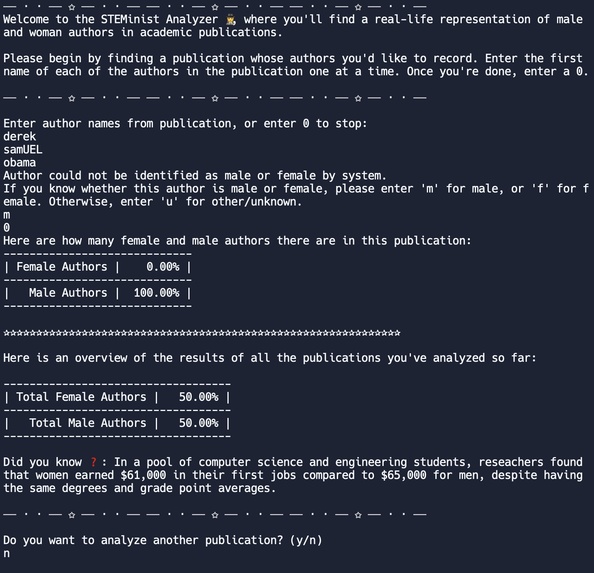
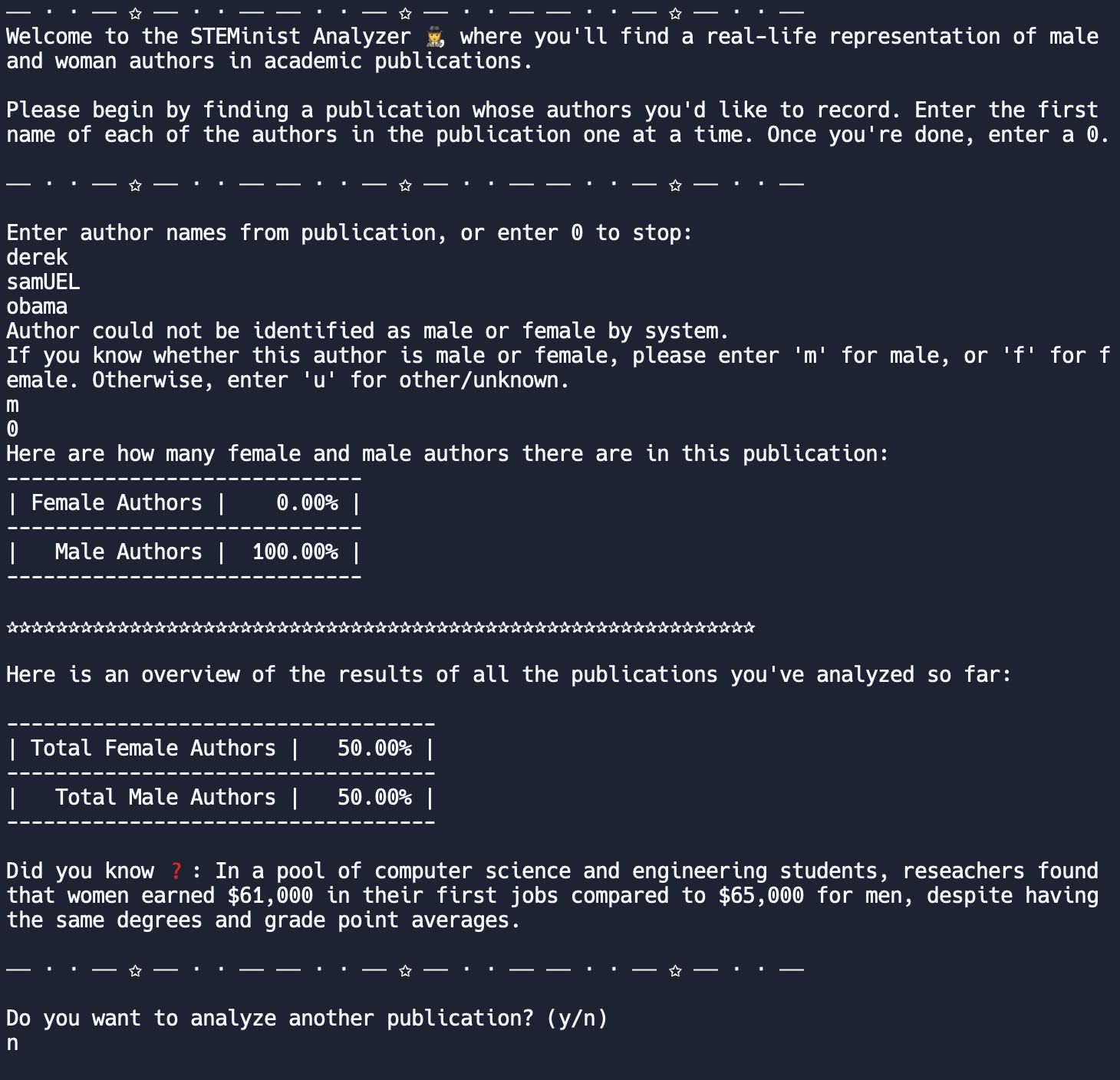
A complete code run of our project!
Inspiration
As women in STEM, we look up to every woman who contributes to scientific knowledge and academic publications. However, we are often disheartened by the noticeable gender gap in the distribution of male and female authors. This inspired us to create a tool that can highlight and raise awareness about this disparity, empowering more women to pursue and persist in STEM fields.
What it does
STEMinist Analyzer 🕵️ is a tool that allows users to input the first names of authors from any academic publication. It then analyzes and provides a real-life representation of the gender distribution among the authors. The tool helps highlight the current state of gender diversity in academic publications, fostering greater awareness and encouraging discussions on gender equality in STEM.
How we built it
We built STEMinist Analyzer using C++ with a focus on simplicity and efficiency. The tool reads predefined lists of male and female names from text files. Users input the names of authors, and the tool classifies them as male, female, or unknown. The results are then displayed, showing the percentage distribution of each gender.
Challenges we ran into
One of the main challenges we encountered was ensuring the accuracy of gender classification based on first names, as some names can be unisex or culturally ambiguous. Additionally, managing user inputs and file handling in C++ required careful consideration to avoid errors and ensure smooth functionality. Another significant challenge was how to approach the topic of gender inequality in a sensible and respectful way. We also struggled with creating an appealing user interface with our current knowledge in C++, as well as figuring out how to append and read from different files efficiently.
Accomplishments that we're proud of
Considering the limited time we had to complete this challenge, we were proud of our work ethic and the way we handled different aspects of our project. We managed to brainstorm and come up with a solid concept quickly, and effectively time-managed our tasks to ensure the project was completed on time. We hope our tool can be a stepping stone for further developments in promoting gender equality in academic and professional environments.
What we learned
Throughout this project, we learned a lot about file handling, user input management, and data analysis in C++. More importantly, we deepened our understanding of the gender gap in STEM fields and the importance of continuous efforts to bridge this divide. This project has strengthened our commitment to advocating for gender equality in STEM.
What's next for STEMinist Analyzer
Moving forward, we plan to enhance STEMinist Analyzer by integrating more advanced algorithms for name-gender classification, including machine learning techniques. We also aim to expand our database to include more names from diverse cultural backgrounds. Additionally, we hope to develop a web-based version of the tool to make it more accessible to a broader audience. One exciting future enhancement is to use machine learning to analyze the content of publications to detect any biases towards a specific gender in the actual writing. This would provide a more comprehensive tool for understanding and addressing gender biases in academic publications.
Built With
- c++
- replit


Log in or sign up for Devpost to join the conversation.