-
-
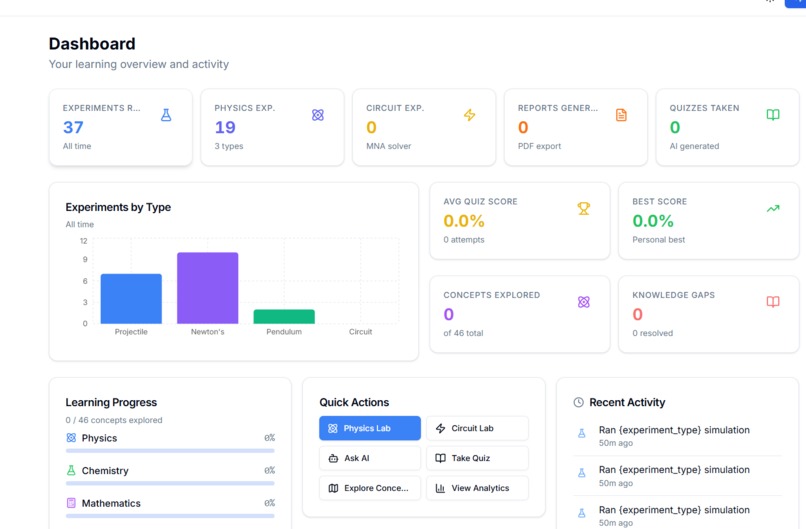
Dashboard
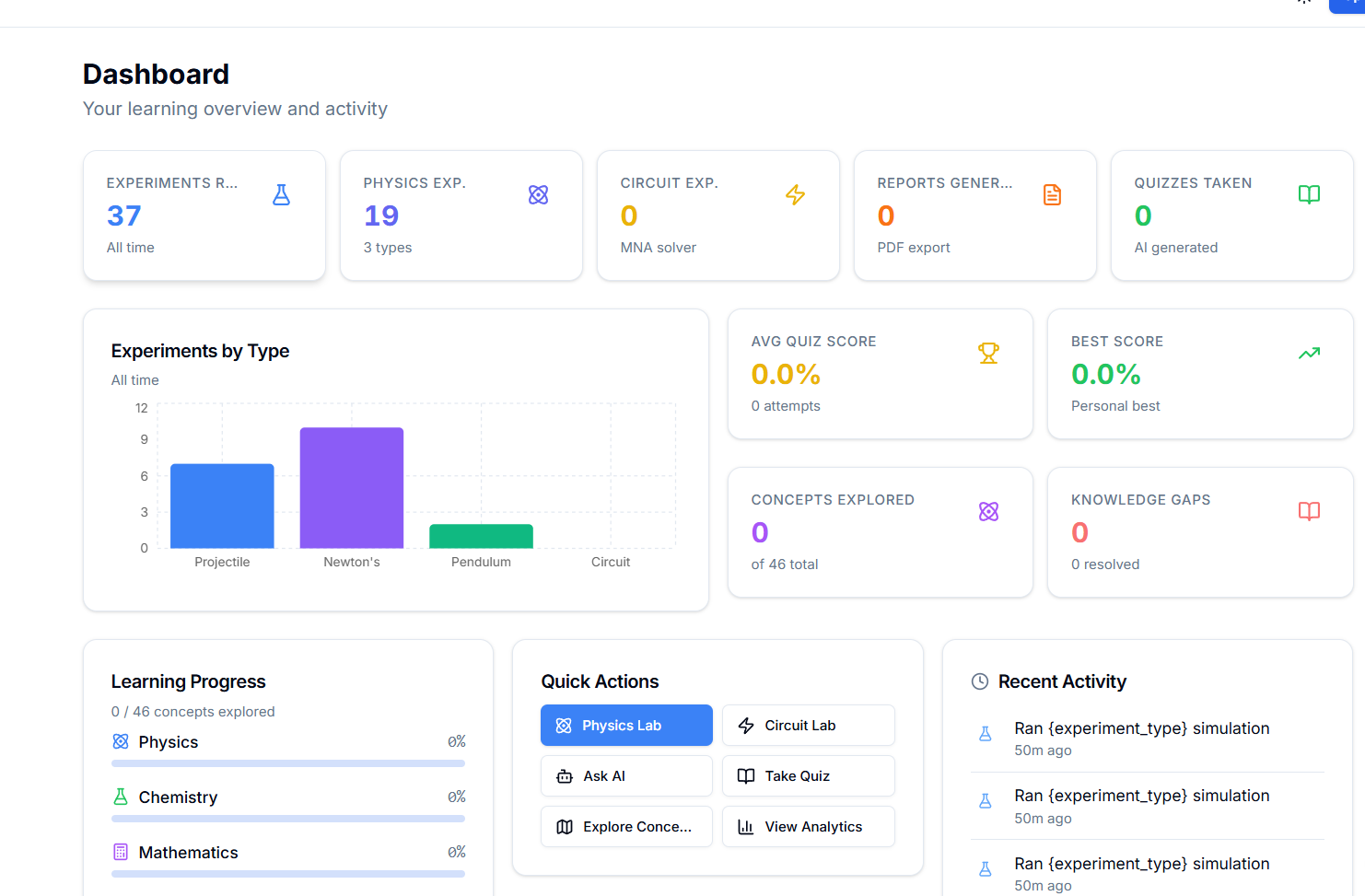
STEMLab AI
Inspiration
Science and engineering are best learned through experimentation, yet millions of students around the world have limited access to laboratory equipment due to cost, infrastructure, safety concerns, or geographical constraints. While educational content is widely available online, hands-on learning opportunities remain inaccessible for many learners.
We wanted to bridge this gap by creating STEMLab AI, an AI-powered virtual laboratory that allows students to perform experiments, explore scientific concepts interactively, and receive personalized guidance from an intelligent STEM instructor. Our goal was to make high-quality STEM education accessible to anyone with an internet connection.
What It Does
STEMLab AI is a virtual STEM learning platform that combines interactive simulations with artificial intelligence.
The platform allows students to:
- Perform Physics experiments such as projectile motion, Newtonian mechanics, and pendulum simulations.
- Build and analyze electrical circuits through a drag-and-drop circuit laboratory.
- Interact with an AI STEM Instructor that explains concepts, answers questions, and analyzes experiment outcomes.
- Generate automated laboratory reports from completed experiments.
- Take AI-generated quizzes tailored to their learning level.
- Identify knowledge gaps and receive personalized learning recommendations.
- Visualize relationships between STEM concepts through an interactive concept explorer.
Instead of memorizing formulas, students learn through experimentation and discovery.
For example, students can modify projectile velocity and launch angle while observing how parameters affect range and flight time according to:
$$ R = \frac{v^2 \sin(2\theta)}{g} $$
This transforms abstract equations into intuitive visual experiences.
How We Built It
We built STEMLab AI as a full-stack web application.
Frontend
- Next.js
- TypeScript
- Tailwind CSS
- Shadcn UI
- React Three Fiber
- Framer Motion
The frontend provides interactive simulations, visual dashboards, circuit-building tools, and responsive user interfaces.
Backend
- FastAPI
- Python
The backend handles simulation logic, experiment storage, analytics, report generation, and AI orchestration.
Artificial Intelligence
- Gemini API
The AI system powers:
- STEM tutoring
- Experiment explanations
- Knowledge gap detection
- Personalized learning recommendations
- Quiz generation
- Report generation
Database
- PostgreSQL
Used for storing experiment results, reports, quiz history, analytics, and AI conversations.
Infrastructure
- Docker
- AWS
The application is containerized and designed for scalable cloud deployment.
Challenges We Faced
One of the biggest challenges was combining scientific simulations with conversational AI in a meaningful way. Most AI educational tools simply answer questions, but we wanted AI to actively participate in the learning process.
Another challenge involved creating simulations that were both educational and computationally efficient. We had to balance realism, performance, and usability to ensure smooth interactions.
Designing the Knowledge Gap Detection system was also challenging. We wanted the platform to move beyond simple grading and instead identify prerequisite concepts that students might be missing before progressing to more advanced topics.
Finally, integrating multiple components—including simulations, analytics, AI tutoring, and report generation—into a unified learning experience required careful system architecture and extensive testing.
What We Learned
Throughout this project, we gained valuable experience in:
- Building full-stack AI-powered applications.
- Designing interactive STEM learning experiences.
- Integrating large language models into educational workflows.
- Developing simulation-based learning systems.
- Creating scalable backend architectures.
- Transforming educational theory into practical software solutions.
Most importantly, we learned that effective STEM education is not just about delivering information—it is about enabling exploration, experimentation, and curiosity.
Future Plans
We plan to expand STEMLab AI by introducing:
- Chemistry reaction simulations.
- Biology laboratory modules.
- Voice-based AI tutoring.
- Collaborative classroom features.
- Augmented Reality (AR) experiments.
- Advanced analytics for personalized learning pathways.
Our long-term vision is to create a comprehensive virtual STEM ecosystem where every student can access world-class laboratory experiences regardless of their location or resources.
Impact
STEMLab AI democratizes access to practical STEM education by transforming any device into an intelligent science laboratory. By combining simulations, artificial intelligence, and personalized learning, we aim to make STEM education more engaging, accessible, and effective for learners everywhere.
Built With
- amazon-web-services
- artificial-intelligence
- data-visualization
- docker
- docker-compose
- fastapi
- framer-motion
- gemini-api
- machine-learning
- next.js
- pdf-generation
- postgresql
- python
- react
- react-hook-form
- react-query
- react-three-fiber
- rest-api
- scientific-simulations
- shadcn-ui
- stem-education
- supabase-storage
- tailwind-css
- three.js
- typescript
- webgl
- zod


Log in or sign up for Devpost to join the conversation.