Inspiration
Our team is bound by a shared experience: attending public schools in Nigeria where "Science Lab" was just a name on a door. Inside, the shelves were empty. No beakers, no chemicals, no Bunsen burners. Like millions of students across Africa, we learned chemistry and biology as abstract theories to be memorized, not experiments to be felt.
We built a 3D "lab on a computer" (StanLab) to solve the access problem, reaching students in 10 countries. But we realized a desktop mouse cannot teach the steady hand a surgeon needs or the delicate touch an engineer requires. We are entering this hackathon to evolve our "lab on a computer" into a "lab on a device" that teaches real-world dexterity.
What it does
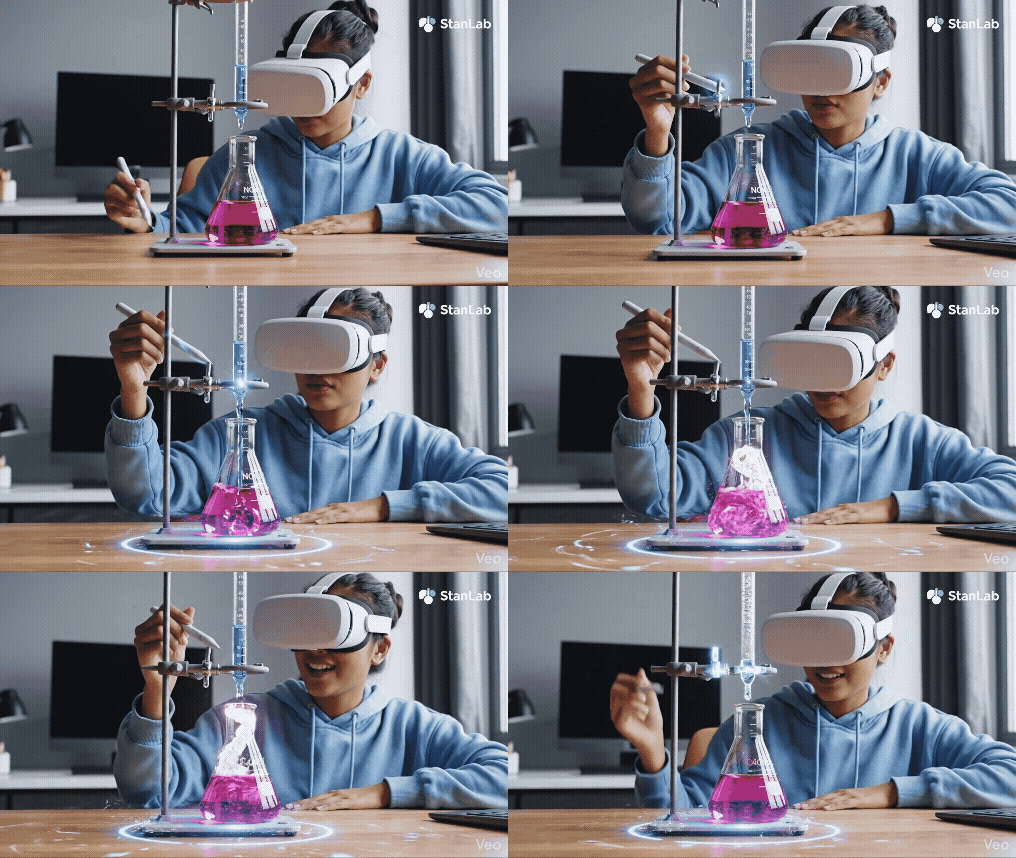
StanLab MR is a planned Mixed Reality (MR) laboratory that transforms science education from passive observation into tactile practice. By moving the "lab on a computer" into the immersive world of the Meta Quest, we allow students to physically conduct experiments.
Using the Logitech MX Ink, the app provides a high-fidelity workspace where the stylus acts as a multi-purpose scientific tool. Our planned features include:
Pressure-Sensitive Chemistry: A titration module where the MX Ink’s tip pressure controls the flow rate of chemicals—forcing students to develop the "steady hand" required in real labs.
Precision Dissection: A biology module using the pen-grip for surgical accuracy that standard VR controllers cannot achieve.
MR Passthrough Learning: Overlaying the lab onto the student’s actual desk, ensuring they remain grounded and safe while interacting with virtual 3D glassware.
How we built it
While this MR version is in the ideation phase, it is built on the robust foundation of StanLab, our existing 3D virtual laboratory.
The Engine: We are porting our scientifically-accurate chemical reaction and physics engine from desktop to Unity.
Logitech Integration: We plan to use the Logitech MX Ink SDK to map 6DoF positioning and linear pressure curves to our interaction system.
The Environment: Using the Meta Interaction SDK, we will create a blended environment where virtual beakers sit on real-world classroom desks.
Challenges we ran into
Technically, our current challenge is translating fine motor skills into a digital space. A mouse-click is binary (on/off), but science is analog. Calibrating the MX Ink to simulate the "weight" of a liquid and the "resistance" of a glass surface is the technical hurdle we are currently solving.
Accomplishments that we're proud of
We are proud of our journey from Nigeria to the Global Stage.
Proven Impact: Our desktop predecessor is already helping students across countries and was recognized as a Top Innovator in Deloitte’s WorldClass Education Challenge.
The Pivot: Successfully identifying that the Logitech MX Ink is the specific "missing link" needed to turn a digital simulation into true professional training. We’ve moved from "the lab on a computer" to a vision of "the lab in your hand."
What we learned
We learned that representation matters, but precision matters more. While students loved the 3D lab on their computers, they told us they still felt "unprepared" for a real university lab. This taught us that to truly empower the next generation, we must move beyond visuals and into digital muscle memory. The familiarity of a pen-grip (MX Ink) is far more intuitive for a student than a gaming trigger.
What's next for StanLab
Our immediate goal is to complete the StemLab MR MVP for the semi-finals, focusing on the Titration and Dissection modules.
Scaling to 1 Million: We are aiming to reach 1 million students by 2030, ensuring no child has to walk into an empty lab.
Logitech Marketplace: We plan to publish StemLab as a flagship educational tool, making professional-grade STEM training accessible to any school with a Meta Quest and an MX Ink stylus.


Log in or sign up for Devpost to join the conversation.