-
-
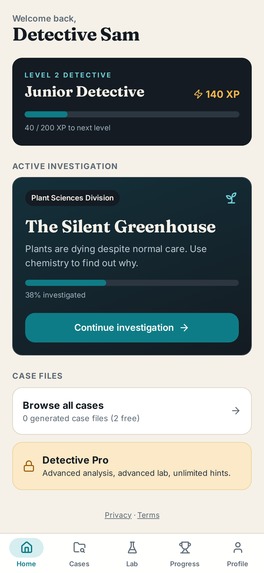
screenshot of app
-

App Icon

Inspiration
STEM subjects are often taught as facts to memorize instead of problems to solve. We wanted to change that.
The idea behind STEM Detective came from a simple question: what if learning science felt like solving a real mystery?
Instead of giving students a chapter, followed by a quiz, we wanted them to become the investigator. They should have to examine evidence, ask questions, perform experiments, connect clues, and use scientific reasoning to reach a conclusion.
That led us to build STEM Detective — an interactive AI-powered mystery game where the science is not just something you learn, but something you need to solve the case.
What it does
STEM Detective turns STEM learning into an investigation.
Players receive a mystery and work through it by:
- Investigating scenes and collecting evidence
- Interacting with witnesses and AI-powered characters
- Analyzing clues and connecting evidence
- Performing virtual STEM experiments
- Building and testing hypotheses
- Getting contextual hints instead of simply being given answers
- Using AI to reason about evidence and explain scientific concepts
- Earning XP, achievements, and unlocking new investigations
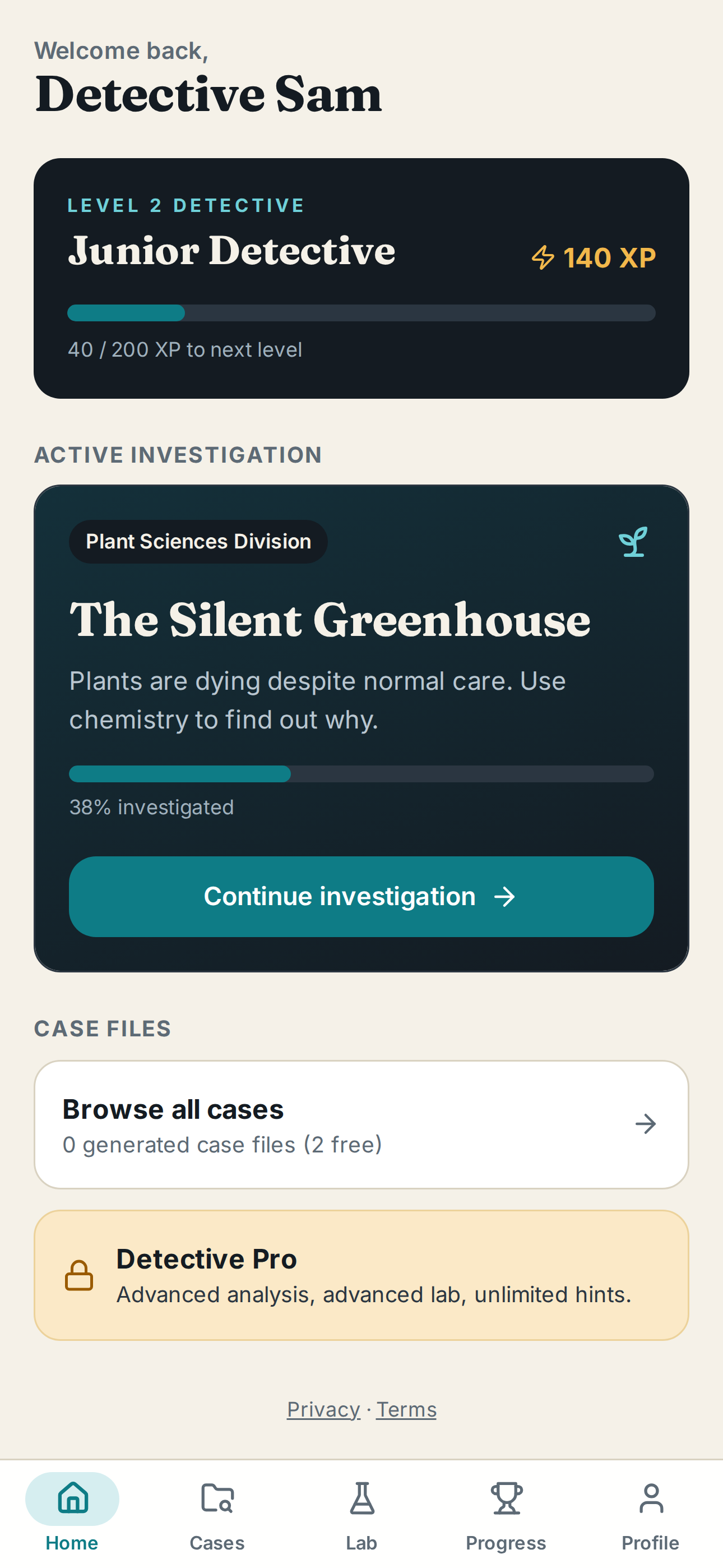
Our flagship experience, The Silent Greenhouse, challenges the player to investigate why plants in a research greenhouse are unexpectedly dying. The player has to use scientific evidence and experimentation to figure out what is actually happening.
The goal is not to make students memorize the answer. The goal is to make them curious enough to discover it.
How we built it
We built STEM Detective as an AI-powered interactive game rather than a traditional learning platform.
The application combines a modern web/mobile interface with a backend that manages investigations, game state, AI interactions, evidence, progression, and learning content.
The core experience is organized around:
Investigation → Evidence → Experiment → Reasoning → Hypothesis → Resolution
AI is used where it adds value to the investigation. It can help generate or interpret clues, provide contextual hints, interact with players, explain STEM concepts, and respond to the player's reasoning.
We also designed the progression system around XP, achievements, case unlocking, and increasingly complex investigations so that learning becomes part of the game loop.
For monetization, we integrated RevenueCat to support a free-to-premium model. Players can experience the core game for free, while Detective Pro can unlock additional investigations, advanced AI interactions, deeper analysis, premium cases, and other advanced features.
We focused heavily on making the experience feel like a mystery game rather than an educational dashboard.
Challenges we ran into
One of our biggest challenges was balancing education and entertainment.
If we focused too much on education, the experience started feeling like a quiz or textbook. If we focused too much on the game, the STEM component became superficial.
We therefore had to design the investigations so that the player actually needs the underlying science to progress.
Another challenge was making AI useful without allowing it to simply solve the mystery for the player. We wanted AI to act more like a detective partner — providing clues, asking questions, and helping the player reason — rather than giving away the answer.
We also had to think beyond the prototype itself and make the product suitable for a real mobile experience, including responsive interactions, progression, monetization, error handling, and a reliable purchase flow.
Accomplishments that we're proud of
We're proud that STEM Detective has grown beyond the idea of "AI + education" into an actual investigation-based learning experience.
In particular, we're proud of:
- Building a complete investigation-to-resolution gameplay loop
- Combining STEM experiments with narrative mystery solving
- Using AI as part of the investigation rather than as a generic chatbot
- Creating evidence and hypothesis-based gameplay
- Building progression through XP, achievements, and case unlocking
- Designing a flagship mystery around a real scientific reasoning process
- Integrating RevenueCat into the product's monetization architecture
- Creating a foundation that can support many different STEM mysteries instead of only one fixed lesson
Most importantly, we built the experience around a simple principle:
Don't tell students the answer. Give them a reason to find it.
What we learned
We learned that building an educational product is not just about putting educational content inside an app.
The experience around that content matters just as much.
We learned to think about learning as a progression of decisions: what does the player notice, what do they investigate, what evidence do they trust, and how do they change their hypothesis when new information appears?
We also learned that AI works best when it has a clearly defined role. In STEM Detective, AI is most useful when it supports curiosity and reasoning instead of replacing them.
Finally, building with RevenueCat made us think about monetization much earlier. A subscription should not simply unlock a random collection of features. It should provide enough additional value that the player understands why the upgrade exists.
What's next for STEM Detective
STEM Detective is designed to grow into a larger library of interactive STEM investigations.
Next, we want to expand into areas such as biology, chemistry, physics, environmental science, and technology, with cases that become progressively more challenging.
We also want to make investigations more adaptive, allowing the difficulty, clues, experiments, and hints to respond to how each player investigates.
Longer term, we see STEM Detective becoming a place where students can learn by doing — where every new concept is another mystery waiting to be solved.
The next case is already waiting.
Built With
- android
- capacitor
- fastapi
- generative-ai
- next.js
- openai
- postgresql
- python
- react
- revenuecat
- tailwind-css
- typescript

Log in or sign up for Devpost to join the conversation.