-
The Potential of Stem Cell Therapy in Treating Muscular Dystrophy
Inspiration
Our interest in stem cell therapy began in Grade 11, when we first learned about its potential to treat complex diseases. That sparked our interest to explore further on the fascinating world of stem cells. That early inspiration led us to this project, where we aimed to explore a real-world application of the science we had studied.
What it does
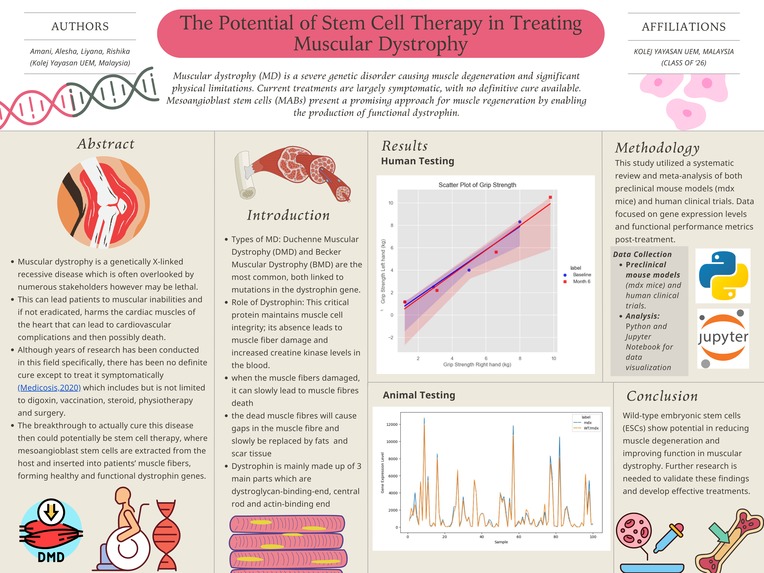
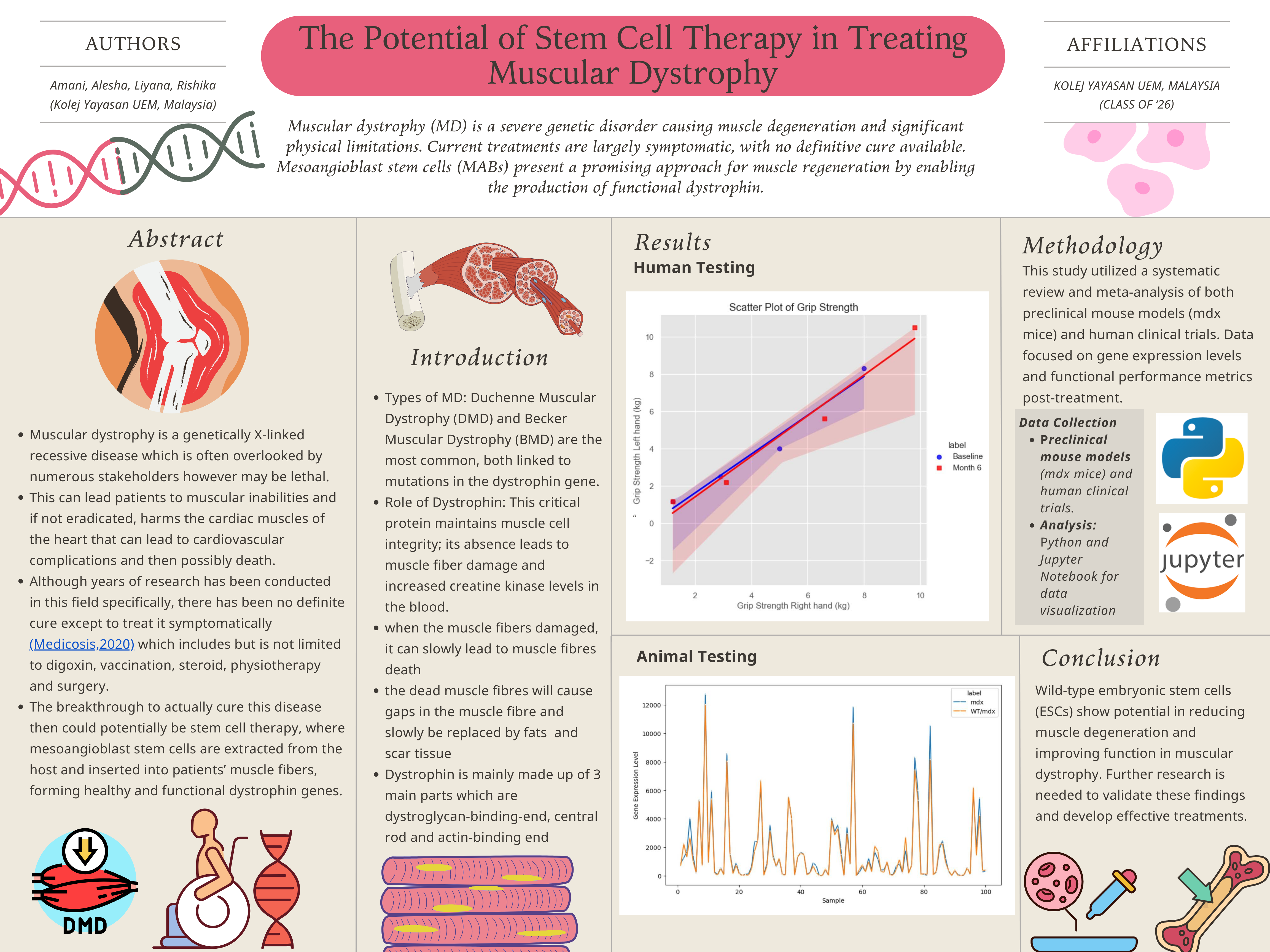
Our findings demonstrate that ESCs can significantly reduce muscle degeneration and improve functional outcomes in both animal models and human trials, particularly through the restoration of dystrophin in affected muscle tissues. We hope our research project could spark further interest in regenerative medicine, encouraging more research into the use of stem cells for treating muscular dystrophy.
How we built it
We began by refining our research focus to investigate the application of stem cell therapy in the treatment of muscular dystrophy. To gather relevant secondary data for our quantitative analysis, we employed keywords such as "stem cell therapy treatment for muscular dystrophy" in Google Scholar. Locating the desired datasets proved challenging and required a significant investment of time. However, we successfully acquired the necessary data and proceeded to analyze it using Python and Jupyter.
Challenges we ran into
Challenges: Our initial challenge was the lack of experience in analyzing real-world datasets, particularly in a complex field such as stem cell treatment for muscular dystrophy. Consequently, we needed to acquire the necessary coding skills before embarking on our research, which required a substantial investment of time to effectively visualize the datasets and identify correlations. Additionally, locating relevant and significant data for our analysis posed a further challenge, given the niche nature of our subject matter.
Accomplishments that we're proud of
We wrote a full research paper by gathering information on FSHD from articles, journals and Youtube videos. Additionally, we learned how to extract relevant datasets to prove correlations effectively. Aterwhich, we applied our theoretical knowledge to real-world data, using Python libraries like Matplotlib, NumPy, Seaborn, and Jupyter Notebook to create detailed graphs and statistical models for research papers. Last but not least, we managed our time quite well, even waking up at 4 am in Malaysia (GMT +8) for the Q&A and talk!
What we learned
Through the educational Q&A session and talk, we gained valuable insights into FSHD and the broader societal lack of awareness surrounding the disease. One key factor is that FSHD is not viewed as life-threatening but rather as manageable, leading to less funding compared to more critical neuromuscular conditions. Additionally, limited exposure to FSHD during medical training means that many healthcare professionals may choose other specialties, resulting in fewer physicians with expertise in the disease.
What's next for Stem Cell Therapy in Treating Muscular Dystrophy
- Better systemic delivery - ensure a sufficient number of mesoangioblasts stem cells is created and successfully reaches all of the damaged muscle fibres. This is to ensure healthy dystrophin protein can be consistently and sufficiently produced
- More accessibility and cheaper prices - the price of an average drug to treat MD in the US is 3.2 million USD. The main aim is to make prices more reasonable so that all patients can easily access the drug and get the treatment that they deserve.
Built With
- jupyter
- matplotlib
- numpy
- seaborn


Log in or sign up for Devpost to join the conversation.