-
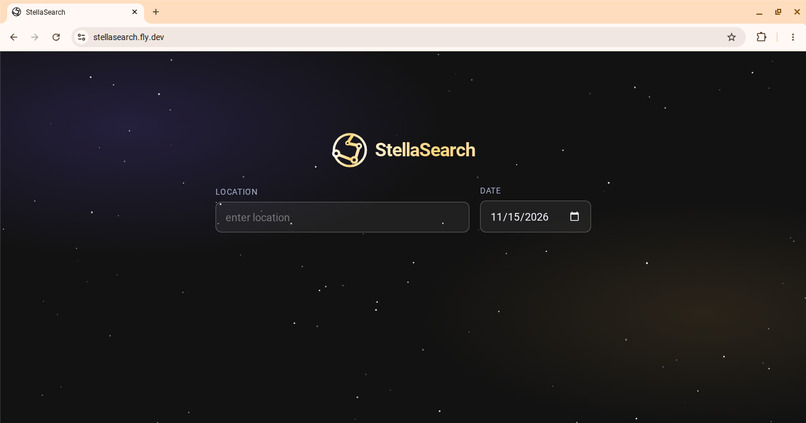
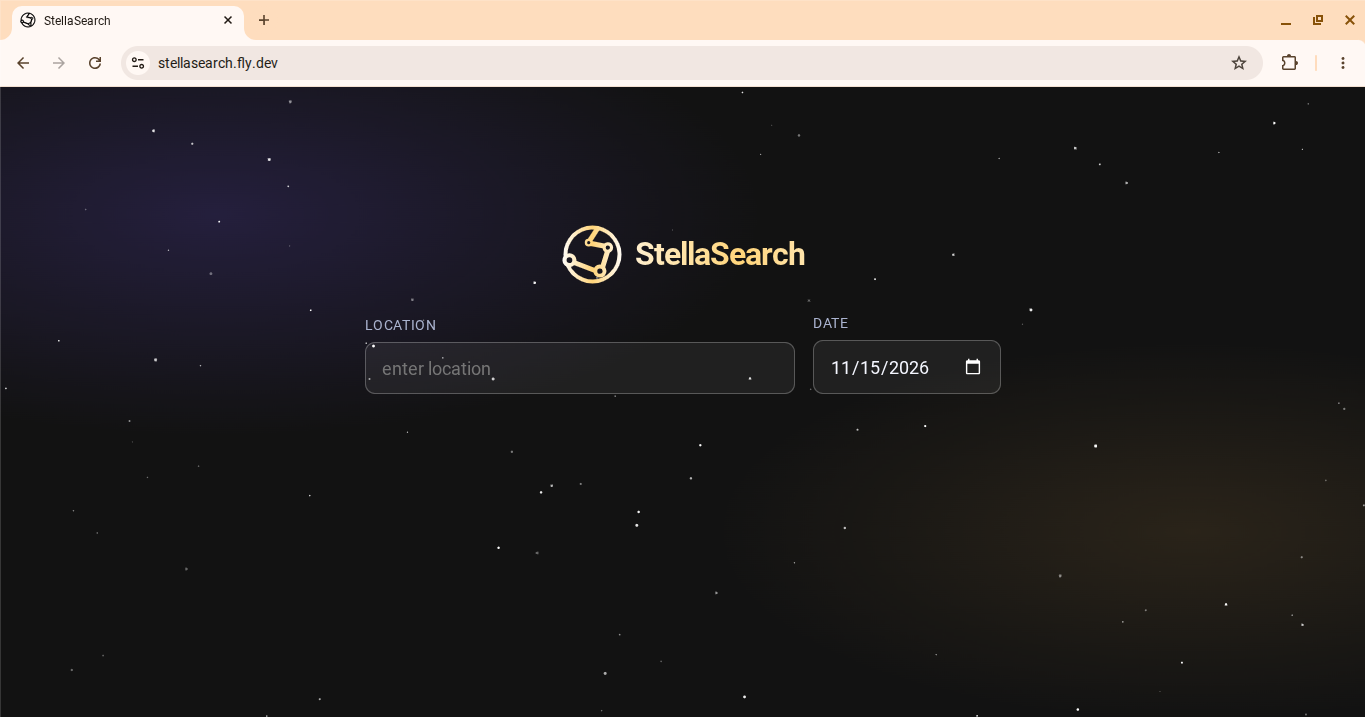
When loading Into The Site
-
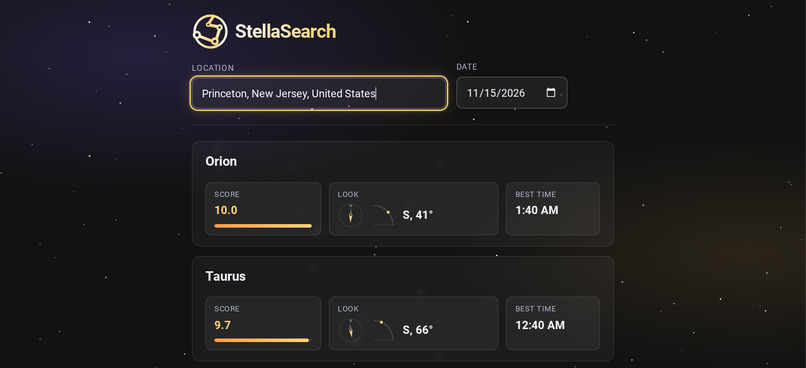
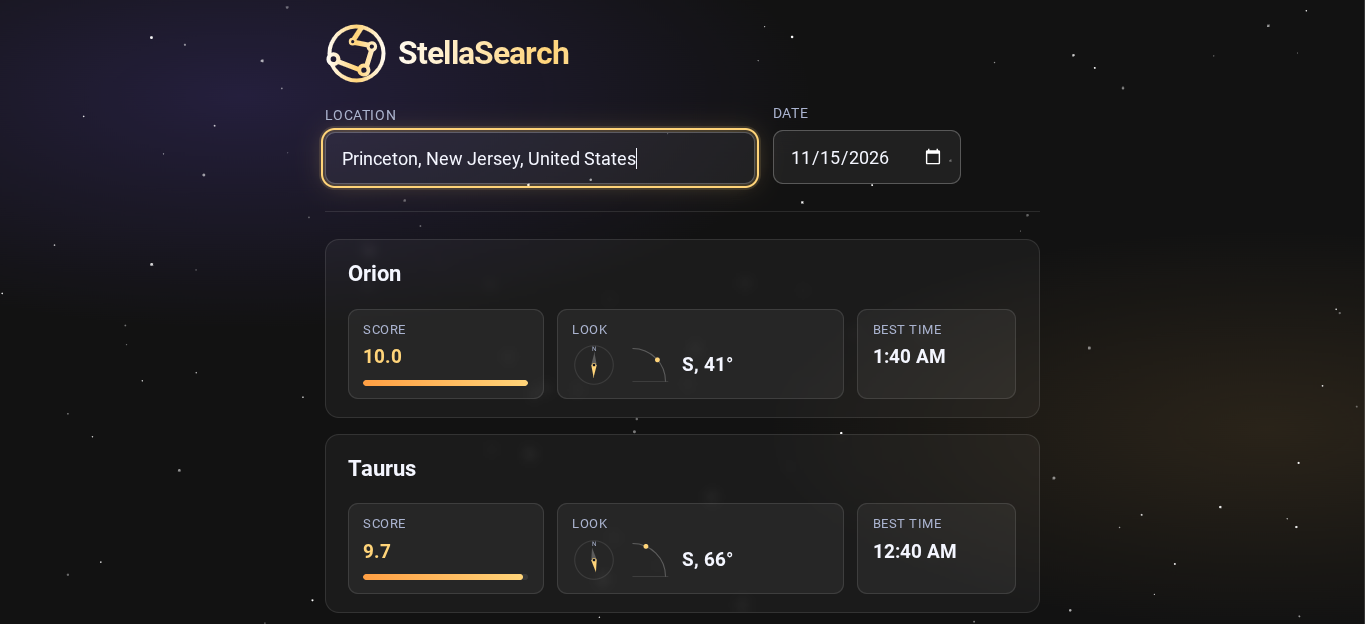
Results After Searching With Date and Time
Inspiration
The inspiration for this project came about when we were brainstorming ideas for the hackathon. It was becoming dark at the time and looking outside we had a thought: what if anyone could open a website and immediately explore the constellations? We set out to turn that curiosity into an interactive digital stargazing experience.
What it does
Stellasearch takes the date and location that you put in to give you a list of constellations that will or did appear on that date using data compiled from various resources.
How we built it
- Backend: Built with Python and managed using uv for fast dependency resolution and package management.
- Frontend: Developed using TypeScript, JavaScript, HTML5, and CSS to create a responsive, interactive stargazing interface.
- Astronomy Engine: Skyfield by Brandon Rhodes (MIT License) for high-precision celestial calculations.
- Star Positions & Magnitudes: Hipparcos Catalogue, ESA (1997), The Hipparcos and Tycho Catalogues, ESA-SP-1200.
- Sun & Moon Positions: JPL Planetary Ephemeris via Skyfield (DE421, Folkner et al. 2009).
- Constellation Names & Boundaries: International Astronomical Union (IAU) data, as shipped with Skyfield.
- Atmospheric Extinction: Airmass formula adapted from Kasten & Young (1989), Applied Optics 28(22), 4735.
- Moon & Twilight Sky Brightness: A simplified, hand-tuned model inspired by Krisciunas & Schaefer (1991), PASP 103, 1033 (using approximated constants rather than a full faithful implementation).
- Light Pollution: Bortle Dark-Sky Scale, J. Bortle (2001), Sky & Telescope, Feb 2001 (using approximate limiting magnitudes per class).
Challenges we ran into
- Primary dataset outage: Right at the start of the hackathon, our original planned data source went offline due to a cybersecurity incident, forcing us to quickly research and pivot to a reliable backup pipeline.
- Steep technical learning curve: Building a full-stack application from scratch meant learning TypeScript, Node.js, and GitHub team workflows on the fly under tight time constraints.
- Modeling real-world sky conditions: Translating complex astronomical coordinates, light pollution scales, and atmospheric extinction formulas into accurate, responsive visuals on the frontend took careful tuning and debugging.
Accomplishments that we're proud of
- Pivoting under pressure: When our original planned site went down to a cyber security incident we quickly adapted and integrated a backup site.
- Learning typescript on the fly: Despite having no prior experience with TypeScript, we were able to pick it up from scratch during the hackathon to build a reliable type-safe web application
- Mastering astronomical data: We navigated through complex celestial datasets to understand how star positions and heavenly bodies are structured, successfully translating that raw data into an interactive web experience
What we learned
- Full-Stack development with Node.js: This was our first time building an end-to-end application, giving us hands-on experience using Node.js to power our back-end and connect it to our front-end interface
- Team collaboration with GitHub: We learned how to manage a shared code-base as a team using branches, pull requests, and merge conflict resolution.
What's next for StellaSearch
- Richer map interactivity: We plan to upgrade the star map with smoother zooming, panning, and clickable celestial objects so users can explore the night sky even more intuitively.
- Custom constellation artwork & pop-ups: When a user selects a constellation, we want to display a custom illustrated overlay alongside an interactive pop-up card featuring its mythology, brightest stars, and best viewing times.
Built With
- css
- git
- html5
- javascript
- makeafile
- node.js
- python
- typescript
- uv

