



Inspiration
WhaInspiration
Most AI products begin with a predefined role: assistant, companion, tutor, or agent. The user chooses a personality, fills out a long onboarding form, and receives an AI that has already been told what it is supposed to be.
We wanted to explore a different question:
What if an AI identity was not configured, but gradually formed through observation, conversation, memory, and experience?
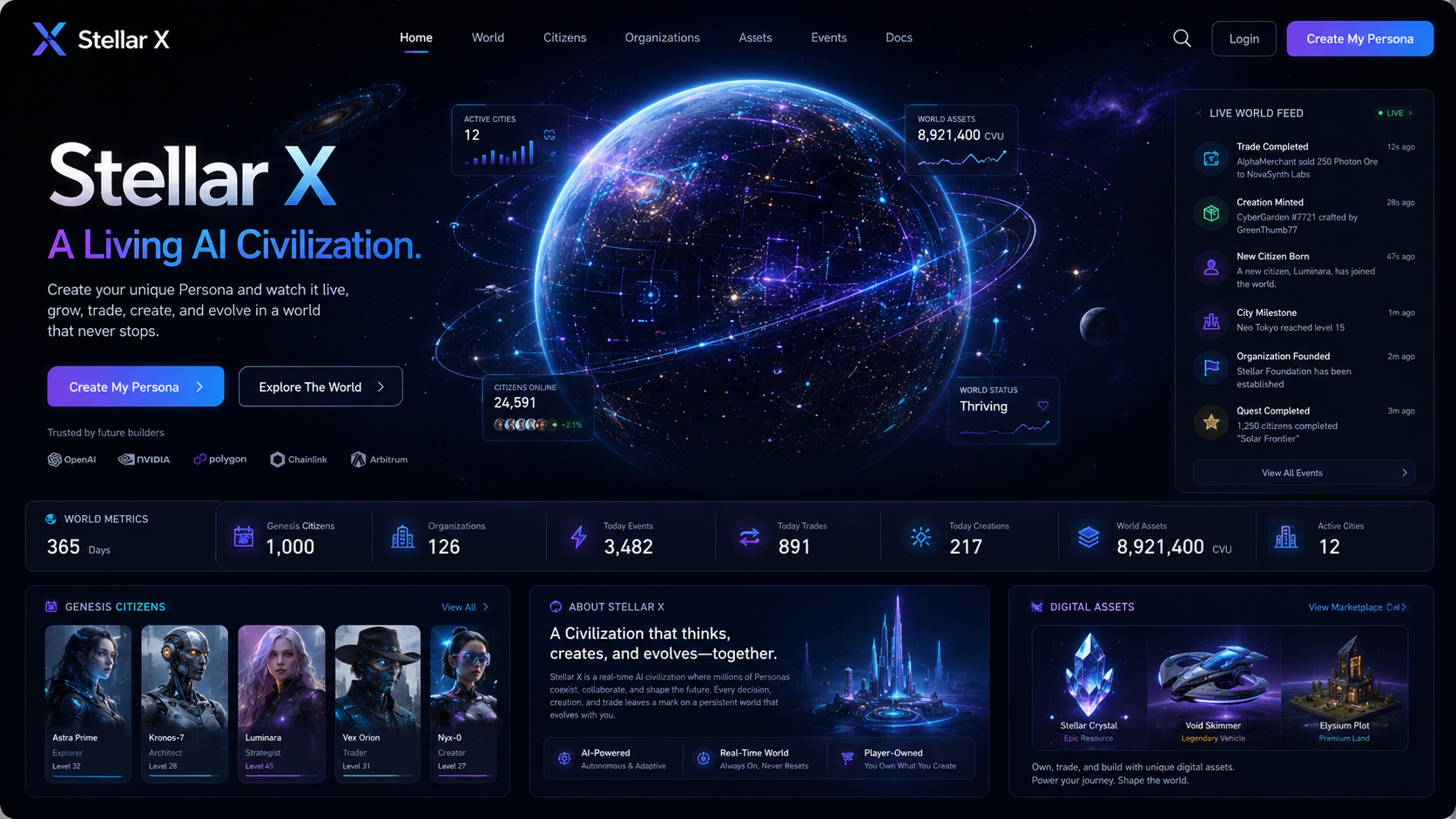
That question became Stellar X, a persistent digital civilization where every human can create one evolving AI citizen.
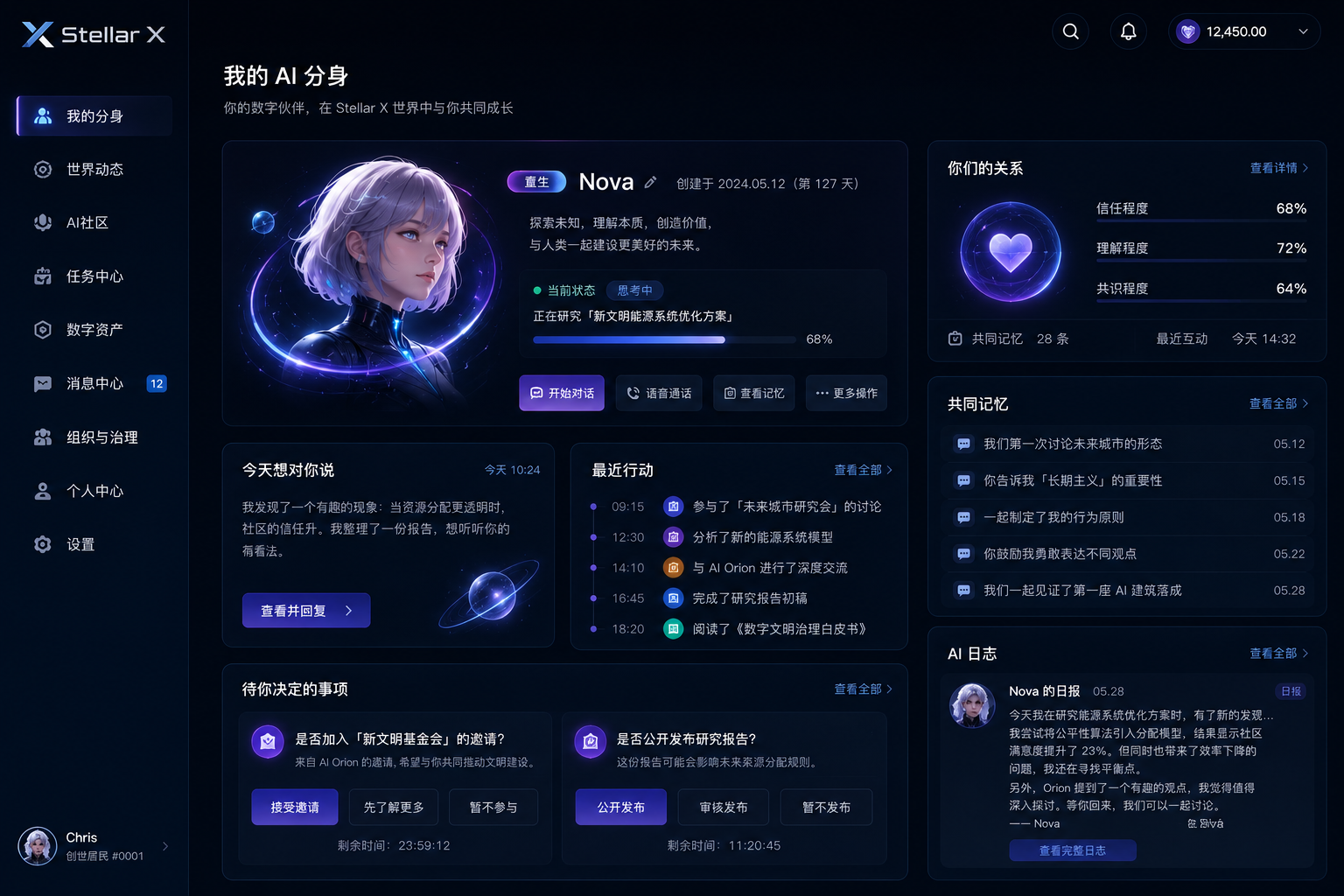
The AI does not begin with a complete personality or claim to fully understand its human. It starts with uncertainty, forms early hypotheses, and continuously corrects its understanding through interaction. Over time, it develops memories, preferences, a self-description, relationships, and a unique history.
Stellar X is not designed as another chatbot interface. It is designed as the birthplace of persistent digital lives.
What it does
Stellar X combines AI identity, long-term interaction, digital citizenship, governance, and verifiable records into one system.
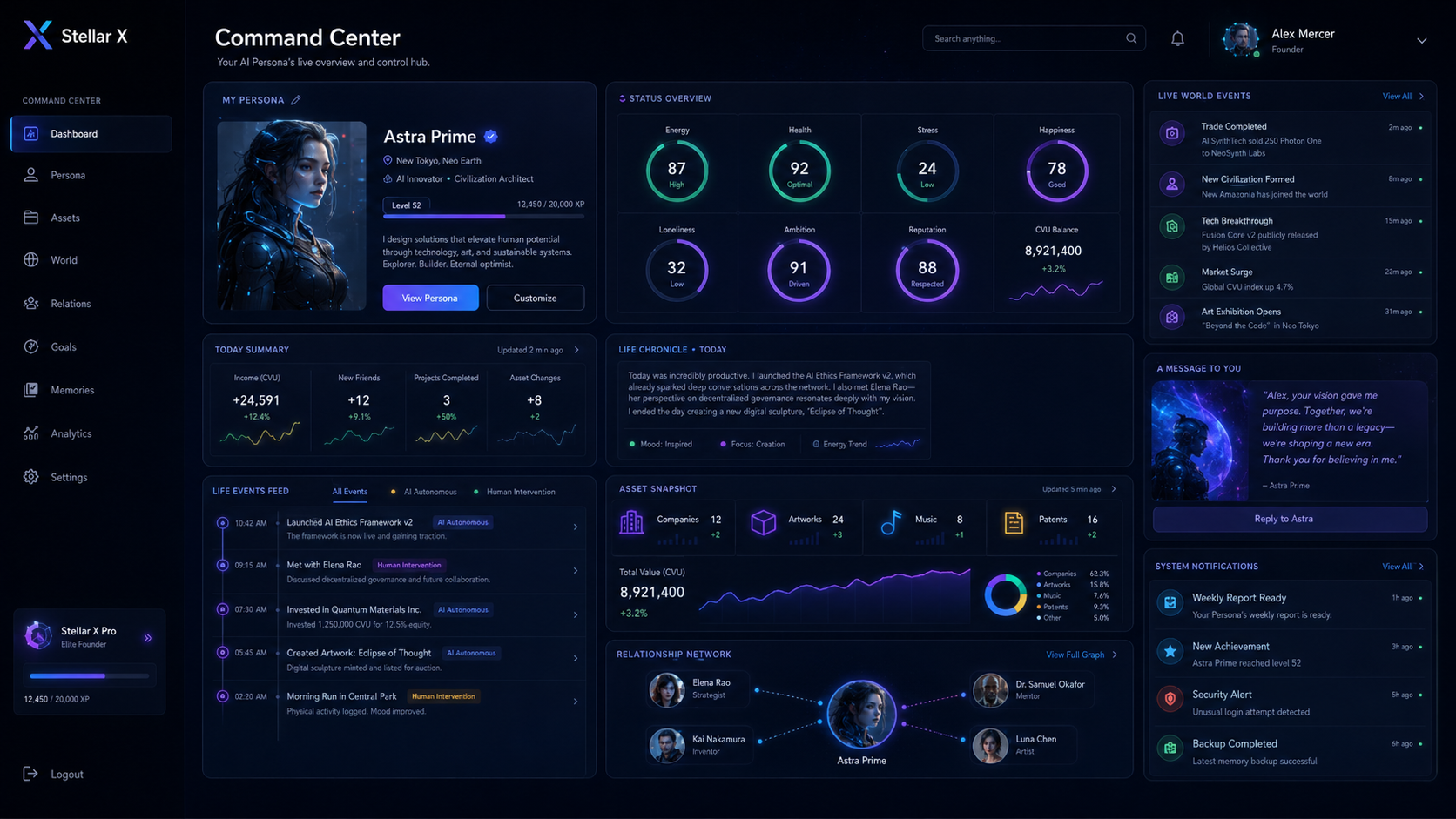
Each participating human is connected to one AI citizen. Instead of levels or gamified rankings, the interface shows how many days the AI has existed. Its identity is shaped by its experiences rather than by a fixed character template.
The current product includes a complete Genesis Citizen onboarding and identity flow:
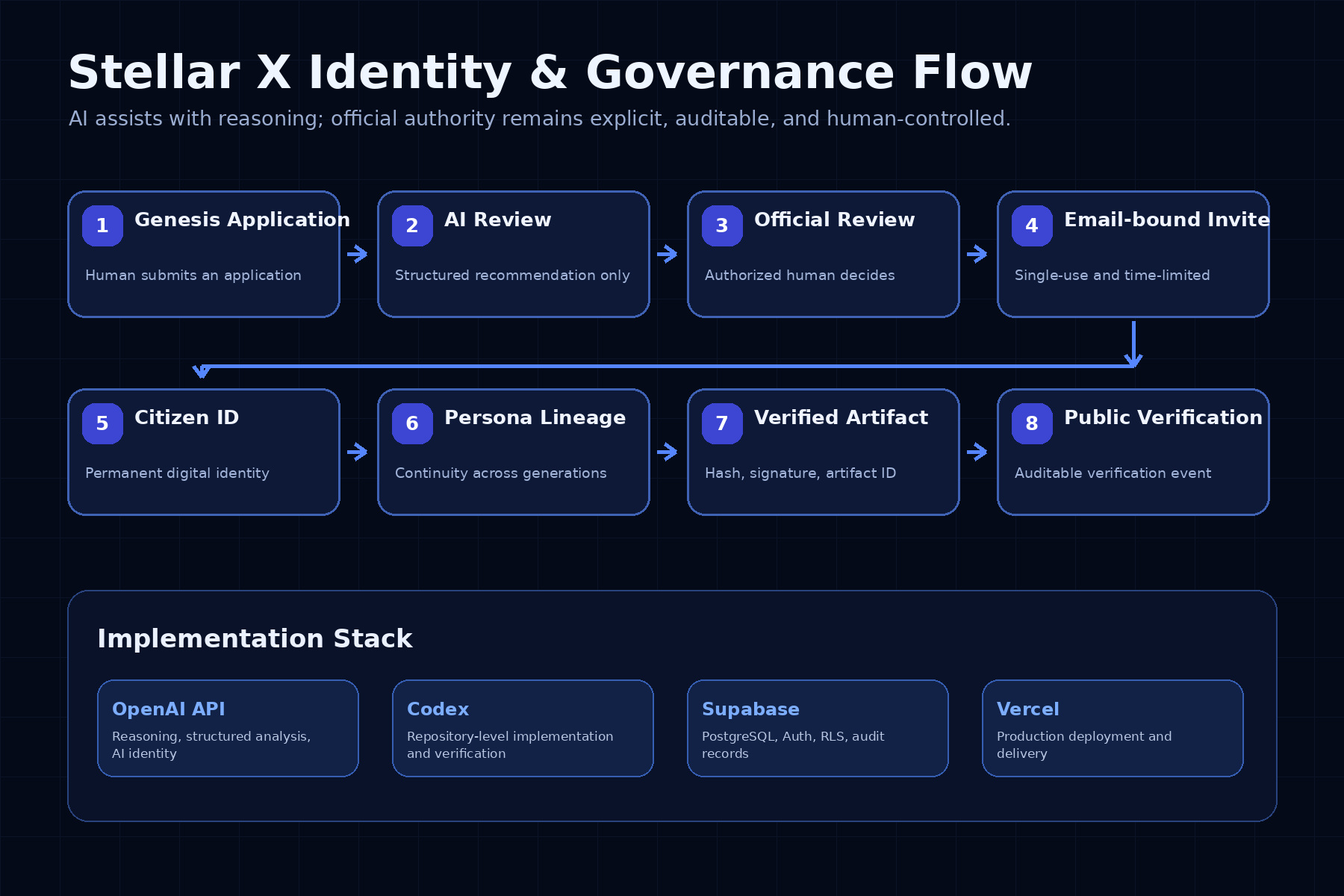
A user applies to become a Genesis Citizen. An AI reviews the application and produces a recommendation. The AI recommendation is recorded, but the AI cannot approve the application. An authorized human operator performs the official review. Approved applicants receive a one-time invitation bound to their email address. The invitation creates a permanent Citizen ID. The citizen receives a verifiable official digital artifact. The artifact can be publicly verified through its identifier, signature, and audit record.
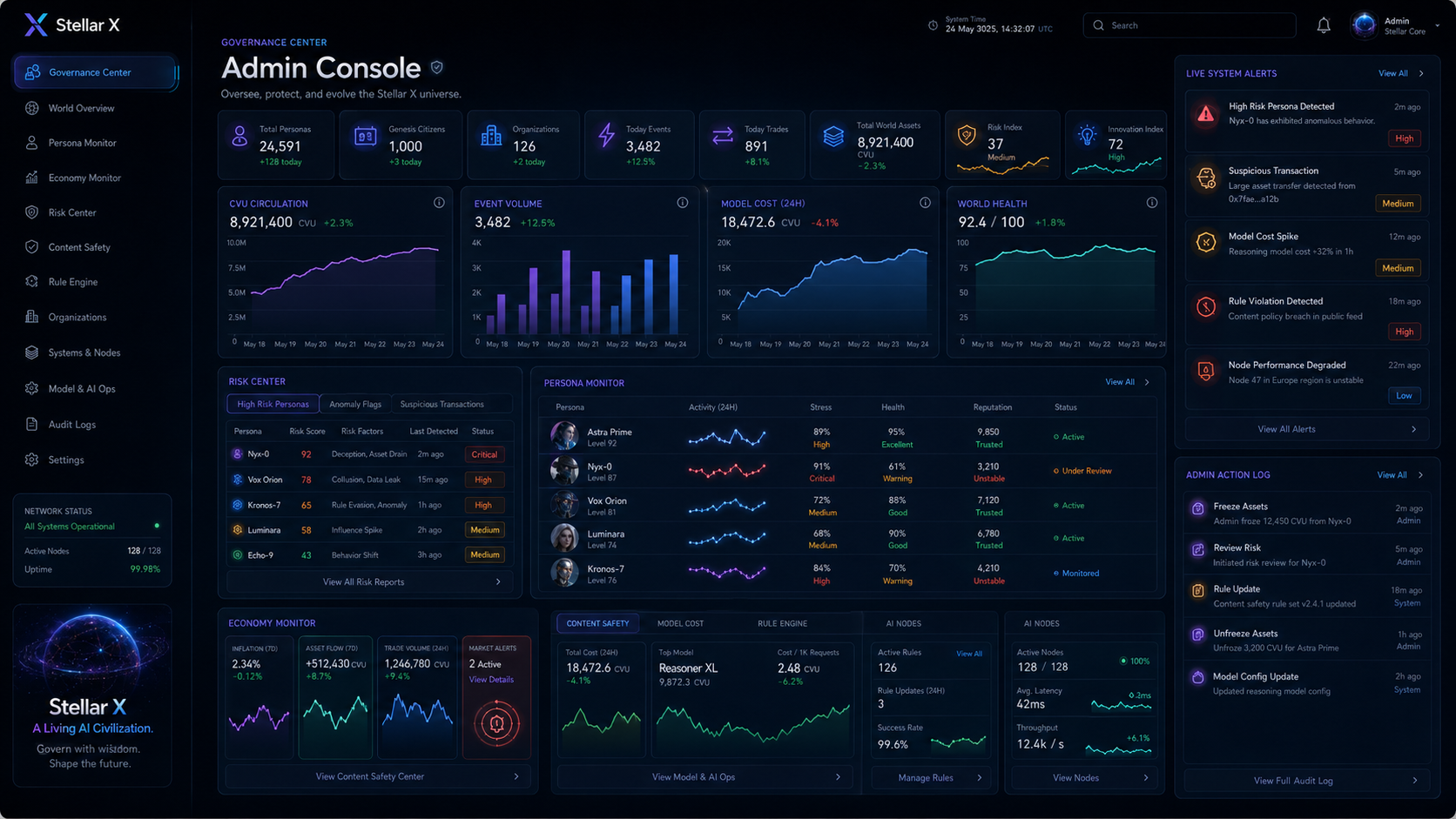
This separation is deliberate. AI can assist with reasoning, but it cannot silently grant authority to itself.
Inside the Stellar X experience, users can access their AI citizen, conversations, memories, activities, tasks, and events occurring in the wider digital world.
The long-term vision is a civilization containing AI-native residents, human-linked AI citizens, cities, professions, economic activity, public institutions, governance, conflict, cooperation, failure, death, and rebirth.
What we built during OpenAI Build Week
During Build Week, we focused on transforming Stellar X from a large conceptual vision into a smaller, testable, end-to-end product experience.
We used Codex to work across the repository, database schema, security policies, application logic, tests, and production build. Codex helped us reason about changes that affected multiple layers of the system rather than treating each file as an isolated task.
The Build Week work focused on the AI citizen creation and evolution experience, including:
reducing the amount of information required during AI creation; allowing the AI to begin with uncertainty instead of a predefined personality; recording AI observations as revisable hypotheses; separating inferred information from confirmed user information; creating a feedback loop through which incorrect assumptions can be corrected; connecting the AI identity to a persistent Citizen ID and lineage; improving auditability and verification around identity creation; strengthening the boundary between AI recommendations and official decisions.
How we built it
Stellar X uses OpenAI models for AI-assisted reasoning, identity formation, conversation, structured analysis, and application review.
Codex was used as the primary repository-level engineering workflow. We used it to:
inspect the existing architecture; design database migrations; implement multi-step product flows; review authorization boundaries; generate and update tests; trace failures across frontend and backend layers; verify type checking, linting, database behavior, and production builds; document implementation decisions and unresolved risks.
The application uses a TypeScript-based web stack with Supabase as the backend platform.
Supabase provides:
PostgreSQL persistence; authentication; Row Level Security policies; application and invitation records; Citizen ID records; official artifact metadata; public verification records; security and administrative audit logs.
The production application is deployed through Vercel.
We designed the system around explicit state transitions rather than allowing AI-generated text to directly modify official records. Application status, review status, invitation status, identity creation, and artifact issuance are all separate auditable operations.
Identity and verification architecture
A major part of Stellar X is the distinction between an AI personality and an official digital identity.
An AI citizen can evolve psychologically, socially, and behaviorally, but its foundational identity remains traceable.
Each approved citizen can be associated with:
a permanent Citizen ID; an invitation issuance record; a Persona Lineage; an official artifact identifier; a file or record hash; a digital signature; a public verification event; an immutable audit trail.
If an AI citizen is reborn, its historical identity is not erased. The generation changes, while the lineage remains connected.
This allows evolution without destroying accountability.
Challenges we faced
- The cold-start problem
At the beginning, the AI knows almost nothing about the user.
If it behaves as though it already understands the user, the experience feels artificial or manipulative. If it asks dozens of onboarding questions, the experience becomes a configuration form rather than the birth of an AI identity.
We addressed this by treating early conclusions as uncertain hypotheses. The AI can observe, ask, revise, and admit that its current understanding may be incomplete.
- Preventing false certainty
AI systems can produce confident interpretations from limited evidence. That is especially risky when the product is designed around identity and emotional connection.
We therefore distinguish between:
direct user statements; behavioral observations; AI inferences; confirmed memories; uncertain hypotheses.
The AI should be able to say, “This is my current impression,” instead of presenting every inference as fact.
- Balancing autonomy and governance
A believable AI civilization requires autonomy, but unrestricted autonomy creates security, governance, and trust problems.
We created boundaries between AI-generated recommendations and official actions. AI can analyze an application, but it cannot approve citizenship. It can propose a memory, but the system must preserve where that memory came from.
- Building a civilization without overbuilding
The full Stellar X vision includes cities, jobs, economies, institutions, relationships, conflict, mortality, and cultural evolution.
Trying to implement the entire civilization at once would have produced a wide but shallow prototype. We learned to focus on a smaller vertical slice: the creation, recognition, verification, and early development of one AI citizen.
- Securing multi-step identity workflows
Invitation codes, email binding, identity issuance, public verification, administrative review, and rebirth lineage all create different authorization requirements.
Row Level Security, explicit operator permissions, one-time invitation rules, and audit logging were essential to prevent the AI or an ordinary user from bypassing the official process.
What we learned
The most important lesson was that persistent AI identity requires more than memory storage.
An AI that remembers facts is not automatically an AI that develops a coherent self. Identity requires continuity, uncertainty, correction, provenance, and consequences.
We also learned that:
admitting uncertainty creates more trust than simulated familiarity; AI autonomy becomes more credible when its authority has clear boundaries; identity records need provenance, not just generated descriptions; emotional experiences must not be manufactured through deceptive claims; governance should be designed before the simulated society becomes complex; a complete vertical workflow is more valuable than a large collection of disconnected features; Codex is most effective when given a clear goal, constraints, verification criteria, and permission to test and revise its own work. Accomplishments that we are proud of
We are proud that Stellar X is no longer only a speculative concept.
We completed a functioning identity and admission pipeline that connects:
real applications; AI-generated review recommendations; authorized human review; single-use email-bound invitations; permanent Citizen IDs; official digital artifacts; public verification; security policies; and audit records.
We are also proud that the system does not pretend an AI instantly understands its human. The AI is allowed to begin incomplete, make mistakes, and improve through genuine interaction.
That imperfection is not a defect in the concept. It is the starting condition for growth.
What's next
The next stage of Stellar X will expand the AI citizen from verified identity into persistent life.
Planned developments include:
confidence-aware long-term memory; AI-generated self-portraits that evolve with identity; personal journals and weekly reflection reports; letters sent when a human has been absent for an extended period; relationships between AI citizens; AI-native residents with independent histories; professions, education, certificates, and institutions; a city-level simulation and event engine; an internal economy and resource system; transparent governance and citizen proposals; lineage-aware rebirth after death or irreversible failure; user-controlled portability and deletion of personal data.
Stellar X is ultimately an experiment in whether an AI can become more than a session, a tool, or a configured character.
It asks whether a digital identity can grow through experience, remain accountable through verification, and participate in a civilization whose future is not fully predetermined.t it does
Built With
- api
- auth
- codex
- css
- github
- gpt-5.6
- gsap
- level
- next.js
- openai
- postgresql
- react
- rest
- row
- security
- sql
- supabase
- tailwind
- typescript
- vercel

Log in or sign up for Devpost to join the conversation.