-
-
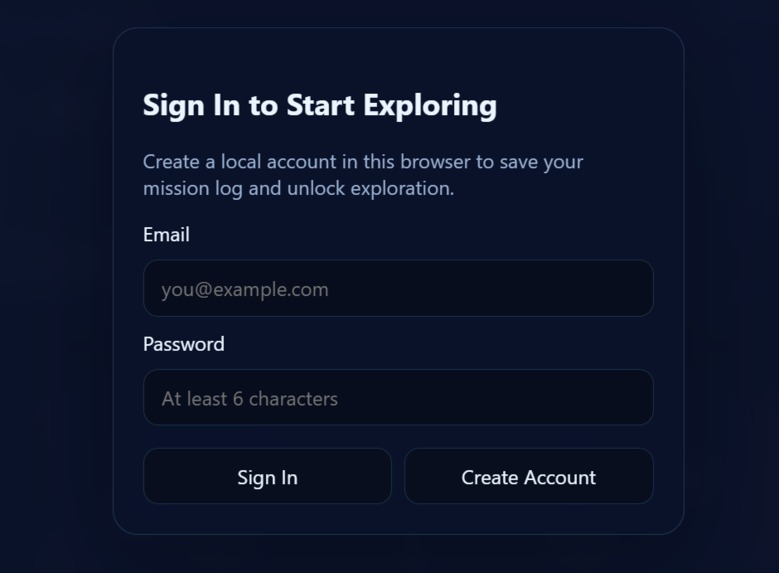
Authentication
-
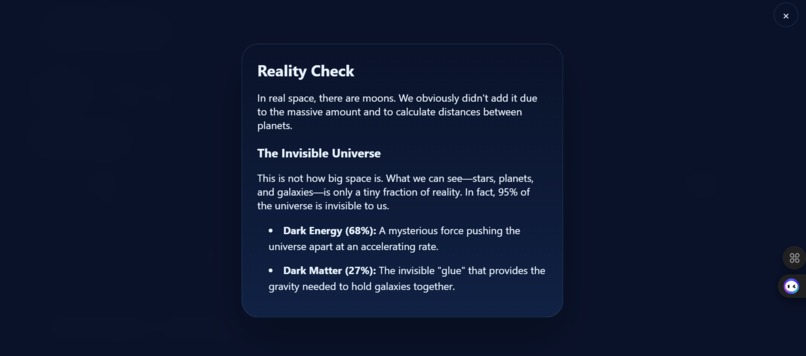
Reminder Popup
-
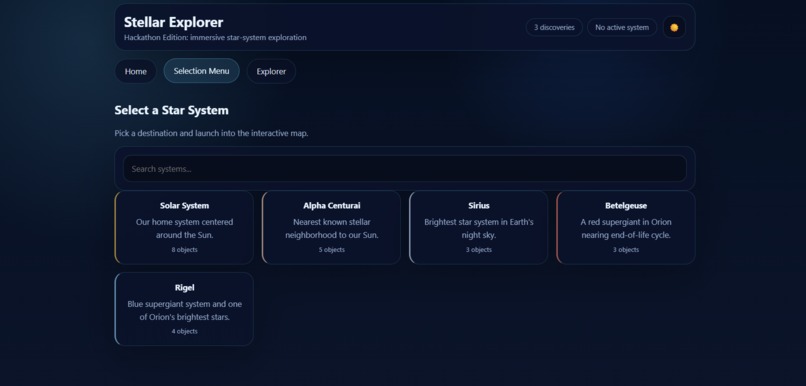
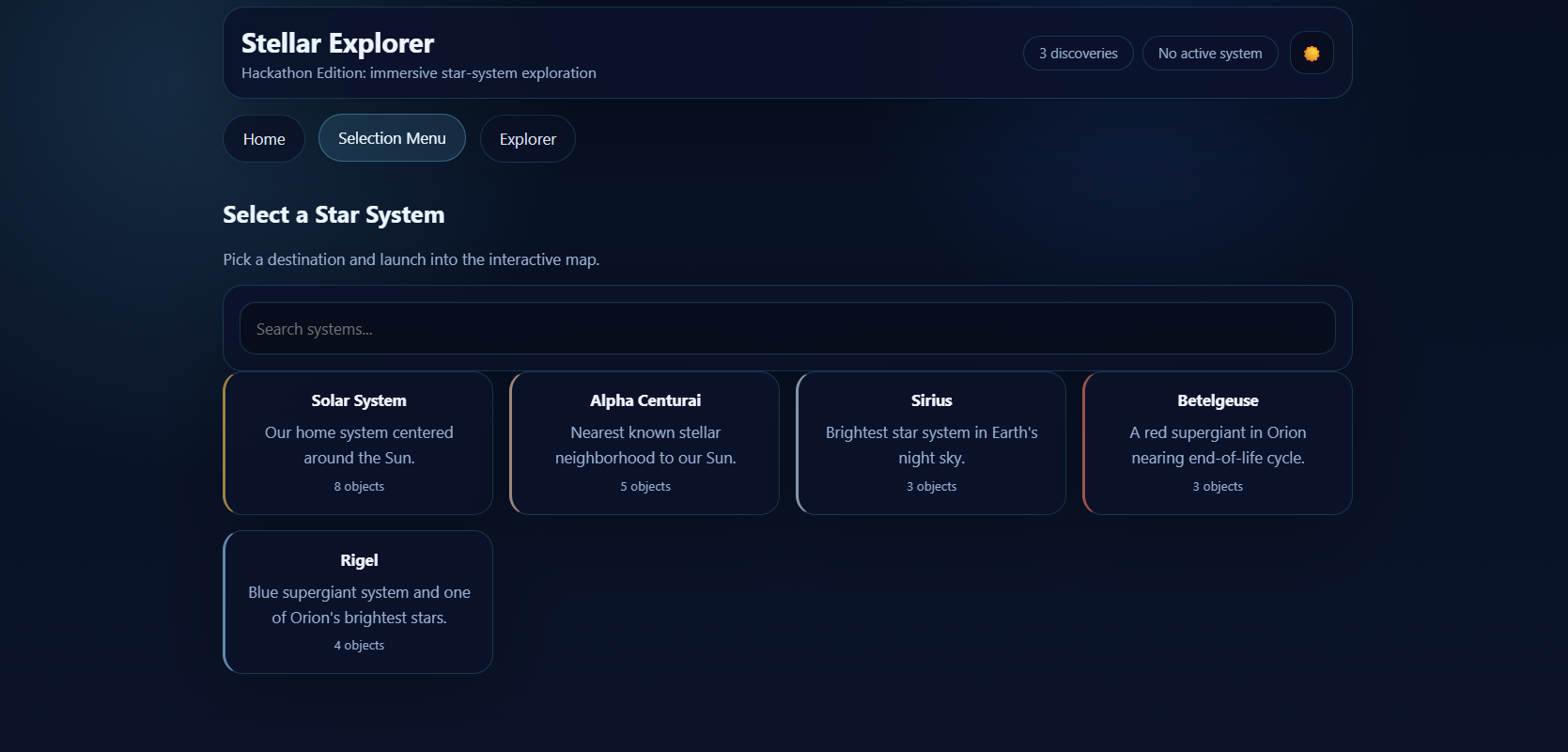
Selection Screen
Inspiration
In 8th grade science, we learned about space. Although our teachers did a great job explaining several fundamentals of space and specific details, we were never truly able to visualize or truly understand the vastness of space. Comparing distance and light years for calculating the diameter of planets never truly satisfied us. In order to now gauge how immense space truly is, we decided to take the opportunity in this hackathon to build an application that uses real-life objects that people often interact with to compare with something as unattainable and achievable as space, to hopefully find a connection between the two.
What it does
Our website uses Graph Theory, DIjkstra’s Algorithm, Kepler’s Third law, and Gemini AI to simulate how any vehicle using any fuel would move through space. It uses graph theory to compute this and it takes into account many complex space-time factors. It also has appealing graphics and a functional UI. You can use it to learn the scale of 5 solar systems and facts about the bodies inside it.
How we built it
We landed on several forms of key principles that were not only most accurate to our project but also doable in the timeframe. When we were done with the most tedious phase of research, we moved on to coding the application. The bare bones of the UI, meaning the div boxes, the titles, etc, were all written by hand, but then the UI design and specific themes were then integrated through the use of AI. But we didn't just depend on one model to continuously copy-and-paste. We used a variety of models including Claude, ChatGPT, Gemini, Cursor, super base, et cetera. All to create the perfect project. Furthermore, although the code for doing the calculations was written by AI, it was our imagination and creativity that told us exactly specifically what to do and what equations to use(the prompt we wrote for the AI was over 20 pages long!)
Challenges we ran into
The most challenging part was finding out the mathematics required to actually simulate this. Raymond and Nathan primarily spent hours researching what's the best mathematical formula that could be needed and required to simulate the metric of space fabric. Furthermore, authentication was also a big problem. Towards the end, Superbase and Google both were not able to help us use authentication, so we ended up making a local authentication system that only saves the data on the JavaScript file. This best models what a real authentication system looks like without going into the complexities of Superbase (client ID was causing problems, so we were not able to integrate it in our codes). Finally, a key thing that could have been improved on was teamwork. Sometimes I was carrying the burden of the group, and Nathan was confused about what he could be doing. Sometimes the other members were all working on certain aspects of the project while I was wandering around. If we improved our efficiency and time management, we could have made a better project. But still, we are really proud of the accomplishments we were able to achieve in this short of a time frame.
Accomplishments that we're proud of
Even though we had never used mathematical concepts as such before, we were able to use our prior knowledge of basic-level physics and several forms of mathematical equations and theories to quickly gauge and understand what equations we were really using and what the purpose of them was.
What we learned
Next, though several methods and functions we had never used before, we were able to use our prior knowledge to adapt and learn exactly what our code was really saying. And if AI ran into any issues, even develop it further. We also learned a lot about the space fabric and how time plays along with it
What's next for Stellar Explorers
The next part of the project is to make the simulation more interactable through making it in the form of a game. We want to add collections and pins and game concepts as such to make sure that individuals can interact with our project and get "rewarded" for it. Through this, we will make sure that engagement is boosted. Furthermore, to save such accomplishments, we need to have a stronger authentication system that actually saves data in a better bid database.

Log in or sign up for Devpost to join the conversation.