Inspiration
Stellanet was inspired by a common challenge for students and early researchers: finding the right faculty mentor and writing meaningful first-contact emails is time-consuming, unstructured, and often discouraging. I wanted to build a practical AI system that makes outreach more focused, transparent, and effective without removing human control.
What it does
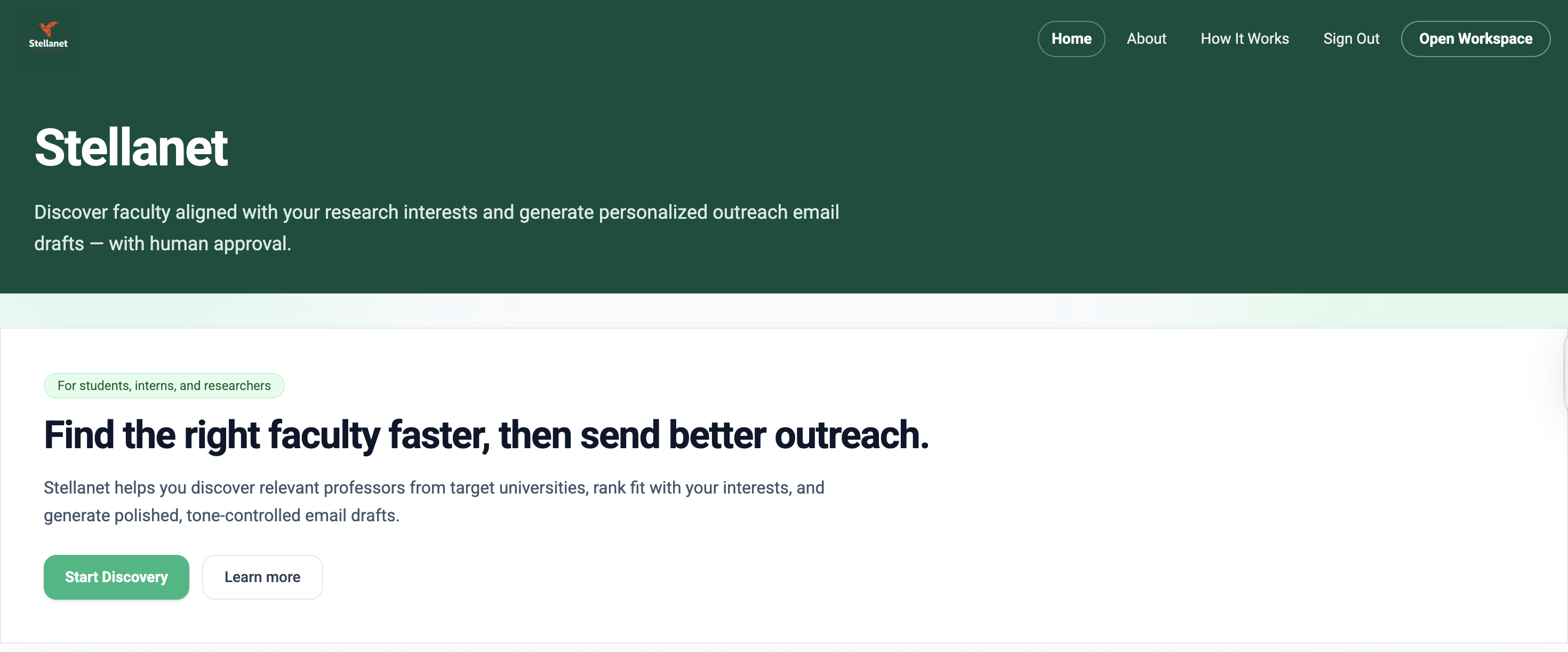
Stellanet helps users run an end-to-end research outreach workflow:
- Takes user interest, profile, and target universities.
- Retrieves and ranks relevant faculty candidates using grounded research signals.
- Shows why a match is relevant with explainable details.
- Generates personalized outreach drafts.
- Rewrites drafts by tone (professional, friendly, short).
- Keeps users in control with human-in-the-loop review before sending.
- Supports secure auth flows including email/password and Google sign-in.
How I built it
I built Stellanet as a full-stack web app:
- Frontend: React + Vite + Tailwind for a responsive workflow UI.
- Backend: FastAPI with modular services for auth, discovery, and draft rewrite.
- AI layer: Amazon Nova 2 Lite (via Amazon Bedrock) for ranking/drafting/rewriting.
- Grounding source: OpenAlex API for research and affiliation signals.
- Auth/Session: local SQLite in development, production-ready PostgreSQL support.
- Deployment: Dockerized backend on AWS App Runner and frontend on Vercel.
I also implemented environment-based configuration, API abstractions, and route handling improvements for production reliability.
Challenges I ran into
- Production deployment differences between local/dev and cloud environments.
- Health check failures caused by invalid database host configuration.
- OAuth origin mismatch issues in Google Cloud setup.
- Route refresh behavior on production domains for SPA paths like
/signinand/about. - Double-slash API URL edge cases causing endpoint 404s in production.
- Ensuring fallback behavior remained user-safe while still being debuggable.
Accomplishments that I am proud of
- Built a complete, usable outreach product instead of a model-only demo.
- Integrated Amazon Nova into the core user value path.
- Delivered grounded, explainable ranking and controllable rewrite workflows.
- Implemented secure auth with Google sign-in support.
- Deployed backend on AWS App Runner with containerized delivery.
- Improved UX reliability with route-safe refresh handling and robust error pathways.
What I learned
- AI product quality depends as much on reliability engineering as model quality.
- Small configuration mismatches (env vars, hostnames, trailing slashes) can break core flows.
- Grounded generation + transparent reasoning improves trust and usefulness.
- Shipping with iterative debugging and real user-style testing is critical for production readiness.
- Building with Nova is strongest when tightly integrated into a practical workflow, not just a chat interface.
What's next for Stellanet
- Improve ranking calibration and confidence transparency.
- Add persistent workspaces, saved runs, and draft history/versioning.
- Expand personalization controls for outreach style and intent.
- Add stronger observability and automated quality checks.
- Introduce advisor/team review workflows for collaborative outreach.
- Explore multimodal inputs (CVs, statements, and research docs) for richer context.

Log in or sign up for Devpost to join the conversation.