Inspiration
In hospitality environments, communication defines the guest experience. Hotels serve international travelers daily, yet language barriers often create misunderstandings, delays, and friction at the front desk.
We were inspired to build STELLA after observing how staff rely on manual translation apps that interrupt natural conversation flow. We asked:
What if communication could be instant, voice-based, and seamless?
That idea became STELLA — a real-time AI voice assistant designed specifically for hospitality.
What it does
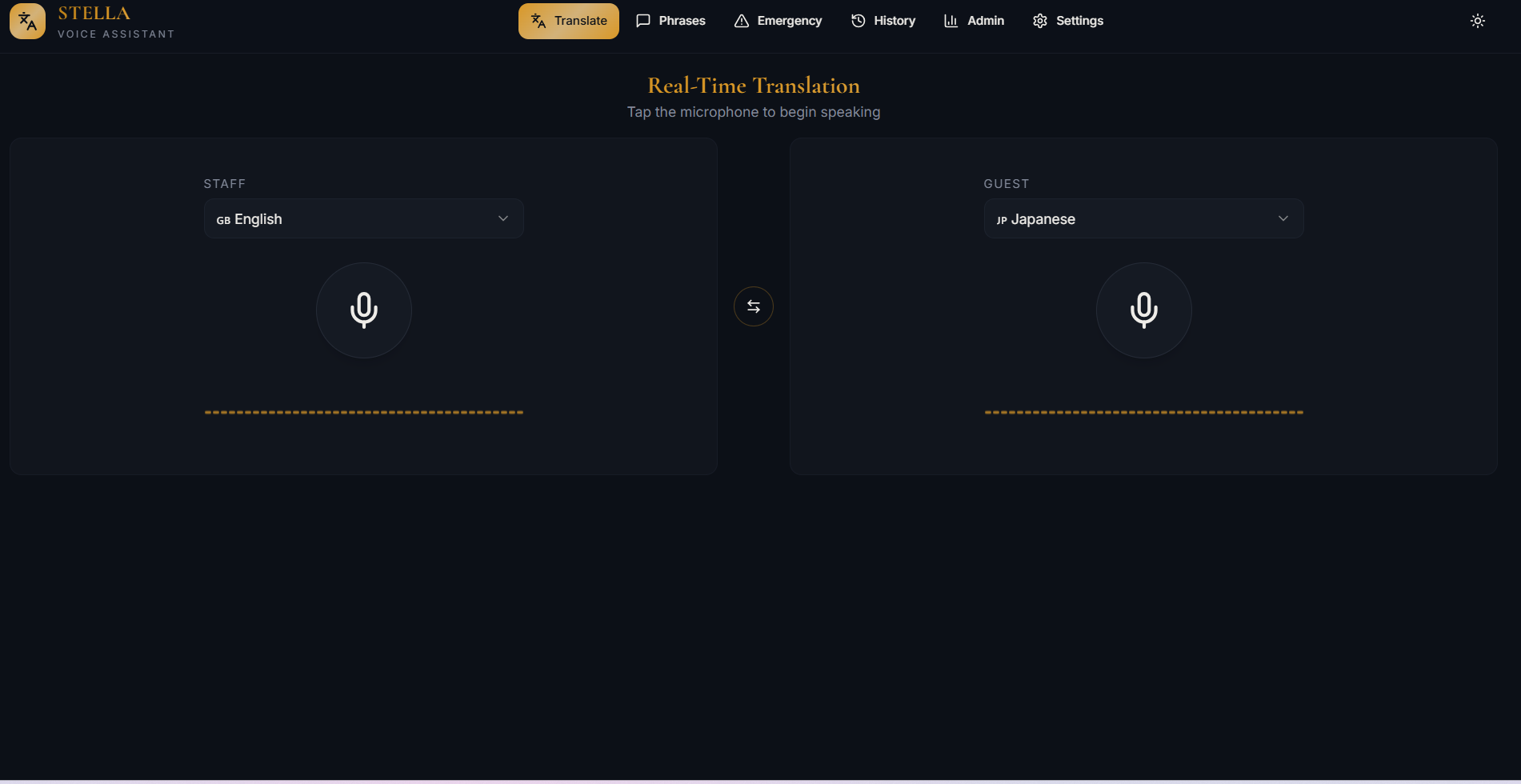
STELLA is a real-time multilingual AI voice assistant for hotels.
Staff speak naturally into a device, and STELLA:
Transcribes speech instantly
Translates it contextually for hospitality scenarios
Speaks the translated message aloud in a natural voice
The system supports multiple global languages and is optimized for tablet and front-desk use.
How we built it
We built STELLA as a production-ready MVP using:
Web Speech API for real-time Speech-to-Text
Gemini AI via Lovable edge functions for contextual translation
ElevenLabs API for high-quality Text-to-Speech
Lovable Cloud backend for secure edge function execution
Vercel deployment for hosting
Responsive React-based UI for accessibility and usability
The system processes:
Speech → Text → AI Translation → Natural Voice Playback
All within seconds.
Challenges we ran into
Building a real-time voice workflow introduced several challenges:
Managing latency between transcription, translation, and playback
Handling API rate limits and failures gracefully
Ensuring translations were context-aware (not literal word-for-word)
Securing API keys properly using environment variables
Designing an interface simple enough for non-technical hotel staff
Each challenge helped us refine STELLA into a stable, usable system.
Accomplishments that we're proud of
Built a fully functional, end-to-end real-time voice translation system
Delivered a production-ready MVP rather than a prototype
Implemented secure API key management following least-privilege principles
Designed a clean, accessible UI optimized for hospitality use
Demonstrated applied AI solving a real-world communication problem
What we learned
Through building STELLA, we learned:
Real-time AI systems require thoughtful UX flow design
Latency optimization is critical for voice applications
Context-aware AI is more impactful than literal translation
Security and production readiness matter even in hackathon builds
Applied AI should enhance human interaction, not replace it
What's next for STELLA — Multilingual AI Voice for Hospitality
Our next steps include:
Piloting STELLA in real hospitality environments
Adding intent recognition for common guest requests (check-in, room service, amenities)
Building a conversation insights dashboard for hotel management
Expanding support for more languages and dialects
Integrating with hotel management systems
Releasing a dedicated mobile and tablet application
Our long-term vision is to make STELLA the AI-powered voice layer for global hospitality communication.
Built With
- ai
- api
- cloud
- edge
- elevenlabs
- gemini
- javascript
- lovable
- react
- speech
- vercel
- web

Log in or sign up for Devpost to join the conversation.