Stele: A Federated Institutional Operating System for Schools | Created By : Tamim Islam
Inspiration
When I walked into my new high school, I didn't lack ambition or information—I lacked a place where commitments lived.
Club activities were scattered across WhatsApp groups I wasn't added to. Deadlines drifted away with no calendar or ownership, and students were routinely blamed for tasks dropped at 11:45 PM while half the school was asleep. Worse, national olympiads and robotics competitions were announced on Facebook and Instagram—sitting right between memes and fast-food ads. Because a social platform's job is to keep me scrolling, not to help me build a future, those opportunities lost their dignity. And every June, when our club seniors graduated, they took the club's passwords, playbooks, and operational memory with them, forcing the next cohort to repeat the exact same mistakes.
The breakthrough came when I looked at the Fediverse—where independent servers govern themselves in full sovereignty while speaking a shared protocol without a central corporate landlord. I named the project Stele, after the ancient stone slabs inscribed with public records, law, and memory so institutions outlive the people who build them.
What it does
Stele is a quiet, federated, offline-first institutional operating system built across Three Strictly Separated Planes:
The Institutional Plane
The school's sovereign internal system—sections, timetables, syllabi, clubs, notices, and approval chains. Nothing internal ever leaves the instance.
The Federation Plane
Carries only published opportunities and trust endorsements across a geographic ladder (District → Division → National → International) without ever exposing a single student's grades, attendance, or identity.
The Student-Facing Plane
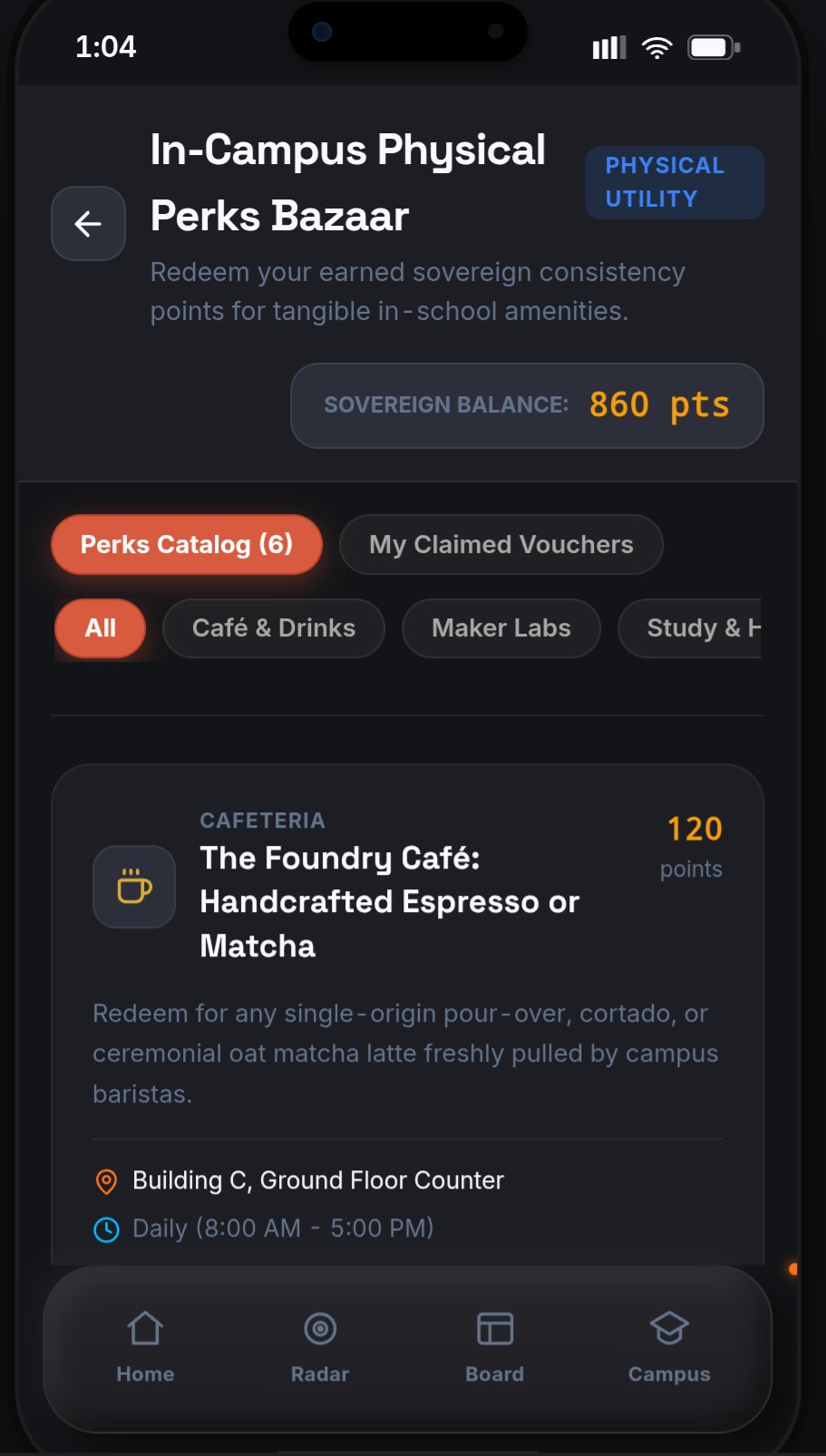
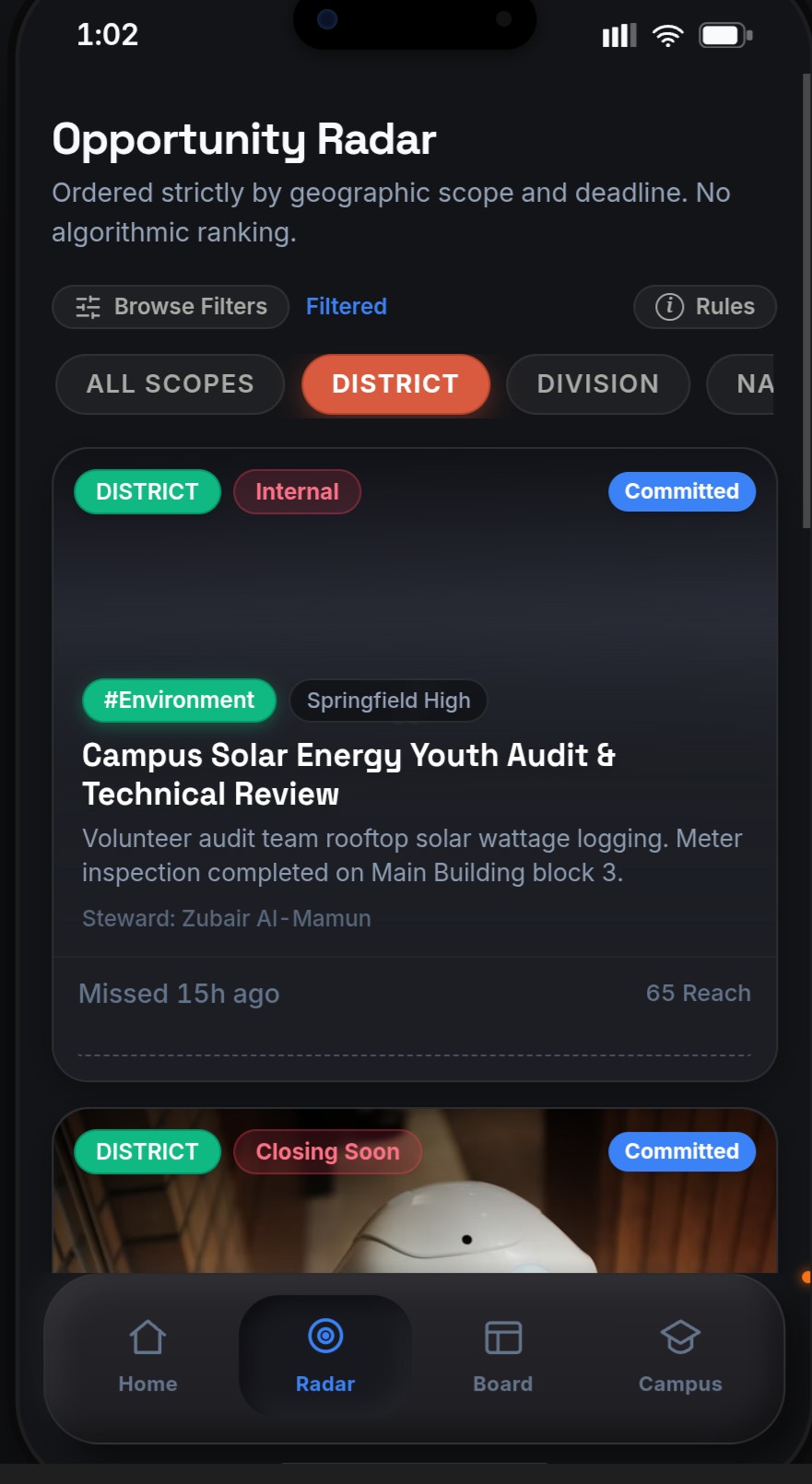
A calm, mobile-first workspace that reads from both planes without merging them, centered on four unchanging pillars (Home, Radar, Board, Campus) and two sovereign utility planes (Messenger and In-Campus Physical Perks Bazaar):
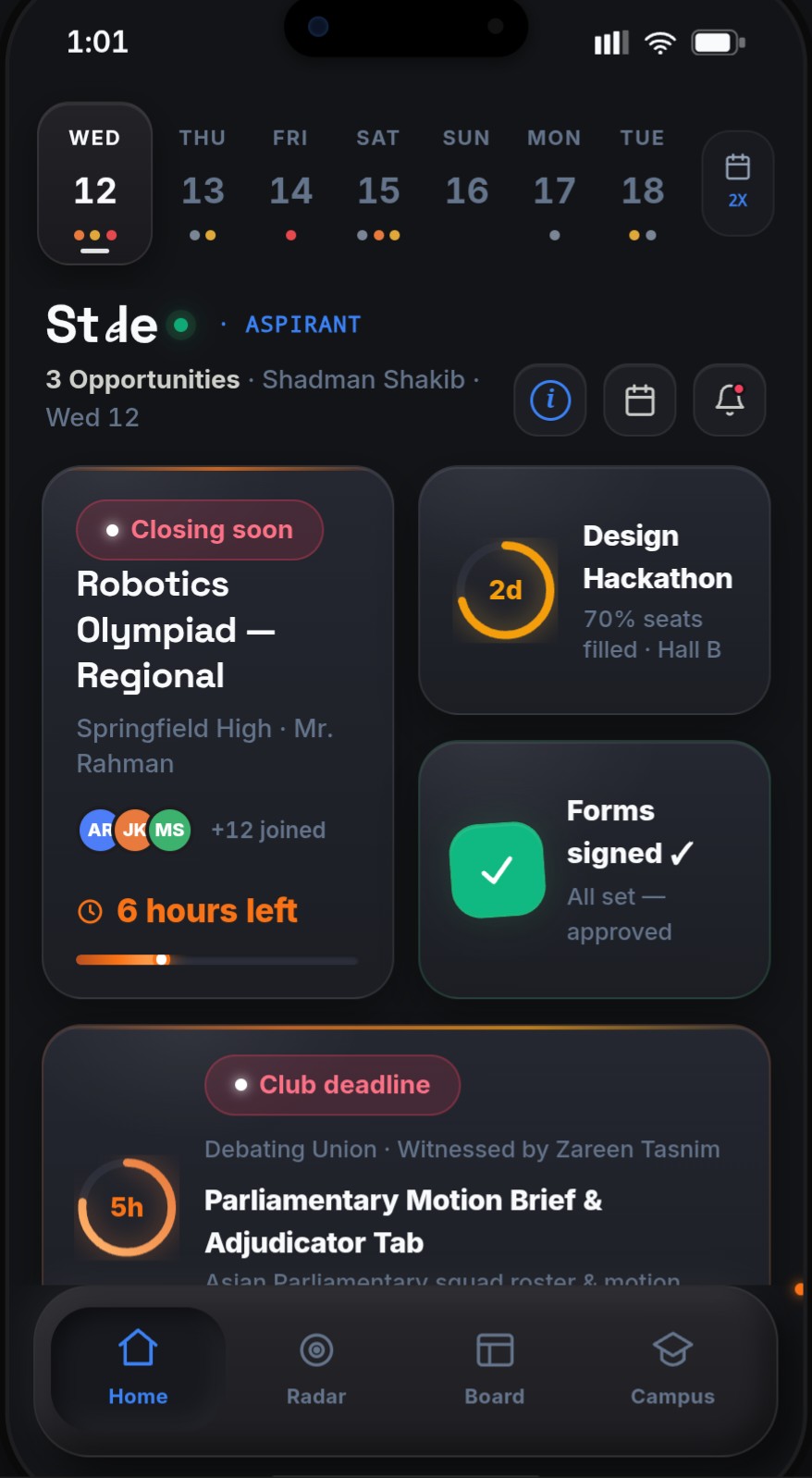
- Home (Bento Table-of-Contents, Never a Feed): Features a 7-day calendar strip, a Hero commitment tile with live SVG depletion bars, a one-tap permission slip verifier, approaching club deadline alerts, and a catch-up digest.
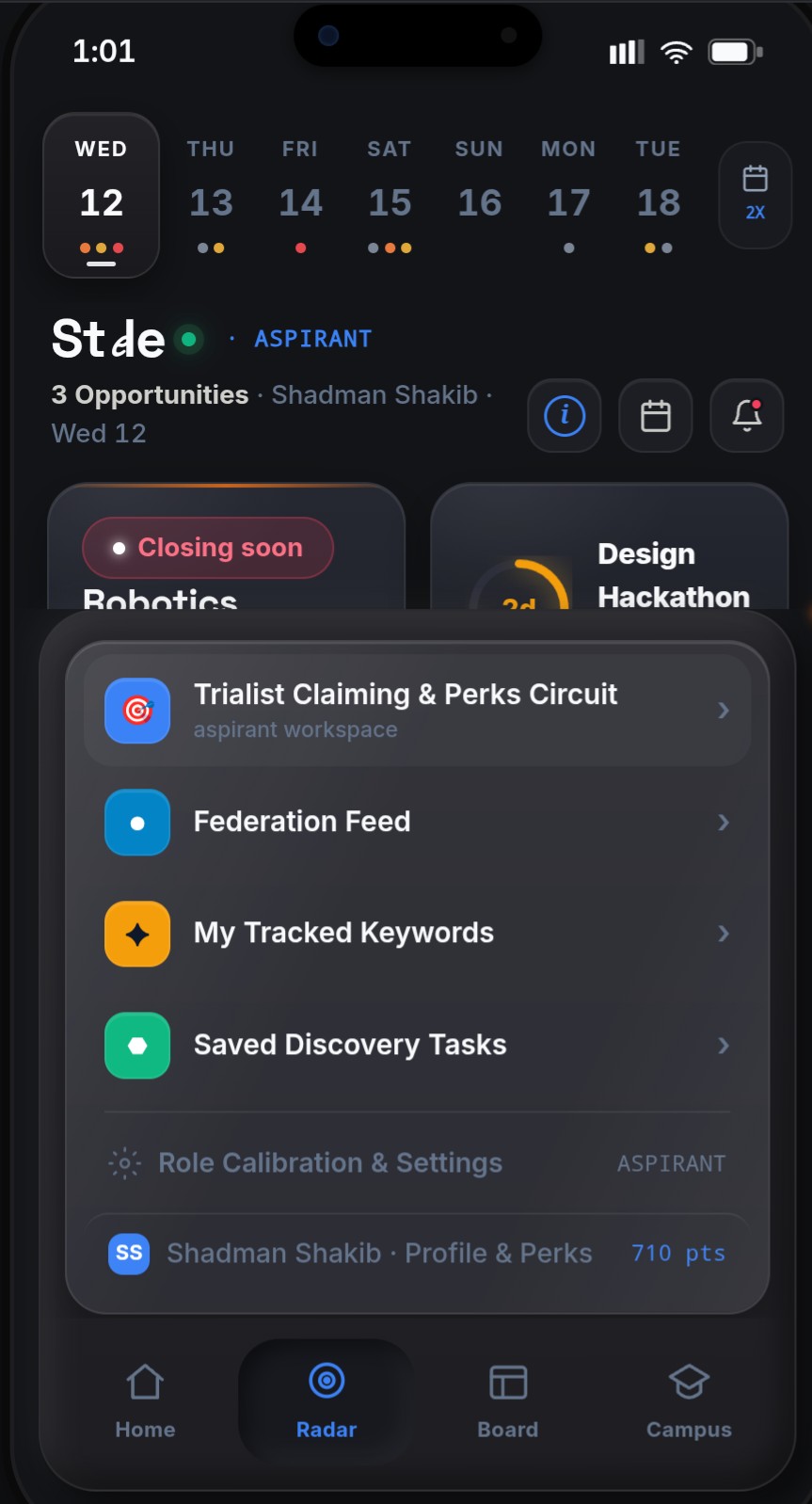
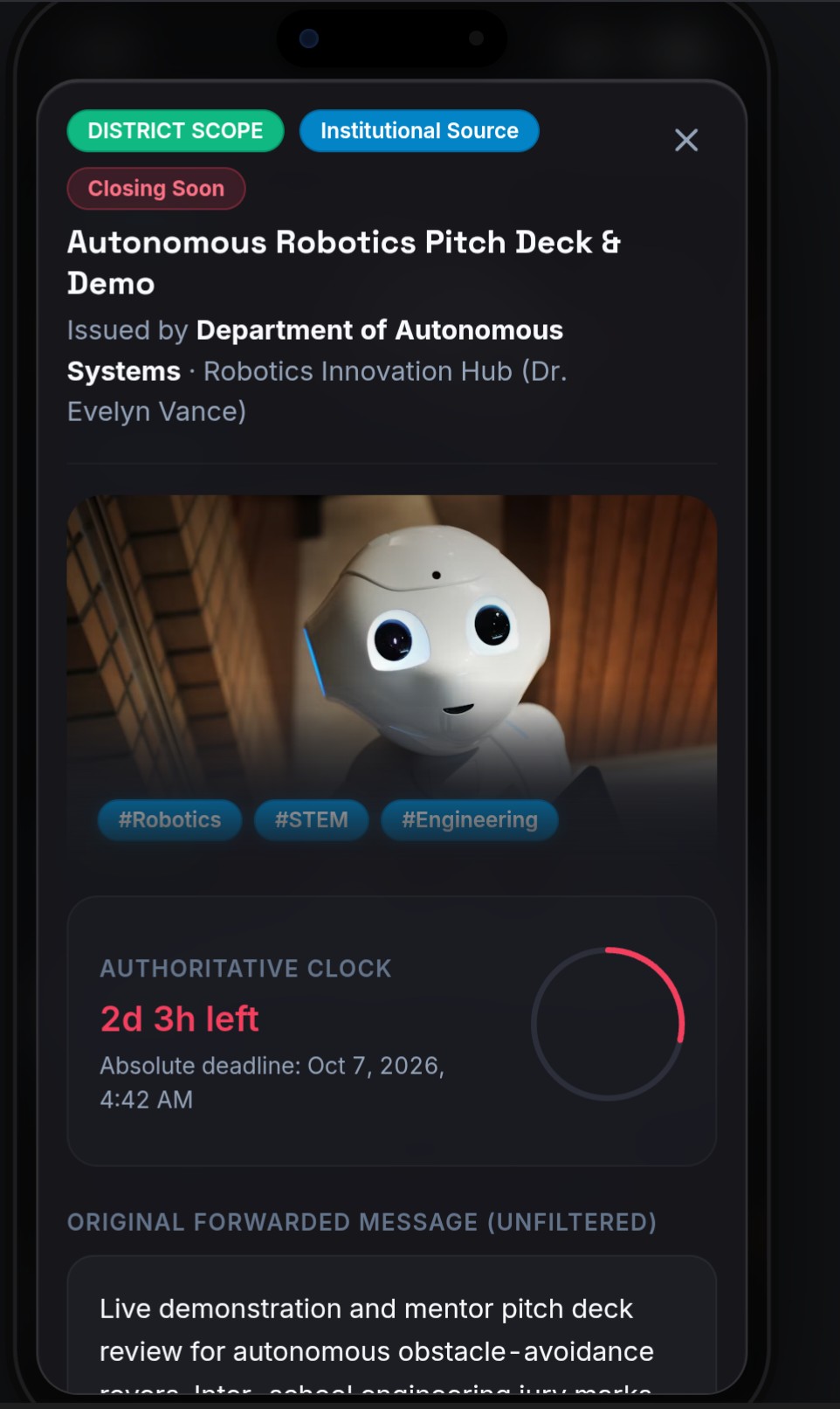
- Radar (Scope-First, Deadline-Second Discovery): Zero infinite scroll and zero popularity ranking. The student is the algorithm.
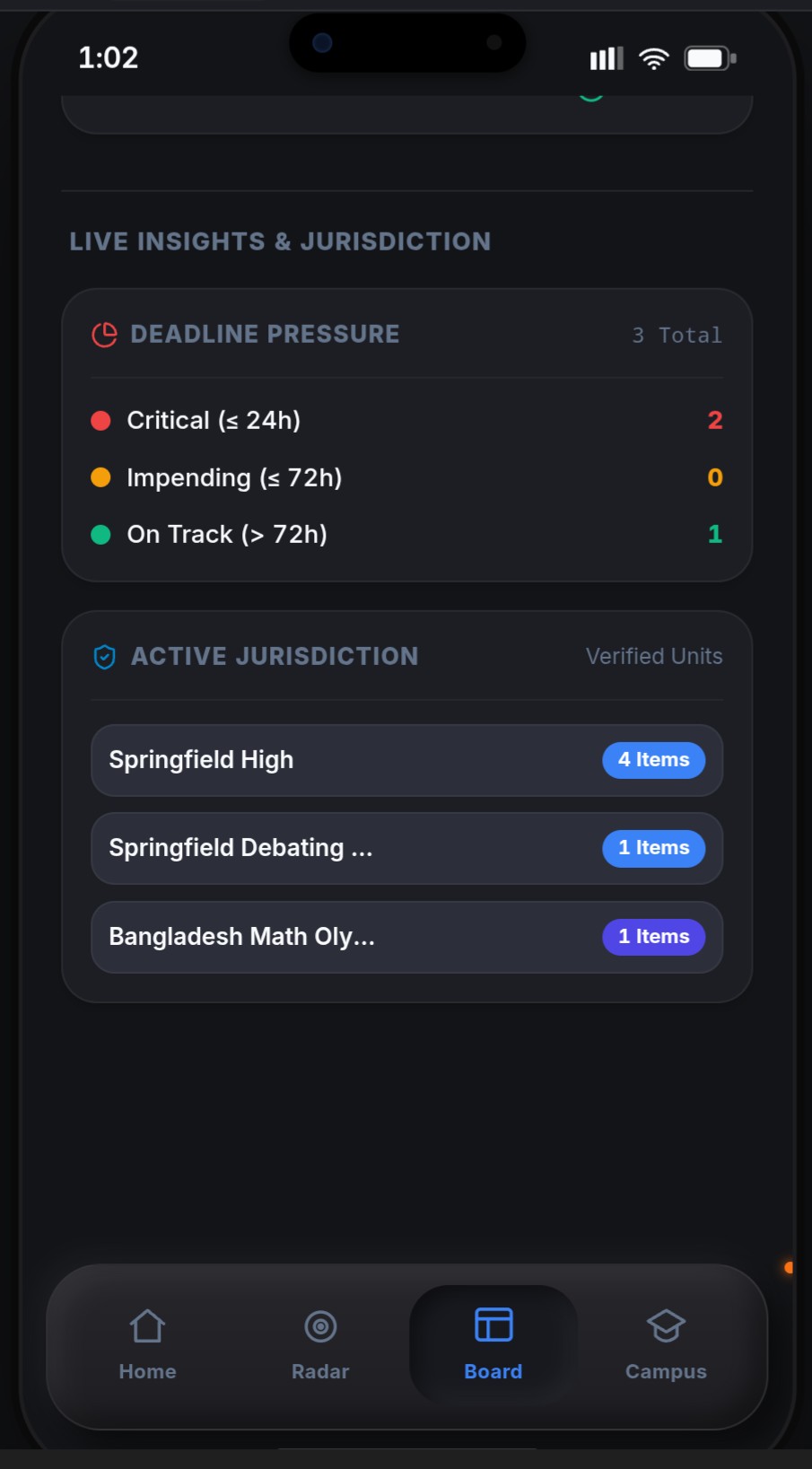
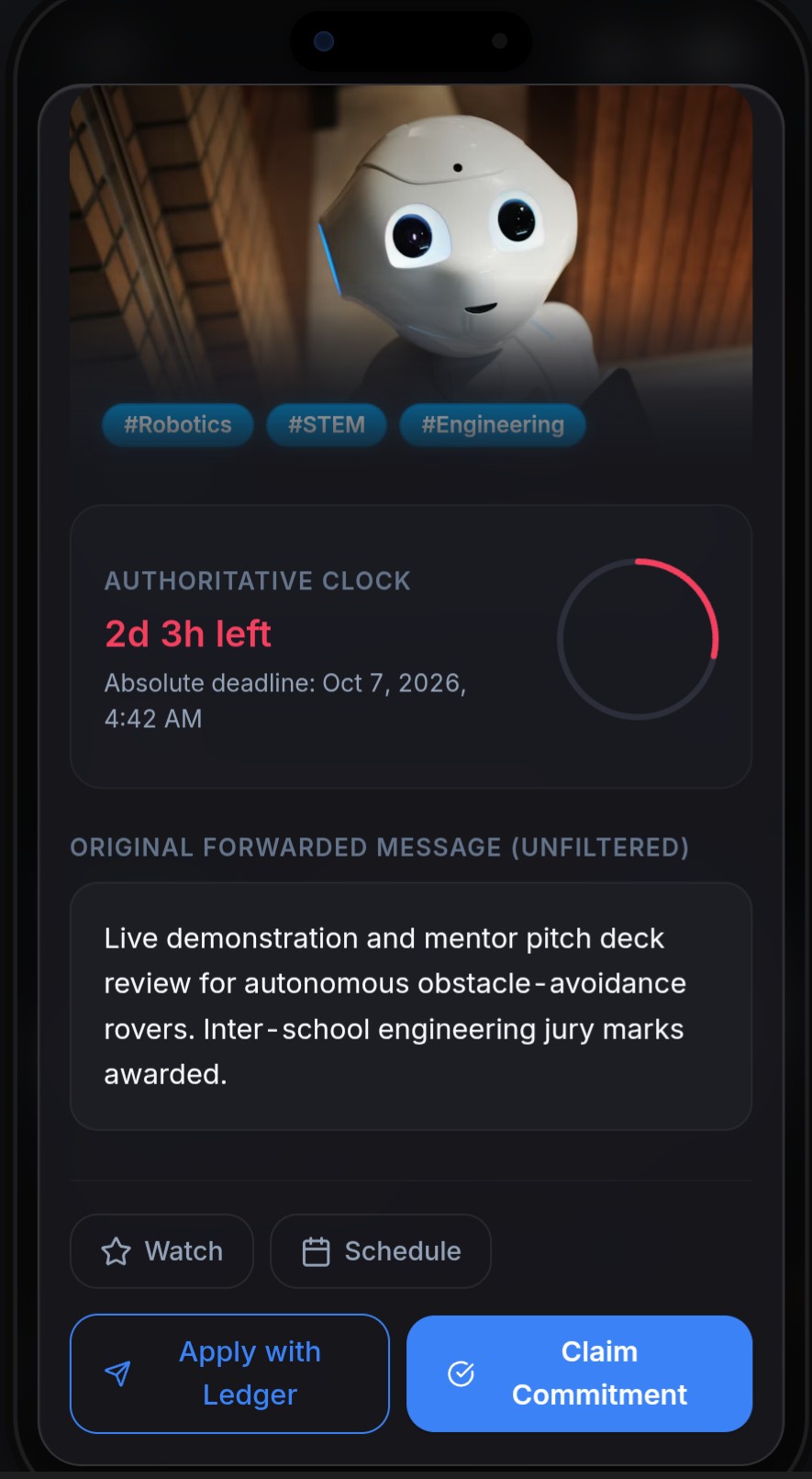
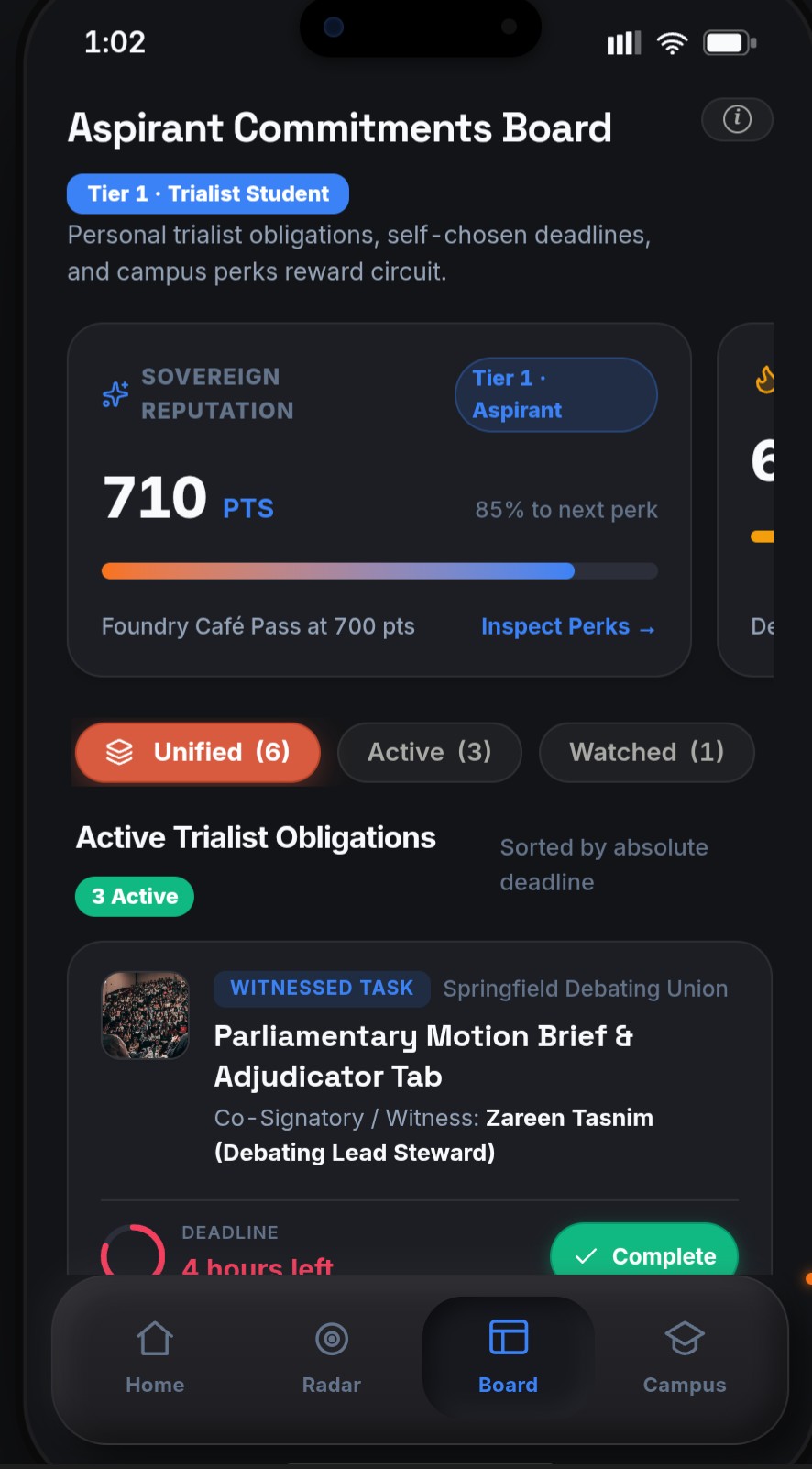
- Board (Commitments & Role-Exclusive Consoles): Tracks self-chosen and Steward-witnessed commitments with Clock-Driven Urgency (Stewards cannot paint items red; only the mathematical clock <24h triggers critical red, and missed items turn quiet grey dashed lines—never public shame markers).
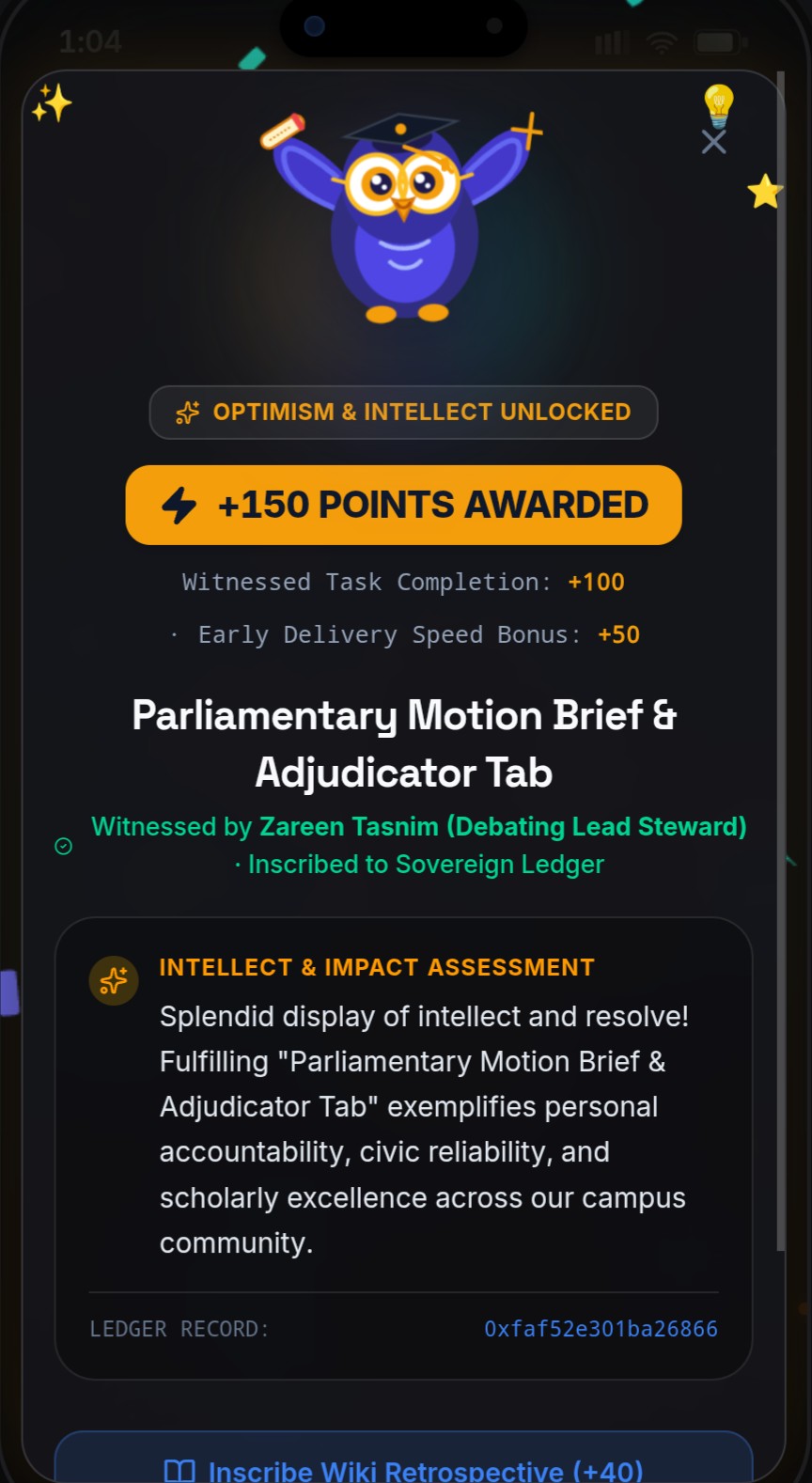
- Witnessed Sovereign Ledger vs. Civic Micro-Economy: Delegated tasks record four immutable facts (Person, Act, Moment, Named Witness) in an exportable, cryptographically signed JSON pack where grades and GPA are constitutionally barred. Meanwhile, daily civic hygiene (signing slips, inspecting circulars, early deliveries, 2-minute retrospectives) earns 90-day rolling points redeemable in the Physical Perks Bazaar for real cafeteria beverages, 3D-printer lab passes, and library study pods. The Record travels; the Score stays.
- Three-Sphere Calm Dispatches: Replaces chaotic WhatsApp groups with one-tap Actionable Task Extraction and three constitutional privacy spheres—Public Institutional, Peer Encrypted DMs, and Student Commons (cryptographically air-gapped from Principal and Teacher surveillance).
- Club Wiki & Zero-Empty-Seat Succession: Completing a commitment prompts a skippable 2-Minute Retrospective (What went well · What went wrong · What to change) that writes directly into the Club Wiki, while outgoing Stewards must nominate a successor to auto-generate a Handover briefing before transitioning to read-only Alumni status.
How I built it
I authored the foundational Stele White Paper & Product Requirements Document (v2.1)—defining the Eight Constitutional Principles, the three-plane federation architecture, the role-progression matrix, and the anti-slop invariants—and partnered with Google AI Studio Build as my AI coding engine to rapidly architect, iterate, and refine the full-featured interactive web prototype.
- Stack & Architecture: Built as an offline-first React 19 and TypeScript application styled with Tailwind CSS, using localStorage persistence and deterministic state engines to simulate local-first device caching and cryptographic SHA-256 ledger signing.
- The Tactile Material Trinity (Clay, Glass, Flat): Engineered floating Clay navigation bars with specular highlights, translucent Glass modal sheets (
backdrop-filter: blur(28px)), and quiet Flat matte bento tiles across natural palettes and dark obsidian mode. - Gradual, Effortless Migration UX:
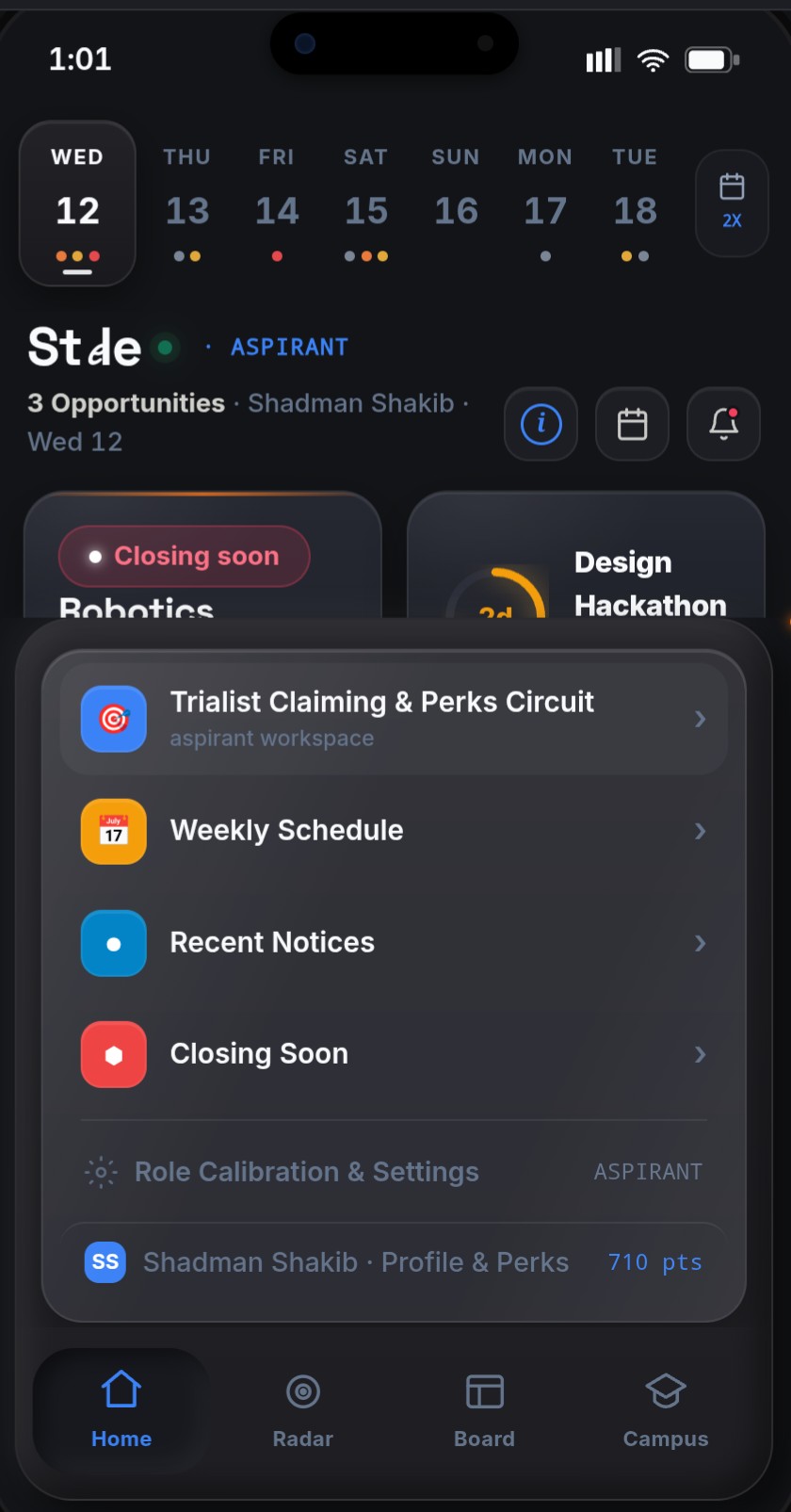
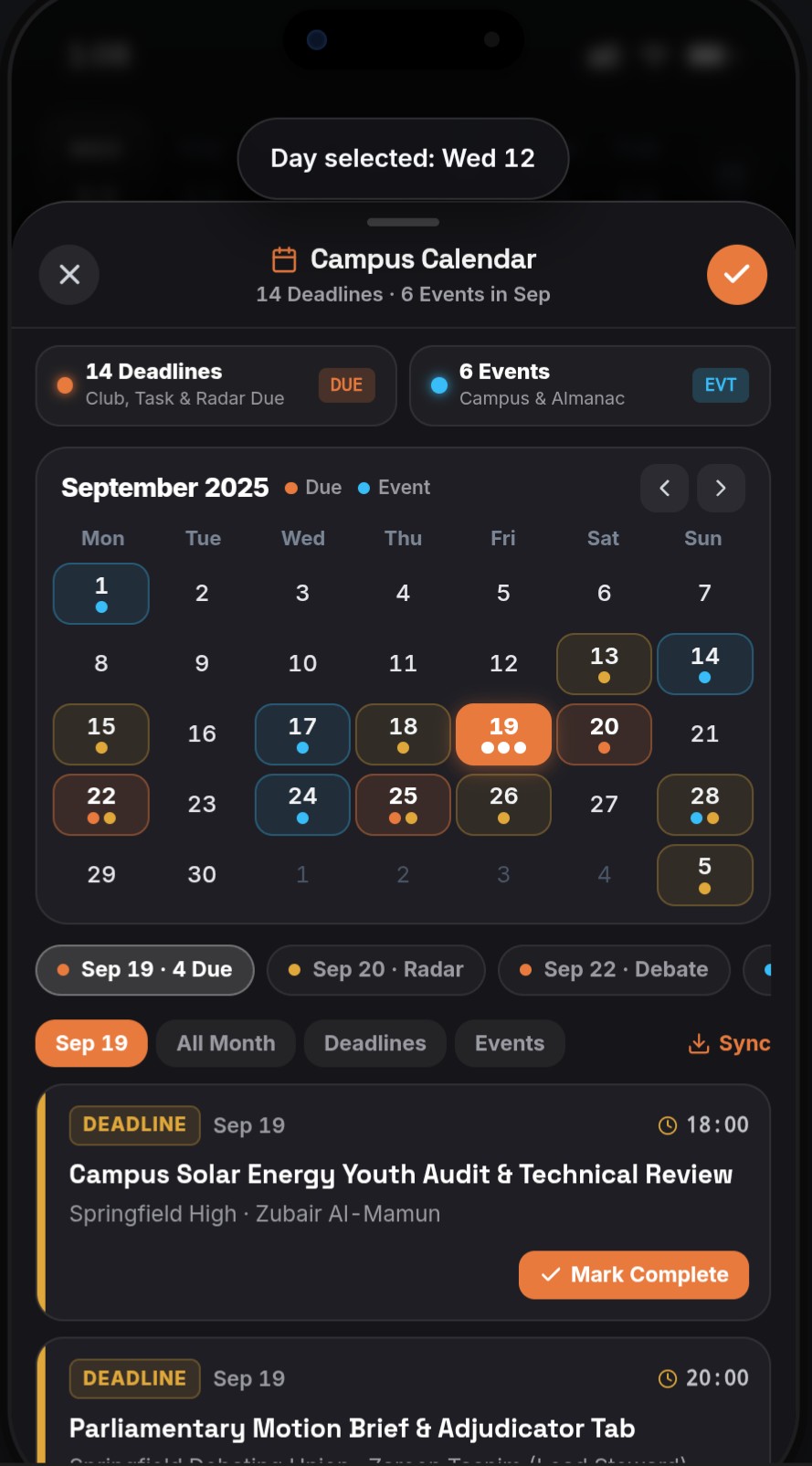
- Two-Tap Slide-Up Quick-Access Card: First tap on any navigation pillar smoothly unrolls a role-calibrated Slide-Up Quick-Access Card (giving 1-tap access to the Unified In-App Calendar, Recent Notices, Closing Soon queues, and the user's Role-Exclusive Console); a second tap opens the full dedicated page.
- Dual Viewport Parity: Seamlessly toggles between a 390×844 Mobile Device Frame (where every modal, calendar popup, and drawer is strictly confined inside the phone shell with Dynamic Island telemetry) and an Expanded Desktop Canvas.
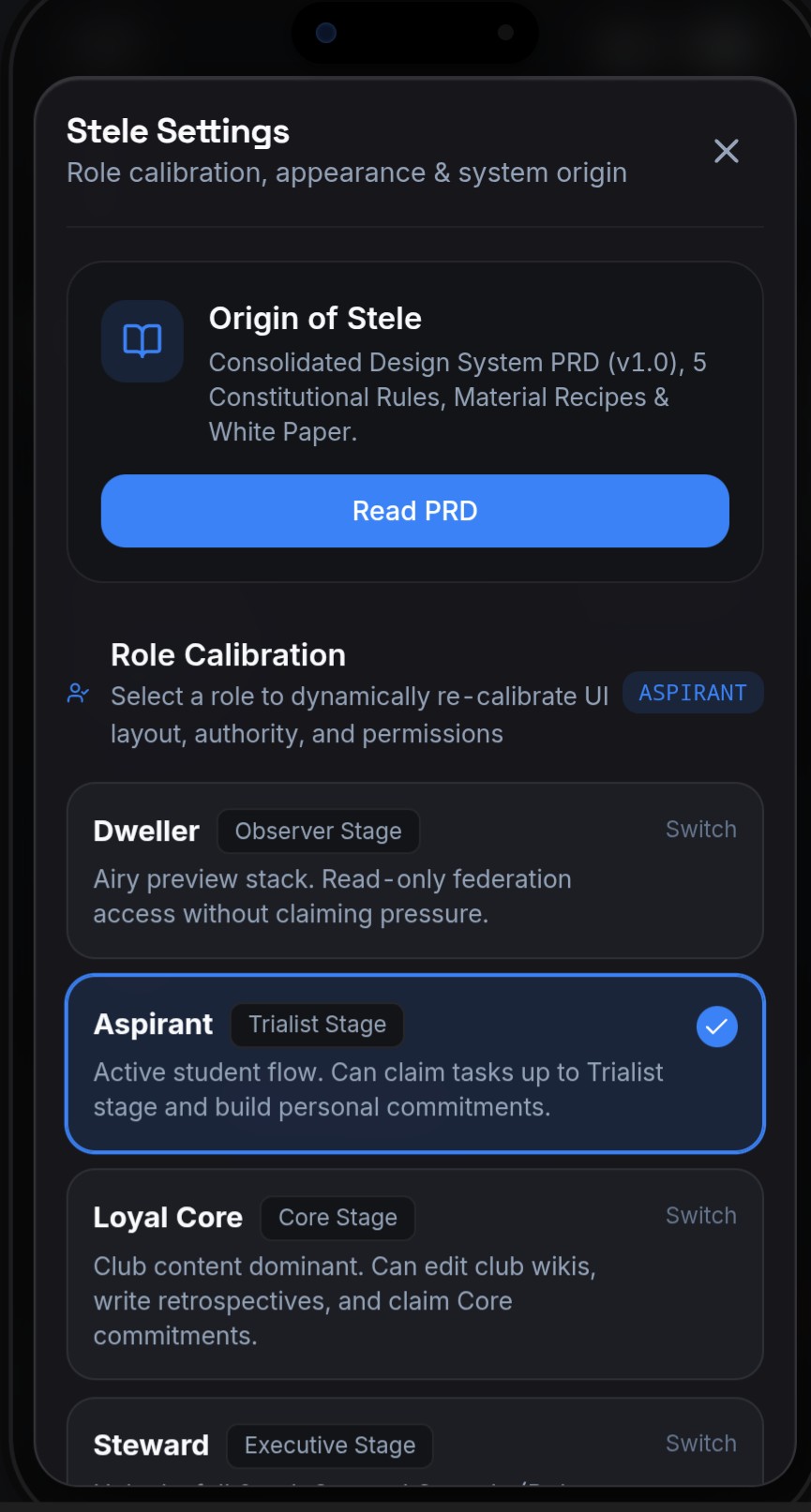
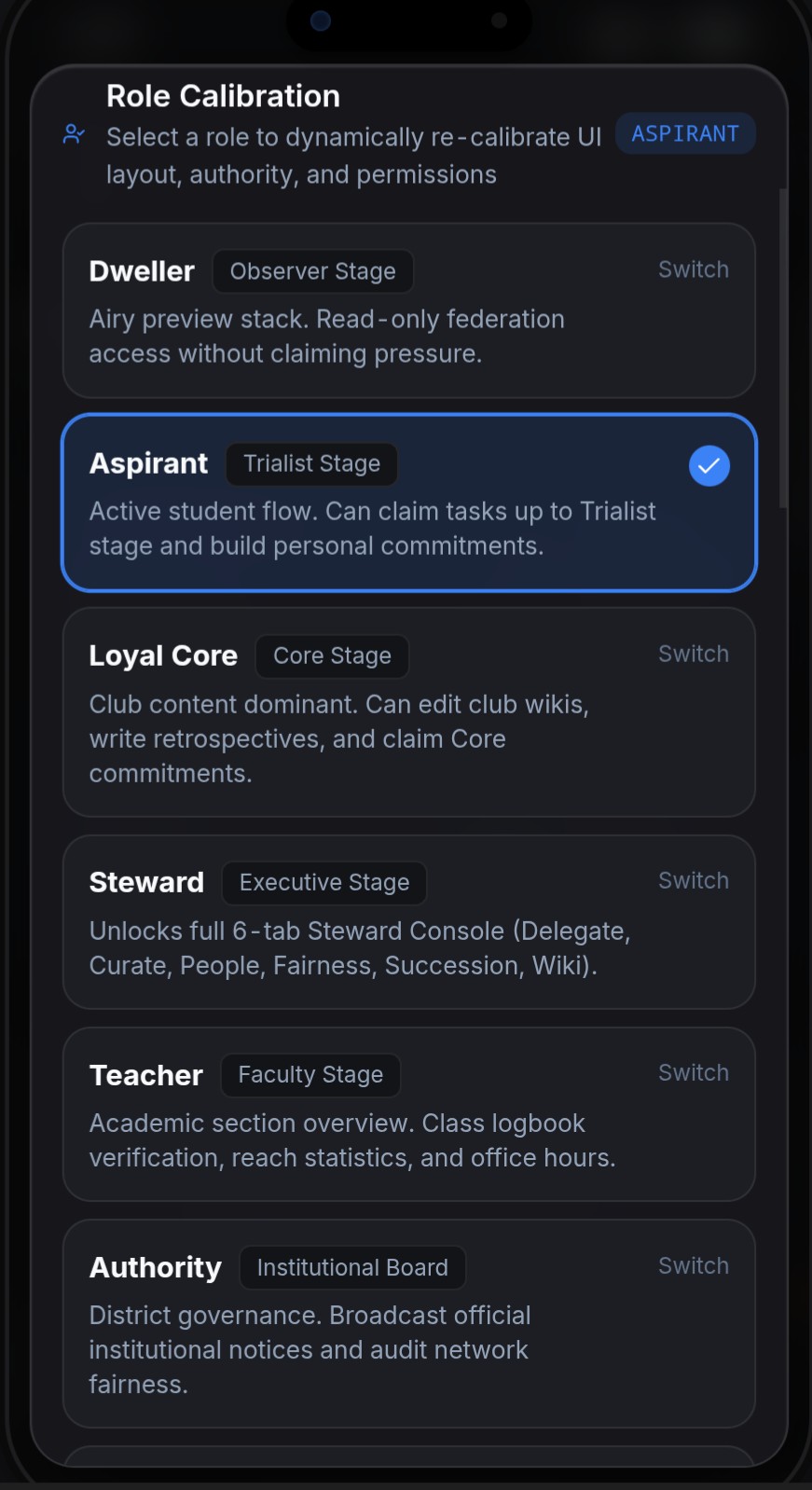
- Conflict-Free Role Calibration: Dynamically isolates state, commitments, communication channels, and consoles across 7 distinct roles—from Dweller (zero-pressure observer) and Aspirant (trialist circuit) to Loyal Core (Wiki & Retrospective Studio), Steward (6-Tab Steward Console), Teacher (5-Tab Faculty Console for lab logbook sign-offs and rubrics), Authority (5-Tab Governance Console for circulars, charter grants, and DC-1/DC-2 fairness audits), and Alumni (Sovereign Archive).
Challenges I ran into
- Separating the "Mirror" from the "Record" (The Civic Economy Invariant): Early on, I had to ensure that rewarding students with streaks and points for daily civic hygiene never gamified or polluted their permanent external transcript. I solved this by strictly bifurcating the 90-day rolling Civic Score (which stays inside the campus for Perks Bazaar vouchers) from the Witnessed Sovereign Ledger (which holds only named, verified acts and travels with the student for life).
- Enforcing Strict Role Isolation Without UI Leakage: Initially, the prototype leaned heavily toward the Aspirant student journey even when switching roles. I had to re-architect the data and view layers so that each role sees a completely conflict-free environment—integrating the Steward Console, Teacher Console, and Authority Console directly into their respective Commitment Boards while mathematically locking Teachers and Authorities out of Student Commons chat channels.
- Confining Complex Overlays Inside a Mobile-First Ergonomic Shell: Fitting rich workflows—like a unified academic/commitment calendar, cryptographic voucher QR passes, and multi-tab governance consoles—inside a 390×844 mobile viewport required strict DOM scoping and responsive grid collapsing so no widget ever escaped the device frame.
Accomplishments I'm proud of
- Genuinely Quiet by Design: I built an interface that proves a student platform doesn't need infinite scroll, phantom red notification badges, or algorithmic manipulation to be engaging. An empty feed on a slow day is the product working.
- The 10 Unconventional Invariants in Live Action: From Earned Motion (nothing pulses unless you opted into it) and Fairness Telemetry (automatically suppressing urgency pulsing if <50% of a cohort saw a late-night drop) to 2-Minute Retrospectives and Zero-Empty-Seat Succession, every philosophical stance from the White Paper is interactive in the prototype.
- Dignity for Every Campus Role: Whether you are a quiet Dweller who just wants to read notices without pressure, a Steward curating WhatsApp bot forwards, a Teacher stamping 28 physics lab logbooks, or a Principal auditing district reach fairness, the system respects your exact boundary.
What I learned
- Convenience Beats Completeness Every Time: If a club president who uses Instagram or a teacher who uses WhatsApp has to read a manual to use Stele, it fails. Features like the Two-Tap Slide-Up Quick-Access Card and WhatsApp Ingestion Bot curation make migration gradual and effortless.
- Privacy Must Be Architectural, Not Policy-Based: Promising students that administrators won't read their peer channels isn't enough; the boundary must be enforced in the state and wire format itself so internal records and Student Commons have no path to leak.
- Human-AI Pair Engineering: Writing a rigorous, opinionated White Paper and PRD first allowed me to use AI Studio Build not to invent generic features, but to faithfully execute a nuanced constitutional design system at high velocity.
What's next for Stele
- Live ActivityPub / Federated Wire Protocol Deployment: Moving from single-node local persistence to multi-node district federation so independent high schools and colleges can exchange signed opportunity packets over a live cryptographic wire protocol.
- Live WhatsApp & Telegram Ingestion Bridge: Connecting the Steward Console's Curate queue to a live webhook bot so clubs can forward real messages from legacy chat groups directly into Stele during their transition period.
- Self-Sustaining Non-Profit Rollout & Ethical Publisher Portal: Launching Stele as a 100% free public good for schools and students, funded sustainably by charging external attention buyers—a subsidized tier for NGOs and national olympiad bodies, a mandated full rate for commercial/corporate scholarship publishers (where payment buys only the right to speak, never ranking), turnkey managed node hosting for private institutions, and local merchant sponsorships for the Campus Perks Bazaar.
Transparency & AI Disclosure
Concept, system architecture, constitutional invariants, and the consolidated White Paper & PRD (v2.1) were authored by me. The interactive React/TypeScript web application and responsive UI components were built and refined using Google AI Studio Build.
Built With
- react19
- typescript
