-
-
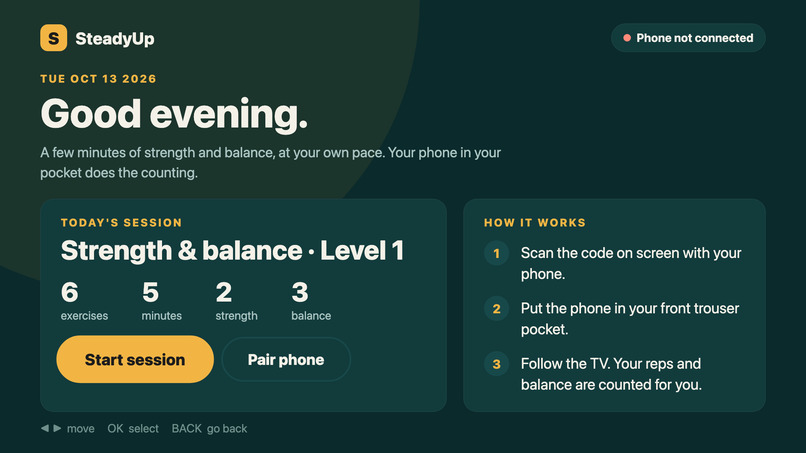
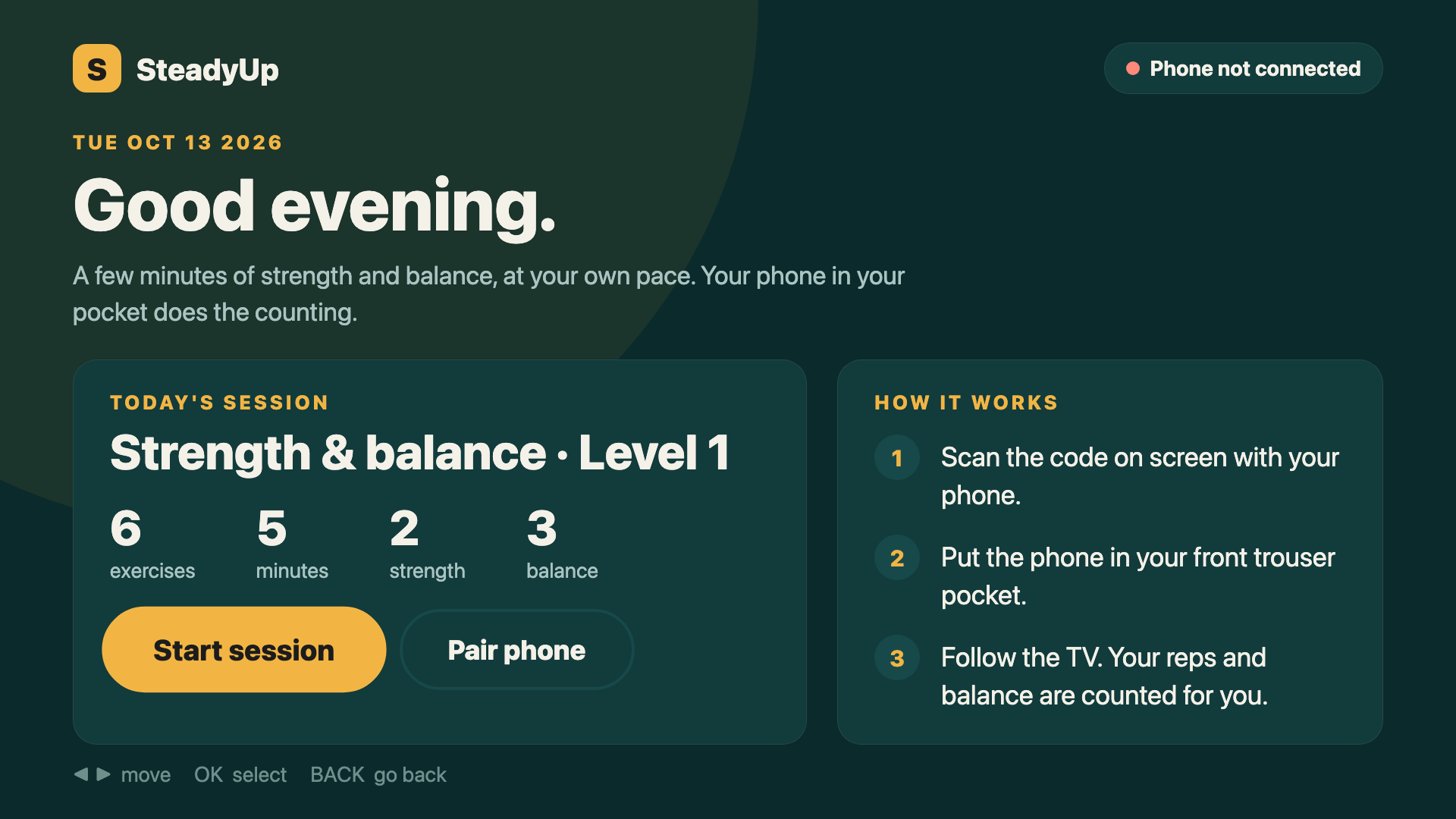
Home screen: today's 5-minute strength and balance session, driven by the TV remote
-
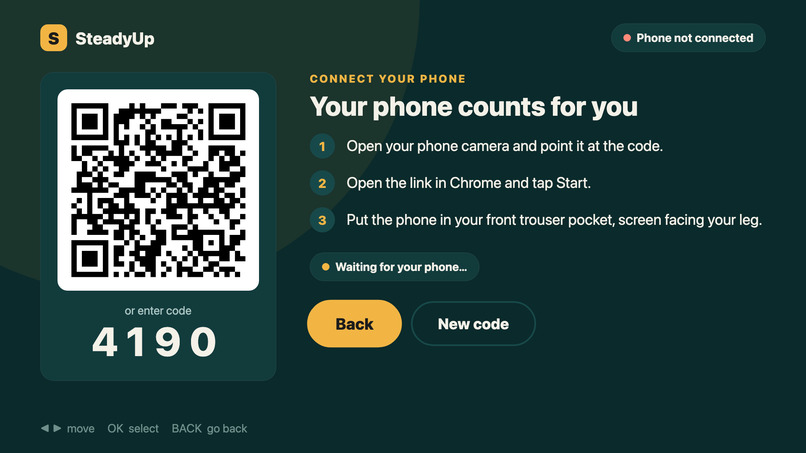
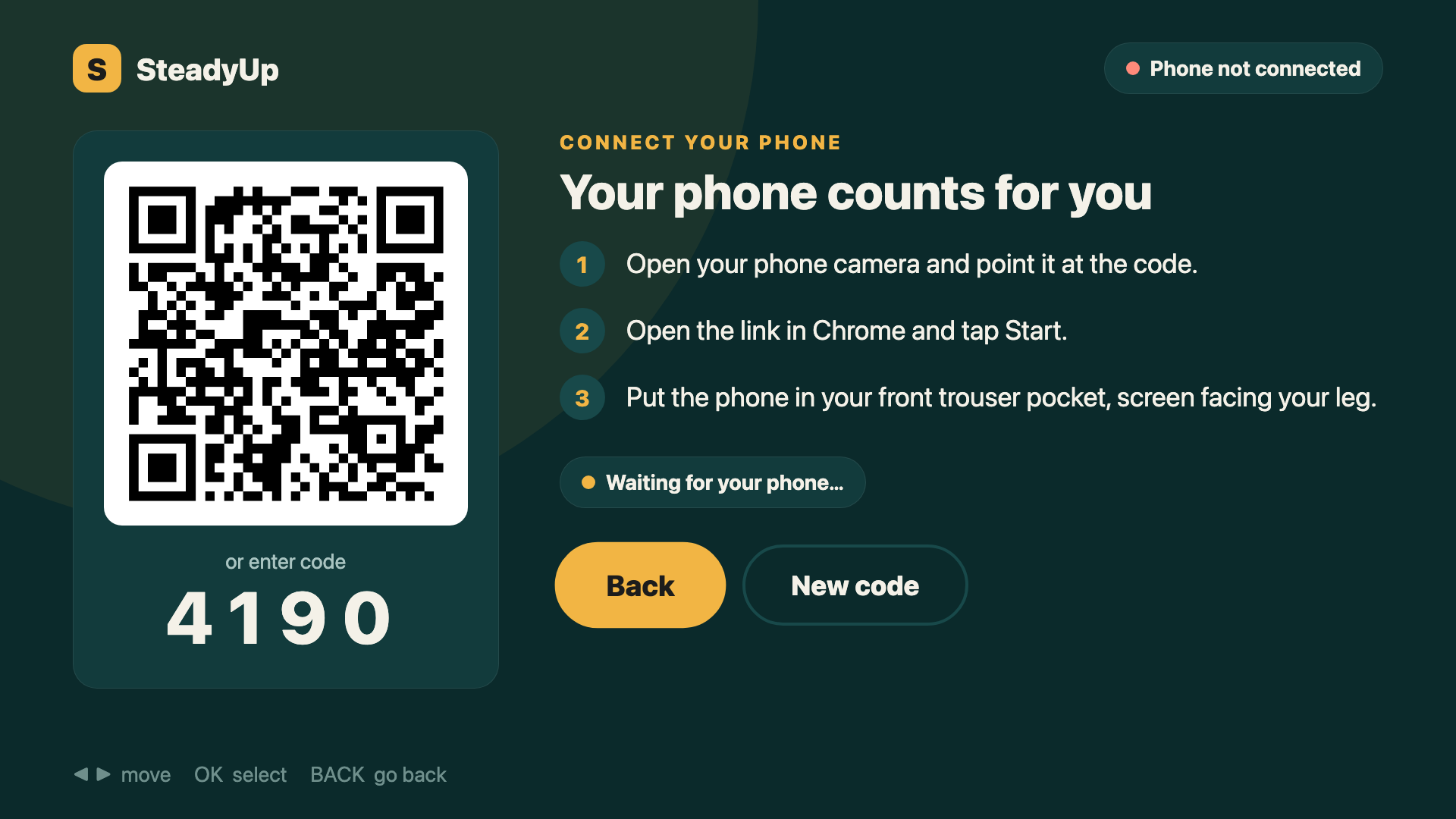
Pair your phone by scanning a QR code. No app to install
-
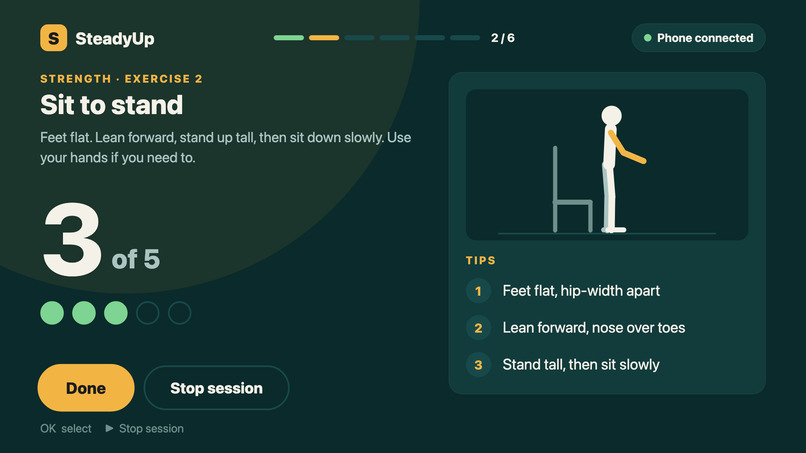
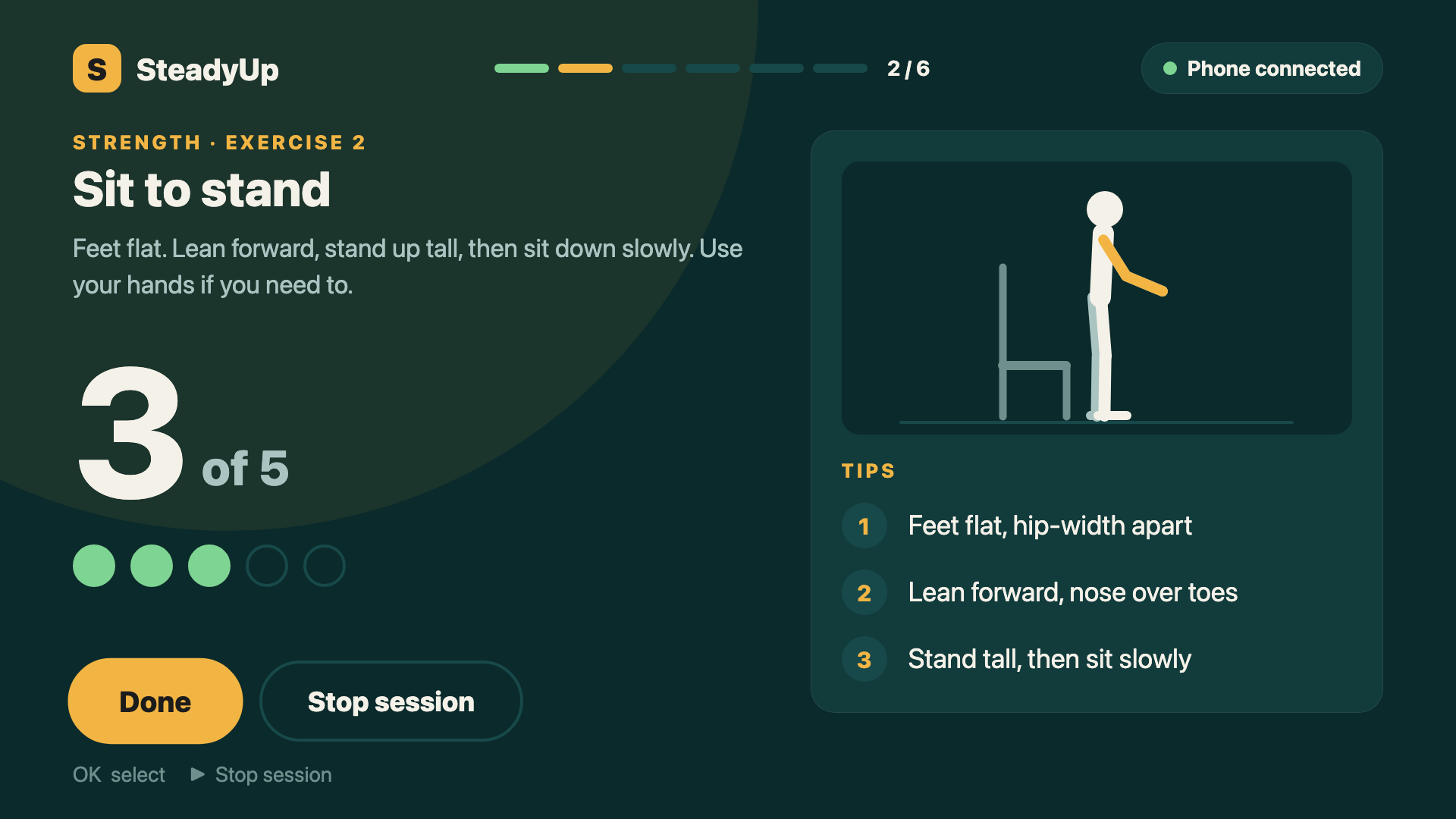
Sit-to-stand reps counted automatically from the phone in your pocket
-
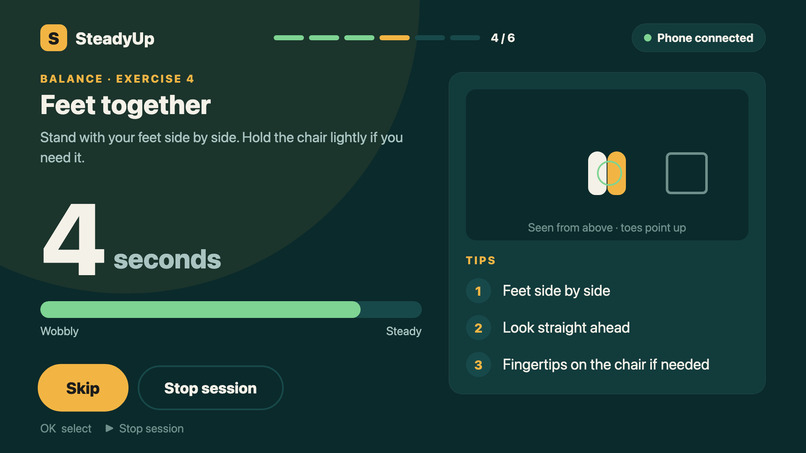
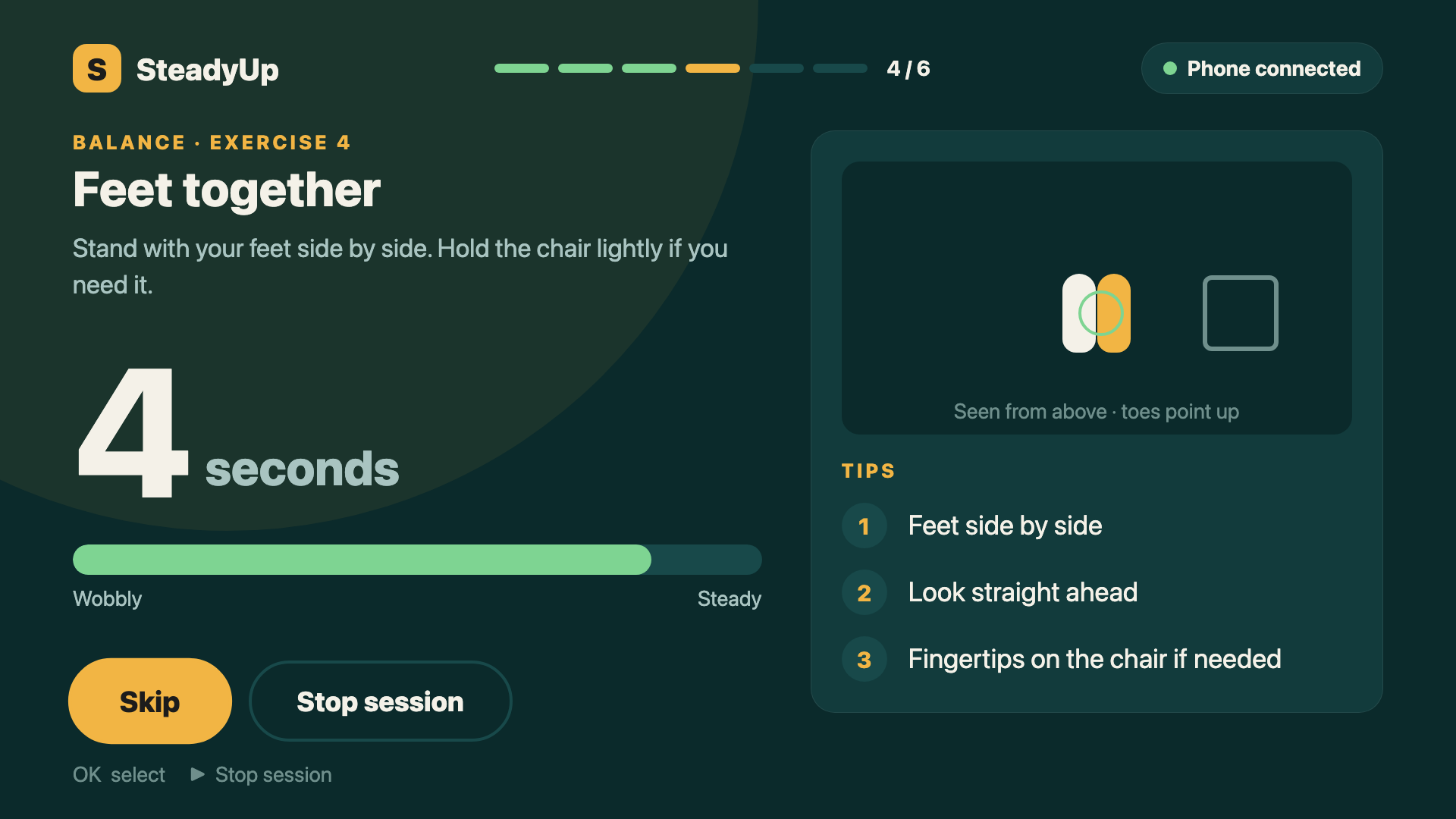
Balance holds get a live 0–100 steadiness score
-
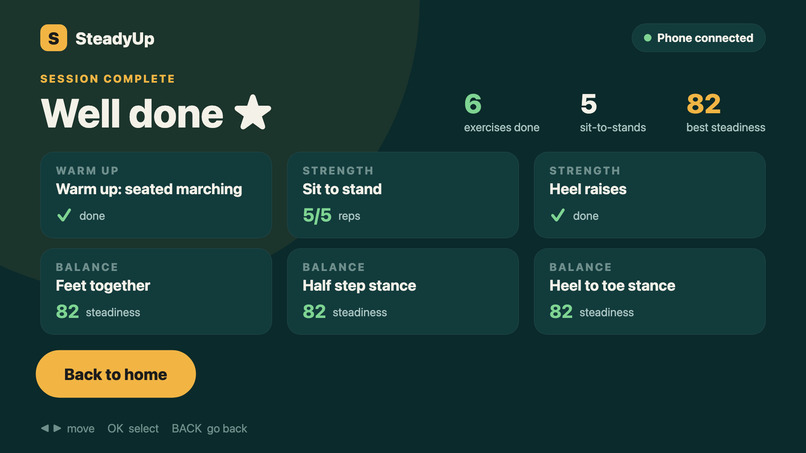
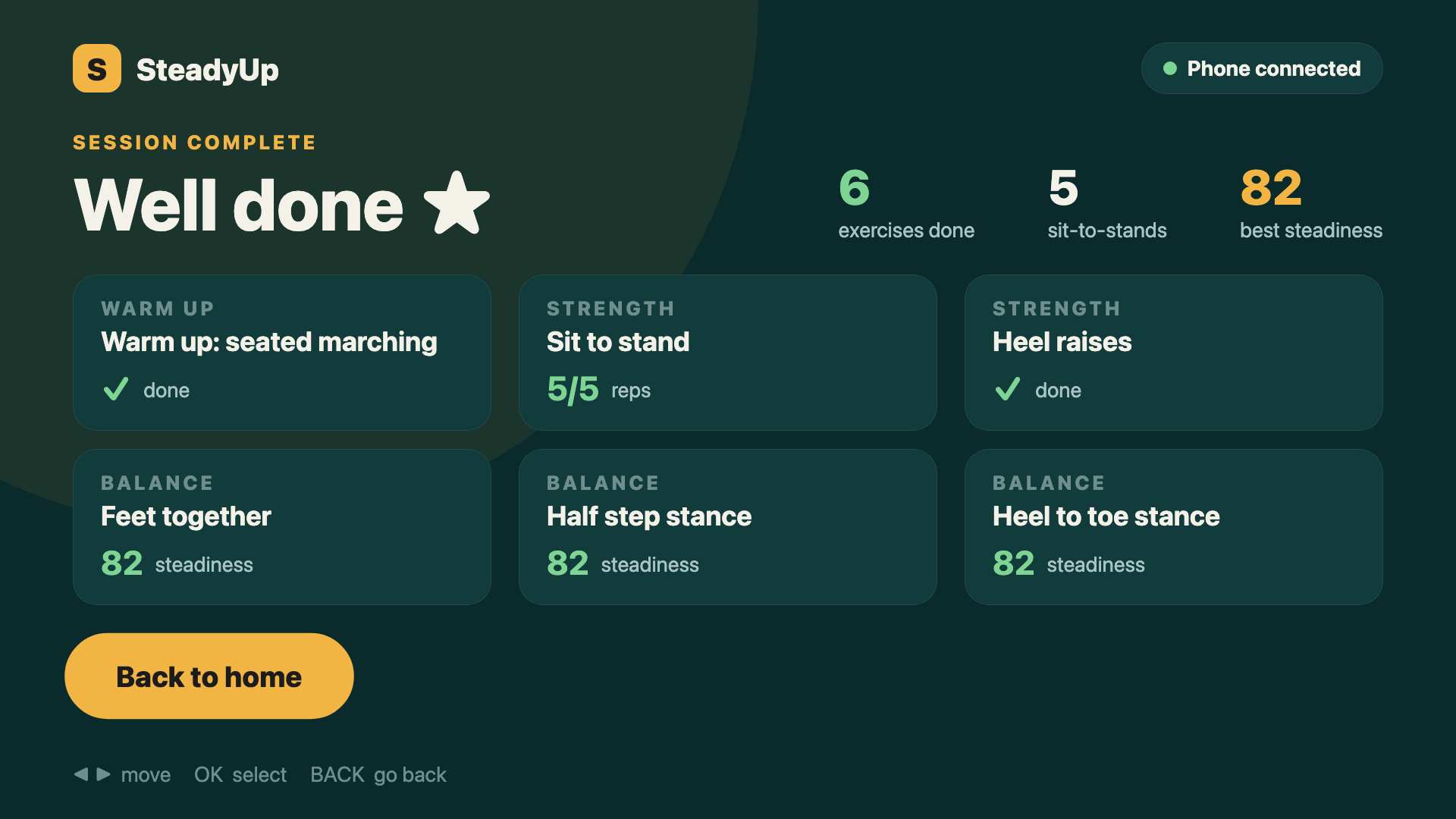
Session summary with a personal message from the AI coach
Inspiration
Falls are the leading cause of injury among older adults. Strength and balance exercise is one of the best-proven ways to stay steady, but people stop doing it at home: nobody counts the reps, there's no sign of progress, and exercise apps on a small phone screen are hard to follow. Wearables and cameras cost money and feel intrusive. I wanted to use two things almost every household already has: a TV and a phone.
What it does
SteadyUp is a guided 5-minute strength and balance routine on Fire TV, built on the moves in the CDC's STEADI tests: the chair stand and the feet together, half-step and heel-to-toe stances, each held for 10 seconds.
- The TV is the coach. Large, high-contrast screens readable from the sofa, an animated demo and three tips for every exercise, a safety check before starting, and nothing but the arrows and OK on the remote.
- The phone is the sensor. Scan a QR code, tap Start, and put the phone in your front trouser pocket. There's no app to install and nothing to wear.
- Sit-to-stand reps are counted automatically from the angle of the thigh
- Balance holds get a live 0–100 steadiness score from how much the body sways
- An impact followed by stillness brings up an "Are you OK?" prompt on the TV
- A spoken coach talks you through each move through the phone's speaker ("Stand up tall, then sit down slowly", rep counts, "Ten seconds left"), so you never have to read the screen mid-exercise.
- An AI coach on Amazon Bedrock (Amazon Nova Lite) writes a short personal message about today's results, with one specific win and one tip, and reads it aloud.
- Progress that brings people back: day streak, sessions this week and steadiness trend ("79, was 72"), kept privately on the user's phone with no account. A Share my progress button sends a summary to family by WhatsApp, SMS or email.
Why a phone and not a camera? Most Fire TV sticks have no camera, and many people don't want one pointed at them in their living room. The phone they already own is a private, free motion sensor.
How I built it
- TV app: React Native, from one shared codebase that runs on Fire TV (Vega OS) and in the browser, with a Fire OS / Android TV app in the same codebase, based on Amazon's
react-native-multi-tv-app-sampletemplate for remote-control focus handling. The exercise demos are animated with plain views (no video files), so they work offline and look the same on every platform. - Phone: a plain web page using the browser's
devicemotionsensors. All motion processing runs on the phone:- a low-pass filter estimates gravity, and the angle against a "seated" reference tells sitting from standing, with hysteresis (stand above 60°, seated below 30°) and a minimum rep time
- steadiness is the RMS spread of acceleration over the hold, mapped to 0–100
- a possible fall is an impact above 2.5 g followed by 2 s of stillness
- Server: a small Node.js service that pairs the TV and phone with a 4-digit code and QR code, then relays messages over WebSockets.
- AI coach: the server calls the Amazon Bedrock Converse API with a cleaned summary of the session. It caps the wait at 8 seconds, falls back to a rule-based message so the coach always answers, and rate-limits requests to control cost.
- Voice: the TV sends coaching lines to the phone, which speaks them with the Web Speech API.
- Testing: 30 unit tests for pairing, rep counting, steadiness, fall detection and the AI coach, plus an end-to-end test that drives the TV app in headless Chrome with a simulated phone, screenshots every screen, and fails if anything overlaps or runs off a 1080p TV.
Challenges I ran into
- Phones sit in pockets at any angle. Calibrating a "seated" reference at the start of each set made counting work however the phone is oriented.
- Settling into a stance looks like wobble. The steadiness score ignores the first 1.5 seconds of each hold.
- Motion sensors only work on HTTPS pages, so the server has to be reachable over HTTPS during development as well as in production.
- One UI on every TV platform. To make the screens look identical on Vega OS, Fire OS and the web, I avoided SVG and gradients and drew every visual, including the exercise animations, with basic views.
Accomplishments that I'm proud of
- Rep counting and balance scoring from a phone in a pocket, with no app install and no wearable
- One codebase running on Vega OS and in the browser
- An AI coach that never breaks the session, even when the network or Bedrock is slow
What I learned
- How much signal a phone's accelerometer gives from a pocket, and how simple filters were enough for this
- Designing for a 10-foot screen and a remote: large type, few choices per screen, everything reachable with arrows and OK
- Building for Vega OS alongside Fire OS from one React Native codebase
What's next for SteadyUp
- Automatic level-ups as a user's results improve
- Voice control through Alexa ("Alexa, start my SteadyUp session")
- Let the AI coach adapt tomorrow's targets from recent sessions
- Optional weekly summaries for a family member or physiotherapist
- An Amazon Appstore release
SteadyUp is not a medical device. It encourages exercise and gives feedback; it doesn't diagnose anything or replace an emergency alarm.
Built With
- amazon-bedrock
- amazon-nova
- amazon-web-services
- devicemotion
- fire-os
- fire-tv
- javascript
- node.js
- react-native
- typescript
- vega-os
- web-speech-api
- websockets

Log in or sign up for Devpost to join the conversation.