-
-
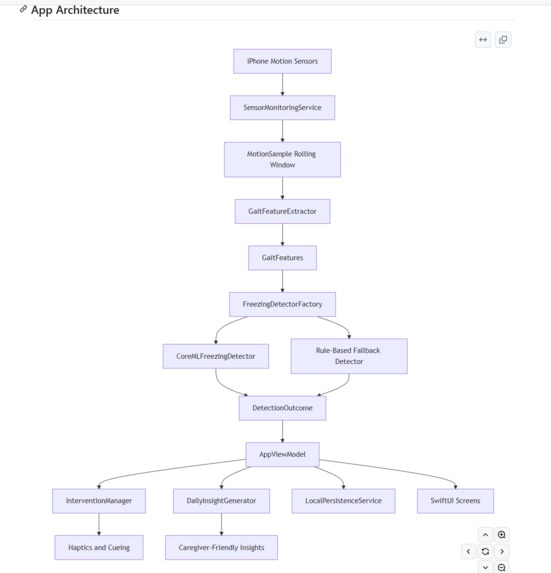
SteadyStep Architecture
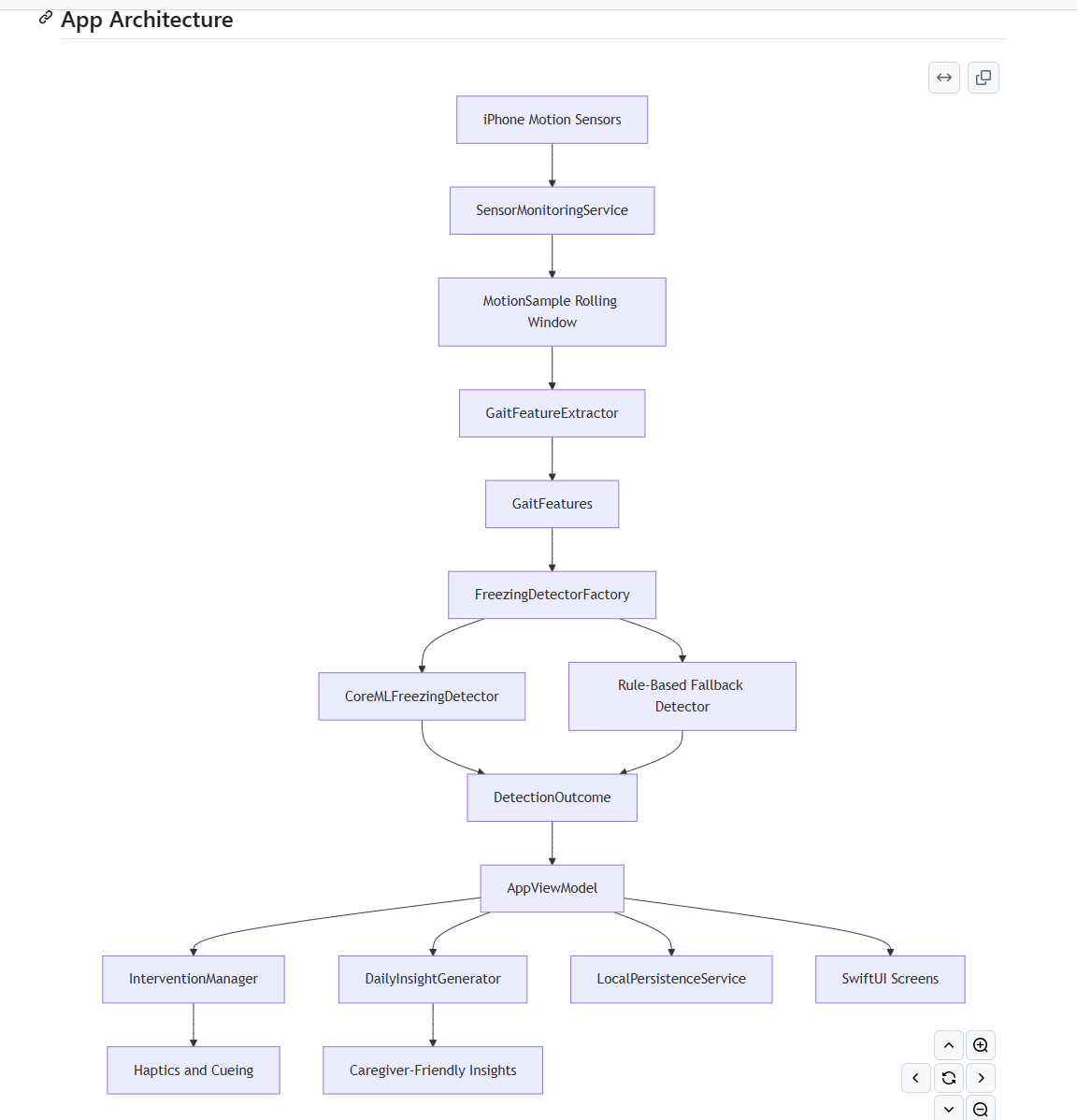
Inspiration
My grandparents both had Parkinson’s disease. One of the hardest symptoms they dealt with was freezing of gait. Freezing of gait, or FoG, is when someone suddenly feels like their feet are stuck to the ground even though they are trying to keep walking.
Seeing how difficult this could be made me want to build something that could help people simply and practically. Many existing solutions use extra hardware, like sensors attached to the feet or legs. I wanted to try a different approach: using something most people already carry every day, their phone.
What It Does
My app detects possible FoG episodes using motion data from a phone in the user’s pocket. When the app detects a possible freeze, it triggers a vibration cue to help remind the person to restart movement.
The app also tracks data over time, including the number of detected freezing episodes and whether the user’s movement patterns seem to be improving or getting worse. This could help users, caregivers, or doctors better understand how often freezing happens in daily life.
How I Built It
I built the app using the phone’s built-in motion sensors, such as the accelerometer and gyroscope. The phone collects movement data while it is in the user’s pocket. Then the app analyzes the walking pattern and uses an AI/ML model to detect possible freezing episodes.
The basic process is:
- The phone collects motion data.
- The app analyzes walking patterns.
- The AI model detects possible freezing of gait.
- The phone vibrates to cue the user.
- The app records the event and tracks progress over time.
A simple way to think about the model is that it looks at movement signals over time and tries to classify them as either normal walking or a possible freeze:
$$ \text{Movement Data} \rightarrow \text{AI Model} \rightarrow \text{Freeze or No Freeze} $$
Challenges I Faced
One major challenge was that phone movement can be noisy. A phone does not always stay in the same position in someone’s pocket, and different people walk in different ways. This made it hard to tell the difference between normal walking, stopping, turning, and actual freezing of gait.
Another challenge was balancing sensitivity and accuracy. If the app vibrates too often, it can become annoying. But if it misses freezing episodes, then it is not helpful enough. Since people with Parkinson’s may rely on this kind of cue, the app needs to be simple, fast, and reliable.
What I Learned
I learned that AI and sensor data can be used to help with real health and accessibility problems. But I also learned that building a useful health-related app is not just about making a model work. It also has to be comfortable, practical, and easy for real people to use.
This project helped me learn more about motion sensors, machine learning, real-time detection, and how technology can be designed around a real human need.
What’s Next
Next, I want to improve the model with more training data from different walking patterns, phone positions, and users. I also want to add personalization so the app can adapt to each person’s movement style.
Future improvements could include caregiver reports, doctor-facing summaries, better progress tracking, and customizable vibration patterns. The long-term goal is to make this app something that can genuinely help people with Parkinson’s manage freezing of gait in daily life.

Log in or sign up for Devpost to join the conversation.